
New Geological Evidence Proves Humans, Not Glaciers, Moved Stonehenge's 6-Tonne Altar Stone
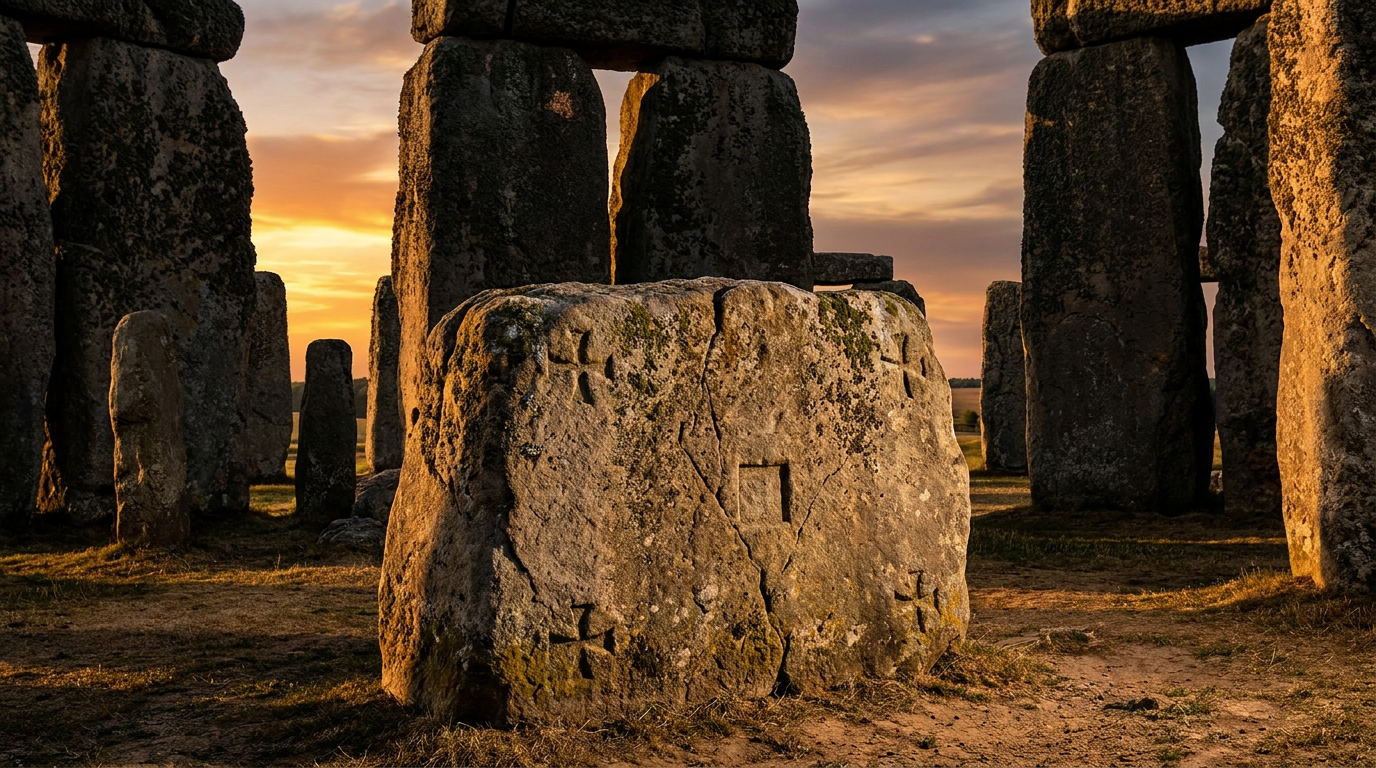
Geochemical fingerprinting and ice-flow modeling have definitively ruled out glaciers as the transport mechanism for Stonehenge's central megalith, revealing an astonishing feat of Neolithic engineering.
By Factlen Editorial Team
- Geochemical Researchers
- Focuses on the hard mineral data and ice flow modeling that ruled out natural transport.
- Archaeological Science Media
- Focuses on the human element, the Neolithic coordination, and the 'rescue mission' hypothesis.
- General News
- Focuses on the resolution of a century-old mystery and the sheer scale of the journey.
What's not represented
- · Indigenous and Modern Pagan Communities
Why this matters
For centuries, modern society has underestimated the capabilities of prehistoric humans, assuming natural forces were responsible for ancient engineering marvels. This definitive proof of human transport rewrites our understanding of Neolithic society, revealing an interconnected culture capable of astonishing logistical planning and cooperation.
Key points
- Geochemical analysis of river sands near Stonehenge found no evidence of glacial debris from Scotland.
- Computer models confirm Ice Age glaciers flowed north or into the North Sea, not toward southern England.
- The combined evidence definitively rules out natural glacial transport for the 6-tonne Altar Stone.
- Neolithic humans must have transported the megalith for a minimum of 400 kilometers, and potentially up to 700 kilometers.
- The findings reveal an unprecedented level of organization, planning, and cooperation among prehistoric British communities.
The Altar Stone, a six-tonne sandstone megalith lying at the heart of Stonehenge, has long been one of prehistoric Europe's greatest enigmas. In 2024, scientists stunned the archaeological world by tracing the stone's chemical signature to the Orcadian Basin in northeast Scotland—a staggering 700 kilometers away from Salisbury Plain.[3]
That discovery immediately amplified a century-old debate: did Neolithic humans physically haul the massive rock across the length of Britain, or did Ice Age glaciers act as a natural conveyor belt, dragging the stone south over millennia?[4][7]
Now, a pair of definitive geological studies published in 2026 has provided the answer. By combining microscopic mineral fingerprinting with advanced computer modeling of ancient ice sheets, researchers have systematically dismantled the glacial transport theory. The evidence points to a single, staggering conclusion: human beings moved the Altar Stone.[3][5]
The first major blow to the glacial theory arrived in January 2026, when researchers published a study in Communications Earth & Environment. The team sought to find the physical trail that glaciers inevitably leave behind.[2]

When massive ice sheets move across a landscape, they grind down the rocks they carry. This erosion releases tiny, indestructible mineral grains—such as zircon and apatite—into the surrounding environment. If glaciers had carried stones from Scotland or Wales to southern England, the soil and riverbeds around Stonehenge would be saturated with these microscopic Scottish minerals.[2][3]
Researchers analyzed river sands across the Salisbury Plain, searching for the specific detrital zircon fingerprint of the Orcadian Basin. They found absolutely nothing. The complete absence of these grains provides hard empirical evidence that northern glaciers never reached the site of Stonehenge.[2][7]
The second piece of the puzzle was published in June 2026 in the Journal of Quaternary Science. Even if glaciers didn't reach Stonehenge, could they have carried the Altar Stone part of the way?[1]
The second piece of the puzzle was published in June 2026 in the Journal of Quaternary Science.
To answer this, scientists modeled the behavior and direction of Ice Age glaciers originating in northeast Scotland between 33,000 and 11,700 years ago. The simulations revealed that the vast majority of ice from the Orcadian Basin flowed north. A few localized pathways flowed southeast, but they terminated in the North Sea, far short of southern England.[1][5]

Specifically, the ice models showed that glaciers could have deposited Scottish rocks at Dogger Bank, a region that was once part of Doggerland—a vast prehistoric landmass connecting Britain to Europe that is now submerged beneath the ocean.[1][4]
Synthesizing these two datasets leaves no room for natural emplacement. Because ice flows could not bridge the gap between Scotland and southern England, Neolithic communities must have transported the six-tonne stone themselves for a minimum of 400 kilometers, and potentially the entire 700-kilometer distance.[1][6]

This realization has given rise to the 'Doggerland Rescue' hypothesis. Some researchers now suggest that prehistoric Britons may have discovered the Altar Stone resting on Dogger Bank after it was deposited by a glacier. Recognizing its significance, they may have moved it south before rising sea levels at the end of the Ice Age swallowed the landmass entirely.[4][6]
Regardless of whether the journey started in the Scottish Highlands or on the plains of Doggerland, the logistical reality of moving a six-tonne stone reveals an astonishing level of Neolithic organization. It required deep landscape knowledge, sustained cooperation across different regional groups, and immense determination.[5][7]
While the geochemical evidence proves that humans moved the stone, the exact mechanism remains a matter of transparent uncertainty. The fragile tools of the era—braided ropes, stone axes, and wooden rollers—leave no permanent archaeological trace along the route.[3][7]
Experts suggest the journey likely involved multiple stages. The stone may have been sailed down the coast on rudimentary vessels, navigated through inland river networks, and hauled overland using log rollers.[5][6]

Once in southern England, the megalith could have been transported along the Berkshire Ridgeway. Recognized as Europe's oldest road, the Ridgeway was highly active during the Neolithic period and would have provided a cleared, navigable route toward Salisbury Plain.[6]
The exact source outcrop within the Orcadian Basin also remains unidentified, leaving researchers with a final geographical mystery to solve. Future expeditions will attempt to match the Altar Stone's precise mineralogy to a specific cliff face in northeast Scotland.[1][5]
Ultimately, this evidence pack forces a profound reevaluation of prehistoric Britain. The builders of Stonehenge were not isolated communities restricted to their local geography; they were part of a highly interconnected society capable of executing multi-generational engineering feats, bound together by cultural symbols powerful enough to be hauled across a continent.[4][7]
How we got here
33,000–11,700 years ago
During the last Ice Age, glaciers potentially carry the Altar Stone from northeast Scotland southeast to Dogger Bank.
Around 3000 BCE
Neolithic communities transport the stone the remaining distance to Salisbury Plain, incorporating it into Stonehenge.
August 2024
Geochemical analysis definitively traces the Altar Stone's origin to the Orcadian Basin in Scotland.
January 2026
Mineral fingerprinting of Salisbury Plain rivers rules out the possibility that glaciers carried the stone all the way to southern England.
June 2026
Ice flow modeling confirms glaciers could only reach Dogger Bank, cementing the necessity of human transport.
Viewpoints in depth
Geochemical Researchers
Focuses on the hard mineral data and ice flow modeling that ruled out natural transport.
This camp relies on detrital zircon-apatite fingerprinting and computer simulations of Ice Age ice sheets. By proving that Salisbury Plain lacks the microscopic debris glaciers would have left behind, and showing that ice flows went the wrong direction, they provide the empirical baseline that forces a reevaluation of human capabilities.
Neolithic Archaeologists
Focuses on the societal implications of moving a 6-tonne stone hundreds of kilometers.
For archaeologists, the geochemical data is a gateway to understanding human behavior. If humans moved the stone, it implies an unprecedented level of organization, maritime capability, and shared cultural values across prehistoric Britain. They explore hypotheses like the 'Doggerland rescue,' suggesting the stone held immense significance long before it reached Stonehenge.
What we don't know
- The exact physical mechanism used to move the 6-tonne stone (e.g., coastal boats, log rollers, or sledges).
- The specific source outcrop in the Orcadian Basin where the stone was originally quarried.
- Whether the stone was transported directly from Scotland or rescued from Dogger Bank before sea levels rose.
Key terms
- Altar Stone
- The largest bluestone at Stonehenge, a 6-tonne sandstone megalith lying flat at the center of the monument.
- Orcadian Basin
- A geological region in northeast Scotland identified as the original source of the Altar Stone's sandstone.
- Detrital Zircon Fingerprinting
- A technique that analyzes microscopic mineral grains in soil or rock to determine their age and geographical origin.
- Doggerland
- A vast prehistoric landmass that once connected Britain to mainland Europe before being submerged by rising sea levels.
- Glacial Erratic
- A piece of rock that has been transported by a glacier and left behind when the ice melts, often far from its original source.
Frequently asked
Did glaciers move any of the stones at Stonehenge?
No. Recent mineral fingerprinting of the soil around Salisbury Plain shows a complete absence of the microscopic debris that glaciers would have left behind if they had dragged stones from Scotland or Wales.
How did Neolithic people move a 6-tonne rock?
While the exact method leaves no archaeological trace, experts believe it required a highly coordinated mix of coastal sailing, river transport, and overland hauling using wooden rollers and braided ropes.
What is the Doggerland rescue hypothesis?
Ice flow models suggest glaciers may have carried the stone partway to Dogger Bank in the North Sea. Prehistoric Britons may have recovered it from this area before rising sea levels submerged the landmass.
Sources
Source coverage
7 outlets
3 viewpoints surfaced







[1]Journal of Quaternary ScienceGeochemical Researchers
From Highlands to Henge: Refining the Provenance and Transport Pathways of Stonehenge's Altar Stone
Read on Journal of Quaternary Science →[2]Communications Earth & EnvironmentGeochemical Researchers
Detrital zircon–apatite fingerprinting challenges glacial transport of Stonehenge's megaliths
Read on Communications Earth & Environment →[3]Curtin UniversityGeochemical Researchers
Stonehenge's most mysterious stone traveled 700 kilometers across Britain
Read on Curtin University →[4]BBC Science FocusArchaeological Science Media
We may have just cracked one of Stonehenge's greatest mysteries
Read on BBC Science Focus →[5]Sci.NewsArchaeological Science Media
Neolithic People May Have Hauled Stonehenge's Giant Altar Stone across Britain
Read on Sci.News →[6]ITV NewsGeneral News
Stonehenge mystery: Famous 'altar stone' may have been moved by glaciers and a rescue mission
Read on ITV News →[7]ScienceDailyArchaeological Science Media
Stonehenge's most mysterious stone traveled 700 kilometers across Britain
Read on ScienceDaily →

Every angle. Every day.
Get science stories with full source coverage and perspective breakdowns delivered to your inbox.