
The Evidence on Office-to-Residential Conversions: Can Empty Towers Fix the Housing Crisis?
As the national pipeline for office-to-apartment conversions hits a record 90,300 units, data reveals the physical, financial, and environmental realities of transforming empty commercial real estate into housing.
By Factlen Editorial Team
- Urban Planners & Architects
- Focuses on the physical viability of buildings and the need for zoning flexibility to allow alternative housing models.
- Economic Researchers
- Emphasizes the environmental dividends of adaptive reuse and the necessity of public subsidies to make projects viable.
- Real Estate Developers & Investors
- Driven by loan maturities and the search for financial feasibility in a distressed commercial market.
- Independent Synthesis
- Evaluates the competing claims to determine the true scale and limitations of the conversion trend.
What's not represented
- · Local small business owners relying on office foot traffic
- · Affordable housing advocates concerned about luxury-only developments
Why this matters
With commercial office vacancies hovering near 20% and a severe national housing shortage, adaptive reuse offers a rare opportunity to solve two urban crises simultaneously. Understanding the evidence behind these conversions reveals whether your city's downtown is poised for a vibrant residential renaissance or a prolonged period of stagnation.
Key points
- The national pipeline for office-to-apartment conversions reached a record 90,300 units in early 2026.
- Research indicates 11% to 15% of U.S. office buildings are physically suitable for traditional residential conversion.
- Converting an older office building into green apartments can reduce its greenhouse gas emissions by up to 80%.
- Due to high retrofitting costs, most projects require municipal tax incentives or grants to be financially viable.
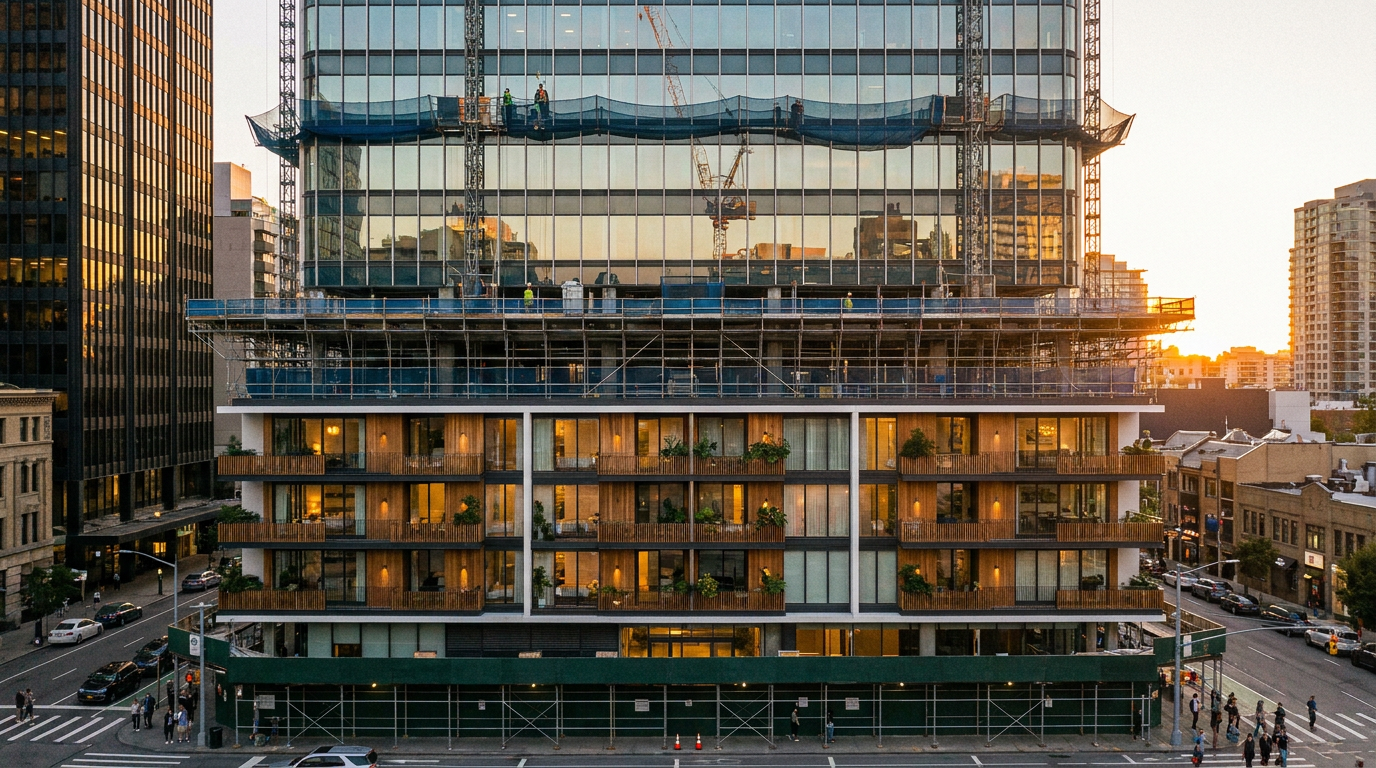
The narrative of the "doom loop" in American downtowns has dominated post-pandemic urban economics, but a counter-trend is rapidly gaining physical momentum. As office vacancy rates hover near 20% nationally and billions in commercial real estate loans mature, developers are increasingly pivoting to adaptive reuse. Rather than allowing aging towers to sit empty, a growing coalition of architects, urban planners, and investors are attempting to engineer a massive shift from commercial to residential zoning.
The data indicates this shift is accelerating at an unprecedented pace. According to a spring 2026 report by RentCafe, the pipeline for office-to-apartment conversions has surged to a record 90,300 units nationwide. This represents a 28% increase from the previous year and is nearly quadruple the volume seen in 2022. Office buildings now make up 47% of all future adaptive reuse projects in the United States, far outpacing hotels and industrial properties.[1][8]
The boom is highly concentrated but beginning to spread geographically. New York City leads the nation by a wide margin with over 16,300 units underway, driven by robust demand and aggressive local incentives. Washington, D.C., and Chicago follow closely, but secondary markets are also gaining traction. Cities like Denver and Philadelphia have recently seen their conversion pipelines double, signaling that the trend is no longer confined exclusively to the nation's most expensive coastal hubs.[1]

The primary claim driving this boom is that obsolete office stock can meaningfully dent the national housing shortage. The evidence supporting this claim is robust, though researchers are careful to bound expectations. Adaptive reuse is not a silver bullet for the housing crisis, but rather a highly effective surgical tool for specific high-density neighborhoods.[9]
A landmark working paper from the National Bureau of Economic Research (NBER) evaluated the commercial districts of the 105 largest U.S. cities to quantify the true scale of the opportunity. The researchers concluded that approximately 11% to 15% of office buildings are physically suitable for residential conversion, once factors like long-term tenant leases and structural dimensions are accounted for.[2]
If fully realized, this subset of viable buildings could add roughly 400,000 new apartments to the national housing stock. While this would not single-handedly solve a housing deficit measured in the millions, researchers note it represents a highly concentrated injection of supply in high-demand urban cores where new ground-up construction is notoriously difficult, expensive, and politically fraught.[2]
However, the physical reality of transforming a mid-century cubicle farm into habitable apartments presents severe architectural constraints. The core challenge lies in the "floor plate"—the sheer depth of a typical office building. Because commercial buildings were designed for artificial lighting and massive open floor plans, their interior spaces are often too far from exterior windows to meet legal light and ventilation requirements for residential bedrooms.[9]

However, the physical reality of transforming a mid-century cubicle farm into habitable apartments presents severe architectural constraints.
To solve this bottleneck, the global architecture firm Gensler developed a proprietary algorithm known as Conversions+. The tool evaluates 150 distinct data points—including core-to-window depth, structural grid spacing, and elevator placement—to determine a building's viability in hours rather than months. Gensler's assessments of over 1,300 buildings across North America align closely with the NBER data, finding that roughly 25% to 30% of assessed structures make viable candidates for traditional apartment layouts.[3]
For the remaining "problem buildings" with massive, windowless interiors, new evidence suggests alternative housing models might be the answer. A 2026 analysis by The Pew Charitable Trusts argues that buildings with deep cores and irregular layouts are uniquely suited for "co-living" conversions, a model that bypasses the strict window requirements of traditional studio apartments.[4]
In the co-living model, residents rent private bedrooms on the perimeter of the building while sharing expansive, windowless interior spaces repurposed as communal kitchens, gyms, and lounges. Pew's research indicates that this approach is highly cost-effective; it could yield nearly four times as many affordable housing units per dollar of public subsidy compared to traditional studio apartments, offering a highly efficient pathway for municipalities willing to update their zoning codes.[4]
Beyond housing supply, proponents claim that adaptive reuse offers a massive environmental dividend by preserving the "embodied carbon" of existing structures. The evidence strongly supports this assertion, framing office conversions as a critical tool for municipal climate action.[9]

The carbon math is compelling. The NBER study found that converting older, energy-inefficient "brown" office buildings into modern, green apartments can reduce greenhouse gas emissions by up to 1.5 million tons—an 80% reduction compared to the building's previous lifecycle. By avoiding the carbon-intensive processes of demolition and new steel and concrete production, adaptive reuse aligns tightly with stringent municipal climate goals, such as New York City's Local Law 97.[2]
Despite the architectural and environmental promise, the financial evidence reveals a fragile economic equation. Converting an office building is extraordinarily expensive, often requiring complete overhauls of plumbing, HVAC, and electrical systems to serve hundreds of individual units rather than a few corporate tenants. The structural skeleton is saved, but the internal organs must be entirely rebuilt.[9]
J.P. Morgan notes that without government intervention, financial feasibility typically only "pencils out" in premium markets like Manhattan, San Francisco, or Boston, where post-conversion rents are high enough to absorb the massive capital expenditure. In most other markets, a significant gap exists between the cost of conversion and the projected value of the finished apartments, leaving developers hesitant to break ground without public assistance.[7]

To bridge this financial gap, municipalities are increasingly deploying public subsidies. Cities from Calgary to Chicago are offering property tax abatements, grants, and expedited permitting to incentivize developers. The Brookings Institution highlights that these interventions are motivated not just by housing needs, but by the desperate need to preserve the tax base and social vitality of downtown districts. Cushman & Wakefield's 2026 data confirms that where incentives and market demand align—such as in Manhattan, which saw 5.0 million square feet of conversion starts in 2025—the pipeline accelerates rapidly.[5][6]
Ultimately, the evidence suggests that office-to-residential conversions are a proven, highly effective surgical tool rather than a blanket cure-all. The data confirms they can revitalize specific neighborhoods, drastically reduce carbon emissions, and provide a lifeline for distressed commercial real estate portfolios. What remains uncertain is whether mid-tier cities can engineer the financial incentives necessary to scale this trend beyond the nation's most expensive coastal hubs, and whether zoning boards will adapt quickly enough to embrace innovative layouts like co-living.[9]
How we got here
Early 2020
The COVID-19 pandemic triggers a massive shift to remote work, emptying downtown office buildings.
2022
Early office-to-apartment conversions begin to gain traction, with roughly 23,000 units entering the national pipeline.
October 2023
The NBER publishes a landmark study identifying that 11% to 15% of U.S. office buildings are physically suitable for residential conversion.
2024
Architecture firms like Gensler deploy advanced algorithms to rapidly assess thousands of buildings for conversion viability.
Spring 2026
The national conversion pipeline hits a record 90,300 units, driven by maturing commercial loans and aggressive city subsidies.
Viewpoints in depth
Urban Planners & Architects
Focuses on the physical viability of buildings and the need for zoning flexibility.
This camp argues that the primary bottleneck for conversions is physical and regulatory, not just financial. They advocate for algorithmic assessments to quickly identify the roughly 15% of buildings that are structurally viable for traditional apartments. Furthermore, they push for zoning reforms that allow for alternative models like co-living, arguing that rigid requirements for bedroom windows prevent the adaptive reuse of massive, deep-core office buildings that would otherwise sit empty.
Economic Researchers
Emphasizes the environmental dividends and the necessity of public subsidies.
Researchers highlight that the free market alone will only convert buildings in ultra-high-rent districts like Manhattan. They argue that because conversions offer massive public benefits—specifically an 80% reduction in greenhouse gas emissions and the preservation of downtown tax bases—municipalities are justified in offering heavy tax abatements and grants. They view conversions as a public-private partnership rather than a purely private real estate play.
Real Estate Developers
Driven by loan maturities and the search for financial feasibility.
For developers and investors, the conversion trend is a pragmatic response to the collapse of commercial office values and the looming maturity of billions in commercial real estate loans. They argue that while the environmental and social benefits are nice, a project must ultimately "pencil out." They point to the massive costs of retrofitting plumbing and HVAC systems, arguing that without significant government incentives or a total collapse in the building's acquisition price, most conversions remain financially out of reach.
Independent Synthesis
Evaluates the competing claims to determine the true scale of the trend.
The evidence suggests that while office-to-residential conversions will not single-handedly solve the national housing crisis, they are a highly effective, targeted solution for revitalizing specific urban cores. The data confirms the environmental benefits and the physical viability of a subset of buildings, but also underscores that widespread adoption will require a sustained commitment from local governments to bridge the financial gap.
What we don't know
- Whether mid-tier cities can afford to offer the massive tax incentives required to make conversions financially viable outside of premium coastal markets.
- How quickly local zoning boards will adapt to allow non-traditional layouts, such as co-living spaces, in deep-core office buildings.
- The long-term impact of these conversions on the affordability of downtown neighborhoods, as many early projects lean heavily toward luxury pricing.
Key terms
- Adaptive Reuse
- The process of repurposing an existing building for a use other than what it was originally designed for, such as turning an office into apartments.
- Floor Plate
- The total leasable square footage of a single floor in a building, which dictates how deep the interior spaces are from the exterior windows.
- Embodied Carbon
- The total greenhouse gas emissions generated by the manufacturing, transportation, and assembly of building materials like steel and concrete.
- Class B and C Office
- Older, less modern commercial buildings that lack the premium amenities of newer Class A spaces, making them the most common candidates for conversion.
Frequently asked
Can any empty office building become an apartment?
No. Only about 11% to 15% of office buildings have the right physical dimensions, such as a suitable distance from the core to the windows, to meet residential light and ventilation codes.
Are office conversions cheaper than building from scratch?
Not always. While they save on the structural frame, completely replacing commercial plumbing, electrical, and HVAC systems for hundreds of individual apartments is extremely expensive.
How do conversions help the environment?
By reusing the existing concrete and steel, conversions avoid the massive 'embodied carbon' emissions associated with demolishing an old building and constructing a new one.
Why are cities offering tax breaks for these projects?
Many conversions are not financially viable on their own. Cities offer subsidies to prevent downtowns from hollowing out, preserve their property tax base, and add much-needed housing.
Sources
Source coverage
9 outlets
4 viewpoints surfaced









[1]RentCafeReal Estate Developers & Investors
Office-to-Apartment Conversions Surge as Pipeline Nears 100,000 Units
Read on RentCafe →[2]National Bureau of Economic ResearchEconomic Researchers
Converting Brown Offices to Green Apartments
Read on National Bureau of Economic Research →[3]GenslerUrban Planners & Architects
Conversions+™ by Gensler Turns Stranded Offices Into Valuable Real Estate
Read on Gensler →[4]The Pew Charitable TrustsEconomic Researchers
Converting Obsolete Offices to Small Co-Living Apartments Could Help Ease U.S. Housing Shortage
Read on The Pew Charitable Trusts →[5]Brookings InstitutionEconomic Researchers
The promises—and realities—of converting offices into housing
Read on Brookings Institution →[6]Cushman & WakefieldReal Estate Developers & Investors
Office-to-Residential Conversions
Read on Cushman & Wakefield →[7]J.P. MorganReal Estate Developers & Investors
What to know about office-to-residential conversion
Read on J.P. Morgan →[8]Construction DiveUrban Planners & Architects
Office-to-housing conversions grew 28% last year
Read on Construction Dive →[9]Factlen Editorial TeamIndependent Synthesis
Synthesis by Factlen editorial team
Read on Factlen Editorial Team →
Every angle. Every day.
Get real estate stories with full source coverage and perspective breakdowns delivered to your inbox.