
Cold Plunges vs. Saunas: The Science of Temperature-Based Muscle Recovery
While ice baths and saunas are both popular recovery tools, they trigger opposite physiological responses. Choosing the wrong modality can inadvertently sabotage your specific fitness and muscle-building goals.
By Factlen Editorial Team
- Endurance Coaches
- Favor cold therapy for rapid turnaround and inflammation reduction.
- Strength Specialists
- Favor heat therapy to protect hypertrophy and mTOR signaling.
- Sports Scientists
- Advocate for context-dependent, periodized recovery protocols.
What's not represented
- · Recreational gym-goers who lack access to high-end recovery facilities
- · Physical therapists treating acute injuries rather than exercise-induced soreness
Why this matters
Athletes and fitness enthusiasts spend billions on recovery tools, but choosing the wrong temperature protocol can actively sabotage your goals. Using ice baths when you want to build muscle, or saunas when you need immediate inflammation relief, means you are fighting your body's natural adaptations.
Key points
- Cold water immersion reduces inflammation and soreness, making it ideal for endurance athletes needing rapid recovery.
- Ice baths immediately after strength training can blunt the inflammatory signals required for muscle growth.
- Sauna use promotes vasodilation, increasing blood flow to clear metabolic waste without suppressing inflammation.
- Heat stress activates Heat Shock Proteins and the mTOR pathway, actively supporting muscle hypertrophy.
- Contrast therapy alternates hot and cold to create a vascular pumping effect, offering strong psychological benefits.
The modern locker room looks more like a thermodynamics lab than a place to change clothes. Athletes and weekend warriors alike are plunging into ice baths and sweating in infrared saunas, chasing the promise of accelerated recovery.
But as temperature-based recovery goes mainstream, a critical nuance is getting lost in the hype. The physiological responses to extreme heat and extreme cold are fundamentally different, and they trigger entirely separate biological pathways.
Choosing the wrong modality for your specific fitness goals can actually sabotage your progress. Freezing away inflammation might sound ideal, but if your goal is building muscle, you might be freezing away your gains along with the pain.
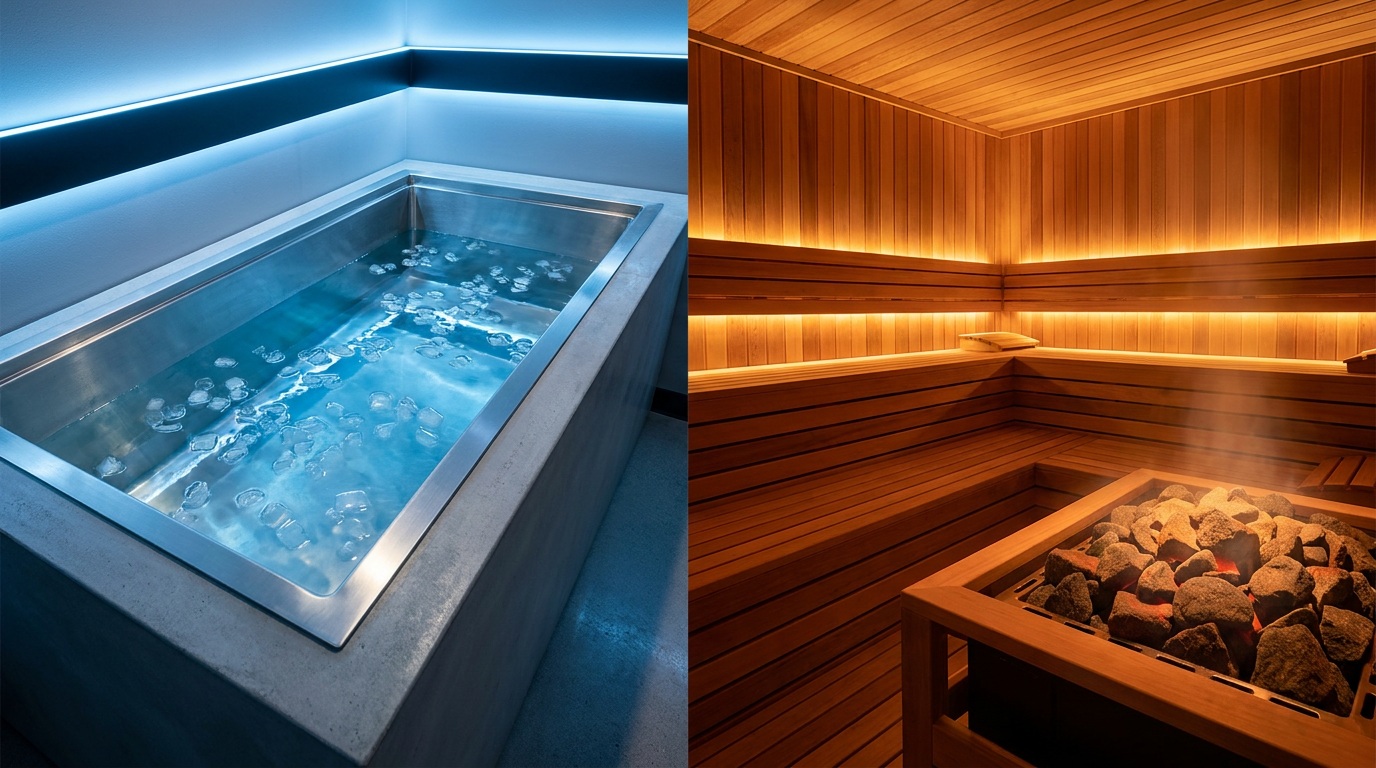
To understand why, we have to look at the cellular mechanisms of cold water immersion (CWI). When you submerge your body in water below 60°F (15°C), your blood vessels rapidly constrict.
This vasoconstriction acts like a physiological tourniquet, flushing blood away from the extremities and toward the core to preserve heat. Simultaneously, the cold activates TRPM8 receptors in the skin, which inhibit the firing frequency of nerve endings and slow the transmission of pain signals.[5]

The result is a profound, immediate reduction in delayed-onset muscle soreness (DOMS). A comprehensive meta-analysis published in Sports Medicine confirmed that CWI is highly effective at reducing both perceived soreness and circulating levels of creatine kinase, a biochemical marker of muscle damage.[1][2]
For endurance athletes, CrossFitters in competition, or team-sport players needing to perform again within 24 hours, this rapid reduction in inflammation is a superpower. It allows for a quicker return to baseline performance when time is of the essence.
However, that same anti-inflammatory mechanism is exactly why strength athletes and bodybuilders should approach the ice bath with caution. Muscle hypertrophy—the process of building larger muscles—relies on the very inflammation that cold water suppresses.
However, that same anti-inflammatory mechanism is exactly why strength athletes and bodybuilders should approach the ice bath with caution.
When you lift heavy weights, you create microscopic tears in the muscle fibers. The body's natural inflammatory response signals the immune system to repair and rebuild those fibers stronger than before. By jumping into an ice bath immediately after a heavy lifting session, you blunt this crucial signaling cascade.[6]
This is where heat therapy, particularly sauna use, enters the conversation as the superior tool for strength and hypertrophy. Unlike cold, which constricts, heat causes vasodilation. Blood vessels widen, increasing circulation to damaged tissues.
This enhanced blood flow delivers oxygen and nutrients to fatigued muscles while helping clear metabolic waste products. But the real magic of heat therapy happens at the molecular level, through the activation of Heat Shock Proteins (HSPs), specifically HSP70.

Heat Shock Proteins act as molecular chaperones. When the body is exposed to thermal stress, these proteins are deployed to repair misfolded proteins and protect cells from oxidative stress. According to research in the Journal of Applied Physiology, regular sauna use increases your baseline levels of HSPs, essentially giving your muscles a larger, more active maintenance crew.[4]
Furthermore, heat stress has been shown to trigger the mammalian target of rapamycin (mTOR) signaling pathway. The mTOR pathway is the central regulator of cell growth and protein synthesis. While lifting weights is the primary driver of this pathway, thermal stress acts as a supplementary stimulus, essentially priming the muscle for growth even while you sit passively in the heat.[4]
So, what happens when you combine the two? Contrast Water Therapy (CWT)—alternating between hot and cold exposure—has become a popular middle ground. The theory is that alternating vasodilation and vasoconstriction creates a pumping action that flushes out waste more effectively than either modality alone.

The evidence for contrast therapy is positive, though nuanced. A systematic review in PLOS One found that CWT is significantly better than passive rest for reducing muscle soreness and perceived fatigue.[3]
However, when compared head-to-head with cold water immersion alone, contrast therapy doesn't always show objective superiority in clearing biochemical markers of fatigue. Its primary advantage seems to be psychological; athletes consistently report feeling more recovered and invigorated after a contrast session, thanks to the massive endorphin release triggered by the temperature swings.[5]
Ultimately, the science of temperature-based recovery dictates that context is everything. There is no universally best recovery method, only the right tool for the specific physiological adaptation you are trying to achieve.[6]
If your goal is to reduce soreness and bounce back quickly for another endurance bout or a game the next day, the cold plunge is your best ally. If your goal is to maximize muscle growth, build strength, and support long-term cellular repair, the sauna is the clear winner. And if you simply want to feel rejuvenated and flush out the stiffness of a long training week, contrast therapy offers the best of both worlds.
How we got here
Early 2000s
Cold water immersion becomes a staple in professional team sports for rapid turnaround between matches.
2015
Studies begin to show that post-workout cold exposure may blunt muscle hypertrophy and strength adaptations.
2020
Contrast therapy (alternating hot and cold) surges in popularity among wellness enthusiasts and boutique recovery clinics.
2024
Research solidifies the role of heat therapy and Heat Shock Proteins in supporting the mTOR pathway and muscle growth.
Viewpoints in depth
Endurance & Team Sports Coaches
Prioritize rapid inflammation reduction to get athletes back on the field quickly.
For coaches managing athletes through grueling multi-day tournaments or high-mileage endurance blocks, the priority is immediate functional recovery. This camp heavily favors cold water immersion because it rapidly constricts blood vessels, flushes out metabolic waste, and numbs the nerve endings responsible for delayed-onset muscle soreness (DOMS). They argue that while cold might slightly blunt long-term muscle adaptation, the trade-off is worth it if it allows an athlete to perform at 90% capacity the next day rather than 70%.
Strength & Hypertrophy Specialists
Avoid cold exposure post-workout to protect the body's natural muscle-building signals.
Strength coaches and bodybuilders view inflammation not as an enemy, but as a necessary signal for growth. When muscles are damaged during heavy lifting, the resulting inflammatory cascade is what tells the body to rebuild those fibers larger and stronger. This camp warns against post-workout ice baths, citing research that cold exposure blunts the mTOR signaling pathway. Instead, they advocate for heat therapy, which increases blood flow without suppressing inflammation, and actively promotes the release of muscle-protecting Heat Shock Proteins.
Sports Scientists
Advocate for periodized, goal-specific application rather than a one-size-fits-all approach.
Researchers emphasize that recovery modalities should be periodized just like training programs. Sports scientists argue that athletes should use cold therapy during the competitive season when immediate performance is paramount, but switch to heat therapy or passive rest during the off-season when the primary goal is building new muscle and adapting to training stress. They view contrast therapy as a useful middle ground, particularly for its psychological benefits and ability to stimulate the parasympathetic nervous system.
What we don't know
- The exact temperature threshold where cold exposure begins to significantly blunt muscle hypertrophy.
- Whether the long-term cardiovascular benefits of sauna use can fully replace the need for traditional Zone 2 cardio.
- The optimal ratio of hot-to-cold time in contrast therapy for maximizing the pumping effect without causing excessive central nervous system fatigue.
Key terms
- Delayed-Onset Muscle Soreness (DOMS)
- The muscle pain and stiffness that typically peaks 24 to 72 hours after intense or unfamiliar exercise.
- Vasoconstriction
- The narrowing of blood vessels, typically in response to cold, which reduces blood flow to the extremities and decreases inflammation.
- Vasodilation
- The widening of blood vessels, typically in response to heat, which increases blood flow and delivers oxygen and nutrients to tissues.
- Heat Shock Proteins (HSPs)
- A family of proteins produced by cells in response to stressful conditions, like heat, that help repair damaged proteins and protect against cellular stress.
- mTOR Pathway
- A crucial cellular signaling pathway that regulates cell growth, protein synthesis, and muscle hypertrophy.
- Creatine Kinase (CK)
- An enzyme found in muscle tissue; elevated levels in the blood are used as a biochemical marker of muscle damage after exercise.
Frequently asked
Should I take an ice bath immediately after lifting weights?
If your primary goal is building muscle (hypertrophy), you should avoid cold water immersion immediately after lifting. Cold blunts the natural inflammatory response needed to signal muscle growth.
How long should I stay in a cold plunge?
Research suggests that 10 to 15 minutes in water temperatures between 5°C and 10°C (41°F–50°F) is optimal for reducing muscle soreness and biochemical markers of fatigue.
Does sitting in a sauna actually help build muscle?
While it doesn't replace lifting weights, heat stress activates Heat Shock Proteins and the mTOR pathway, which support protein synthesis and help protect muscles from breaking down.
What is contrast water therapy?
Contrast therapy involves alternating between hot and cold environments (like a sauna and an ice bath) to create a 'pumping' effect in the blood vessels, which can improve subjective feelings of recovery.
Sources
Source coverage
6 outlets
3 viewpoints surfaced






[1]Sports MedicineEndurance Coaches
Effects of Cold-Water Immersion Compared with Other Recovery Modalities on Athletic Performance Following Acute Strenuous Exercise
Read on Sports Medicine →[2]Frontiers in PhysiologyEndurance Coaches
Impact of different doses of cold water immersion on recovery from acute exercise-induced muscle damage: a network meta-analysis
Read on Frontiers in Physiology →[3]PLOS OneSports Scientists
Contrast Water Therapy and Exercise Induced Muscle Damage: A Systematic Review and Meta-Analysis
Read on PLOS One →[4]Journal of Applied PhysiologyStrength Specialists
Muscle Hypertrophy: Can Heat Stress in Saunas Mimic Mild Exercise?
Read on Journal of Applied Physiology →[5]MDPISports Scientists
Comparison of the Effects of Cold-Water Immersion Applied Alone and Combined Therapy on the Recovery of Muscle Fatigue After Exercise
Read on MDPI →[6]Factlen Editorial TeamSports Scientists
Synthesis by Factlen editorial team
Read on Factlen Editorial Team →

Every angle. Every day.
Get fitness stories with full source coverage and perspective breakdowns delivered to your inbox.