
How the 'Abundance Agenda' is Rewriting the Rules of Economic Progress
A new intellectual movement argues that cutting red tape and building massive infrastructure is the only way to solve the housing and climate crises. However, the framework faces fierce pushback from ecological economists and labor advocates who warn against unchecked material growth.
By Factlen Editorial Team
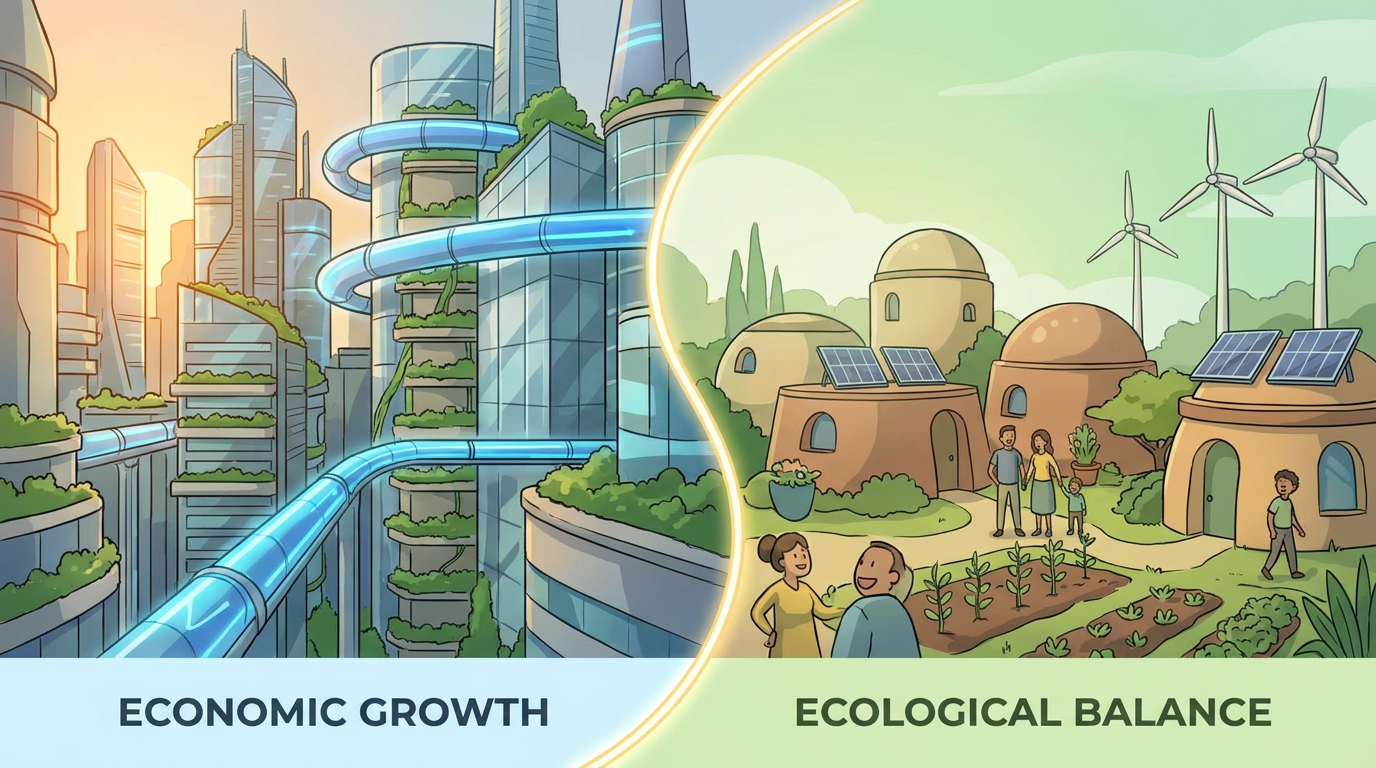
- Supply-Side Progressives
- Argue that deregulation and state investment are necessary to build a high-growth, affordable future.
- Degrowth Advocates
- Argue that true abundance comes from expanding public commons and reducing material throughput, not endless GDP growth.
- Labor & Equity Left
- Support building more but warn that the abundance agenda ignores corporate power and labor rights.
- Free-Market Conservatives
- Agree with deregulating supply bottlenecks but oppose the reliance on heavy state industrial policy.
- Neutral Analysts
- Provide overarching synthesis of the competing economic frameworks.
What's not represented
- · Local community zoning boards
- · Developing nations' economic planners
- · Fossil fuel industry executives
Why this matters
The outcome of this debate will directly determine how quickly your city builds new housing, how much you pay for electricity, and whether the government prioritizes rapid construction over local community input.
Key points
- The Abundance Agenda argues that over-regulation has created artificial scarcity in housing and clean energy.
- Proponents push for cutting red tape and utilizing industrial policy to rapidly build essential infrastructure.
- Degrowth advocates counter that infinite material expansion is ecologically impossible and urge expanding public commons instead.
- Labor groups warn that deregulation without strong union protections will primarily enrich corporate developers.
- Free-market conservatives support the deregulation aspect but strongly oppose the movement's reliance on state subsidies.
For decades, the defining economic debates in Western democracies centered on how to distribute wealth. Today, a new intellectual fault line has emerged over how to physically create the things society desperately needs. Across think tanks, academic journals, and policy circles, a movement known as the "Abundance Agenda" is challenging the long-held orthodoxies of both the political left and right. Driven by skyrocketing costs for housing, healthcare, and clean energy, this framework argues that modern governments have become exceptionally good at subsidizing demand but catastrophically bad at enabling supply. The result is a society where money is printed to solve problems, but the actual physical infrastructure—from high-speed rail to solar farms—remains unbuilt. As this philosophy gains traction in the halls of power, it has sparked a fierce counter-reaction from environmentalists, labor advocates, and free-market conservatives, fundamentally reshaping how policymakers think about growth, scarcity, and the future of the physical world.[1]
The core premise of the Abundance Agenda, often referred to as "supply-side progressivism," is that well-meaning regulations have inadvertently engineered an era of artificial scarcity. For the past half-century, progressive policy has largely focused on giving people financial assistance to afford essential goods, such as housing vouchers or healthcare subsidies. However, proponents argue that pumping money into sectors with heavy supply barriers simply drives up prices. If a city refuses to zone for new apartment buildings, giving renters more money only accelerates rent inflation. Thinkers leading this movement point out that the United States has closed more nuclear power plants than it has opened this century, while major infrastructure projects languish in decades of environmental review.[2]
The mechanism driving this paralysis is what policy analysts call the "vetocracy" or "everything-bagel liberalism." In an effort to ensure that every new project promotes equity, protects the environment, and satisfies local community input, governments have created a labyrinth of administrative burdens. A proposed wind farm or transit line must survive years of environmental impact statements, historical preservation reviews, and local zoning board hearings, allowing any single interest group to veto the project. The Abundance Agenda argues that this procedural fetishism has crippled state capacity. By prioritizing the process of consultation over the outcome of construction, governments have made it nearly impossible to build the very infrastructure required to solve the housing crisis or transition away from fossil fuels.[2][6]
To break this gridlock, supply-side progressives propose a radical pivot: the left must learn to build again. This means aggressively rolling back the red tape that hinders construction, even if it means overriding local community objections or streamlining environmental reviews. The goal is to unleash a massive wave of development in clean energy, high-density housing, and domestic manufacturing. Rather than viewing deregulation solely as a right-wing tool to boost corporate profits, the Abundance Agenda reclaims it as a necessary mechanism to achieve progressive outcomes. By flooding the market with abundant housing and cheap, clean electricity, the movement envisions a future where the cost of living plummets and the physical environment is rapidly decarbonized.[2]

This philosophy is no longer confined to white papers; it is actively shaping federal policy. The passage of the CHIPS and Science Act and the Inflation Reduction Act represents the first major federal pivots toward this brand of industrial policy. These legislative packages are pouring hundreds of billions of dollars into domestic semiconductor manufacturing and green technology deployment. However, the rollout of these programs has also highlighted the exact friction the Abundance Agenda warns against. Billions in funding have occasionally stalled as agencies attach complex requirements—ranging from childcare provisions to domestic sourcing mandates—onto the grants, testing whether the government can actually prioritize rapid deployment over a multitude of secondary social goals.[1][2][6]
As the Abundance Agenda gains momentum, it has collided with a powerful intellectual counter-movement: Degrowth. Rooted in ecological economics, the degrowth movement argues that the pursuit of infinite material expansion on a finite planet is a biological impossibility. Where supply-side progressives see a lack of building as the primary crisis, degrowth scholars see the relentless extraction of natural resources and energy as the true existential threat. They argue that attempting to build our way out of the climate crisis with massive new infrastructure projects will only accelerate ecological breakdown, as the material throughput required for endless green growth still demands devastating levels of mining, land use, and energy consumption.[5]
The mechanism underpinning the degrowth critique relies on the Lauderdale Paradox, an economic concept noting that private riches often increase only through the destruction of public wealth. Degrowth theorists argue that capitalism inherently encloses free public goods—such as clean water, land, and community spaces—creating artificial scarcity that forces people to rely on the market. In this view, the scarcity of housing or energy is not a failure of the permitting process, but a deliberate feature of an economic system designed to maximize corporate profit. Therefore, simply deregulating the supply side to allow developers to build more will not solve the root crisis of inequality and ecological overshoot.[5]

Therefore, simply deregulating the supply side to allow developers to build more will not solve the root crisis of inequality and ecological overshoot.
Instead, degrowth offers its own vision of "radical abundance." This version of abundance does not mean producing more consumer goods or building sprawling new developments. Rather, it means expanding the public commons—providing universal access to free healthcare, robust public transit, and decommodified social housing. By guaranteeing the essentials of life outside the market, society can ensure that people need significantly less income to live well. This decoupling of well-being from GDP growth would allow advanced economies to deliberately scale down their material and energy throughput, meeting climate targets without sacrificing human flourishing.[5]
Meanwhile, traditional left-wing institutions and labor advocates have launched their own critique of the Abundance Agenda, warning that it focuses entirely on procedure while ignoring the realities of political and economic power. Critics argue that streamlining regulations and fast-tracking permits does not guarantee that the resulting infrastructure will serve the public good. Without strong labor protections, anti-monopoly enforcement, and wealth redistribution, they warn that "abundance" will simply translate into a massive transfer of wealth to real estate developers, tech monopolies, and private equity firms. To these advocates, a purely procedural fix risks accelerating the very inequalities that progressive politics is supposed to dismantle.[4][7]
Labor economists point out that the bottlenecks in construction are not solely caused by environmental reviews; they are also the result of a decimated skilled workforce. Decades of anti-union policies and the prioritization of college over vocational training have left the country with a severe shortage of electricians, welders, and construction workers. Advocates argue that true democratic abundance requires empowering unions to train the next generation of workers and ensuring that new green jobs offer family-sustaining wages. They caution that if the Abundance Agenda merely strips away regulations without rebuilding worker power, it will fail to deliver equitable prosperity.[4][7]

On the opposite end of the political spectrum, free-market conservatives have offered what some analysts call "one and a half cheers" for the progressive embrace of supply-side economics. Libertarian and conservative economists have spent decades arguing that zoning laws, occupational licensing, and environmental permitting stifle economic growth. They welcome the sudden realization among progressives that over-regulation causes housing shortages and energy bottlenecks. However, their enthusiasm stops at the Abundance Agenda's reliance on heavy state intervention.[3][8]
Conservative critics point out a perceived fatal flaw in supply-side progressivism: it pairs the deregulation of physical building with massive state subsidies and top-down industrial policy. They argue that empowering the administrative state to pick winners and losers in the clean energy or semiconductor markets will inevitably lead to cronyism, inefficiency, and misallocated capital. From the free-market perspective, true abundance can only be achieved by getting the government out of the way entirely, rather than replacing local veto points with centralized federal planning and multi-billion-dollar subsidy packages.[3][8]
The debate over abundance has recently been stress-tested by the explosive growth of artificial intelligence. The rapid deployment of massive AI data centers requires unprecedented amounts of electricity, threatening to overwhelm regional power grids and derail climate targets. For techno-optimists within the abundance movement, AI represents the ultimate engine of future prosperity, justifying whatever infrastructure build-out is required. However, for critics, the AI boom exemplifies the dangers of unchecked growth, where the demands of a few tech giants are allowed to dictate the nation's energy policy and consume resources that could be used for public goods.[1][6]

Moving forward, the central uncertainty is whether the political coalition required to enact the Abundance Agenda can actually hold together. The strategy demands that environmentalists accept faster permitting for projects that might disrupt local ecosystems, and that labor unions accept streamlined processes that could bypass traditional bargaining levers. It also requires local homeowners to surrender their veto power over neighborhood development. Forging a consensus among these historically divergent groups remains a monumental political challenge, one that will test the limits of progressive governance in the coming decade.[4][6]
The stakes of this intellectual battle are difficult to overstate. As global climate deadlines loom and housing affordability reaches crisis levels across the developed world, the procedural status quo is widely recognized as untenable. The inability to rapidly deploy clean energy infrastructure or build sufficient housing threatens both ecological stability and social cohesion. Whether the solution lies in the high-tech, deregulated industrial build-out championed by the Abundance Agenda, or the ecological downscaling and expansion of the public commons advocated by Degrowth, the pressure to deliver tangible results is mounting.[1][2]
Ultimately, the emergence of these competing frameworks signals a profound shift in political economy. The late-20th-century consensus—which assumed that markets would automatically handle supply while governments merely tweaked demand—is being fundamentally rewritten. As policymakers grapple with the physical constraints of the 21st century, the debate has moved beyond how to slice the economic pie, focusing instead on the much harder question of how to bake a new one that can sustain both human prosperity and the planet.[1]
How we got here
1970s
The passage of major environmental laws introduces rigorous review processes for infrastructure projects.
2018
The IPCC report accelerates calls for rapid decarbonization, sparking debates over how quickly clean energy infrastructure can be built.
Jan 2022
Derek Thompson publishes an influential essay in The Atlantic coining the term 'Abundance Agenda'.
Aug 2022
The US passes the Inflation Reduction Act and CHIPS Act, injecting billions into domestic industrial policy.
2025
Ezra Klein and Derek Thompson publish the bestselling book 'Abundance', bringing supply-side progressivism to the mainstream.
Viewpoints in depth
Supply-Side Progressives
Argue that deregulation and state investment are necessary to build a high-growth, affordable future.
This camp, led by journalists and policy wonks, believes the left has become too focused on redistributing scarce resources rather than creating more of them. They argue that environmental reviews and local zoning laws have been weaponized by NIMBYs to block clean energy and housing. Their solution is to aggressively streamline permitting and use federal industrial policy to flood the market with abundant, cheap essentials.
Degrowth Advocates
Argue that true abundance comes from expanding public commons and reducing material throughput, not endless GDP growth.
Ecological economists and degrowth theorists argue that infinite material growth is biologically impossible on a finite planet. They contend that capitalism creates artificial scarcity by enclosing public goods. Instead of building massive new infrastructure to sustain high consumption, they advocate for 'radical abundance'—expanding free public services like transit and healthcare so people need less income, allowing society to safely scale down its energy use.
Labor & Equity Left
Support building more but warn that the abundance agenda ignores corporate power and labor rights.
Traditional progressive institutions and unions argue that simply cutting red tape is a recipe for corporate exploitation. They point out that procedural bottlenecks are often the only tools communities have to fight environmental racism or demand fair wages. They insist that any push for abundance must be paired with strong union protections, anti-monopoly enforcement, and wealth redistribution to ensure the working class actually benefits from the new infrastructure.
Free-Market Conservatives
Agree with deregulating supply bottlenecks but oppose the reliance on heavy state industrial policy.
Libertarian and conservative thinkers offer cautious praise for the left's sudden realization that over-regulation stifles growth. They strongly support the push to dismantle zoning laws and occupational licensing. However, they draw a hard line against the Abundance Agenda's embrace of massive federal subsidies and state-directed industrial policy, arguing that government intervention will inevitably lead to cronyism, inefficiency, and misallocated capital.
What we don't know
- Whether the political coalition required to streamline environmental permitting can survive pushback from local community groups.
- How the massive energy demands of the artificial intelligence boom will affect the timeline for achieving clean energy abundance.
- If federal industrial policy can efficiently allocate capital without falling victim to cronyism or bureaucratic bloat.
Key terms
- Supply-Side Progressivism
- A political ideology that emphasizes increasing the supply of essential goods through deregulation and state investment to achieve progressive goals like affordability and decarbonization.
- Vetocracy
- A system of governance where numerous interest groups and procedural rules have the power to veto or indefinitely delay new projects.
- Lauderdale Paradox
- An economic observation that private wealth often increases only when public goods are enclosed and made artificially scarce.
- Industrial Policy
- Targeted government intervention, such as subsidies or tariffs, designed to develop or support specific economic sectors, like semiconductor manufacturing or green energy.
- Material Throughput
- The total volume of physical resources and energy that flows through an economy, from extraction to disposal.
Frequently asked
What is the Abundance Agenda?
It is a political and economic framework arguing that society must focus on building more essential goods—like housing and clean energy—by cutting the red tape and regulations that currently restrict supply.
How does Degrowth differ from Abundance?
While the Abundance Agenda seeks to build more infrastructure to meet demand, Degrowth argues for scaling down material consumption and expanding free public services to reduce the overall energy and resource burden on the planet.
What is 'everything-bagel liberalism'?
A term used by critics to describe the tendency of policymakers to attach numerous secondary goals (like historical preservation or specific labor quotas) to a single project, often making it too complex and expensive to complete.
Why are free-market conservatives skeptical of this movement?
While they agree with the goal of deregulation, conservatives oppose the Abundance Agenda's reliance on massive government subsidies and top-down industrial policy to direct where and how things are built.
Sources
Source coverage
8 outlets
5 viewpoints surfaced








[1]Factlen Editorial TeamNeutral Analysts
Synthesis by Factlen editorial team
Read on Factlen Editorial Team →[2]The AtlanticSupply-Side Progressives
The Abundance Agenda
Read on The Atlantic →[3]Cato InstituteFree-Market Conservatives
One and a Half Cheers for Supply-Side Progressivism
Read on Cato Institute →[4]Roosevelt InstituteLabor & Equity Left
Democratic Abundance: An Abundance That Works for Workers
Read on Roosevelt Institute →[5]Real-World Economics ReviewDegrowth Advocates
Economics of abundance with degrowth
Read on Real-World Economics Review →[6]Niskanen CenterSupply-Side Progressives
Abundance of what? Abundance for what?
Read on Niskanen Center →[7]JacobinLabor & Equity Left
What the 'Abundance Agenda' Leaves Out
Read on Jacobin →[8]Manhattan InstituteFree-Market Conservatives
Supply-Side Progressivism Has a Fatal Flaw
Read on Manhattan Institute →
Every angle. Every day.
Get opinion stories with full source coverage and perspective breakdowns delivered to your inbox.