
How Soundscapes and Micro-Saws Are Accelerating Coral Reef Restoration
Marine biologists are combining acoustic enrichment and micro-fragmentation to rebuild degraded coral reefs up to 50 times faster than natural growth rates.
By Factlen Editorial Team
- Marine Biologists & Restoration Scientists
- Argue that active interventions like acoustic enrichment and micro-fragmentation are essential to buy time for reef ecosystems.
- Climate Policy Advocates
- Emphasize that while restoration is vital, it must be paired with aggressive emissions reductions to stop ocean warming.
- Acoustic Ecologists
- Focus on the role of soundscapes in rebuilding the entire marine food web, from microscopic larvae to apex predators.
What's not represented
- · Commercial fishing industries affected by reef closures during restoration.
- · Traditional ecological knowledge holders from Indigenous island communities.
Why this matters
Coral reefs support a quarter of all marine species and protect coastlines from storm surges. Accelerating their recovery is critical to preserving global food security, coastal economies, and marine biodiversity in a warming ocean.
Key points
- Acoustic enrichment uses underwater speakers to play healthy reef sounds, attracting coral larvae to degraded areas.
- Larval settlement rates can increase up to seven times when exposed to the bustling soundscape of a thriving reef.
- Micro-fragmentation involves cutting massive corals into tiny pieces, triggering an emergency healing response.
- The fragmented clones grow up to 50 times faster than natural rates and fuse back together to form mature colonies.
- The UN-backed Coral Reef Breakthrough aims to secure 125,000 square kilometers of reefs by 2030.
Coral reefs are often described as the rainforests of the sea, supporting a quarter of all marine species and providing food and economic security for over half a billion people. Yet, these vibrant ecosystems are vanishing. Since the 1950s, the world has lost roughly half of its coral cover to pollution, overfishing, and climate-driven mass bleaching events.[8]
For decades, marine conservation primarily meant drawing a protective line around a reef and hoping nature would heal itself. But as ocean temperatures continue to break records, passive protection is no longer sufficient. The sheer pace of ecological decline has forced marine biologists to pivot from traditional conservation to active, high-tech restoration.[9]
This urgent shift is codified in the United Nations-backed Coral Reef Breakthrough, a global initiative aiming to secure 125,000 square kilometers of shallow-water tropical reefs by 2030. Achieving this ambitious target requires scaling up interventions that can rebuild the living infrastructure of the oceans faster than climate change can dismantle it.[8]
Two major scientific breakthroughs are now moving from the laboratory to the open ocean, offering a viable blueprint for mass-producing and repopulating reefs. The first involves tricking nature with sound, while the second involves hacking the biological healing mechanisms of the corals themselves.[1][6]

To understand the first technique, one must listen to a healthy reef. Beneath the waves, a thriving coral ecosystem is a cacophony of biological noise. Snapping shrimp create a persistent, crackling backdrop, while fish grunt, purr, and scrape algae off the limestone rocks.[3][4]
Degraded reefs, by contrast, are eerily silent. Following severe bleaching events or destructive cyclones, the surviving marine life flees, leaving behind what researchers describe as an underwater graveyard. This silence creates a deadly feedback loop: without the ambient noise of a healthy ecosystem, new life does not know where to settle.[3][4]
Enter "acoustic enrichment." Marine biologists have discovered that coral larvae—microscopic, free-swimming organisms—rely heavily on sound to find a permanent home. Though they lack ears, the larvae are covered in tiny, hair-like cilia that allow them to sense acoustic vibrations in the water column and swim toward the source.[2]
Researchers at the Woods Hole Oceanographic Institution (WHOI) recently deployed solar-powered underwater speakers, known as Reef Acoustic Playback Systems, on degraded reefs in the U.S. Virgin Islands. They broadcast the bustling soundscape of a healthy reef to see if it would lure new life to the barren rocks.[1][5]

The results were staggering. Golfball coral larvae exposed to the healthy reef sounds settled at rates up to seven times higher than those in silent waters. It marked the second coral species proven to respond to acoustic cues, suggesting the "fake it till you make it" approach could be a broadly applicable tool for reef repopulation.[1][2][5]
Golfball coral larvae exposed to the healthy reef sounds settled at rates up to seven times higher than those in silent waters.
But attracting larvae is only half the battle; rebuilding the massive, three-dimensional limestone structures that protect coastlines takes decades. Historically, restoration focused on fast-growing branching corals, like staghorn, because massive species—such as brain and boulder corals—grow at an agonizingly slow rate of just 0.5 to 2 square centimeters per year.[6][7]
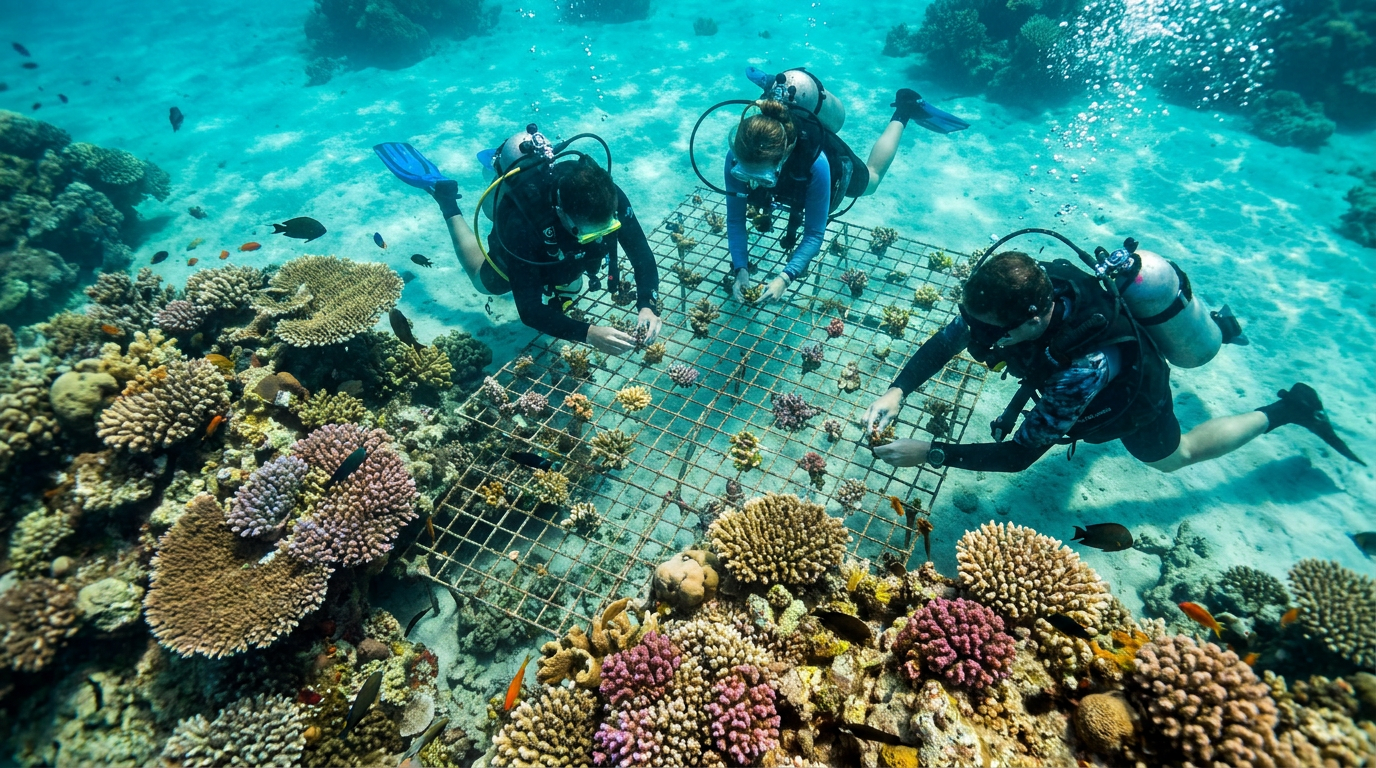
That biological limitation was shattered by the discovery of "micro-fragmentation." Pioneered by Dr. David Vaughan at the Mote Marine Laboratory, the technique involves using a specialized diamond-blade saw to cut slow-growing massive corals into tiny pieces, often just a few polyps wide.[6]
Slicing the coral triggers an extraordinary biological emergency response. Recognizing the severe trauma, the tiny fragments redirect all their metabolic energy into rapid tissue expansion to heal their newly exposed edges.[6]
When cut into one-to-two-square-centimeter pieces, these massive corals accelerate their growth by up to 50 times their natural rate. Instead of growing a fraction of an inch, they expand by 10 to 25 square centimeters annually.[6]

Even more remarkably, because the micro-fragments share the exact same genetic code, they do not compete for space when planted near one another on the ocean floor. Instead, as they grow outward and eventually touch, they seamlessly fuse back together.[6]
This fusion allows restoration teams to grow a massive coral head in two to three years—a structural feat that would normally take a quarter-century to form in the wild. Nurseries in Florida, Mexico, and the Maldives are now mass-producing these climate-resilient clones to rebuild degraded reef frameworks.[6][7]
Despite the immense promise of acoustic enrichment and micro-fragmentation, scientists caution that these tools are not silver bullets. Outplanting tiny coral fragments comes with high mortality risks; they are highly vulnerable to predation by parrotfish and sudden spikes in water temperature.[7]

Field assays in Hawaii and the Maldives have shown that while micro-fragmentation works, success is highly site-specific. Fragments must be carefully monitored, and acoustic enrichment must be calibrated so it does not inadvertently attract predators to a vulnerable, newly planted nursery.[7]
Furthermore, scaling these technologies to meet the UN's 125,000-square-kilometer target will require an estimated $12 billion in global investment by 2030. Currently, restoration efforts remain localized and labor-intensive, requiring armies of divers and sophisticated land-based aquaculture facilities.[8]
Most importantly, researchers emphasize that restoration only buys time. Rebuilding a reef is ultimately futile if the ocean continues to warm past the thermal limits of the species living there. These active interventions must be paired with aggressive global emissions reductions to address the root cause of the crisis.[8][9]
Yet, for the marine biologists working on the front lines, the rapid advancement of these techniques provides a vital lifeline. As researchers note, the worsening conditions of the oceans are not a cue to retreat, but a signal to double down. With underwater soundscapes and micro-saws, science is giving coral reefs a fighting chance to survive the century.[9]
How we got here
2005
Hurricane Wilma devastates Florida reefs, sparking early, large-scale coral fragmentation efforts.
2014
Researchers pioneer micro-fragmentation, discovering the rapid healing response of massive corals.
2021
Studies confirm that oyster larvae respond to acoustic enrichment, expanding the use of sound in marine restoration.
2023
The UN launches the Coral Reef Breakthrough to secure 125,000 square kilometers of reefs by 2030.
2024
Woods Hole Oceanographic Institution proves a second coral species settles at higher rates when exposed to healthy reef sounds.
Viewpoints in depth
Restoration Scientists' view
Argue that active interventions are essential to buy time for reef ecosystems.
Marine biologists and restoration practitioners argue that passive conservation is no longer enough in an era of rapid ocean warming. By scaling up active interventions like acoustic enrichment and micro-fragmentation, they believe it is possible to rebuild the structural complexity of reefs faster than climate change degrades them. They view these technologies as critical tools to maintain the genetic diversity and physical barriers that coral reefs provide.
Climate Policy Advocates' view
Emphasize that restoration must be paired with aggressive emissions reductions.
Climate policy experts and international organizations, such as those leading the UN Coral Reef Breakthrough, stress that while restoration is a vital lifeline, it is not a cure. They argue that investing billions in rebuilding reefs will ultimately fail if global greenhouse gas emissions are not drastically reduced. For this camp, restoration is a way to buy time, but halting the warming of the oceans remains the only permanent solution.
Acoustic Ecologists' view
Focus on the role of soundscapes in rebuilding the entire marine food web.
Acoustic ecologists emphasize that a reef is more than just coral; it is a complex, interconnected food web. They argue that the "fake it till you make it" approach of broadcasting healthy reef sounds is crucial because it attracts not only coral larvae but also the herbivorous fish needed to keep algae in check. By restoring the acoustic environment, they aim to jumpstart the entire ecosystem's recovery.
What we don't know
- Whether acoustic enrichment might inadvertently attract predators to newly planted, vulnerable coral nurseries.
- How well micro-fragmented corals will withstand future, unprecedented marine heatwaves.
- If the $12 billion required to meet the UN's 2030 restoration targets can be successfully mobilized.
Key terms
- Acoustic Enrichment
- The practice of broadcasting recorded sounds of a healthy ecosystem to attract marine life to a degraded area.
- Micro-fragmentation
- A technique where corals are cut into tiny pieces to trigger a rapid healing response, accelerating their growth.
- Coral Larvae
- The free-swimming, microscopic early life stage of corals before they attach to a hard surface.
- Benthic Substrate
- The ocean floor or hard surfaces where coral larvae settle and grow into mature colonies.
- Cilia
- Microscopic, hair-like structures on the exterior of coral larvae that allow them to sense acoustic vibrations.
Frequently asked
How do corals "hear" without ears?
Coral larvae are covered in tiny hair-like structures called cilia, which allow them to sense and swim toward acoustic vibrations in the water.
Can micro-fragmentation work for all corals?
It is especially revolutionary for massive, slow-growing species like brain and boulder corals, which were previously considered too slow to restore effectively.
Does restoration replace the need to stop climate change?
No. Scientists emphasize that these techniques only buy time; long-term reef survival requires halting the ocean warming that causes mass bleaching.
Sources
Source coverage
9 outlets
3 viewpoints surfaced









[1]Woods Hole Oceanographic InstitutionMarine Biologists & Restoration Scientists
WHOI researchers reinforce acoustic enhancement as a reef restoration method
Read on Woods Hole Oceanographic Institution →[2]Earth.OrgClimate Policy Advocates
Can Soundscapes Save Coral Reefs?
Read on Earth.Org →[3]Atmos MagazineAcoustic Ecologists
Can Nature's Own Sounds Help Heal the Earth?
Read on Atmos Magazine →[4]Hakai MagazineAcoustic Ecologists
Playing Recordings of a Healthy Ocean Can Help Restore Marine Ecosystems
Read on Hakai Magazine →[5]JASA Express LettersMarine Biologists & Restoration Scientists
Replayed reef sounds induce settlement of Favia fragum coral larvae in aquaria and field environments
Read on JASA Express Letters →[6]Coral VitaMarine Biologists & Restoration Scientists
Coral Fragmentation: Key to Reef Restoration
Read on Coral Vita →[7]PeerJMarine Biologists & Restoration Scientists
Coral micro-fragmentation assays for optimizing active reef restoration efforts
Read on PeerJ →[8]UN Climate ChampionsClimate Policy Advocates
Coral Reef Breakthrough launches to prevent extinction of one of the world's most threatened ecosystems
Read on UN Climate Champions →[9]The Cool DownMarine Biologists & Restoration Scientists
Coral-reef researcher declares it is time to 'double down' on restoration work
Read on The Cool Down →
Every angle. Every day.
Get environment stories with full source coverage and perspective breakdowns delivered to your inbox.