
The Rise of Local AI: How to Run Powerful LLMs on Your Own Device
As privacy concerns and API costs mount, a new generation of tools is allowing users to run highly capable AI models entirely offline on consumer hardware.
By Factlen Editorial Team

- Local-First Advocates
- Argue that local inference is essential for data sovereignty, protecting IP, and avoiding vendor lock-in.
- Hardware Ecosystem Builders
- Focus on integrating AI directly into the operating system to process tasks ambiently and privately.
- Hybrid Architecture Pragmatists
- Maintain that while local AI handles daily tasks, frontier cloud models are still required for complex reasoning.
What's not represented
- · Hardware manufacturers outside of Apple and Nvidia
- · Cloud API providers losing market share
Why this matters
Running AI locally gives you absolute control over your data and eliminates subscription fees. For professionals handling sensitive information, it is the only way to safely integrate AI into daily workflows without risking confidentiality.
Key points
- Local AI allows users to run Large Language Models entirely offline, ensuring absolute data privacy.
- Techniques like quantization have shrunk the memory requirements of AI models, allowing them to run on standard laptops.
- Tools like Ollama and LM Studio have eliminated the technical barriers to entry, offering simple CLI and GUI interfaces.
- While local models handle daily tasks flawlessly, a hybrid approach is emerging that reserves cloud APIs for the most complex reasoning.
The cloud AI boom of the last three years was built on a fundamental compromise: in exchange for world-class intelligence, users handed over their private documents, proprietary code, and daily operating context to centralized servers. Every prompt sent to a chatbot burned electricity in a distant data center and added to a growing repository of corporate training data. But in 2026, that compromise is no longer mandatory. A quiet architectural rebellion is moving artificial intelligence off the grid and directly onto consumer laptops.[5]
Known as "local AI," this shift allows users to run Large Language Models (LLMs) entirely on their own hardware, without an internet connection. Instead of renting intelligence by the API call, developers, professionals, and everyday users are downloading open-weight models and running them locally. The appeal is straightforward: absolute data privacy, zero latency, and immunity from subscription price hikes.[4][5]
This transition was made possible by a rapid convergence of hardware and software. Just two years ago, running a capable AI model required a massive desktop PC with multiple expensive graphics cards. Today, the unified memory architecture of Apple Silicon and the inclusion of dedicated Neural Processing Units (NPUs) in standard Windows laptops have created a baseline of hardware parity.[2]
But the real breakthrough happened in the software layer, specifically through a technique called quantization. Quantization mathematically compresses the massive neural networks of an LLM, reducing the precision of its weights from 16-bit to 4-bit or 8-bit formats. This shrinks a model that would normally require 30 gigabytes of memory down to just 6 or 8 gigabytes, allowing it to run comfortably on a standard 2026 laptop without a noticeable drop in reasoning quality.[1][6]

The models themselves have also caught up. While the absolute frontier of AI—capable of the most complex, multi-step reasoning—still lives in the cloud, open-weight models are now roughly three to six months behind that bleeding edge. Models like Meta's Llama 3.1, Google's Gemma 4, and Mistral's latest releases are highly capable of drafting emails, analyzing spreadsheets, and writing code.[2][4]
For developers, the gateway to local AI is a tool called Ollama. Often described as the "Docker for LLMs," Ollama is a command-line interface that abstracts away the agonizing complexity of Python dependencies and CUDA drivers. With a single command—like `ollama run llama3`—the software downloads the model, configures the hardware acceleration, and opens a chat prompt in the terminal. It has amassed over 170,000 stars on GitHub, becoming the default backend for local AI development.[1][2][6]
For users who prefer a visual interface, applications like LM Studio and Jan have democratized access even further. These desktop applications offer a polished, ChatGPT-like graphical user interface. Users can browse a directory of models, download them with a click, and chat with them in a familiar window. LM Studio even provides real-time metrics on how much RAM and CPU the model is consuming during inference.[1][6]

For users who prefer a visual interface, applications like LM Studio and Jan have democratized access even further.
The primary driver for this local migration is the "privacy paradox." For professionals bound by confidentiality—such as therapists drafting session notes, lawyers analyzing contracts, or founders building stealth startups—sending sensitive data to a third-party API is a non-starter. Local models create a closed-loop system where the data never leaves the solid-state drive.[4][5]
Beyond privacy, local AI solves the problem of "prompt drift." Cloud-based models are frequently updated by their providers, meaning a prompt that perfectly formatted a report in May might break in June because the underlying model changed. With a local model, the user controls the version. The intelligence is frozen in time, ensuring perfectly reproducible results until the user explicitly decides to upgrade.[5]
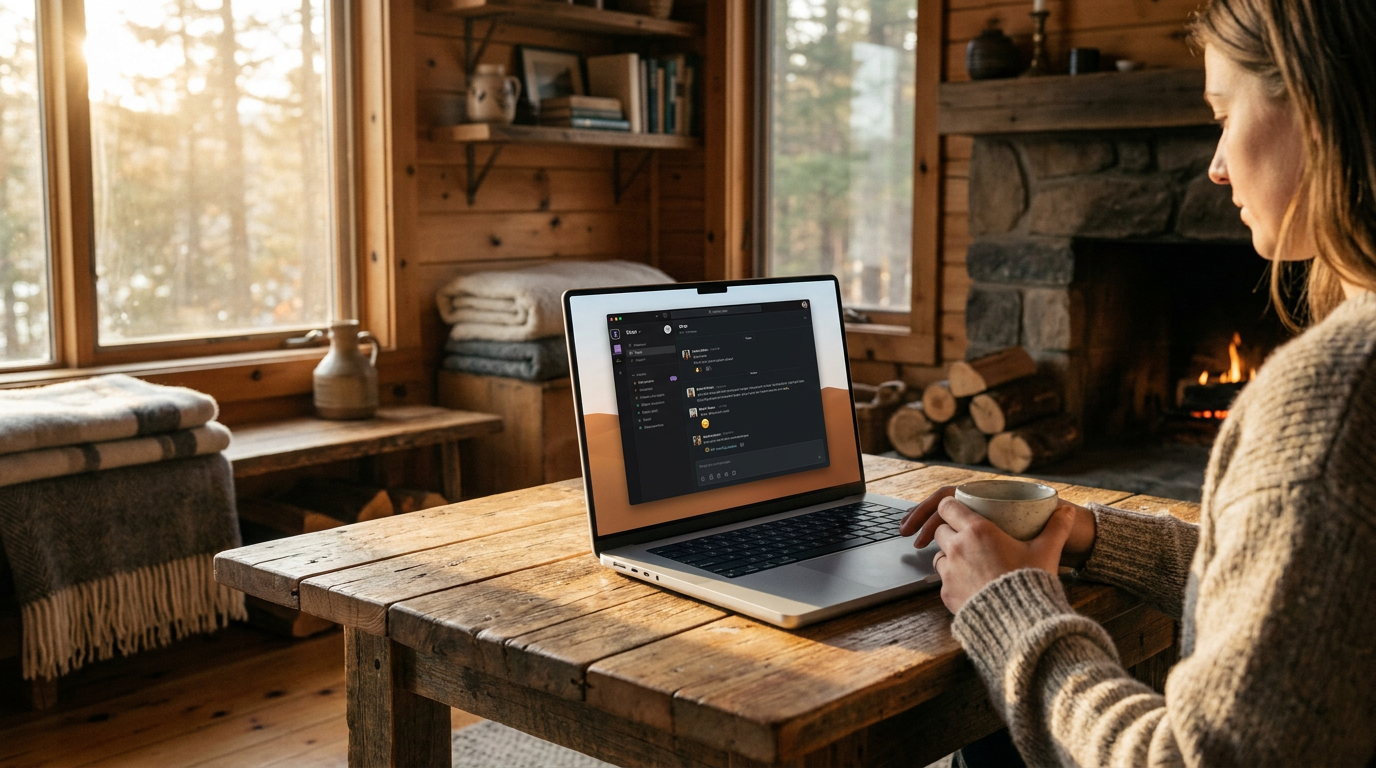
The offline advantage is another major draw. In 2026, productivity is no longer tethered to a Wi-Fi connection. A local AI agent can summarize downloaded documents on an airplane, assist with coding in a remote cabin, or function seamlessly during a server outage. Because the compute happens on-device, there is zero network latency—the model begins typing its response the millisecond the user hits enter.[5][6]
The tech giants are aggressively validating this architecture. At its 2026 Worldwide Developers Conference, Apple positioned on-device inference as the cornerstone of its Apple Intelligence strategy. By running the majority of daily AI tasks locally on the iPhone or Mac, Apple is pitching privacy as a product, reserving its "Private Cloud Compute" servers only for the heaviest workloads.[3]

Enterprises are also doing the math. Rather than paying per-token fees for thousands of employees to use cloud chatbots, companies are setting up private inference servers. These internal hubs run open-weight models behind the corporate firewall, allowing employees to query internal wikis and meeting transcripts without exposing institutional knowledge to the outside world.[4][6]
Despite the momentum, local AI is not a complete replacement for the cloud. There are material limits to what consumer hardware can process. For highly complex agentic workflows, massive context windows, or cutting-edge multimodal tasks, the sheer compute power of an Nvidia-packed data center remains unmatched.[3][4]
The consensus architecture for 2026 is hybrid routing. Developers are building applications that use local models for 80 percent of daily tasks—where privacy and speed are paramount—and only route requests to frontier cloud APIs when the local model determines the task is too complex. This hybrid approach offers the best of both worlds: the security of local compute and the boundless power of the cloud.[4][6]

Ultimately, the rise of local LLMs represents a shift in how we view artificial intelligence. It is transitioning from a rented service controlled by a handful of mega-corporations into a decentralized utility that anyone can own. By putting the models directly into the hands of users, local AI is ensuring that the future of computing remains personal, private, and profoundly empowering.[5][6]
How we got here
Early 2023
Llama.cpp is released, proving that large language models can be run on standard consumer CPUs without massive server farms.
Mid 2024
Ollama launches, simplifying local AI deployment into a single terminal command and sparking widespread developer adoption.
Late 2025
Open-weight models like Llama 3 and Mistral achieve performance parity with early commercial cloud models, making local AI viable for daily work.
June 2026
Apple heavily emphasizes on-device AI processing at WWDC, validating the local-first architecture for mainstream consumers.
Viewpoints in depth
Local-First Advocates
Argue that local inference is essential for data sovereignty and protecting intellectual property.
This camp, primarily made up of privacy advocates, open-source developers, and security-conscious founders, views cloud AI as a fundamental security risk. They argue that sending proprietary code, financial data, or personal health information to a centralized server creates an unacceptable 'hidden risk architecture.' By running models locally, they believe users reclaim ownership of their digital context and insulate themselves from the shifting pricing and privacy policies of massive tech conglomerates.
Hardware Ecosystem Builders
Focus on integrating AI directly into the operating system to process tasks ambiently.
Companies like Apple and Qualcomm are pushing the narrative that AI should not be a destination you visit in a web browser, but an ambient layer woven into the device itself. They emphasize that modern Neural Processing Units (NPUs) and unified memory architectures have advanced enough to handle the vast majority of daily AI requests. For this camp, local AI is less about open-source ideology and more about delivering a seamless, zero-latency user experience that inherently respects user privacy.
Hybrid Architecture Pragmatists
Maintain that frontier cloud models are still required for the most complex reasoning tasks.
Enterprise IT leaders and AI workflow builders acknowledge the privacy benefits of local models but warn against overestimating their capabilities. They point out that while a local 8-billion parameter model is excellent for summarizing a PDF, it cannot compete with a trillion-parameter cloud model when it comes to complex coding architectures or multi-step agentic reasoning. This camp advocates for a hybrid approach: routing sensitive, high-volume tasks to local hardware while reserving the cloud for the heavy lifting.
What we don't know
- How quickly open-weight models will close the remaining 3-to-6 month capability gap with frontier cloud models.
- Whether upcoming regulations on AI safety will attempt to restrict the distribution of powerful open-weight models to consumers.
Key terms
- Quantization
- A mathematical compression technique that shrinks the memory footprint of an AI model by reducing the precision of its weights, allowing it to run on consumer hardware.
- Inference
- The process of a trained AI model generating a response or prediction based on a user's prompt.
- Open-weight model
- An AI model whose core architecture and trained parameters are publicly available for anyone to download and run.
- VRAM (Video RAM)
- The dedicated memory on a graphics card, which is significantly faster than standard system RAM and crucial for running AI models efficiently.
- Prompt Drift
- The phenomenon where a cloud-based AI model's responses change over time due to hidden updates by the provider, breaking previously reliable workflows.
Frequently asked
Do I need an expensive computer to run local AI?
No. While massive models require specialized hardware, highly capable quantized models like Llama 3.1 8B can run smoothly on a standard laptop with 8GB to 16GB of RAM.
Is local AI completely private?
Yes. When running entirely on-device, your prompts and data never leave your computer, making it impossible for third parties to intercept or use your data for training.
Can local models replace ChatGPT entirely?
For everyday tasks like drafting emails, summarizing documents, and basic coding, yes. However, frontier cloud models still hold an edge in highly complex, multi-step reasoning tasks.
What is the easiest way to get started?
Tools like LM Studio and Jan offer simple, one-click desktop applications that let you download and chat with models without needing to use the command line.
Sources
Source coverage
6 outlets
3 viewpoints surfaced






[1]TechsyLocal-First Advocates
8 Best Tools to Run LLMs Locally in 2026, Ranked
Read on Techsy →[2]PinggyHardware Ecosystem Builders
Top 5 Local LLM Tools in 2026
Read on Pinggy →[3]MacRumorsHardware Ecosystem Builders
Apple to Highlight On-Device AI Processing at WWDC
Read on MacRumors →[4]MindStudioHybrid Architecture Pragmatists
Local AI vs Cloud: When to Run Open-Weight Models
Read on MindStudio →[5]MediumLocal-First Advocates
The Privacy Paradox: Why I Moved My AI Off the Grid
Read on Medium →[6]Factlen Editorial TeamLocal-First Advocates
Synthesis by Factlen editorial team
Read on Factlen Editorial Team →


Every angle. Every day.
Get ai stories with full source coverage and perspective breakdowns delivered to your inbox.