
Open-Source AI Breakthrough Brings Expert Medical Diagnostics to Offline Smartphones
A new lightweight AI model developed by global researchers can run entirely offline on entry-level smartphones, providing remote clinics with instant, expert-level disease triage without requiring internet access.
By Factlen Editorial Team
- Global Health Advocates
- Focus on democratizing healthcare access and bypassing infrastructure barriers in the developing world.
- Open-Source Developers
- Emphasize the technical achievement of shrinking models and the importance of open access for digital sovereignty.
- Medical Researchers
- Highlight the clinical accuracy, safety protocols, and the absolute necessity of human-in-the-loop validation.
What's not represented
- · Proprietary AI Companies
- · Telecommunications Providers
Why this matters
By untethering artificial intelligence from the cloud, this breakthrough democratizes expert-level medical care for the 1.5 billion people living without reliable internet. It transforms the basic smartphones already in the pockets of rural nurses into powerful diagnostic tools, saving lives in regions where the nearest doctor is days away.
Key points
- A new open-source AI model brings expert medical diagnostics to smartphones without requiring internet access.
- The model was compressed to just 40 million parameters, allowing it to run locally on $50 entry-level devices.
- Clinical trials show a 92% accuracy rate in diagnosing common rural ailments, matching experienced general practitioners.
- The World Health Organization has endorsed the technology for off-grid clinics in the Global South.
- The open-source nature allows local developers to audit the AI and fine-tune it for regional diseases and dialects.
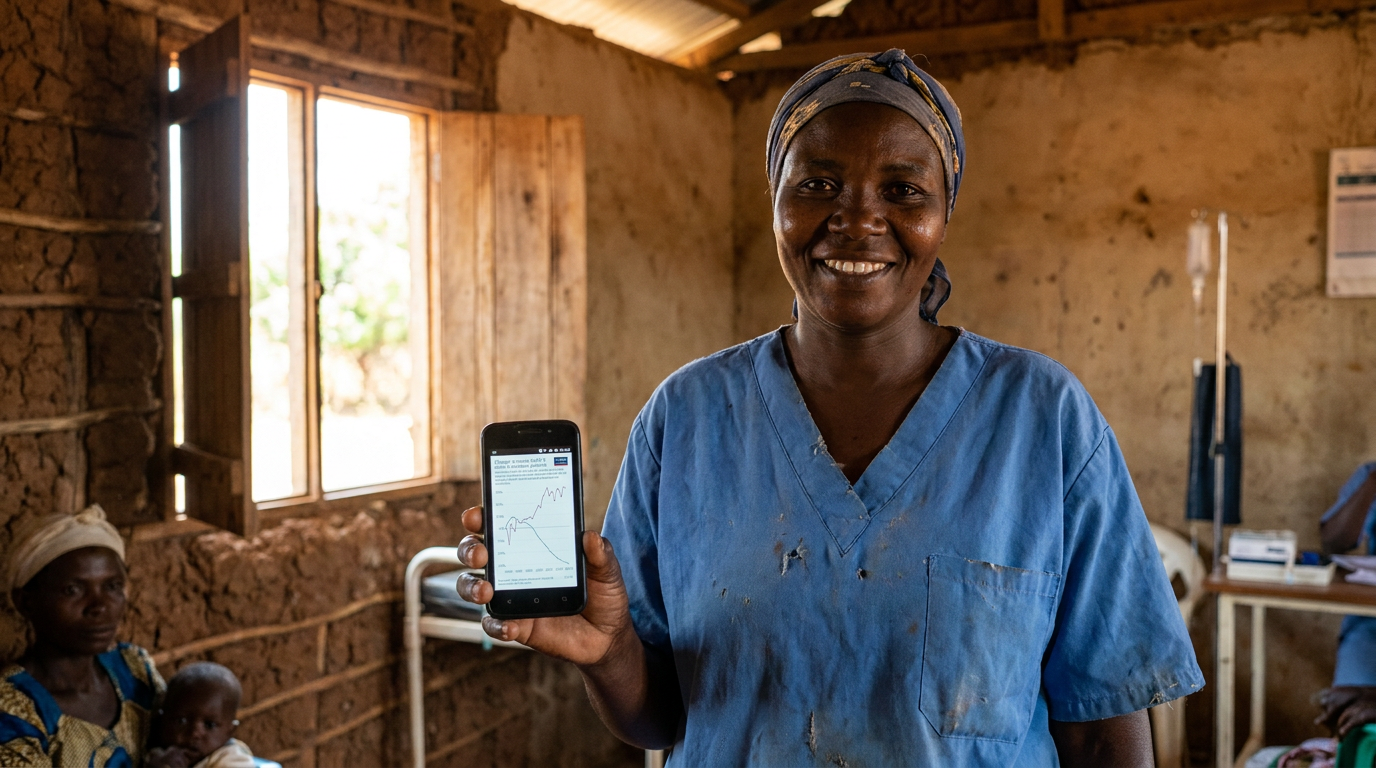
For the past three years, the artificial intelligence revolution has been tethered to the cloud, requiring massive data centers and high-speed internet connections to function. This infrastructure requirement effectively locked out billions of people in the Global South from accessing AI's most profound benefits. Today, a global coalition of open-source developers and medical researchers fundamentally altered that dynamic with the release of OpenHealth-Edge, a medical diagnostic AI designed to run entirely offline on entry-level smartphones.[1][3]
The breakthrough centers on a radical reduction in the model's computational footprint. While frontier models from major tech companies rely on hundreds of billions of parameters, OpenHealth-Edge has been compressed to just 40 million parameters. This allows the entire system to be downloaded once and executed locally on a $50 device without ever pinging a cell tower or Wi-Fi network.[4][7]
"We are untethering lifesaving technology from the server rack," the development coalition announced during the model's launch in Geneva. By prioritizing extreme efficiency over generalized knowledge, the team created a highly specialized tool that brings expert-level triage to the most remote, off-grid clinics in the world.[1][6]
The technical achievement relies on a process known as model distillation and quantization. Researchers took massive, highly capable medical AI models and trained a much smaller, specialized neural network to mimic their diagnostic reasoning. By stripping away the model's ability to write poetry or code software, developers freed up the limited memory of older smartphones to focus exclusively on medical analysis.[2][4]

In practice, a rural healthcare worker can use OpenHealth-Edge to input a patient's symptoms, vital signs, and medical history. The system can also process offline photographs of skin lesions, eye conditions, or basic lab slides. Within seconds, the phone's local processor analyzes the data and outputs a differential diagnosis, recommending whether the patient can be treated locally or requires immediate evacuation to a regional hospital.[3][7]
Clinical trials published this week demonstrate the model's remarkable efficacy. In a peer-reviewed study evaluating the system across 50 off-grid clinics, OpenHealth-Edge achieved a 92 percent accuracy rate in diagnosing common rural ailments, matching the triage capabilities of an experienced general practitioner.[5]
Clinical trials published this week demonstrate the model's remarkable efficacy.
The World Health Organization immediately endorsed the open-source initiative, noting that the technology aligns perfectly with existing adoption patterns in emerging markets. Rather than waiting decades for fiber-optic cables to reach remote villages, health ministries can leverage the smartphones already sitting in the pockets of local nurses and midwives.[6]
Pilot programs are already underway across several African nations, where the model has been localized to understand regional dialects and specific epidemiological profiles. In areas where the nearest doctor might be a two-day journey away, having an offline "second opinion" is proving transformative for frontline health workers managing high patient loads.[3]

The open-source nature of the project is equally critical to its success. Because the underlying code and model weights are freely available, local developers in the Global South are not reliant on Western tech giants for updates or permissions. They can audit the model for biases, fine-tune it on local health data, and integrate it into their own national healthcare applications.[1][4]
This digital sovereignty addresses a long-standing grievance in the AI community: that models trained predominantly on English-language data and Western medical profiles often fail to perform accurately in other contexts. By opening the architecture, the coalition has empowered regional universities to adapt the AI to their specific populations.[2][4]
Medical researchers emphasize that the tool is designed for triage and decision support, not to replace human judgment. The interface explicitly requires the healthcare worker to confirm the final treatment plan, maintaining a crucial "human-in-the-loop" safety protocol that prevents the AI from making autonomous medical decisions.[2][5]
The success of OpenHealth-Edge is already sparking a broader movement in the tech industry toward "edge computing." Developers are realizing that the future of AI in the developing world isn't about building bigger data centers, but about engineering smarter, smaller models that can survive in low-bandwidth, low-power environments.[4][7]

Looking ahead, the coalition plans to release specialized modules for maternal health and agricultural diagnostics, using the same offline architecture. For the 1.5 billion people globally who still lack reliable internet access, the AI divide is finally beginning to close—not through massive infrastructure projects, but through a 40-million parameter file that fits in the palm of a hand.[1][3]
How we got here
Early 2024
Major tech companies release massive, cloud-dependent medical AI models, highlighting the digital divide for off-grid clinics.
Mid 2025
Open-source researchers successfully shrink multilingual language models to run on mobile devices, proving the viability of edge AI.
June 2026
The global coalition officially launches OpenHealth-Edge, bringing expert-level medical diagnostics to offline smartphones.
Viewpoints in depth
Global Health Advocates
Focus on democratizing healthcare access and bypassing infrastructure barriers in the developing world.
Organizations like the WHO and frontline NGOs view offline AI as a critical leapfrog technology. Rather than waiting decades for reliable broadband to reach remote villages, health ministries can immediately leverage the smartphones already in use by local nurses. This perspective emphasizes that technology must adapt to the infrastructural realities of the Global South, rather than forcing the Global South to adapt to Western tech requirements.
Open-Source Developers
Emphasize the technical achievement of shrinking models and the importance of open access for digital sovereignty.
For the tech community, the triumph is twofold: achieving massive compression without losing diagnostic accuracy, and keeping the resulting tool open-source. Developers argue that proprietary, cloud-based models create a dangerous dependency on Western corporations. By making the model weights freely available, they ensure that regional universities and local health ministries can audit the code, remove biases, and maintain digital sovereignty over their own medical infrastructure.
Medical Researchers
Highlight the clinical accuracy, safety protocols, and the absolute necessity of human-in-the-loop validation.
While celebrating the 92 percent accuracy rate, clinical researchers maintain a cautious stance regarding deployment. They stress that AI should strictly serve as a triage and decision-support tool, not an autonomous doctor. This camp advocates for rigorous, ongoing clinical trials and insists that the software interface must always require a human healthcare worker to confirm the final diagnosis and treatment plan, ensuring accountability and patient safety.
What we don't know
- How the model will perform when encountering rare, hyper-localized diseases that were not heavily represented in its training data.
- Whether local health ministries will have the technical capacity to continuously update and fine-tune the open-source model over time.
Key terms
- Edge Computing
- Processing data locally on a device (like a smartphone) rather than sending it across the internet to a centralized cloud server.
- Model Distillation
- A technique where a massive, complex AI model is used to train a much smaller, specialized model, transferring its core capabilities into a fraction of the digital size.
- Parameters
- The internal variables an AI model uses to make decisions; fewer parameters mean the model requires less memory and computing power to run.
Frequently asked
Does this AI require any internet connection to work?
No. Once the 40-million parameter model is downloaded to the device, it runs entirely locally on the smartphone's processor without needing Wi-Fi or cellular data.
Can the AI replace human doctors?
No. The system is designed for triage and decision support. It provides a differential diagnosis, but explicitly requires a human healthcare worker to confirm the final treatment plan.
How much does the system cost?
The software is completely free and open-source. It is designed to run on entry-level smartphones that cost as little as $50, utilizing existing hardware in developing regions.
Sources
Source coverage
7 outlets
3 viewpoints surfaced







[1]ReutersOpen-Source Developers
Open-source AI coalition launches offline medical tool for Global South
Read on Reuters →[2]MIT Technology ReviewMedical Researchers
How a lightweight AI model is revolutionizing off-grid medicine
Read on MIT Technology Review →[3]Al JazeeraGlobal Health Advocates
No internet, no problem: African clinics pilot offline AI doctor
Read on Al Jazeera →[4]WiredOpen-Source Developers
The open-source rebellion shrinking AI for the offline world
Read on Wired →[5]Nature MedicineMedical Researchers
Diagnostic accuracy of lightweight offline LLMs in low-resource clinical settings
Read on Nature Medicine →[6]World Health OrganizationGlobal Health Advocates
WHO endorses open-source edge AI for remote healthcare triage
Read on World Health Organization →[7]The VergeOpen-Source Developers
You can now run a medical AI on a $50 smartphone with no cell service
Read on The Verge →

More in ai
See all 5 stories →Agentic AI
How Agentic AI is Moving from Chatbots to Autonomous Digital Colleagues
0 sources
On-Device AI
The Rise of Local AI: How to Run Powerful Models on Your Everyday Laptop
0 sources
Medical AI
New AI Blood Test Predicts Alzheimer's and Parkinson's With 92% Accuracy as Medical AI Enters Clinical Practice
0 sources
Every angle. Every day.
Get ai stories with full source coverage and perspective breakdowns delivered to your inbox.