
How Self-Driving Labs Are Automating Scientific Discovery
By combining artificial intelligence with advanced robotics, autonomous laboratories are compressing the timeline for discovering new materials and drugs from decades to days.
By Factlen Editorial Team
- Academic Researchers
- Focused on accelerating the pace of discovery and solving the reproducibility crisis.
- Industrial Innovators
- Focused on commercializing new materials and scaling laboratory successes to factory production.
- Systems Engineers
- Focused on the complex integration of AI software with physical robotic hardware.
- Technology Analysts
- Focused on the broader societal and economic impacts of automated scientific infrastructure.
What's not represented
- · Traditional laboratory technicians whose manual roles may be displaced by automation.
- · Regulatory bodies overseeing the safety of AI-generated chemical compounds.
Why this matters
The materials needed to solve global challenges—from higher-capacity EV batteries to novel medical treatments—traditionally take a decade to discover. By fully automating the scientific method, self-driving labs are compressing this timeline to mere days, promising a rapid acceleration in the technologies that power our daily lives.
Key points
- Self-driving labs combine AI and robotics to fully automate the scientific method.
- The technology aims to reduce the time and cost of discovering new materials by a factor of ten.
- A closed-loop system allows AI to design, execute, and learn from experiments continuously.
- Automation solves the reproducibility crisis by eliminating human error and undocumented variables.
- Scaling discoveries from the lab to industrial production remains a key challenge.
The traditional image of scientific discovery—a researcher in a white coat meticulously pipetting liquids—is undergoing a radical transformation. Across the globe, a quiet revolution is replacing manual trial and error with continuous, automated innovation.[8]
Known as "self-driving labs" (SDLs) or autonomous laboratories, these systems integrate artificial intelligence, machine learning, and robotic hardware into a single, closed-loop ecosystem. Like self-driving cars, which operate with minimal human intervention, these laboratories are designed to run experimental protocols, fast-track discoveries, and generate rigorous data around the clock.[5][6][7]
Historically, discovering a new functional material—such as a more efficient solar cell, a higher-capacity battery, or a novel drug compound—has been a grueling process. The University of Toronto's Aspuru-Guzik research group estimates that developing a new material typically requires ten years and ten million dollars.[1]
Autonomous laboratories aim to reduce that timeline and cost by a factor of ten, compressing decades of research into months or even days. By combining the best technologies of our time, this integration promises to substantially accelerate the rate of materials discovery by up to 100 times, surpassing human capabilities alone.[1][2][5]

The core mechanism driving this acceleration is an entirely closed-loop, decision-making ecosystem. The cycle begins with the "AI brain." Rather than relying on human intuition, active learning algorithms model high-dimensional parameter spaces to generate mathematically optimal formulation recipes.[5]
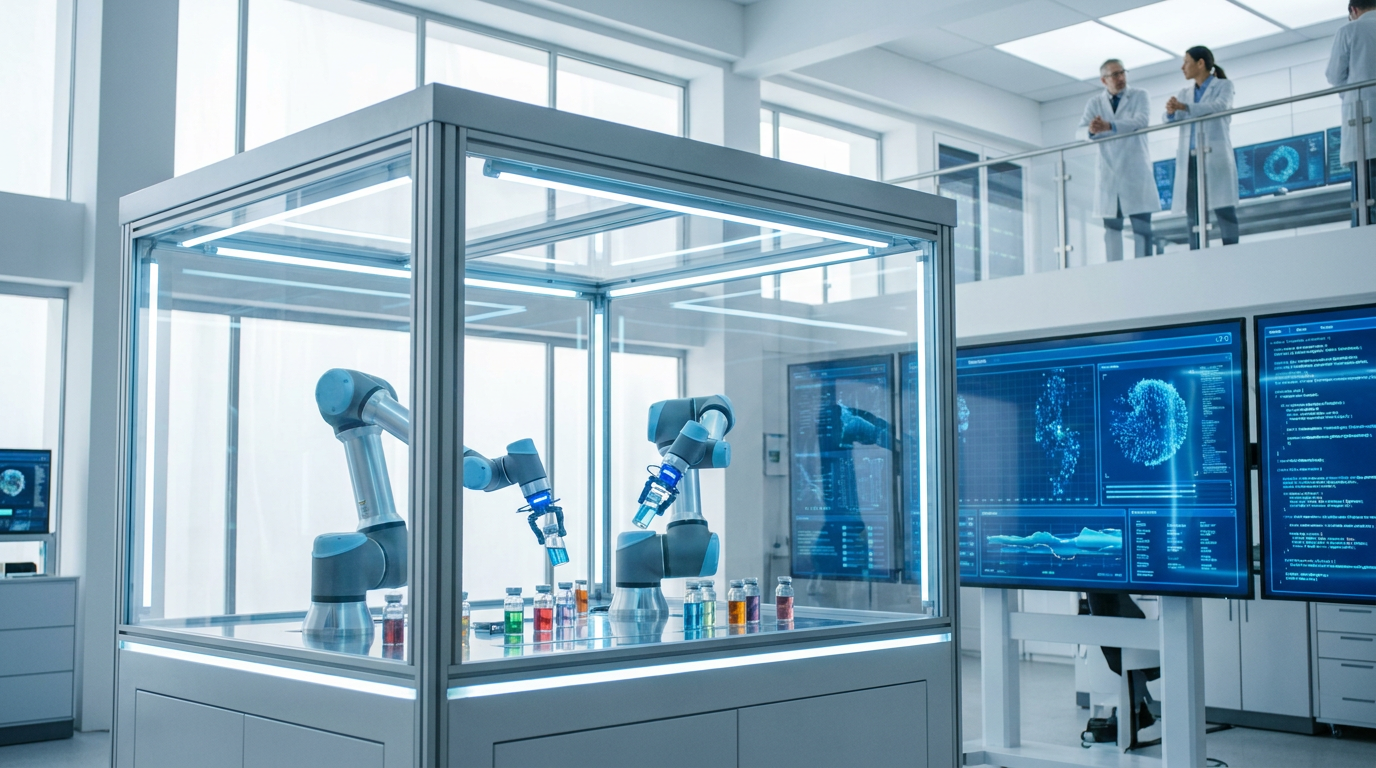
Once the AI proposes an experiment, robotic systems take over. Automated fluid-handlers and multi-axis mechanical arms execute the raw machine code, physically blending precursors and controlling reaction conditions without human intervention.[5][7]
The newly synthesized material is immediately passed to integrated analytical suites—such as spectrometers and rheometers—which run real-time characterization checks to measure its properties.[5]
The loop closes when the characterization data is fed back into the AI system. The machine learning models update their understanding of the chemical space and instantly trigger the next, optimized experimental run.[2][5]

The loop closes when the characterization data is fed back into the AI system.
This continuous design-build-test-learn cycle is no longer theoretical. At Oak Ridge National Laboratory (ORNL), researchers are building "Labs of the Future," interconnected platforms that combine leadership-class supercomputing with cutting-edge instrumentation to pave the way for AI-driven scientific discovery.[3]
By removing human latency from the iterative loop, these systems do not replace scientists; rather, they liberate them. Researchers can focus on high-level strategy, interpreting complex results, and guiding research priorities while the machines handle the physical execution.[3][5]
Beyond speed, self-driving labs address one of modern science's most persistent challenges: reproducibility. Studies estimate that nearly 70% of scientists struggle to reproduce others' findings, often due to undocumented variables or human error in manual execution.[6]
Automation ensures that every step of an experiment is executed with exact precision and logged transparently. This consistency generates rigorous, reliable data that bolsters scientific credibility and eliminates subjective decision points.[6][7]

Despite the rapid progress, significant hurdles remain. While AI significantly speeds up the discovery and validation of new materials, the absence of a seamless method to scale these innovations from the lab to industrial production can hinder their practical application.[2]
Furthermore, robust error detection and fault recovery are still underdeveloped. If a robotic arm drops a vial or a sensor miscalibrates, the AI must be sophisticated enough to recognize the physical anomaly rather than blindly ingesting flawed data into its models.[7]
Looking ahead, the democratization of this technology is expanding through "cloud labs," which offer subscription-based, remote-control access to autonomous experimental capabilities. This shift promises to make world-class scientific infrastructure accessible to startups and researchers globally, fundamentally accelerating the pace of human progress.[4][8]
How we got here
Early 20th Century
Industrial manufacturing introduces mechanical automation to simplify labor.
Late 2010s
Advances in machine learning and robotics begin converging in academic chemistry and materials science departments.
2023
Fully autonomous solid-state synthesis platforms, like A-Lab, successfully demonstrate AI-driven materials discovery.
2026
Self-driving labs transition from academic prototypes to industrial infrastructure and accessible cloud labs.
Viewpoints in depth
Academic Researchers
Focused on accelerating the pace of discovery and solving the reproducibility crisis.
For the academic community, the primary value of autonomous laboratories lies in their ability to compress decades of trial-and-error research into a fraction of the time. Furthermore, researchers emphasize that removing human manual execution from the equation directly addresses the reproducibility crisis, ensuring that experimental data is rigorous, transparent, and universally verifiable.
Industrial Innovators
Focused on commercializing new materials and scaling laboratory successes to factory production.
Chemical and materials companies view self-driving labs as a critical engine for economic competitiveness. By compressing R&D timelines, industries can bring novel batteries, solar cells, and pharmaceuticals to market faster. However, these stakeholders caution that discovering a material in an automated lab is only the first step; the ongoing challenge is developing seamless methods to scale these micro-discoveries into massive industrial production.
Systems Engineers
Focused on the complex integration of AI software with physical robotic hardware.
Engineers building these platforms are primarily concerned with the physical realities of automation. They highlight that while the AI 'brain' is highly advanced, the physical execution remains vulnerable to real-world friction. Developing robust error detection, fault recovery, and adaptive planning—so the system knows what to do if a robotic arm drops a vial—remains their most pressing technical hurdle.
What we don't know
- How seamlessly these automated micro-discoveries can be scaled up to massive industrial manufacturing.
- Whether AI models can reliably detect and recover from physical hardware faults without human intervention.
Key terms
- Self-Driving Lab (SDL)
- An automated laboratory system that combines artificial intelligence with robotic hardware to continuously design, execute, and learn from experiments.
- Closed-Loop System
- A process where the results of an experiment are automatically fed back into an AI model to instantly design the next, optimized experiment without human input.
- Active Learning
- A machine learning approach where the algorithm actively queries and selects the most informative next experiments to perform, rather than passively analyzing existing data.
- High-Throughput Experimentation
- The use of automation to rapidly conduct a large number of simultaneous or sequential scientific tests.
Frequently asked
What is a self-driving lab?
A scientific space where artificial intelligence and robotics work together to design, execute, and analyze experiments with minimal human intervention.
Will AI replace human scientists?
No. Autonomous labs handle the manual, repetitive tasks, freeing scientists to focus on high-level strategy, complex data interpretation, and guiding research goals.
How do these labs improve scientific reproducibility?
By automating every physical step, self-driving labs eliminate human error and undocumented variables, ensuring experiments are executed with exact, loggable precision.
What are cloud labs?
Cloud labs offer subscription-based, remote-control access to automated experimental hardware, allowing researchers anywhere to run physical experiments via the internet.
Sources
Source coverage
8 outlets
4 viewpoints surfaced








[1]University of TorontoAcademic Researchers
AI for Discovery and Self-Driving Labs
Read on University of Toronto →[2]VSParticleIndustrial Innovators
SDLs: A game-changer in scientific research
Read on VSParticle →[3]Oak Ridge National LaboratorySystems Engineers
Autonomous Laboratories at Oak Ridge National Laboratory
Read on Oak Ridge National Laboratory →[4]Royal Society PublishingAcademic Researchers
Review of autonomous, 'self-driving' laboratories
Read on Royal Society Publishing →[5]ChemCopilotIndustrial Innovators
Self-Driving Labs: The Rise of Autonomous Chemical Discovery in 2026
Read on ChemCopilot →[6]Athens Science ObserverAcademic Researchers
What is an Autonomous Lab?
Read on Athens Science Observer →[7]OAE PublishingSystems Engineers
Artificial intelligence-driven autonomous laboratory for accelerating chemical discovery
Read on OAE Publishing →[8]Factlen Editorial TeamTechnology Analysts
Synthesis by Factlen editorial team
Read on Factlen Editorial Team →



Every angle. Every day.
Get ai stories with full source coverage and perspective breakdowns delivered to your inbox.