
The Premium Compact Camera Renaissance: Why Dedicated Shooters Are Beating Smartphones
Despite massive advancements in smartphone computational photography, consumers are increasingly turning to premium, fixed-lens compact cameras for better image quality, tactile controls, and a more mindful shooting experience.
By Factlen Editorial Team
- Tactile Purists
- Value physical dials, viewfinders, and the mindful separation of photography from smartphones.
- Computational Optimists
- Argue that modern flagship smartphones with multiple lenses and AI processing make dedicated compacts unnecessary for most.
- Hybrid Creators
- Focus on video capabilities, 1-inch sensors, and vlogging features over retro aesthetics.
- Luxury Enthusiasts
- Prioritize absolute image quality and full-frame sensors regardless of price or portability compromises.
- Market Analysts
- View the trend as a broader consumer shift toward intentional, single-purpose technology.
What's not represented
- · Budget-conscious consumers priced out of the $1,500+ camera market
- · Professional sports and wildlife photographers who require massive telephoto lenses
Why this matters
Understanding the difference between smartphone AI processing and true optical sensors helps consumers make informed purchasing decisions. For many, investing in a dedicated camera offers a creative outlet that reduces screen time and preserves memories with higher fidelity.
Key points
- Premium compact cameras are experiencing a massive resurgence despite advancements in smartphone technology.
- Larger physical sensors (APS-C and Full-Frame) provide natural depth of field that smartphones must fake with software.
- The 'Everyday Carry' trend treats cameras as mindful, single-purpose tools that reduce screen time.
- Built-in film simulations allow users to get stylized, ready-to-share JPEGs without editing RAW files.
- Fixed lenses require users to 'zoom with their feet,' trading versatility for superior optical quality.
We are living in a technological paradox. In 2026, the smartphone in your pocket possesses a multi-lens camera system backed by neural engines capable of trillions of operations per second. Yet, across the globe, dedicated premium compact cameras are perpetually sold out, commanding waitlists that stretch for months. This is not merely a nostalgic fad for early-2000s digicams; it is a deliberate consumer shift toward high-end, purpose-built photography tools.[1][2][7]
The driving force behind this surge is the "Everyday Carry" (EDC) movement. Much like a mechanical watch or a premium fountain pen, a dedicated compact camera has become an intentional lifestyle accessory. Consumers are increasingly viewing their smartphones as "distraction machines"—devices where opening the camera app inevitably leads to checking notifications or scrolling social media. A dedicated camera offers a singular, mindful purpose: observing and capturing the world.[5][6][7]
To understand why buyers are spending upwards of $1,500 on a device that seemingly duplicates a smartphone feature, we have to look at the physics of light. Smartphones are constrained by their physical thickness, which limits the size of the image sensors they can house. To compensate for these tiny sensors, tech giants rely on "computational photography"—a suite of software tricks that instantly stacks multiple exposures, brightens shadows, and artificially blurs backgrounds.[1][3][7]
While computational photography looks spectacular on a six-inch mobile screen, its limitations become glaringly obvious when images are printed or viewed on larger displays. The software often over-sharpens details, struggles with complex edges like hair when faking depth of field, and produces a hyper-processed, somewhat sterile aesthetic. The magic of the smartphone is algorithmic, not optical.[1][3][6]

Premium compact cameras take the opposite approach. They pack massive image sensors—ranging from 1-inch formats to APS-C, and even 35mm Full-Frame—into pocketable bodies. These larger sensors gather exponentially more light naturally. The result is true optical "bokeh" (the aesthetic quality of the out-of-focus areas), superior dynamic range, and a natural tonal depth that software simply cannot replicate.[3][4][7]
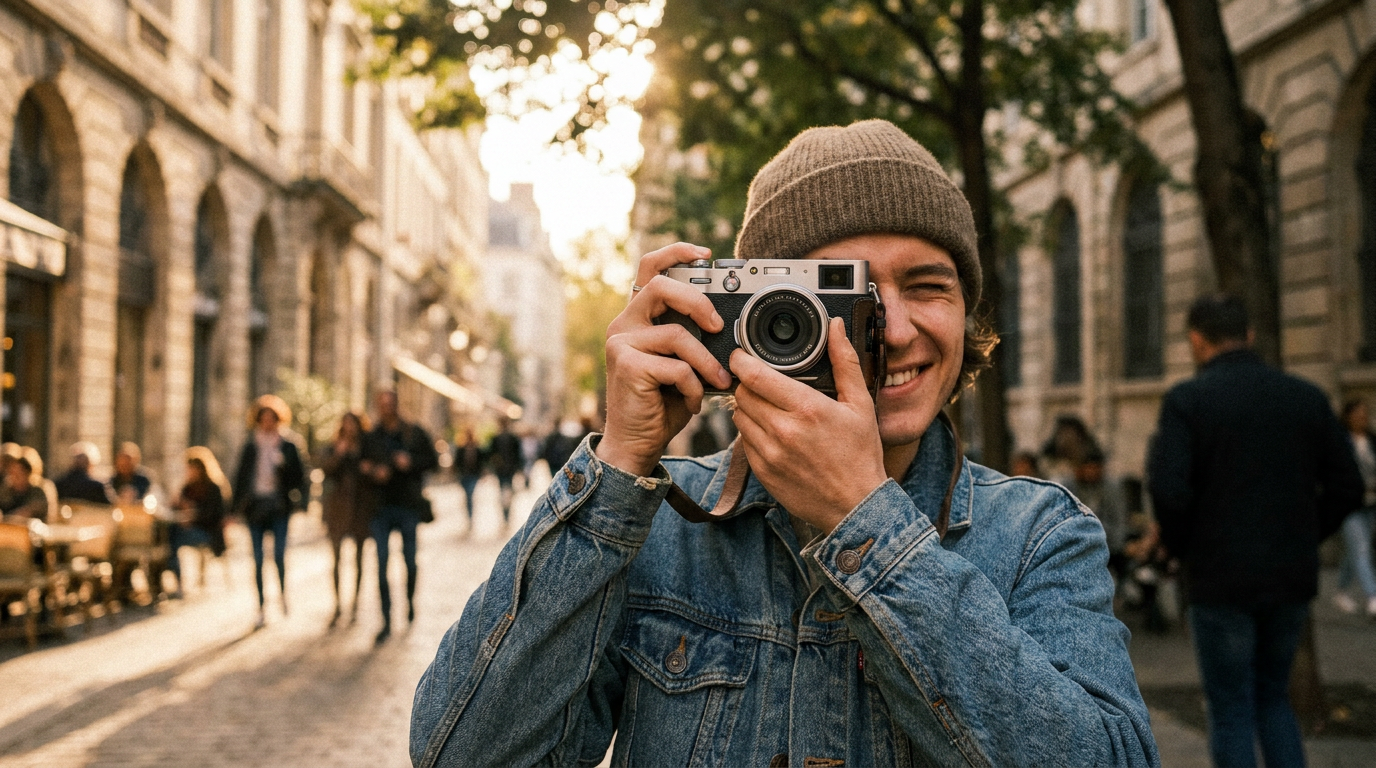
Beyond the sensor, the appeal lies heavily in the tactile experience. Modern premium compacts feature machined metal dials for shutter speed, aperture rings on the lens, and dedicated exposure compensation wheels. This physical engagement forces the user to slow down and think about the exposure triangle, transforming photography from a passive tap on a glass screen into an active, creative craft.[2][5][7]
Another major factor fueling this renaissance is the "Straight Out of Camera" (SOOC) movement. In previous decades, serious photographers shot in RAW formats and spent hours editing files in software like Adobe Lightroom. Today's creators, particularly Gen Z and Millennials, are rejecting that workflow. They want beautiful, distinct aesthetics instantly, without the burden of post-processing.[6][7]
Another major factor fueling this renaissance is the "Straight Out of Camera" (SOOC) movement.
Fujifilm has capitalized on this desire masterfully with its X100 series, currently led by the 40.2-megapixel X100VI. The camera features built-in "Film Simulations"—color profiles engineered from Fujifilm's decades of analog film manufacturing, such as Classic Chrome and Reala Ace. These profiles deliver rich, nostalgic JPEGs instantly, allowing users to share cinematic images directly from the camera to their phones.[2][6][7]

While Fujifilm dominates the retro aesthetic, Ricoh has cornered the market on stealth and portability with the GR IIIx and the newly anticipated GR IV. Stripped of a viewfinder and styled like a generic point-and-shoot, the GR series houses a massive APS-C sensor and a razor-sharp lens in a body that genuinely fits into a jeans pocket. It is the ultimate tool for street photographers who value one-handed operation and absolute discretion.[2][5][7]
For the hybrid creator focused heavily on video, the market offers a different flavor of compact. Models like the Sony ZV-1 II and the RX100 VII utilize 1-inch sensors paired with industry-leading autofocus tracking. These cameras cater to vloggers and travelers who need articulating screens, high-quality built-in microphones, and optical zoom capabilities that smartphones still struggle to match cleanly.[3][6][7]
At the absolute zenith of the market sits the luxury full-frame compact. Cameras like the Leica Q3 and Sony's recently revived RX1R III squeeze massive 60-megapixel full-frame sensors into relatively small chassis. These engineering marvels offer image quality that rivals professional studio setups, albeit at price points that cater strictly to dedicated enthusiasts and professionals.[4][7]

However, the premium compact lifestyle requires significant compromises. The most defining characteristic of these cameras—aside from the zoom-focused 1-inch models—is the fixed focal length lens. Whether it is a 28mm, 35mm, or 40mm equivalent, the lens cannot be changed or optically zoomed. Users must embrace the philosophy of "zooming with their feet," physically moving to frame their subjects.[1][5][7]
This limitation is exactly what computational optimists point to when defending the smartphone. A modern flagship phone offers an ultrawide lens, a standard wide, and a periscope telephoto lens all in a device less than a centimeter thick. For the average consumer capturing a child's soccer game from the bleachers, the sheer versatility of a smartphone is undeniably superior to a fixed-lens compact.[1][7]
There is also the undeniable friction of carrying and charging a second device. In an era of minimalist, frictionless technology, choosing to sling a metal camera over your shoulder or stuff it into a jacket pocket is an intentional burden. It requires a commitment to the craft that casual snapshot-takers may quickly abandon once the initial novelty wears off.[1][5][7]

Ultimately, the premium compact camera is not replacing the smartphone; it is serving a completely different emotional and creative need. While the smartphone is a utilitarian tool designed to document data seamlessly, the dedicated camera is an instrument designed to interpret light. In a world saturated with AI-generated perfection, the tactile, optical authenticity of a real camera has never been more valuable.[5][6][7]
How we got here
Early 2000s
Digital point-and-shoot cameras dominate the consumer market before the rise of the smartphone.
2010s
Smartphones decimate the budget compact camera market, forcing manufacturers to pivot to high-end, large-sensor models.
2020
Fujifilm launches the X100V, which eventually goes viral on social media, sparking the modern premium compact craze.
2024
Demand for the Ricoh GR III and Fujifilm X100VI reaches unprecedented levels, leading to global backorders and halted orders.
2025-2026
The premium compact market stabilizes as a luxury 'Everyday Carry' staple, with new full-frame entries pushing technological boundaries.
Viewpoints in depth
Tactile Purists
Photographers who value physical controls and the mindful separation of photography from smartphone distractions.
This camp argues that the medium shapes the art. By using a device that only takes photos, users are freed from the constant barrage of notifications and the temptation to immediately post to social media. They champion the physical engagement of turning dials and looking through optical viewfinders, asserting that this friction leads to more intentional, thoughtful composition rather than mindless snapping.
Computational Optimists
Tech enthusiasts who believe modern smartphones render dedicated compact cameras obsolete for most users.
This perspective highlights the sheer versatility of modern flagship phones. They argue that having an ultrawide, standard, and telephoto lens in a single, pocketable device that is always with you is far more practical than carrying a fixed-lens camera. They point to rapid advancements in AI processing, which can now simulate complex lighting and depth of field well enough to satisfy 99% of viewing environments, particularly on social media.
Hybrid Creators
Vloggers and content creators who prioritize video features, autofocus, and larger sensors over retro aesthetics.
For this group, the camera is a production tool. They gravitate toward 1-inch sensor compacts with articulating screens, built-in ND filters, and advanced microphone arrays. They acknowledge the convenience of smartphones but argue that dedicated cameras offer superior thermal management for long recording sessions, better low-light video performance, and professional-grade autofocus tracking that is crucial for solo content creation.
What we don't know
- Whether the current massive demand for retro compacts is a permanent market shift or a generational trend that will eventually cool.
- How quickly smartphone computational photography will improve to the point where it can flawlessly mimic large-sensor optics without visual artifacts.
Key terms
- Computational Photography
- The use of software algorithms and AI to enhance or artificially generate image qualities, such as depth of field or dynamic range, compensating for small physical sensors.
- APS-C Sensor
- A digital image sensor size (roughly 23.6 x 15.6mm) that is significantly larger than a smartphone sensor, offering professional-level light gathering and detail.
- Bokeh
- The aesthetic quality of the out-of-focus areas in an image, naturally produced by large sensors and wide lens apertures.
- Film Simulation
- In-camera color profiles designed to mimic the look, contrast, and grain of classic analog film stocks.
- Fixed-Lens Camera
- A camera with a permanently attached lens that cannot be swapped out, often featuring a single focal length with no optical zoom.
Frequently asked
Why are premium compact cameras so expensive?
They utilize large, professional-grade image sensors (like APS-C or Full-Frame) and high-quality glass optics packed into miniaturized bodies, which requires complex and costly engineering.
Can't my smartphone take the same quality photos?
Smartphones use software to simulate high-end photography. While they look great on small screens, dedicated cameras capture true optical light, resulting in better detail, natural background blur, and superior performance when printed or viewed on large monitors.
What does it mean to 'zoom with your feet'?
Because many premium compacts have a fixed focal length (no optical zoom), photographers must physically walk closer to or further from their subject to change the framing.
Are point-and-shoot cameras the same as premium compacts?
Traditional point-and-shoots had tiny sensors similar to modern phones. Premium compacts share the small form factor but house massive sensors equivalent to those found in professional mirrorless cameras.
Sources
Source coverage
7 outlets
5 viewpoints surfaced







[1]Digital Camera WorldComputational Optimists
Compact cameras are dead; long live the camera phone
Read on Digital Camera World →[2]PetaPixelTactile Purists
The GR III Is So Popular, Ricoh Can't Keep It in Stock
Read on PetaPixel →[3]Canon RumorsHybrid Creators
What Camera Should Beginners Buy Instead of a Smartphone?
Read on Canon Rumors →[4]PhototrendLuxury Enthusiasts
Sony RX1R III: The long-awaited full-frame compact camera
Read on Phototrend →[5]Reddit r/CamerasTactile Purists
Why buy a compact camera over a smartphone in 2026?
Read on Reddit r/Cameras →[6]YouTube Tech CreatorsHybrid Creators
Why Everyone is Buying Compact Cameras in 2026
Read on YouTube Tech Creators →[7]Factlen Editorial TeamMarket Analysts
Synthesis by Factlen editorial team
Read on Factlen Editorial Team →

More in shopping
See all 5 stories →

Every angle. Every day.
Get shopping stories with full source coverage and perspective breakdowns delivered to your inbox.