
How Major Faiths Are Rewriting the Rules of Climate Action Through Eco-Theology
Religious institutions worldwide are reinterpreting ancient texts to frame environmental stewardship as a moral imperative, mobilizing billions of believers to adopt green technologies and advocate for climate justice.
By Factlen Editorial Team
- Eco-Theologians & Clergy
- Argues that ancient scriptures mandate environmental stewardship and that ecological destruction is a moral failing.
- Grassroots Faith Activists
- Focuses on the practical implementation of green technologies and community-level climate resilience.
- Traditionalists
- Views extreme weather primarily through an eschatological lens, interpreting climate change as an inevitable sign of the end times.
What's not represented
- · Secular environmentalists skeptical of religious involvement
- · Fossil fuel industry representatives
Why this matters
By translating abstract climate science into deeply personal spiritual duties, the world's major religions are unlocking a massive new demographic for environmental action. This shift is moving billions of dollars in religious investments and transforming local places of worship into hubs for green technology.
Key points
- Major world religions are increasingly framing climate action as a moral and spiritual imperative.
- Morocco is retrofitting 15,000 state-owned mosques with solar panels to promote clean energy.
- Indonesia's Istiqlal Mosque became the world's first environmentally certified place of worship.
- Christian organizations are launching decade-long initiatives to electrify churches and divest from fossil fuels.
- Interfaith coalitions are uniting diverse religious leaders to advocate for global climate justice.
- Eco-theologians are actively working to counter apocalyptic fatalism that discourages environmental action.
For decades, the global climate movement has relied heavily on the language of science, policy, and economics to communicate the urgency of a warming planet. Charts detailing atmospheric carbon parts-per-million and treaties negotiated in sterile conference halls have formed the backbone of environmental advocacy. Yet, a profound shift is underway as the movement taps into a different, arguably more powerful reservoir of human motivation: faith. Across the globe, major world religions are rewriting the rules of climate action through a rapidly expanding framework known as eco-theology.[9]
Eco-theology is not a fringe movement; it is a fundamental reinterpretation of ancient scriptures to address modern ecological crises. It challenges the long-held anthropocentric view that humans have a divine mandate to dominate and exploit the Earth. Instead, religious scholars and clerics are emphasizing texts that demand stewardship, balance, and reverence for the natural world. By framing environmental degradation not just as a policy failure, but as a moral failing or even a sin, faith leaders are translating abstract climate data into deeply personal spiritual duties.[5][8][9]
The impact of this theological shift is highly visible in the Islamic world, where the concept of khalifah—humanity's role as stewards or caretakers of the Earth—is driving tangible infrastructure changes. Morocco has emerged as a pioneer with its ambitious "Green Mosques" program. The government has committed to retrofitting its 15,000 state-owned mosques with solar panels, LED lighting, and energy-efficient technologies. Because the payback period for solar investments in Morocco is typically less than five years, the initiative makes economic sense, but its primary goal is to use the mosque as a vehicle for environmental awareness, capturing the hearts and minds of congregants.[1][7]
This architectural and spiritual greening extends far beyond North Africa. In Indonesia, the world's largest Muslim-majority nation, the iconic Istiqlal Mosque in Jakarta recently became the first place of worship globally to receive environmental certification from the International Finance Corporation. The massive structure now features smart energy meters, solar panels, and a sophisticated water recycling system for ritual ablutions. Furthermore, research indicates that "green mosques" in Indonesia successfully engage over 70 percent of their congregations in community sustainability programs, such as tree planting and rainwater harvesting, proving that religious legitimacy is a powerful catalyst for collective action.[2][7]

Education is also being overhauled to reflect these values. Across Indonesia, a network of "Green Pesantren"—Islamic boarding schools—is integrating environmentalism directly into the curriculum. Students are taught that taking care of the environment is an act of worship, supported by fatwas (religious edicts) from Islamic authorities that explicitly prohibit activities that harm nature. To fund these broad initiatives, many Muslim-majority countries are increasingly utilizing Green Sukuk, which are Sharia-compliant financial instruments specifically designed to support eco-friendly projects.[2][5]
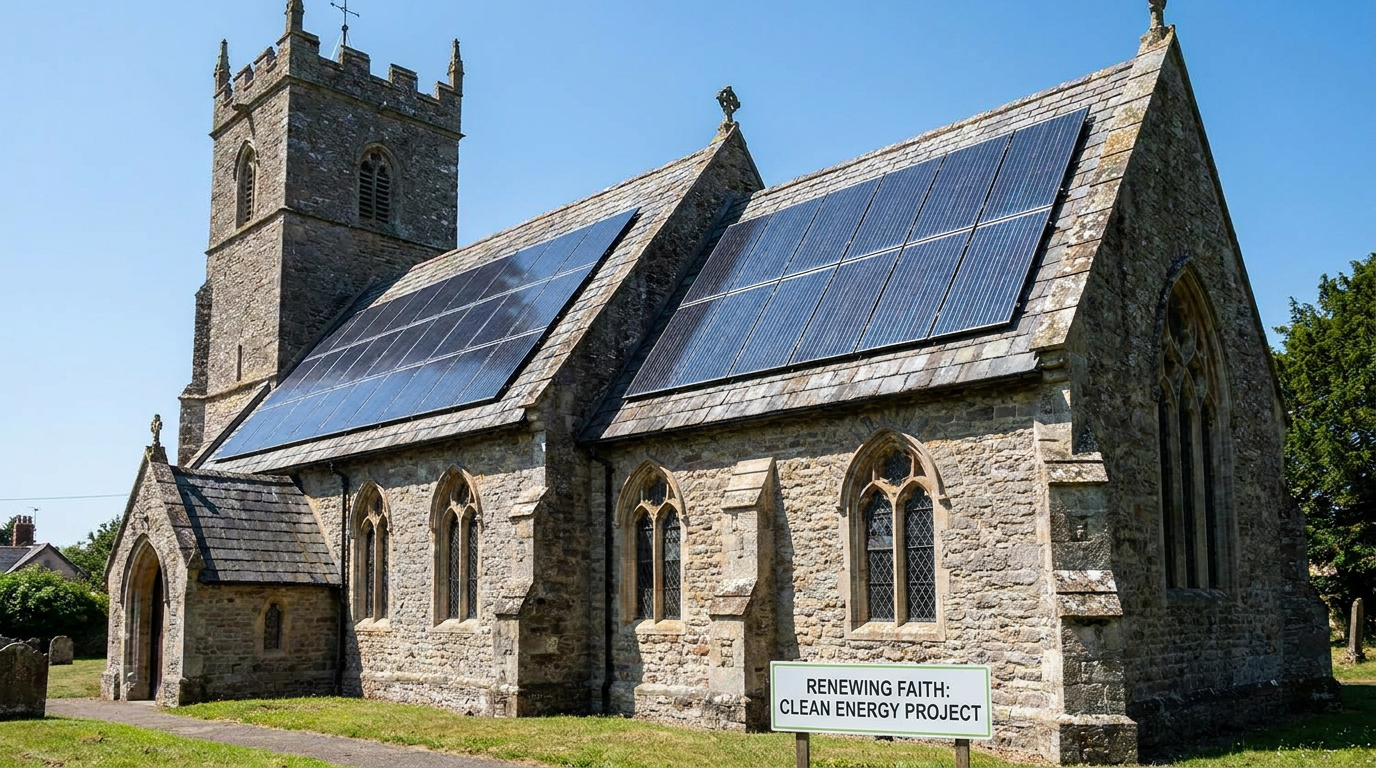
Parallel transformations are sweeping through Christian denominations. The World Council of Churches has officially designated 2025 to 2034 as the "Ecumenical Decade of Climate Action," providing thousands of congregations with resources for eco-theology, worship, and fossil fuel divestment campaigns. This top-down institutional support is matched by vibrant grassroots energy. In the United States, organizations like Interfaith Power & Light are mobilizing thousands of faith communities for their 2026 "Powered by Nature" initiative. The campaign frames the transition to renewable energy as both a practical necessity and a spiritual imperative, urging churches to install solar sanctuaries and electrify their buildings.[3][5]
Parallel transformations are sweeping through Christian denominations.
The theological framing in Christian circles often centers on "Creation Care," a movement that views the Earth as a sacred web of interdependent systems rather than a mere repository of resources to be extracted. By emphasizing that humans are not separate from nature, but rather formed from the Earth's elements, Christian eco-theologians are advocating for policies that prioritize the planet over profit. This perspective is increasingly echoed in sermons, where pastors are equipped with message-tested insights to weave environmental justice into their weekly preaching.[3][9]
Beyond the Abrahamic faiths, indigenous cosmologies and Eastern philosophies are contributing vital perspectives to the global eco-theological discourse. African Traditional Religions frequently view ecological degradation not just as physical damage, but as a severe rupture in the sacred relational order between the living, the ancestors, and the land. Similarly, Buddhist and Hindu eco-spiritualities emphasize the profound interdependence of all living creatures. In India, Dalit and Adivasi thinkers are developing alternative frameworks that explicitly link environmental preservation with caste justice, refusing to separate the health of the planet from the rights of its most marginalized inhabitants.[5][8]

Recognizing the universal nature of the climate threat, these diverse religious traditions are increasingly joining forces. The Global Interfaith Leaders Fellowship on Climate Change, a strategic partnership between Faith for Our Planet and Duke University's Divinity School, exemplifies this collaborative approach. The highly selective program trains emerging leaders from over twenty countries, bridging moral vision with practical community-level impact. By bringing together representatives from an extraordinary diversity of religious and indigenous traditions, the fellowship fosters alliances built around the shared conviction that climate change is the defining moral crisis of our time.[4]
This interfaith solidarity is also manifesting in large-scale public mobilizations. Organizations like GreenFaith are coordinating global events, such as the "Sun Day" mobilization scheduled for September 2025, which will see millions of people across various congregations raise their voices for a just energy transition. Similarly, the National Faith + Climate Forum in April 2026 is set to connect attendees across more than 80 local host locations nationwide. These gatherings provide the tools, inspiration, and community necessary for faith leaders to advocate effectively for clean air, clean water, and resilience strategies in their local neighborhoods.[6][9]
Despite these profound advancements, the intersection of religion and climate action is not without its challenges. One of the most significant hurdles is the persistence of apocalyptic fatalism. In many faith traditions, extreme weather events and ecological disasters are interpreted through an eschatological lens—viewed as inevitable signs of the "end times" rather than problems requiring human intervention. A 2024 survey in Indonesia, for instance, revealed that while a strong majority accepted the reality of climate change, nearly 58 percent also viewed it as a sign of the coming apocalypse.[5]

This fatalistic narrative can induce a paralyzing sense of inevitability, leading believers to conclude that human efforts to halt climate change are futile or even contrary to divine will. Furthermore, in some regions, prosperity-driven teachings and literalist scriptural readings continue to prioritize immediate economic gain over long-term ecological sustainability. Bridging the gap between high-level theological environmental ethics and the everyday beliefs of local congregations remains a critical task for the eco-theology movement.[5][8]
To combat this, religious scholars are actively reclaiming concepts of trust and divine will. They argue that true faith requires humans to take responsible action first, rather than passively awaiting divine intervention. By debunking viral falsehoods and challenging fatalism from within the faith itself, these leaders are proving that religion is not inherently an obstacle to environmentalism. Instead, when properly mobilized, the moral capital of the world's religions offers a uniquely potent antidote to climate despair, transforming the fight for a livable planet into a sacred, unifying duty.[5][9]
How we got here
2008
The Mosque Foundation in Illinois becomes the first US mosque to go green by installing solar panels.
2015
The Islamic Declaration on Climate Change is signed by over 60 Muslim leaders, calling for urgent environmental action.
2016
Morocco launches an ambitious initiative to retrofit 15,000 state-owned mosques with solar power.
2022
Indonesia's Istiqlal Mosque becomes the world's first place of worship to be environmentally certified by the International Finance Corporation.
2025
The World Council of Churches officially launches the Ecumenical Decade of Climate Action.
2026
Interfaith Power & Light launches the 'Powered by Nature' campaign to electrify faith communities across the US.
Viewpoints in depth
Eco-Theologians' view
Emphasizes the moral imperative of stewardship found in ancient scriptures.
Eco-theologians argue that the historical interpretation of human 'dominion' over the Earth has been fundamentally misunderstood, leading to centuries of ecological exploitation. By returning to the original texts, they highlight concepts like stewardship, balance, and the sacredness of creation. In this view, protecting the environment is not a secular political issue, but a core tenet of religious obedience and a necessary expression of love for the Creator and one's neighbors.
Grassroots Activists' view
Focuses on translating theological principles into tangible community action.
For grassroots faith activists, theology must be paired with immediate, practical implementation. This camp prioritizes retrofitting places of worship with solar panels, establishing community gardens, and organizing divestment campaigns to pull religious funds out of the fossil fuel industry. They view the local church, mosque, or temple as the ideal hub for modeling sustainable living, arguing that visible, community-centered action is the most effective way to inspire broader societal change.
Traditionalists' view
Interprets ecological changes primarily as inevitable signs of the end times.
A significant portion of believers in various traditions view climate change through an eschatological or apocalyptic lens. From this perspective, extreme weather events and environmental degradation are seen as prophesied signs of the end times rather than problems that humans can or should attempt to solve. This fatalistic interpretation often leads to skepticism regarding climate interventions, as traditionalists may feel that attempting to halt these changes is either futile or contrary to a preordained divine plan.
What we don't know
- Whether the push for eco-theology will successfully overcome deeply entrenched apocalyptic fatalism in more conservative congregations.
- The total financial impact of religious institutions divesting from fossil fuels globally over the next decade.
Key terms
- Eco-theology
- A form of constructive theology that focuses on the interrelationships of religion and nature, framing environmental protection as a spiritual duty.
- Khalifah
- An Islamic concept translating to 'steward' or 'vicegerent,' emphasizing humanity's God-given responsibility to care for the Earth.
- Green Sukuk
- Sharia-compliant financial bonds used specifically to fund environmentally sustainable and climate-resilient projects.
- Creation Care
- A Christian framework that views environmental protection as a biblical mandate to steward and protect God's creation.
Frequently asked
What exactly is a 'green mosque'?
A green mosque integrates sustainable practices into its operations, such as installing solar panels, utilizing water recycling systems for ritual ablutions, and actively teaching environmentalism to its congregation.
How does religion influence climate fatalism?
In some religious traditions, extreme weather and ecological disasters are interpreted as inevitable signs of the apocalypse, which can discourage believers from taking proactive steps to halt climate change.
Are different religions working together on climate action?
Yes. Numerous interfaith coalitions, such as the Global Interfaith Leaders Fellowship and GreenFaith, mobilize diverse religious groups to advocate collectively for clean energy and climate justice.
Sources
Source coverage
9 outlets
3 viewpoints surfaced








[1]The WorldGrassroots Faith Activists
Morocco wants 15,000 of its mosques to run on solar power
Read on The World →[2]Interfaith ClimateGrassroots Faith Activists
Green Islam: Environmentalism in Indonesia and Beyond
Read on Interfaith Climate →[3]Interfaith Power & LightGrassroots Faith Activists
Faith Climate Action Week 2026: Powered by Nature
Read on Interfaith Power & Light →[4]Faith for Our PlanetGrassroots Faith Activists
Global Interfaith Leaders Fellowship on Climate Change
Read on Faith for Our Planet →[5]The New Global OrderEco-Theologians & Clergy
Faith, fate, and the climate crisis: how religion shapes climate action
Read on The New Global Order →[6]GreenFaithGrassroots Faith Activists
Sun Day: A National Mobilization for Climate Justice
Read on GreenFaith →[7]ResearchGateGrassroots Faith Activists
Green Mosques: Encouraging Environmental Stewardship and Sustainable Development
Read on ResearchGate →[8]IMPACT International JournalsEco-Theologians & Clergy
Religion and Climate Justice: An Eco-Theological Analysis
Read on IMPACT International Journals →[9]Factlen Editorial TeamEco-Theologians & Clergy
Synthesis by Factlen editorial team
Read on Factlen Editorial Team →
Every angle. Every day.
Get culture stories with full source coverage and perspective breakdowns delivered to your inbox.