
Germany's 2026 World Cup Tactical Blueprint: Inside Julian Nagelsmann's 'Double Diamond' System
After consecutive early exits, Germany has embraced a fluid, high-pressing tactical identity under Julian Nagelsmann. Driven by the dual creativity of Jamal Musiala and Florian Wirtz, the system relies on narrow attacking overloads but leaves calculated vulnerabilities to the counter-attack.
By Factlen Editorial Team
- Tactical Analysts
- Focuses on the geometric structure and narrow overloads that define Nagelsmann's system.
- German Supporters
- Balances excitement over dynamic attacking play with anxiety over recent tournament failures.
- Opposing Managers
- Looks to exploit the structural vulnerabilities on the flanks by absorbing central pressure.
What's not represented
- · Traditional target-man strikers
- · Defensive purists
Why this matters
For a footballing giant desperate to restore its prestige, Nagelsmann's complex tactical gamble will define whether Germany reclaims its elite status or suffers another early tournament collapse. Understanding this system reveals exactly how the modern international game is evolving toward fluid, position-less attacking.
Key points
- Julian Nagelsmann has rebuilt Germany's tactical identity following consecutive World Cup group-stage exits.
- The team utilizes a fluid 4-2-3-1 that shifts into a 'double diamond' to overload central areas in possession.
- Joshua Kimmich plays a crucial role as an inverted right-back, tucking into midfield to dictate tempo.
- Florian Wirtz and Jamal Musiala operate in narrow central channels to disrupt opposing defensive blocks.
- A remarkably high defensive line leaves Germany vulnerable to rapid counter-attacks on the flanks.
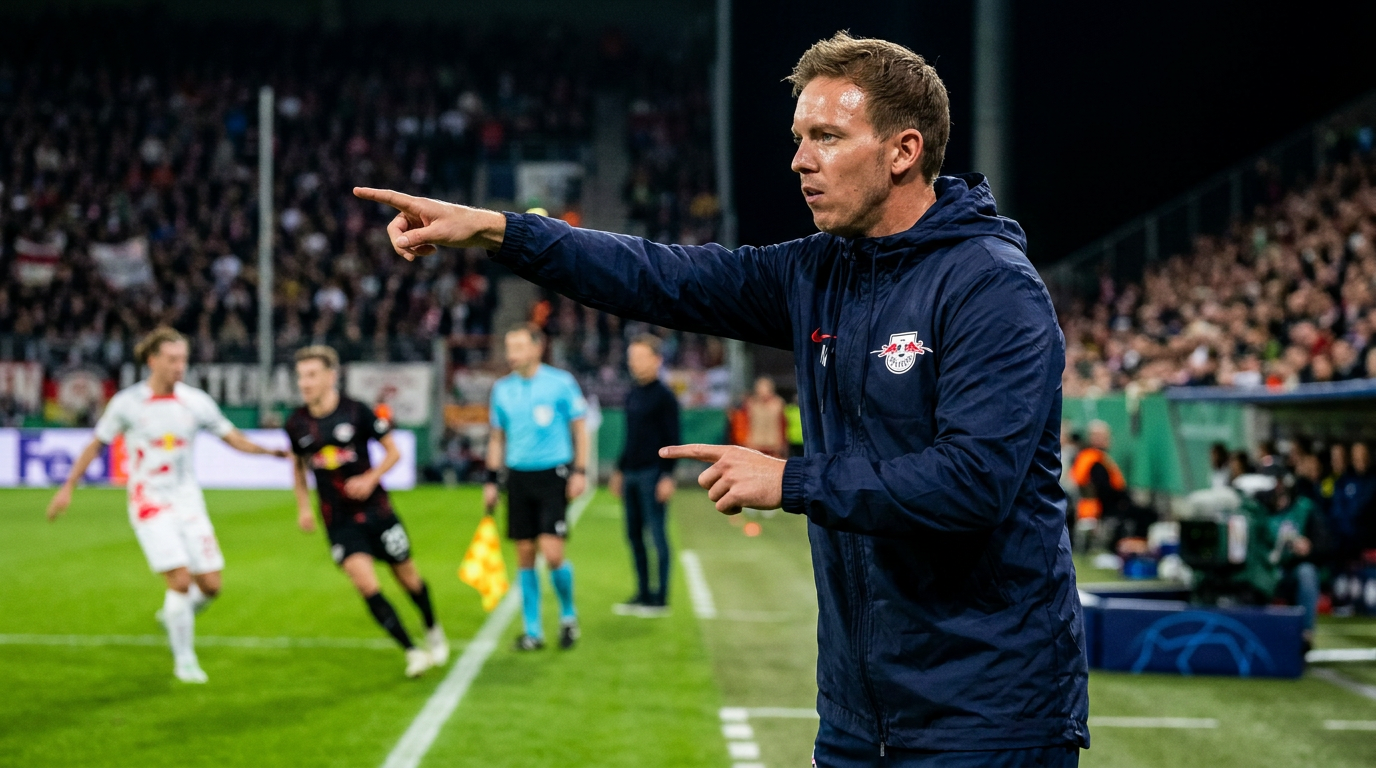
For a footballing nation accustomed to deep tournament runs, the 2018 and 2022 World Cups were a trauma. Consecutive group-stage exits left Germany searching for an identity, trapped between outdated possession dogmatism and a vulnerability to rapid counter-attacks. As the 2026 FIFA World Cup kicks off across North America, manager Julian Nagelsmann has completely overhauled the team's tactical blueprint. Tasked with restoring Die Mannschaft to the global elite, the 38-year-old coach has implemented a highly fluid, aggressive system that prioritizes spatial manipulation over rigid formations. Rather than overpowering opponents through sheer physical dominance, Nagelsmann's setup operates as an intellectual, geometric network designed to suffocate central channels and lock opponents into hyper-specific pressing traps.[3][4][6][7]
On paper, Germany lines up in a standard 4-2-3-1 formation, but that shape collapses the moment they win possession. Nagelsmann's approach is built around a "double diamond" structure that constantly asks questions of opposing defensive blocks. The base of this system relies on the center-back pairing of Jonathan Tah and Nico Schlotterbeck, supported by Aleksandar Pavlovic operating as a deep-lying playmaker. This foundation allows the rest of the team to push aggressively forward, creating a massive front four designed to pin the opposition deep in their own half. By consistently looking to receive the ball between the opposition's defensive units, the German attackers force the defensive block to move vertically, stretching the distances between the midfield and the back line.[2][3][4][5]

The key to Germany's build-up phase is the reinvention of Joshua Kimmich. Officially deployed as a right-back, Kimmich rarely stays on the flank. Instead, he tucks inside to act as an inverted full-back, dictating the tempo alongside Pavlovic and providing a defensive shield against transitions. This movement allows left-back David Raum to push high up the pitch, effectively transforming the back line into a temporary back three and creating wide overloads on the left side. Kimmich's central positioning ensures that Germany maintains a numerical advantage in the midfield, allowing them to patiently circulate the ball until a vertical passing lane opens up into the attacking third.[2][4][5]
Further up the pitch, the system is explicitly designed to maximize the generational talents of Florian Wirtz and Jamal Musiala. Rather than using the full width of the pitch, Germany prefers "narrow-lane finishing," clustering their attacking midfielders in the central channels. Wirtz frequently drifts in from the left to act as a primary playmaker, using his open body orientation to slide through-balls behind the defensive line. Musiala, meanwhile, operates in the tightest spaces between the lines, using his elite close control to disrupt crowded penalty areas. These "yo-yo movements"—dropping deep to receive the ball and immediately spinning to attack the space—make it nearly impossible for opposing defenders to maintain a strict marking scheme.[1][3][5][6]

Further up the pitch, the system is explicitly designed to maximize the generational talents of Florian Wirtz and Jamal Musiala.
This narrow attacking focus requires a unique profile at center-forward. Instead of a traditional target man waiting in the box, Kai Havertz operates as a highly mobile false nine. Havertz frequently drops into midfield or drifts into the channels between opposing center-backs and full-backs. By dragging defenders out of position, he creates the exact pockets of space that Wirtz and Musiala need to operate. When a more direct, physical presence is required to break down a stubborn low block, Nagelsmann can turn to Deniz Undav, who offers a clinical alternative off the bench and a more traditional penalty-box threat.[1][2][5]
Without the ball, Germany is equally aggressive. Nagelsmann has instituted a high-intensity pressing system that begins from the opponent's goal kicks. Rather than pressing the center-backs directly, the German front line overloads the central spaces, intentionally leaving the flanks open to force the opposition into playing predictable long balls. Tah and Schlotterbeck hold a remarkably high defensive line, squeezing the pitch and allowing the midfield double-pivot to aggressively contest the resulting second balls. This proactive defending aims to win the ball back as close to the opponent's goal as possible, immediately launching rapid transitions before the defense can reset.[5][7]

However, this high-wire act is not without its flaws. The heavy reliance on a narrow shape and a remarkably high defensive line leaves structural gaps on the flanks. Opponents utilizing low blocks and rapid counter-attacks have found success exploiting the massive spaces left behind by Raum and Kimmich when they push forward. During the qualifying campaign, a 2-0 defeat to Slovakia highlighted exactly how vulnerable Germany can be during defensive transitions if their initial counter-press is bypassed. If the midfield pivot fails to win the second ball, the center-backs are often left exposed in isolated one-on-one situations.[1][3][6]
As Germany navigates Group E alongside Curaçao, Ivory Coast, and Ecuador, these tactical mechanisms will be rigorously tested. The opening fixtures offer an opportunity for Nagelsmann to refine his complex system against varied defensive setups, building momentum for the knockout stages. The ultimate success of this campaign hinges on balance. If the Bayern Munich-heavy core can maintain its structural discipline while unleashing the unpredictable creativity of Wirtz and Musiala, Germany possesses the tactical sophistication required for a deep World Cup run. For a nation desperate to erase the memories of 2018 and 2022, Nagelsmann's bold gamble represents their best chance at redemption.[1][3][4][7]
How we got here
June 2018
Germany suffers a shocking group-stage elimination at the World Cup in Russia, finishing bottom of their group.
December 2022
A second consecutive World Cup group-stage exit in Qatar prompts a crisis in German football.
September 2023
Julian Nagelsmann is appointed manager, tasked with overhauling the team's tactical identity.
June 2026
Germany opens their 2026 World Cup campaign in North America, debuting Nagelsmann's fluid 'double diamond' system.
Viewpoints in depth
Tactical Analysts
Focuses on the geometric structure and narrow overloads that define Nagelsmann's system.
Tactical purists view Germany's 2026 setup as a masterclass in spatial manipulation. Analysts highlight the "double diamond" structure and the use of inverted full-backs as cutting-edge solutions to break down modern low blocks. By clustering elite playmakers like Musiala and Wirtz in the central half-spaces, Germany forces opponents to collapse their defensive width, which in turn opens up passing lanes. The system is praised for its intellectual rigor, prioritizing fluid movement and numerical superiority over rigid positional play.
German Supporters
Balances excitement over dynamic attacking play with anxiety over recent tournament failures.
For the German fanbase, the current tactical setup inspires a mix of immense hope and lingering dread. The attacking fluidity shown during qualifying and the 2024 Euros is a welcome departure from the stagnant possession football that plagued the team in 2018 and 2022. However, supporters remain acutely aware of the team's fragility on the counter-attack. Every time an opponent launches a long ball over the high defensive line, fans hold their breath, knowing that a single structural lapse could lead to another humiliating early exit.
Opposing Managers
Looks to exploit the structural vulnerabilities on the flanks by absorbing central pressure.
Rival coaches in Group E and beyond are meticulously studying the gaps left by Germany's aggressive posture. The blueprint to beat Nagelsmann's side relies on conceding possession, maintaining a disciplined low block, and waiting for the German full-backs to overcommit. Opposing managers aim to bypass the initial counter-press with direct, vertical passes into the wide channels, forcing center-backs Jonathan Tah and Nico Schlotterbeck into uncomfortable footraces. The goal is to turn Germany's greatest strength—their overwhelming attacking numbers—into a fatal defensive liability.
What we don't know
- Whether Germany's high defensive line can withstand the pace of elite counter-attacking teams in the knockout stages.
- If Kai Havertz can consistently provide the necessary goalscoring output as a false nine against top-tier center-backs.
Key terms
- Double Diamond
- A tactical shape in possession featuring a diamond structure in the build-up phase and another in the attacking phase, designed to create vertical passing lanes.
- Inverted Full-back
- A defender who, instead of staying wide on the flank, moves into the central midfield when their team has the ball to help control possession.
- False Nine
- A center-forward who frequently drops deep into midfield to link play and drag opposing defenders out of position, rather than staying near the penalty box.
- Half-spaces
- The vertical channels on the pitch between the center and the wide areas, often exploited by attacking midfielders to create scoring opportunities.
Frequently asked
What formation does Germany play under Julian Nagelsmann?
Germany typically starts in a 4-2-3-1, but the shape fluidly shifts into a 3-4-3 or a "double diamond" in possession, with full-backs pushing high or tucking into midfield.
Who are the key playmakers in the German squad?
The attack is driven by the dual creativity of Jamal Musiala and Florian Wirtz, who operate in the central half-spaces to break down defenses.
What is Germany's biggest tactical weakness?
Because they commit so many players forward into narrow central areas, Germany is vulnerable to rapid counter-attacks in the wide spaces left behind their full-backs.
Sources
Source coverage
7 outlets
3 viewpoints surfaced







[1]The GuardianOpposing Managers
Germany: Group E fixtures and tactical plan
Read on The Guardian →[2]SquawkaTactical Analysts
Germany analysis: Julian Nagelsmann's double diamond tactics
Read on Squawka →[3]World Soccer TalkOpposing Managers
Germany World Cup 2026 team preview
Read on World Soccer Talk →[4]Get Football News GermanyGerman Supporters
Julian Nagelsmann's Germany: The Tactical Rebuild Heading Into the 2026 World Cup
Read on Get Football News Germany →[5]Hooligan SoccerTactical Analysts
Germany Tactical Analysis: 8 Characteristics
Read on Hooligan Soccer →[6]Vietnam.vnOpposing Managers
Analysis of Germany at the 2026 World Cup: Pressure on Wirtz and Musiala
Read on Vietnam.vn →[7]BeehiivTactical Analysts
Julian Nagelsmann Tactics At Germany 2026: Spatial Manipulation & The Blueprint For A Deep Run
Read on Beehiiv →
More in sports
See all 11 stories →Injury
Orlando Pride and Zambia Receive Major Boost as Barbra Banda's Injury Deemed Minor
0 sources

Hockey Strategy
How the PWHL's Innovative Rules Are Revolutionizing Hockey Strategy
0 sources
Youth Sports
Global 'Silent Sidelines' Movement Transforms Youth Soccer, Drastically Reducing Referee Abuse
0 sources
Standings
NWSL Mid-Season Standings: San Diego Wave Cling to Top Spot in League's Tightest Race Yet
0 sources

Every angle. Every day.
Get sports stories with full source coverage and perspective breakdowns delivered to your inbox.