
2026 Rivian R2 vs. Tesla Model Y: The Mid-Size Electric SUV Showdown
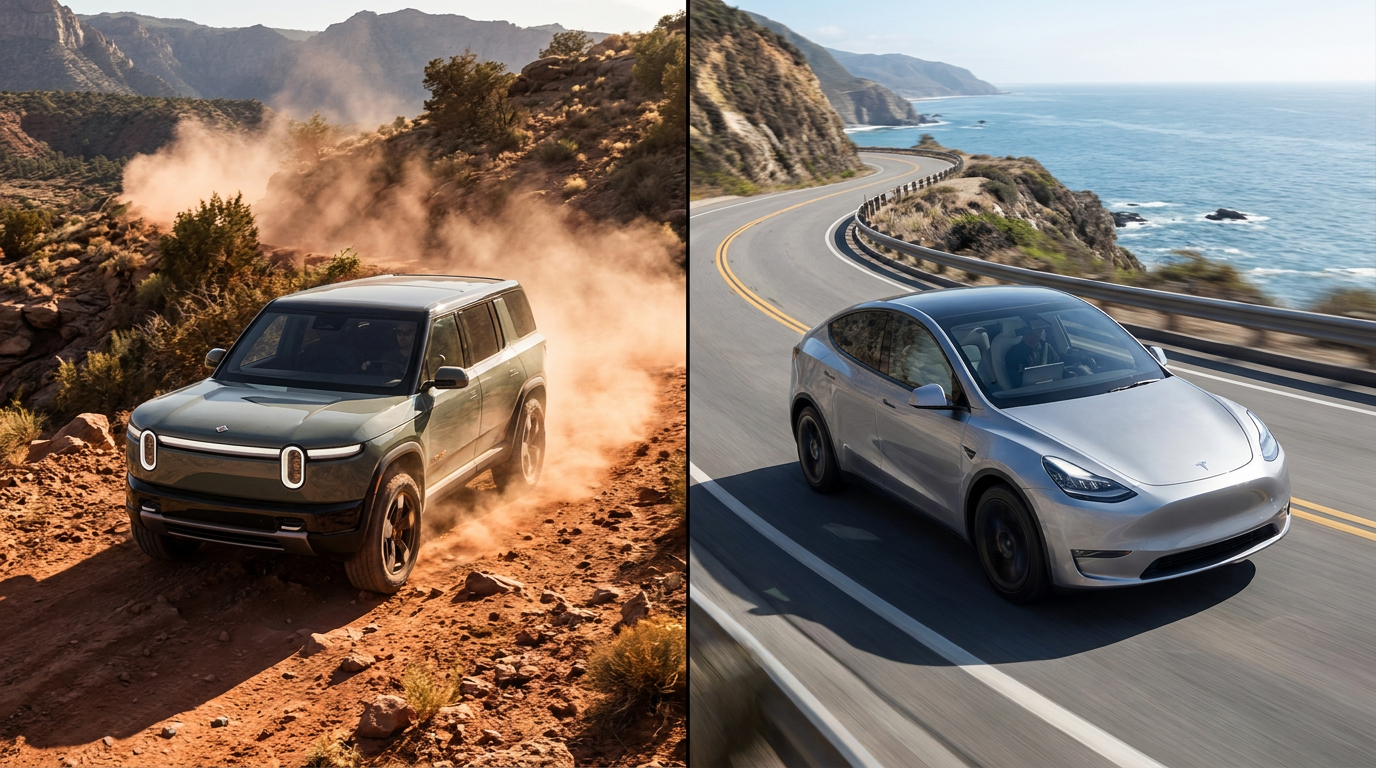
Rivian's highly anticipated R2 has arrived to challenge the Tesla Model Y, offering a rugged, boxy alternative to the world's best-selling electric crossover. While the Model Y retains its crown for on-road agility, the R2 matches its efficiency while delivering superior cargo space and off-road capability.
By Factlen Editorial Team
- Utility & Adventure Buyers
- Prioritizes cargo capacity, off-road capability, and rugged design over aerodynamic efficiency.
- Efficiency & Commuter Advocates
- Values proven software, on-road handling, and aerodynamic efficiency for daily driving.
- Neutral Market Analysts
- Evaluates the vehicles strictly on price-to-performance ratios, range metrics, and market impact.
What's not represented
- · Traditional legacy automakers losing market share to both pure-EV brands
- · Budget-conscious buyers waiting for the $45,000 base models to arrive in 2027
Why this matters
The mid-size SUV segment is the most popular vehicle category in the world. For years, the Tesla Model Y has been the default electric choice, but the arrival of a genuinely competitive, similarly priced alternative forces buyers to finally choose between two distinct automotive philosophies: aerodynamic street performance or rugged outdoor utility.
Key points
- The Rivian R2 officially launched in June 2026, directly challenging the Tesla Model Y.
- Both performance models start around $57,500 and share an identical 105 MPGe efficiency rating.
- The R2 edges out the Model Y in range, offering 330 miles compared to Tesla's 306 miles.
- Rivian prioritizes off-road capability with 9.6 inches of clearance and a boxy, cargo-heavy design.
- Tesla maintains its advantage in on-road handling, acceleration, and a proven software ecosystem.
- Both vehicles natively use the NACS port, granting equal access to the Supercharger network.
The mid-size electric SUV market has officially entered a new era of genuine competition. For years, the Tesla Model Y has dominated the segment, ultimately becoming the world's best-selling vehicle by offering a compelling mix of range, software, and charging convenience. But as of June 2026, Rivian has launched the R2, a highly anticipated vehicle designed specifically to challenge Tesla's supremacy. This is no longer a hypothetical matchup; the R2 is on the road, forcing buyers to make a difficult choice between two highly capable but philosophically opposed electric vehicles.[1][5]
The fundamental difference between the two vehicles lies in their design philosophies and intended use cases. The Tesla Model Y is essentially a raised, aerodynamic hatchback, engineered to slice through the air with minimal resistance and prioritize street performance. In contrast, the Rivian R2 embraces the traditional, two-box silhouette of a classic SUV. It is built for utility, presence, and outdoor adventure, bringing the rugged character of Rivian's larger R1S into a more compact, mass-market footprint.[2][5]
When looking at their physical footprints, the two vehicles take different approaches to the mid-size segment. The Rivian R2 is roughly three inches shorter in overall length than the Model Y, which makes it slightly easier to maneuver into tight urban parking spaces. However, the R2 is also about three inches taller and features a boxier greenhouse. This upright stance gives the Rivian a more commanding presence on the road, while the Tesla relies on its sleek, teardrop profile to maximize aerodynamic efficiency.[2][4]
Ground clearance is where the design priorities become starkly visible. The Tesla Model Y sits at a modest 6.0 to 6.6 inches off the ground, depending on the trim, which contributes to its planted, sports-sedan-like handling on twisty roads. The Rivian R2, meanwhile, boasts a towering 9.6 inches of ground clearance. Combined with aggressive 25-degree approach and 26-degree departure angles, the R2 is engineered to tackle rocky trails and muddy ruts that would easily strand the street-focused Tesla.[1][6]

Despite its boxy shape and off-road hardware, the Rivian R2 delivers a massive surprise in efficiency testing. According to recent EPA ratings, the R2 Performance with 21-inch all-season tires achieves 105 MPGe combined, consuming 32 kilowatt-hours per 100 miles. Astonishingly, this exactly matches the efficiency of the 2026 Tesla Model Y Performance. Achieving aerodynamic parity with a Tesla while pushing a taller, flatter front end through the air is a major engineering triumph for Rivian.[1]
Because the R2 matches the Model Y's efficiency but carries a slightly larger 86.8-kilowatt-hour battery pack, it actually wins the range battle. The R2 Performance delivers an EPA-estimated 330 miles on a full charge, edging out the Model Y Performance's 306 miles. While equipping the Rivian with knobby all-terrain tires drops its range to 307 miles, it still manages to stay neck-and-neck with Tesla's top-tier crossover, eliminating range anxiety as a deciding factor between the two.[1][3]
In terms of straight-line acceleration, both vehicles offer supercar-level thrust that belies their family-hauler status. The Tesla Model Y Performance remains the undisputed king of the drag strip, rocketing from zero to 60 miles per hour in a blistering 3.3 seconds. The Rivian R2 Performance is only a fraction of a second behind, completing the same sprint in 3.6 seconds. For the vast majority of drivers, the difference is imperceptible, with both SUVs delivering the instant, pin-you-to-the-seat torque that electric vehicles are famous for.[6]

Interior cargo capacity is a major battleground, and the Rivian's boxy shape pays massive dividends here. The R2 offers a cavernous 90.1 cubic feet of total storage space when the rear seats are folded down. Furthermore, both the front driver and passenger seats can fold completely flat, transforming the cabin into a makeshift camper or allowing owners to haul exceptionally long items like surfboards or lumber. The Model Y maxes out at 76 cubic feet, and its sloping roofline cuts into the vertical space available for bulky cargo.[3][4]
Interior cargo capacity is a major battleground, and the Rivian's boxy shape pays massive dividends here.
Storage advantages extend to the front trunk, or frunk. Rivian optimized its packaging to provide 5.2 cubic feet of space under the hood, easily accommodating a couple of carry-on suitcases or a large grocery haul. The Tesla Model Y features a respectable 4.1-cubic-foot frunk, but the Rivian's wider opening and lower lift-over height make it slightly more practical. Inside the cabin, the R2 features dual gloveboxes and large door pockets, directly addressing long-standing complaints about the Model Y's minimalist storage options.[2][3]
Cabin technology and user interface highlight another philosophical split. Tesla recently refreshed the Model Y, refining its ultra-minimalist aesthetic by removing physical turn signal stalks and routing almost all controls through a massive 16-inch central touchscreen. It also added an 8-inch rear display for passengers. Rivian takes a slightly more tactile approach; while it also relies heavily on a central screen, the R2 retains a dedicated digital instrument cluster behind the steering wheel and features large haptic scroll wheels to help drivers navigate menus without taking their eyes off the road.[2]

Driver assistance systems are a key selling point for both brands. Tesla continues to iterate on its vision-only Full Self-Driving system, which relies entirely on cameras and neural networks to navigate complex city streets and highways. Rivian's Autonomy+ suite takes a different hardware approach, incorporating a mix of cameras, radar, and a lidar unit. Rivian aims to eventually offer hands-off, eyes-off driving capabilities on the highway, setting up a long-term software race against Tesla's established autonomous driving efforts.[2][5]
Historically, Tesla held a massive advantage in charging infrastructure, but the 2026 landscape has leveled the playing field. The Rivian R2 is built natively with the North American Charging Standard port, meaning it can plug directly into Tesla's vast Supercharger network without the need for a bulky adapter. Both vehicles can charge from 10 percent to 80 percent in roughly 30 minutes, making cross-country road trips equally viable regardless of which badge is on the steering wheel.[2][5]
Pricing for the top-tier trims puts these two vehicles in a dead heat. The Rivian R2 Performance Launch Edition carries a sticker price of $57,990, while the Tesla Model Y Performance sits just below it at $57,490. Both automakers plan to roll out more affordable rear-wheel-drive variants priced around the $45,000 mark in the coming months. Because the financial barrier to entry is nearly identical, buyers are forced to make their decision based entirely on lifestyle fit and driving preferences.[1][4]
The case for the Tesla Model Y centers on its proven track record, unmatched on-road agility, and hyper-efficient highway cruising. The evidence lies in its lower weight, sports-sedan handling dynamics, and a software ecosystem that has been refined over millions of miles. It remains the benchmark for buyers who want a seamless, tech-forward daily commuter that corners beautifully and benefits from a ubiquitous, battle-tested service network.[2][4]
The case against the Tesla Model Y focuses on its lack of true utility for rugged environments and its polarizing cabin design. The removal of physical stalks frustrates some traditional drivers, and its 6.0-inch ground clearance makes it entirely unsuitable for serious off-road trails. Furthermore, as the world's best-selling car, it suffers from visual ubiquity; it no longer turns heads or makes a unique statement in the grocery store parking lot.[2][6]
The case for the Rivian R2 rests on its superior cargo flexibility, genuine off-road capability, and a more traditional, rugged aesthetic. The evidence is found in its towering 9.6-inch clearance, 90.1 cubic feet of total storage, fold-flat front seats, and dedicated all-terrain drive modes. It is a vehicle designed from the ground up to support outdoor hobbies, camping trips, and hauling heavy gear without breaking a sweat.[3][4]

The case against the Rivian R2 highlights its physical bulk and the realities of buying from a younger automaker. It carries a nearly 800-pound weight penalty compared to the Tesla, which makes it feel less nimble and more ponderous on twisty pavement. Additionally, while Rivian is expanding rapidly, its physical service center footprint is still smaller than Tesla's, which could mean longer wait times for specialized repairs in certain regions.[1][5]
Ultimately, the Tesla Model Y fits well when buyers prioritize daily commuting efficiency, canyon-carving handling, and a proven, minimalist tech ecosystem. It is the ideal choice for urban and suburban drivers who want a sporty, reliable electric crossover and rarely venture beyond a well-graded dirt road. It does not fit when owners need to navigate rocky trails, haul oversized camping gear, or desire a commanding, truck-like driving position.[2][5]
Conversely, the Rivian R2 fits well when drivers want a true adventure vehicle, maximum interior cargo space, and a rugged aesthetic that stands out from the crowd. It is the perfect tool for weekend warriors who need to sleep in their vehicle, tackle muddy inclines, or pack a family's worth of outdoor gear. It does not fit when the primary goal is track-level cornering, maximum agility in tight spaces, or the absolute lowest energy consumption in stop-and-go city traffic.[3][6]
How we got here
March 2024
Rivian officially unveils the R2 prototype, announcing its target price and dimensions.
May 2026
The EPA publishes official range and efficiency ratings for the R2 Performance, confirming it matches the Model Y in efficiency.
June 2026
Rivian begins customer deliveries of the R2 Performance Launch Edition, officially entering the mass-market mid-size SUV segment.
Viewpoints in depth
The Adventure Perspective
Focuses on the vehicle as a tool for outdoor exploration and gear hauling.
For outdoor enthusiasts, the EV transition has been frustratingly focused on sleek, street-bound crossovers. This camp views the Rivian R2 as a necessary course correction. By prioritizing ground clearance, a flat roofline for mounting tents, and an interior that can literally be hosed out or slept in, they argue the R2 is the first mid-size EV that truly replaces a traditional gas-powered utility vehicle. To them, the Model Y's aerodynamic teardrop shape is a liability that compromises vertical cargo space and off-road geometry.
The Commuter Perspective
Prioritizes daily driving dynamics, software reliability, and aerodynamic efficiency.
Drivers who spend 99 percent of their time on paved roads view the EV landscape differently. This camp argues that the Tesla Model Y's sports-sedan handling, lower center of gravity, and ultra-minimalist cabin make it the superior daily driver. They point out that carrying around the aerodynamic penalty of a boxy SUV frame and the unsprung weight of all-terrain tires makes little sense for highway commuting. For these buyers, Tesla's proven software ecosystem and unmatched on-road agility outweigh the hypothetical need to traverse a rocky trail.
What we don't know
- How Rivian's service center network will handle the massive influx of new R2 owners compared to Tesla's established infrastructure.
- Whether Rivian's Autonomy+ system will successfully achieve hands-off, eyes-off driving before Tesla's Full Self-Driving system.
- The exact delivery timelines and final specifications for the $45,000 base models of the R2 slated for 2027.
Key terms
- MPGe
- Miles Per Gallon Equivalent, a metric used by the EPA to compare the energy efficiency of electric vehicles to traditional gas-powered cars.
- NACS
- North American Charging Standard, the charging plug design originally developed by Tesla that has now been adopted by most major automakers, including Rivian.
- Frunk
- A portmanteau of 'front trunk,' referring to the enclosed storage space located under the hood of an electric vehicle where a gas engine would traditionally sit.
- Lidar
- Light Detection and Ranging, a sensor technology that uses laser pulses to create a highly accurate 3D map of the vehicle's surroundings for advanced driver assistance systems.
Frequently asked
Does the Rivian R2 use Tesla Superchargers?
Yes. The 2026 Rivian R2 is built natively with the North American Charging Standard (NACS) port, allowing it to plug directly into Tesla Superchargers without an adapter.
Which vehicle is faster from 0 to 60 mph?
The Tesla Model Y Performance is slightly faster, hitting 60 mph in 3.3 seconds, compared to the Rivian R2 Performance's 3.6 seconds.
Is the Rivian R2 bigger than the Tesla Model Y?
The R2 is about three inches shorter in length but three inches taller than the Model Y. However, the R2 offers significantly more interior cargo space.
When can I buy the Rivian R2?
Deliveries for the top-tier R2 Performance Launch Edition began in June 2026, with more affordable trims rolling out later in the year and into 2027.
Sources
Source coverage
6 outlets
3 viewpoints surfaced






[1]ElectrekNeutral Market Analysts
Rivian R2 Performance matches Tesla Model Y on efficiency, beats it on range
Read on Electrek →[2]AutoblogNeutral Market Analysts
2026 Rivian R2 Performance vs. 2026 Tesla Model Y: Which Crossover EV Should You Choose?
Read on Autoblog →[3]CarBuzzUtility & Adventure Buyers
Rivian Has Built The Superior Off-Roader
Read on CarBuzz →[4]CarwowNeutral Market Analysts
Rivian R2 vs Tesla Model Y batteries, range and driving
Read on Carwow →[5]TeslaHubsEfficiency & Commuter Advocates
Buyer's Guide: Rivian R2 vs Tesla Model Y
Read on TeslaHubs →[6]AutoNocionUtility & Adventure Buyers
The Rivian R2 exposes the Tesla Model Y
Read on AutoNocion →
Every angle. Every day.
Get automotive stories with full source coverage and perspective breakdowns delivered to your inbox.