
The Evidence-Based Guide to Sleep Trackers: How Accurate Are Oura, Apple, and Whoop?
We reviewed the latest clinical data and expert testing to determine which consumer wearables actually measure sleep accurately. While none replace medical sleep studies, top devices now offer highly reliable tracking for total sleep time and recovery metrics.
By Factlen Editorial Team
- Consumer Tech Reviewers
- Focuses on user experience, form factor comfort, battery life, and how actionable the software ecosystem is.
- Clinical Sleep Researchers
- Emphasizes that wearables cannot replace polysomnography and warns against over-relying on flawed staging data.
- Data-Driven Consumers
- Values macro-level trends and recovery scores to optimize daily habits, accepting minor inaccuracies in exchange for convenience.
What's not represented
- · Budget-conscious consumers
- · Individuals with diagnosed severe sleep disorders
Why this matters
Millions of consumers spend hundreds of dollars on wearables to optimize their rest. Understanding which metrics are scientifically valid—and which are educated guesses—helps you choose the right device and avoid unnecessary anxiety about your sleep data.
Key points
- Consumer wearables are highly accurate at measuring total sleep time and resting heart rate.
- Because they cannot measure brain waves, wearables are only 50-65% accurate at identifying specific sleep stages like REM or deep sleep.
- The Apple Watch leads in algorithmic accuracy, while the Oura Ring wins on comfort and battery life.
- Experts warn against 'orthosomnia'—anxiety caused by obsessing over imperfect wearable sleep scores.
The modern nightstand has evolved significantly over the last decade. Gone are the days when a simple digital alarm clock was the only piece of technology bedside; today, millions of consumers wear smart rings, watches, and specialized bands to bed, seeking data-driven insights into their nightly rest. The marketing promise is undeniably alluring: clinical-grade sleep analysis delivered straight to a smartphone dashboard every single morning, complete with recovery scores and personalized advice. But as the market for sleep trackers expands into a multi-billion dollar industry, a critical question remains for prospective buyers: how much of this data is actually scientifically accurate, and how much is merely an educated algorithmic guess?[1][6]
To truly understand the accuracy of consumer wearables, we must first look at the medical gold standard for sleep analysis: polysomnography, commonly referred to as PSG. Conducted overnight in a clinical sleep laboratory, a PSG study measures brain waves via electroencephalogram (EEG), eye movements, skeletal muscle activity, and cardiac rhythm. It is a comprehensive, multi-sensor approach that definitively identifies whether a person is awake, transitioning into light sleep, deep in slow-wave sleep, or experiencing the rapid eye movements of REM sleep. Because PSG directly monitors the central nervous system, it provides an unassailable baseline against which all consumer gadgets must ultimately be judged.[3][4]
Consumer wearables, by stark contrast, do not measure brain waves at all. Instead, they rely primarily on two peripheral sensors: a highly sensitive accelerometer to measure physical movement, known as actigraphy, and an optical heart rate sensor, known as photoplethysmography or PPG, to measure pulse and heart rate variability. Their proprietary software algorithms must therefore guess your current sleep stage based entirely on how still your body is and how your cardiovascular system behaves throughout the night. It is a sophisticated form of physiological translation, but it remains fundamentally indirect compared to clinical laboratory equipment.[4][6]

When it comes to the most basic and arguably most important metric—Total Sleep Time (TST)—the evidence pack is highly encouraging. Clinical validations show that top-tier devices like the Apple Watch, Oura Ring, and Whoop are remarkably accurate at determining when you fall asleep and when you wake up. Studies consistently demonstrate that these devices agree with clinical PSG on total sleep time with 85% to 90% accuracy. For the average consumer looking to ensure they consistently get eight hours of rest, this baseline data is highly reliable and actionable.[3][4]
However, the evidence becomes significantly weaker when evaluating sleep staging—the granular breakdown of light, deep, and REM sleep. Because wearables cannot read the brain activity that actually defines these stages, their estimates are inherently flawed. Independent clinical reviews indicate that consumer devices typically only achieve 50% to 65% accuracy in identifying specific sleep stages compared to a clinical PSG. They frequently confuse deep sleep with light sleep if the user's heart rate drops while remaining perfectly still, highlighting the limitations of wrist and finger-based sensors.[4][5]
Among the devices rigorously tested by consumer technology reviewers and validated in independent academic studies, the Apple Watch consistently emerges as the most accurate wrist-based tracker for sleep staging. Its algorithms, refined continuously over recent watchOS iterations, show the highest correlation with clinical data for identifying REM and deep sleep cycles. However, its primary drawback remains battery life; requiring a near-daily charge makes it cumbersome for 24/7 wear, leading some users to abandon sleep tracking entirely due to battery anxiety.[1][2]

Its algorithms, refined continuously over recent watchOS iterations, show the highest correlation with clinical data for identifying REM and deep sleep cycles.
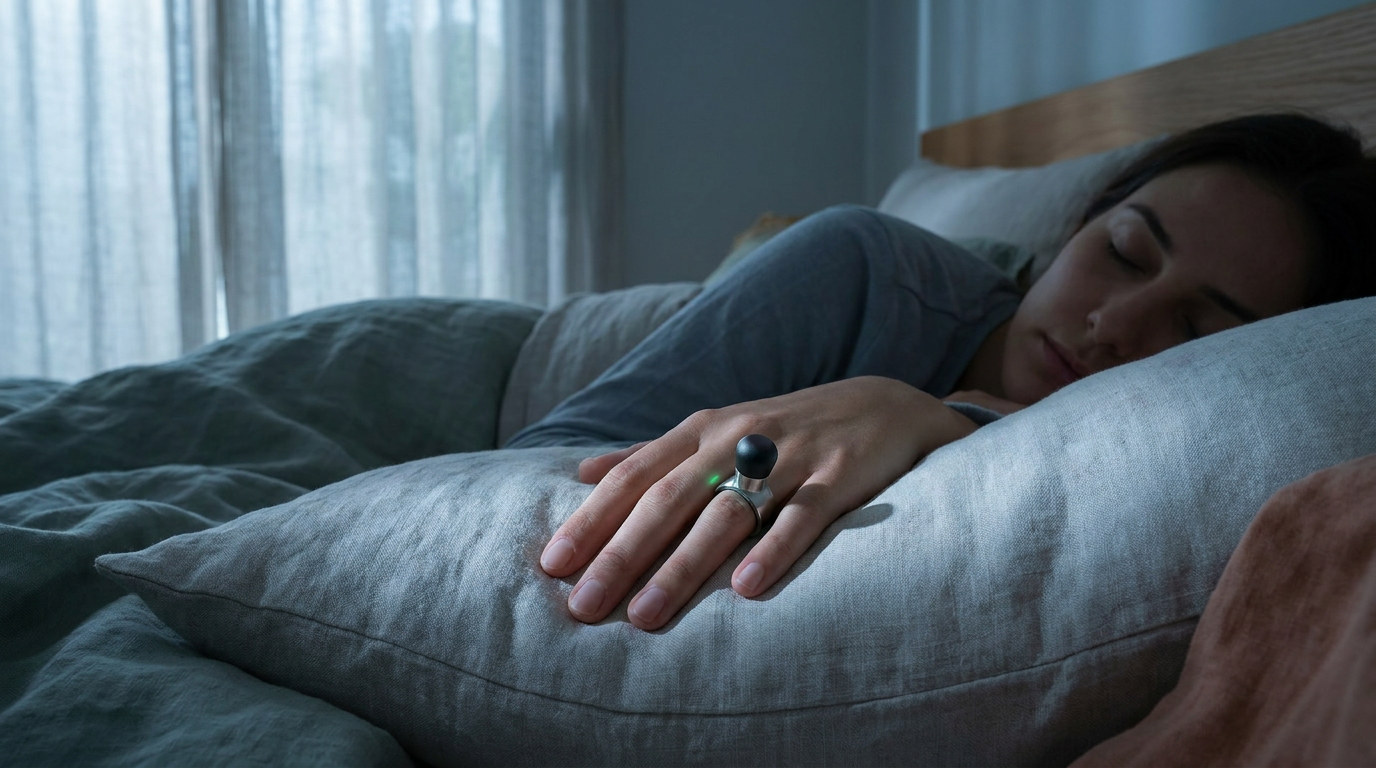
The Oura Ring offers a compelling alternative for those who dislike wearing a bulky watch to bed. The finger is an excellent location for optical heart rate sensors, often yielding clearer pulse signals than the wrist due to the proximity of blood vessels to the skin surface. Oura excels at measuring resting heart rate, heart rate variability (HRV), and subtle shifts in body temperature. While its sleep staging accuracy slightly trails the Apple Watch in some independent tests, its unobtrusive form factor and multi-day battery life make it the preferred choice for many reviewers and consumers.[1][5]
Whoop 4.0 takes a distinctly different approach, positioning itself less as a pure sleep tracker and more as a holistic athletic recovery coach. Whoop requires a monthly subscription and focuses heavily on how your sleep impacts cardiovascular strain and physical readiness for the day ahead. Its raw sleep tracking accuracy is broadly comparable to the Oura Ring, but its software ecosystem is uniquely tailored for athletes and fitness enthusiasts who want actionable advice on exactly how hard they should train based on the previous night's rest.[2][5]
A critical component of this evidence review is the psychological phenomenon known as 'orthosomnia'—an unhealthy, counterproductive obsession with achieving perfect sleep metrics. Sleep researchers warn that because wearable staging data is imperfect, consumers can easily develop anxiety over a 'low deep sleep' score. This anxiety elevates cortisol levels and ironically makes it significantly harder for them to achieve restful sleep the following night, creating a negative feedback loop driven by flawed data.[3][6]

The consensus among sleep scientists and data analysts is that consumers should treat wearable sleep scores as macro-level trends rather than gospel truth. If your device says you got exactly 15 minutes of deep sleep, the absolute number might be clinically inaccurate. However, if that number drops significantly from your normal baseline of 60 minutes after a night of heavy drinking or a stressful day, the trend is accurately reflecting a real physiological disruption that you can act upon.[4][6]
Another area of ongoing uncertainty in the evidence pack is sensor equity across diverse populations. Optical PPG sensors shine green or red light through the skin to detect blood flow. Studies have historically shown that these sensors can be less accurate on darker skin tones, as melanin absorbs more light, potentially weakening the signal. Though manufacturers claim recent hardware revisions have largely mitigated this bias, independent validation of these claims across diverse populations remains an active area of clinical research.[3][4]
Ultimately, the decision of which tracker to buy should be dictated by your preferred form factor and primary use case. If you already own an Apple Watch and can easily manage the daily charging routine, you have access to some of the best sleep tracking algorithms available at no extra cost. If comfort is paramount and you want a device that fades into the background, the Oura Ring is the clear winner. And for data-obsessed athletes focused on training load, Whoop provides the most actionable recovery ecosystem.[1][2][6]

It is also vital to remember what these devices cannot do. None of the consumer wearables currently on the market are FDA-cleared to diagnose sleep apnea, clinical insomnia, or other serious sleep disorders. While they might flag potential breathing disturbances or irregular heart rhythms, they are merely screening tools, not diagnostic medical instruments. Anyone suspecting a true sleep disorder should consult a physician for a proper PSG rather than relying on a smartwatch.[3][4]
The era of quantified rest is here to stay, and the technology is undeniably improving year over year. By understanding the scientific limitations of actigraphy and optical sensors, consumers can use these powerful tools to build healthier habits without falling victim to data-induced anxiety. The best sleep tracker is ultimately the one you wear consistently, find comfortable, and use to make positive, sustainable lifestyle adjustments.[5][6]
How we got here
Early 2010s
Basic actigraphy bands like the early Fitbit models introduce mainstream consumers to movement-based sleep tracking.
2018
The Oura Ring Gen 2 popularizes the finger-based form factor, shifting focus toward Heart Rate Variability (HRV) and recovery.
2022
Apple introduces advanced sleep staging in watchOS 9, significantly closing the accuracy gap with clinical polysomnography.
2026
Clinical consensus establishes that while staging remains flawed, total sleep time and cardiovascular recovery metrics on top wearables are highly reliable.
Viewpoints in depth
Clinical Sleep Researchers
Emphasizes that wearables cannot replace polysomnography and warns against over-relying on flawed staging data.
Medical professionals and sleep scientists view consumer wearables with cautious optimism. While they appreciate that these devices make the general public more aware of sleep hygiene, they frequently highlight the fundamental limitations of wrist and finger actigraphy. Because wearables do not measure electroencephalogram (EEG) brain waves, their sleep staging data is essentially an algorithmic guess. Researchers warn that treating this data as clinical truth can lead to misdiagnosis or unnecessary anxiety, urging patients to seek formal polysomnography if they suspect a genuine sleep disorder.
Consumer Tech Reviewers
Focuses on user experience, form factor comfort, battery life, and how actionable the software ecosystem is.
For technology reviewers, the absolute clinical accuracy of a device is often weighed against its practical usability. A tracker with perfect algorithms is useless if it is too uncomfortable to wear to bed or if its battery dies halfway through the night. This camp heavily favors devices like the Oura Ring for its 'invisible' form factor and multi-day battery, or the Whoop for its highly actionable, gamified recovery software. They argue that consistency of wear and the ability to track personal baselines over time are more important for the average consumer than matching a clinical sleep lab.
Data-Driven Consumers
Values macro-level trends and recovery scores to optimize daily habits, accepting minor inaccuracies in exchange for convenience.
The biohacking and fitness communities utilize sleep trackers not as medical diagnostic tools, but as behavioral modifiers. For this group, the exact minute count of REM sleep matters less than the overall trend line. If a wearable indicates that late-night meals or alcohol consumption consistently depress their recovery scores, that data is valuable for driving lifestyle changes. They accept the inherent margin of error in optical sensors, viewing the technology as a directional compass for wellness rather than a flawless scientific instrument.
What we don't know
- Whether upcoming non-invasive neuro-wearables (like smart headbands) will successfully bridge the gap between wrist actigraphy and clinical EEG.
- The exact degree to which proprietary algorithms from Apple, Oura, and Whoop differ, as their source code remains strictly confidential.
- How effectively recent hardware updates have truly eliminated optical sensor inaccuracies for users with darker skin tones across all sleep stages.
Key terms
- Polysomnography (PSG)
- The medical gold standard for sleep studies, conducted in a lab, which measures brain waves, eye movement, and muscle activity to definitively determine sleep stages.
- Actigraphy
- The use of a wearable accelerometer to track physical movement and rest cycles, used by devices to guess when you fall asleep.
- Photoplethysmography (PPG)
- An optical sensor technology that shines light into the skin to measure changes in blood flow, used to calculate heart rate and heart rate variability.
- Heart Rate Variability (HRV)
- The variation in time between consecutive heartbeats, a key metric used by wearables to determine physical recovery and nervous system stress.
- Orthosomnia
- A psychological condition where an individual becomes overly anxious about perfecting their wearable sleep data, leading to poorer actual sleep.
Frequently asked
Can a smartwatch diagnose sleep apnea?
No. While some devices can flag breathing disturbances or blood oxygen drops, they are not FDA-cleared diagnostic tools. You must consult a doctor for a clinical diagnosis.
Which wearable is most accurate for sleep staging?
Independent clinical validations consistently rank the Apple Watch as having the highest correlation with clinical PSG for identifying REM and deep sleep stages.
What is orthosomnia?
Orthosomnia is a term coined by sleep researchers to describe an unhealthy obsession with achieving perfect sleep tracking metrics, which can ironically cause anxiety and worsen sleep quality.
Are smart rings better than watches for sleep?
Rings like the Oura are generally preferred for comfort and battery life, and the finger provides an excellent pulse signal, though top-tier watches still hold a slight edge in staging algorithms.
Sources
Source coverage
6 outlets
3 viewpoints surfaced






[1]The VergeConsumer Tech Reviewers
The best sleep trackers for 2026: Apple, Oura, and Whoop tested
Read on The Verge →[2]WirecutterConsumer Tech Reviewers
The Best Sleep Trackers for Actionable Rest Data
Read on Wirecutter →[3]Sleep FoundationClinical Sleep Researchers
How Accurate Are Consumer Sleep Trackers? A Clinical Review
Read on Sleep Foundation →[4]Journal of Clinical Sleep MedicineClinical Sleep Researchers
Validation of consumer wearable devices for sleep tracking against polysomnography
Read on Journal of Clinical Sleep Medicine →[5]DC RainmakerConsumer Tech Reviewers
In-Depth Review: The State of Sleep Tracking Accuracy in 2026
Read on DC Rainmaker →[6]Factlen Editorial TeamData-Driven Consumers
Synthesis by Factlen editorial team
Read on Factlen Editorial Team →

Every angle. Every day.
Get shopping stories with full source coverage and perspective breakdowns delivered to your inbox.