
How Video Game Accessibility Became the Industry's New Standard
Driven by innovative hardware like modular controllers and software breakthroughs that assist blind and motor-impaired players, the gaming industry has shifted from treating accessibility as an afterthought to a foundational design pillar.
By Factlen Editorial Team
- Inclusive Designers
- Advocate for accessibility to be built into game engines and hardware from day one, rather than patched in post-launch.
- Hardware Innovators
- Focus on creating affordable, modular, and 3D-printable physical interfaces to bypass motor barriers.
- Disabled Gamers
- Value the independence, social connection, and uncompromised gameplay experiences that these tools unlock.
What's not represented
- · Indie Game Developers
- · Esports Tournament Organizers
Why this matters
With over 400 million disabled gamers worldwide, these advancements not only allow millions to play, connect, and compete independently, but they also drive universal design improvements that make gaming more comfortable and customizable for everyone.
Key points
- Over 400 million gamers worldwide identify as having a disability.
- Modular devices like the Xbox Adaptive Joystick and PlayStation Access Controller bypass traditional motor barriers.
- Game engines are integrating translation layers to automatically support screen readers and high-contrast modes.
- Accessibility options remove physical friction, allowing disabled players to experience a game's intended challenge.
- Universal design features like remappable controls and subtitles ultimately benefit the entire gaming population.
For decades, the video game industry operated behind an invisible velvet rope. If a player lacked the fine motor control to manipulate a standard gamepad, or the visual acuity to read tiny on-screen text, the medium was largely closed to them. Gaming was historically treated as a strict test of physical dexterity and sensory sharpness, leaving millions of potential players on the sidelines of one of the world's most culturally significant entertainment mediums. Developers rarely considered that a rigid control scheme or a lack of audio cues could act as an insurmountable barrier, effectively locking out an entire demographic from participating in digital worlds.[7]
Today, that paradigm has fundamentally shifted. Driven by a combination of grassroots advocacy, demographic realities, and technological breakthroughs, accessibility is no longer treated as a niche afterthought. Instead, it has become a foundational pillar of modern game design. Studios and hardware manufacturers have realized that removing unnecessary friction does not compromise the artistic integrity of a game; it simply allows more people to experience it. This evolution represents one of the most uplifting trends in modern technology, transforming gaming from an exclusive club into a universally accessible platform for connection and play.[7]
The sheer scale of the demographic demands this level of attention. Industry data presented at the 2025 Microsoft Ability Summit highlighted that there are more than 429 million players with disabilities worldwide. This staggering figure underscores the reality that disabled gamers are not a fringe minority, but a massive, underserved market segment. As the gaming population ages and the medium reaches true mainstream ubiquity, the need for adaptable interfaces has shifted from a charitable endeavor to a core business imperative for the world's largest technology companies.[3]
In the United States alone, roughly 30 percent of gamers identify as having some form of disability. For these players, gaming is not just a casual pastime; it is a vital conduit for social connection, community building, and digital independence. When physical mobility is limited in the real world, digital environments offer a space where players can compete, explore, and socialize on equal footing. Ensuring access to these spaces is increasingly viewed as a matter of digital equity, allowing everyone to participate in the cultural zeitgeist regardless of their physical or sensory capabilities.[7]

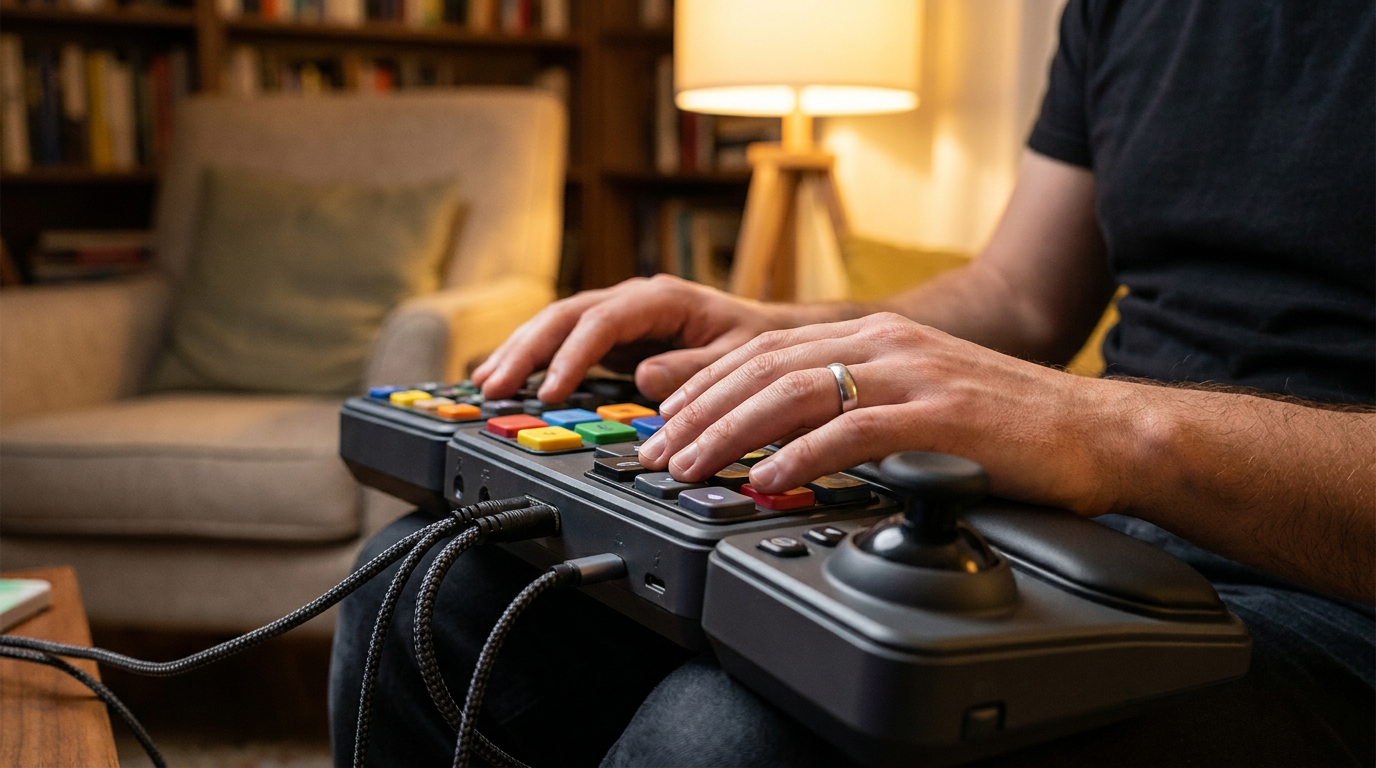
The most visible frontier of this accessibility revolution has been hardware. The traditional controller—a rigid plastic slab requiring two hands, ten fingers, and precise timing—is inherently exclusionary. For players with muscular dystrophy, cerebral palsy, or amputations, a standard gamepad is often entirely unusable. Recognizing this, the industry has spent the last several years completely reimagining how a player physically interfaces with a console, moving away from one-size-fits-all designs toward highly modular, customizable ecosystems that adapt to the player, rather than forcing the player to adapt to the device.[5]
Microsoft shattered this mold with the original Xbox Adaptive Controller, a flat hub featuring 19 different ports that allowed players to plug in custom switches, pedals, and joysticks. This device acted as a universal translator for accessibility hardware, allowing users to build a rig that perfectly suited their body. Sony eventually followed suit with the PlayStation Access Controller, a highly modular, circular device designed to be operated from any 360-degree orientation. These flagship devices proved that major console manufacturers were finally willing to invest heavily in inclusive industrial design.[7]
By 2025, the hardware ecosystem expanded further with the launch of the Xbox Adaptive Joystick. Priced at an accessible $29.99, this wired peripheral was designed specifically for one-handed use or for mounting to wheelchairs and tables. Its introduction addressed a critical gap in the market: the need for affordable, specialized inputs that didn't require players to purchase expensive, bespoke medical equipment just to play a video game alongside their friends. By keeping the price point low, Microsoft ensured that financial barriers wouldn't replace physical ones.[3][6]
Third-party manufacturers have also entered the space with incredibly innovative solutions. Companies like ByoWave released the Proteus Controller, a 'snap-together' modular kit that allows gamers to construct a custom gamepad out of interlocking blocks. This system can be configured with endless combinations of buttons and joysticks, allowing players to build a controller that can be operated with as little as a single finger. This level of granular customization ensures that even the most unique motor requirements can be accommodated with off-the-shelf consumer technology.[6]
Third-party manufacturers have also entered the space with incredibly innovative solutions.
Customization has even reached the realm of 3D printing, democratizing access to specialized hardware. Xbox now offers free, downloadable CAD files for adaptive thumbstick toppers, allowing players to print specialized shapes at their local library or home printer. In May 2026, they expanded this lineup with a highly requested 'Goal Post' design, which helps players with limited grip strength keep their hands securely on the joystick. This open-source approach allows the community to iterate and share ergonomic solutions globally without waiting for corporate manufacturing cycles.[1]

But hardware is only half the equation; the software running on the screen must also be legible and navigable. Historically, adding accessibility features required studios to build bespoke solutions from scratch for every single game, a time-consuming process that often fell off the priority list as release dates loomed. If a developer wanted to add screen-reader support or high-contrast visuals, they had to engineer the underlying code themselves, leading to wildly inconsistent accessibility standards across the industry. This meant a disabled player could never be certain if a new release would actually be playable.[4]
That bottleneck is finally being cleared at the engine level. In 2025, the popular open-source game engine Godot integrated 'AccessKit' into its 4.5 release. This tool acts as a translation layer, allowing games to automatically interface with a player's operating system screen readers and high-contrast modes without requiring extra coding from the developer. By baking these tools directly into the foundational software used to build games, the industry is ensuring that accessibility becomes a default setting rather than an optional luxury.[2]
Similarly, Electronic Arts released IRIS, an open-source tool that detects photosensitivity risks. In early 2025, IRIS was adapted into a real-time plugin for Unreal Engine, allowing developers to instantly spot and fix flashing lights that could trigger seizures before the game even ships. Instead of relying on post-launch patches to fix dangerous visual effects, developers can now monitor photosensitivity metrics in real-time as they build their digital environments, drastically reducing the risk for players with epilepsy and making the medium safer for everyone.[2]

For blind and low-vision players, modern games are deploying sophisticated audio landscapes that go far beyond simple sound effects. Titles like The Last of Us Part II pioneered the use of distinct audio cues to signal ledges, enemies, and loot, allowing visually impaired players to navigate complex 3D environments entirely by sound. These 'audio pings' act as a form of digital echolocation, translating spatial geometry into a language of tones and vibrations that completely bypasses the need for a screen.[5]
Academic research is pushing these boundaries even further to support blind gamers. Frameworks like GamerAstra are exploring how multi-agent artificial intelligence can provide real-time, non-intrusive audio descriptions of complex 2D and 3D game states. This technology aims to bridge the gap for older titles or indie games that lack official accessibility support, using AI to dynamically read the screen and narrate the action, much like a sighted friend sitting on the couch and describing the gameplay. As these AI tools mature, they promise to unlock decades of gaming history for visually impaired players.[4]
Major blockbuster releases are now launching with staggering suites of inclusive features that would have been unimaginable a decade ago. Forza Horizon 6 features 'AutoDrive' navigation assists and a Proximity Radar, allowing visually impaired players to race at high speeds. Meanwhile, recent Call of Duty titles have integrated support for Cephable, a software platform that lets players control the game using facial expressions, head movements, and voice commands, proving that even the most fast-paced competitive shooters can be adapted for diverse mobility needs.[1]

To help players navigate this new landscape, digital storefronts have implemented standardized Accessibility Tags. This system allows disabled gamers to see exactly which features—like remappable controls, subtitle sizing, or colorblind filters—a game supports before they spend their money. By surfacing this information directly on the console dashboard, platforms like Xbox have eliminated the frustrating guesswork that used to define the disabled gaming experience, empowering players to make informed purchasing decisions and ensuring they only buy games they can actually play.[2]
Crucially, the industry has learned to separate the concept of 'accessibility' from 'difficulty.' Accessibility options do not exist to make a game inherently easier; they exist to remove the physical or sensory friction of interacting with the software. Whether it is holding down a button instead of rapidly tapping it, or changing the color of an enemy outline, these features allow disabled players to experience the intended strategic challenge of a game on a truly level playing field. It is about equitable access to the experience, not diluting the accomplishment of overcoming a difficult boss fight.[7]
Ultimately, this push for inclusive design benefits everyone who picks up a controller. Features originally designed for disabled players—like subtitles for the deaf, high-contrast modes for the visually impaired, and remappable buttons for motor disabilities—are now routinely used by parents playing on mute, older gamers with fading eyesight, and anyone who simply prefers a different control scheme. By designing for the margins, the video game industry has inadvertently created a more comfortable, customizable, and welcoming medium for the entire world.[5][7]
How we got here
2018
Microsoft launches the groundbreaking Xbox Adaptive Controller, setting a new hardware standard.
2023
Sony releases the PlayStation Access Controller globally, expanding modular options.
Early 2025
The $29.99 Xbox Adaptive Joystick launches for one-handed and mounted play.
April 2025
The Godot engine integrates AccessKit, standardizing screen reader support at the engine level.
May 2026
Xbox expands its free 3D-printable adaptive thumbstick designs with new ergonomic shapes.
Viewpoints in depth
Inclusive Designers' view
Advocating for accessibility as a foundational element of game development rather than an afterthought.
Inclusive designers argue that the traditional model of retrofitting accessibility into a finished game is inefficient and often ineffective. By integrating tools like AccessKit directly into game engines, developers can ensure that screen readers, high-contrast modes, and remappable controls are baseline features. They emphasize that universal design principles ultimately create better, more customizable experiences for the entire player base, not just those with diagnosed disabilities.
Hardware Innovators' view
Focusing on modularity and affordability to overcome physical barriers to gaming.
For hardware manufacturers, the challenge lies in the sheer diversity of motor disabilities. Because no two players have the exact same physical needs, innovators are prioritizing modularity—creating devices like the Proteus Controller that can be snapped together in custom configurations. They also champion open-source solutions, such as providing free CAD files for 3D-printable thumbsticks, to bypass the high costs traditionally associated with specialized medical or adaptive equipment.
Disabled Gamers' view
Seeking independence, social inclusion, and the ability to experience games as intended.
For the disabled gaming community, accessibility features are about far more than convenience; they are the keys to digital independence. Players emphasize the psychological and social benefits of being able to join friends in multiplayer spaces without needing sighted or able-bodied assistance. They also push back against the stigma that accessibility equates to 'easy mode,' advocating for tools that allow them to engage with a game's true mechanical challenge on a level playing field.
What we don't know
- How quickly competitive esports leagues will standardize rules for adaptive controllers in professional tournaments.
- Whether AI-driven real-time audio descriptions can scale effectively to fast-paced, unpredictable multiplayer games.
Key terms
- Adaptive Controller
- A customizable gaming interface designed to meet the needs of players with limited mobility.
- Screen Reader
- Software that translates on-screen text and menus into synthesized speech for blind and low-vision users.
- High Contrast Mode
- A visual setting that simplifies color palettes and highlights key interactive elements to assist players with low vision.
- Engine-Level Accessibility
- Built-in tools within game creation software that make it easier for developers to implement inclusive features by default.
- Photosensitivity Risk
- Visual patterns or flashing lights in media that can trigger seizures in individuals with photosensitive epilepsy.
Frequently asked
Can adaptive controllers be used on any console?
Currently, most first-party adaptive controllers are locked to their specific ecosystems (e.g., PlayStation Access for PS5, Xbox Adaptive for Xbox/PC), though third-party adapters exist to bridge these gaps.
How do blind players navigate 3D games?
Developers use a combination of spatial audio cues, text-to-speech menus, and navigation assists to guide players without visual feedback, acting like digital echolocation.
Do accessibility features make games too easy?
No. Accessibility options remove physical or sensory barriers to playing the game, which is distinct from lowering the game's intended strategic or mechanical difficulty.
What is engine-level accessibility?
It refers to accessibility tools built directly into game creation software, like Unreal or Godot, allowing developers to implement features like screen-reader support more easily.
Sources
Source coverage
7 outlets
3 viewpoints surfaced







[1]XboxHardware Innovators
Celebrating Our Accessibility Journey Across Xbox
Read on Xbox →[2]Access-AbilityInclusive Designers
2025 Video Game Accessibility Recap
Read on Access-Ability →[3]TechPowerUpHardware Innovators
Microsoft Announces Xbox Adaptive Joystick at 2025 Ability Summit
Read on TechPowerUp →[4]arXivDisabled Gamers
GamerAstra: Facilitating Access to Video Games for Blind and Low Vision Players
Read on arXiv →[5]Level AccessInclusive Designers
Industry-wide initiatives for accessibility in video games
Read on Level Access →[6]New MobilityHardware Innovators
Microsoft Announces New Adaptive Gaming Products
Read on New Mobility →[7]Factlen Editorial TeamDisabled Gamers
Synthesis by Factlen editorial team
Read on Factlen Editorial Team →
Every angle. Every day.
Get gaming esports stories with full source coverage and perspective breakdowns delivered to your inbox.