
Steam Deck OLED vs. ASUS ROG Ally X: The Definitive 2026 Handheld Comparison
A comprehensive side-by-side analysis of the two leading portable gaming PCs, weighing the Steam Deck OLED's efficiency against the ROG Ally X's raw power.
By Factlen Editorial Team
- Console Purists
- Gamers who value a seamless, frictionless user interface and long battery life over raw graphical power.
- Power Maximizers
- Enthusiasts who demand the highest possible frame rates and the flexibility of a full Windows operating system.
- Hardware Analysts
- Tech reviewers focused on the engineering trade-offs between battery capacity, thermal design power, and component efficiency.
What's not represented
- · Budget Gamers
- · Cloud Gaming Advocates
Why this matters
Choosing the right handheld PC is a significant $500 to $800 investment. Understanding the specific trade-offs between battery efficiency, operating systems, and raw performance ensures buyers get the device that actually matches their gaming habits.
Key points
- The Steam Deck OLED excels in battery efficiency for indie games and offers a seamless, console-like SteamOS experience.
- The ASUS ROG Ally X provides unmatched handheld performance, leveraging its Z1 Extreme chip and 24GB of RAM for demanding AAA titles.
- Valve's handheld features a vibrant 7.4-inch OLED display, while ASUS opts for a sharper, faster 1080p 120Hz IPS panel.
- The ROG Ally X includes a massive 80Wh battery to support its high power draw, making it heavier and more expensive than the Steam Deck.
- Choosing between the two depends entirely on whether a buyer prioritizes frictionless immersion or Windows 11 flexibility.
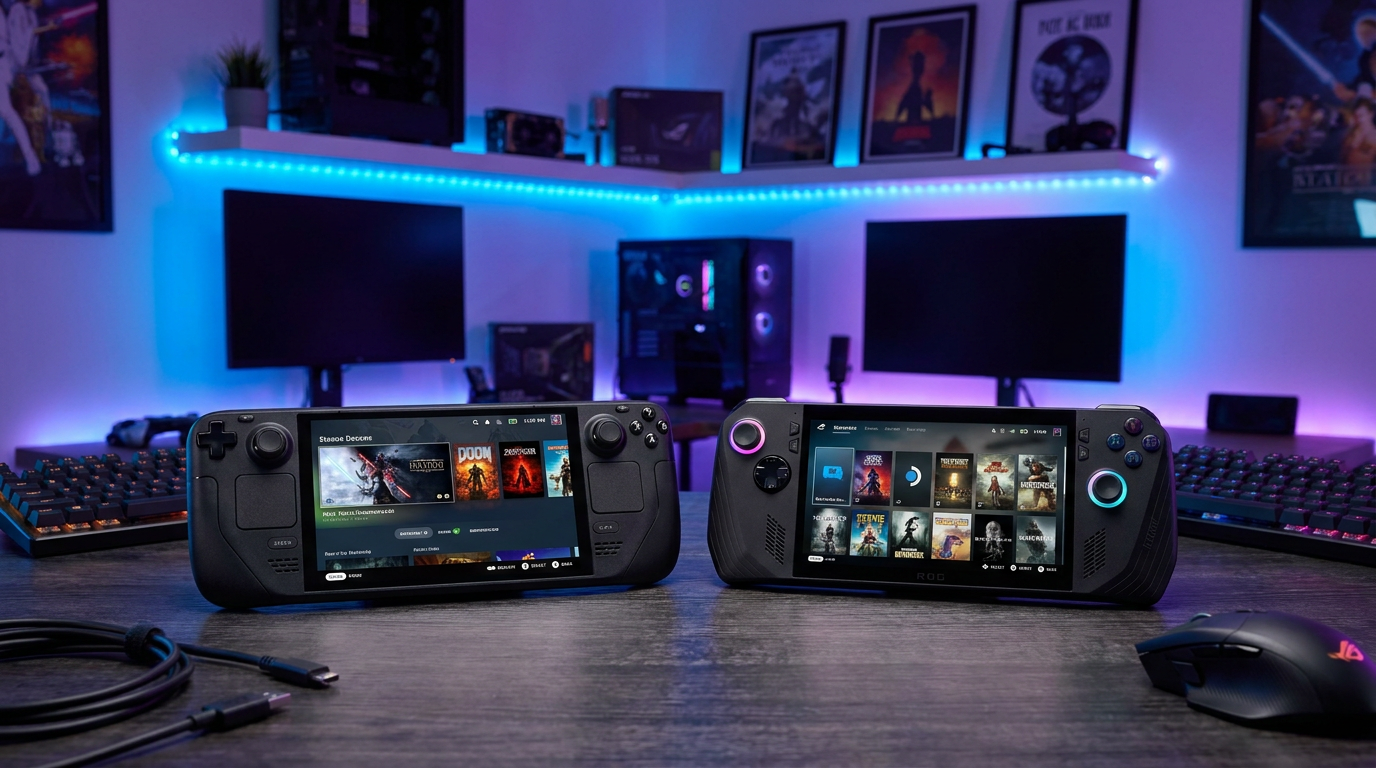
The portable PC gaming market in 2026 is defined by a heavyweight title bout between two distinct engineering philosophies. On one side sits the Valve Steam Deck OLED, a device that prioritizes a seamless, console-like user experience and power efficiency. On the other side is the ASUS ROG Ally X, a brute-force Windows 11 machine designed to push the absolute limits of handheld performance. For consumers looking to invest in a premium portable gaming setup, choosing between these two titans is no longer a simple question of which is objectively better. Instead, it requires a careful side-by-side trade-off analysis of what each player values most: the frictionless immersion of a curated ecosystem or the boundless flexibility of a full desktop operating system shrunk down to a seven-inch form factor.[1][3]
The argument for the Steam Deck OLED centers entirely on its unmatched efficiency and display quality. Valve engineered a custom AMD Zen 2 APU that sips power at lower wattages, allowing the device to excel in a wide variety of gaming scenarios without constantly hunting for a wall outlet. The evidence for this efficiency is striking: when running less demanding indie titles or older games, the Steam Deck OLED can stretch its 50-watt-hour battery to an astonishing six to eight hours of continuous playtime. Furthermore, the 7.4-inch OLED display provides perfect black levels, infinite contrast, and vibrant HDR colors that make games visually pop in a way that traditional LCD panels simply cannot replicate.[2][4]
However, the argument against the Steam Deck OLED is its definitive performance ceiling and software limitations. Because it relies on older Zen 2 architecture and 16GB of RAM, it struggles to maintain high frame rates in the most demanding modern AAA blockbusters. The evidence is clear in benchmark testing: heavy titles often require dropping settings to their lowest presets and relying heavily on upscaling just to hover around 30 frames per second. Additionally, because it runs on the Linux-based SteamOS, players cannot natively install Xbox Game Pass or easily access games burdened by certain anti-cheat software without resorting to cumbersome workarounds or cloud streaming.[1][5]

Conversely, the argument for the ASUS ROG Ally X is rooted in raw, unadulterated processing power and ecosystem freedom. Powered by the AMD Ryzen Z1 Extreme chipset and a massive 24GB of fast LPDDR5X RAM, the Ally X is effectively a high-end gaming laptop condensed into a handheld shell. The evidence supporting this power advantage is easily quantified in side-by-side testing. In demanding titles like Cyberpunk 2077, the ROG Ally X can push 46 frames per second on its Turbo mode, while the Steam Deck OLED lags behind at roughly 28 frames per second. Furthermore, because it runs native Windows 11, every single game launcher, anti-cheat program, and subscription service—including PC Game Pass—works exactly as it would on a desktop computer.[3][6]
The argument against the ROG Ally X focuses on its operating system overhead, thermal output, and premium price tag. Windows 11 was never designed to be navigated with a joystick on a seven-inch screen, leading to a user experience that can often feel clunky, requiring frequent updates and driver management. The evidence of its compromises also shows up in its physical footprint; to support its power-hungry processor, ASUS had to equip the Ally X with a massive 80-watt-hour battery, pushing the device's weight to 678 grams compared to the Deck's 640 grams. Finally, this brute force comes at a steep financial cost, with the Ally X retailing at $799, a full $250 more than the entry-level Steam Deck OLED.[1][2]
The argument against the ROG Ally X focuses on its operating system overhead, thermal output, and premium price tag.
When comparing the displays side-by-side, the trade-offs become a matter of visual preference versus fluid motion. The ROG Ally X features a 7-inch IPS LCD panel with a sharp 1080p resolution and a blazing 120Hz refresh rate, complete with variable refresh rate (VRR) technology to smooth out frame drops. The evidence suggests this screen is objectively superior for fast-paced competitive shooters or racing games where motion clarity is paramount. However, the Steam Deck OLED counters with a slightly larger 7.4-inch panel running at 800p and 90Hz. While it lacks the raw pixel density of the ASUS device, the OLED technology delivers a cinematic vibrancy and HDR peak brightness of 1,000 nits that makes the Ally X's 400-nit IPS panel look somewhat washed out by comparison.[4][5]

Battery life presents the most fascinating engineering divergence between the two handhelds, as capacity does not directly translate to universal longevity. The ROG Ally X boasts an 80-watt-hour battery—the largest ever put into a mainstream gaming handheld—while the Steam Deck OLED relies on a smaller 50-watt-hour cell. The evidence shows that at maximum power draw (around 25 to 30 watts), the Ally X leverages its massive battery to outlast the Steam Deck, providing nearly three hours of heavy AAA gaming compared to the Deck's two hours. However, at lower power limits (around 10 watts), Valve's superior APU tuning allows the Steam Deck OLED to easily outlast the Ally X, making it the undisputed champion for retro emulation and lightweight indie titles.[3][6]
Ergonomics and control schemes also highlight the differing philosophies of Valve and ASUS. The Steam Deck OLED features a wider chassis to accommodate its dual trackpads, which provide precise mouse-like input for strategy games and desktop navigation. The evidence from long-term users indicates that while the Deck is physically larger, its deeply contoured grips make it incredibly comfortable for marathon sessions. The ROG Ally X, meanwhile, opts for a more traditional Xbox-style asymmetrical stick layout without trackpads. While ASUS improved the grips and buttons significantly over the original Ally, the heavier weight and lack of trackpads make navigating its Windows 11 interface a persistent chore that often requires tapping the touchscreen.[2][4]
Storage and expandability present another crucial battleground in this side-by-side comparison. The argument for the ROG Ally X's storage solution is its sheer out-of-the-box capacity and upgradeability. It ships standard with a 1TB PCIe Gen 4 SSD in the widely available 2280 form factor, making it incredibly easy and cheap for users to upgrade to 2TB or even 4TB drives down the line. The evidence for the Steam Deck OLED's storage approach is more modest; it offers 512GB or 1TB options, but utilizes the smaller, slightly more expensive 2230 SSD format. While both devices feature MicroSD card slots for cheap expansion, the Ally X's inclusion of dual USB-C ports—one being USB 4 with 40 Gbps bandwidth—gives it a massive advantage for connecting external drives or even external GPUs.[4][5]

When evaluating thermals and acoustic performance, the trade-offs are directly tied to the power draw of each device. The argument for the Steam Deck OLED's thermal management is its whisper-quiet operation under normal loads. Because the custom APU rarely draws more than 15 watts, the internal fan spins at low, unobtrusive frequencies, and the device's plastic shell remains comfortably cool to the touch. The evidence against the ROG Ally X in this category is its heat output when pushed to its limits. While ASUS engineered an impressive dual-fan cooling system with an additional exhaust vent for the X model, running the Z1 Extreme chip at 30 watts inevitably generates noticeable heat and fan noise. It is a necessary compromise for achieving desktop-level frame rates, but one that breaks the immersion of quiet, handheld play.[3][6]
Ultimately, the Steam Deck OLED fits well when a player wants a frictionless, console-like experience that simply works out of the box. It is the ideal choice for gamers with extensive existing Steam libraries, those who prioritize vibrant HDR visuals, and travelers who need maximum battery life for indie games on long flights. It fits well when the budget is a primary concern, as its $549 starting price offers unparalleled value in the handheld space. It does not fit well when a player's primary goal is to play the latest, most graphically demanding AAA releases at high frame rates, or when their gaming library is heavily tied to Xbox Game Pass, Epic Games Store, or multiplayer titles that utilize strict kernel-level anti-cheat software.[1][3]
Conversely, the ASUS ROG Ally X fits well when a player demands the absolute highest performance available in a portable form factor and is willing to pay a premium for it. It is the perfect fit for power users who want to tinker with settings, utilize mod managers, and have native access to every PC gaming storefront and subscription service on the market. It fits well when docked to an external monitor, as its dual USB-C ports and 24GB of RAM allow it to function admirably as a surrogate desktop PC. It does not fit well when a user wants a simple, plug-and-play experience without the hassle of Windows updates, or when they prioritize a lightweight device with an OLED screen for cinematic, low-wattage gaming in bed.[2][6]

How we got here
February 2022
Valve launches the original Steam Deck, proving the viability of the premium handheld PC market.
June 2023
ASUS enters the market with the ROG Ally, introducing Windows 11 flexibility and the powerful Z1 Extreme chip.
November 2023
Valve releases the Steam Deck OLED, featuring a vastly improved HDR screen and better battery efficiency.
July 2024
ASUS launches the ROG Ally X, doubling down on performance with a massive 80Wh battery and 24GB of RAM.
2026
The two devices solidify their positions as the definitive benchmarks for portable PC gaming, representing two distinct engineering philosophies.
Viewpoints in depth
Console Purists
Gamers who value a seamless, frictionless user interface and long battery life over raw graphical power.
This camp argues that a handheld device should feel like a dedicated gaming console, not a compromised laptop. They point to the Steam Deck's custom SteamOS as the gold standard for portable gaming, highlighting how it eliminates the need to fiddle with drivers, background processes, or clunky touch-based desktop navigation. For these users, the vibrant OLED screen and the ability to play indie games for up to eight hours on a single charge far outweigh the inability to push 60 frames per second in the latest AAA releases.
Power Maximizers
Enthusiasts who demand the highest possible frame rates and the flexibility of a full Windows operating system.
Power maximizers believe that if you are spending premium money on a portable PC, it should actually function as a full PC. They champion the ROG Ally X for its brute-force approach, utilizing the Z1 Extreme chip and 24GB of RAM to achieve frame rates that the Steam Deck simply cannot reach. They argue that dealing with Windows 11's quirks is a small price to pay for native access to Xbox Game Pass, Epic Games Store, and multiplayer titles that require strict anti-cheat software.
Hardware Analysts
Tech reviewers focused on the engineering trade-offs between battery capacity, thermal design power, and component efficiency.
This perspective focuses purely on the numbers and the fascinating dynamic between the two devices' power profiles. Analysts note that while the ROG Ally X has a battery that is 60% larger than the Steam Deck OLED's, it does not universally translate to 60% more playtime. Because the Ally X's Windows OS and Z1 Extreme chip have a higher baseline power draw, the massive 80Wh battery is often necessary just to keep the device alive during heavy gaming, whereas Valve's highly optimized 50Wh system represents a masterclass in low-wattage efficiency.
What we don't know
- When Valve plans to release a true next-generation 'Steam Deck 2' with a significantly upgraded processor.
- Whether Microsoft will release a dedicated, handheld-optimized version of Windows to fix the clunky user experience on devices like the Ally X.
- How future, highly demanding game engines like Unreal Engine 5 will perform on the aging Zen 2 architecture of the Steam Deck over the next few years.
Key terms
- APU
- Accelerated Processing Unit, a single chip that combines both the central processor (CPU) and graphics processor (GPU).
- TDP
- Thermal Design Power, a measure of the maximum heat a chip is expected to generate, which directly correlates to battery drain.
- OLED
- Organic Light-Emitting Diode, a display technology where each pixel lights itself, allowing for perfect blacks and infinite contrast.
- IPS
- In-Plane Switching, a type of LCD screen known for sharp resolutions, high refresh rates, and accurate colors, though it cannot achieve true black.
- SteamOS
- Valve's custom, Linux-based operating system designed to provide a seamless, console-like interface for playing PC games.
Frequently asked
Can I play Xbox Game Pass on the Steam Deck OLED?
Not natively. You must use cloud streaming or undergo a complex process to install Windows, whereas the ROG Ally X runs Game Pass natively out of the box.
Which device has better battery life?
It depends on the workload. The Steam Deck OLED lasts longer when playing lightweight indie games, while the ROG Ally X's massive 80Wh battery outlasts the Deck during heavy AAA gaming.
Is the ROG Ally X heavier than the Steam Deck?
Yes. The ROG Ally X weighs 678 grams compared to the Steam Deck OLED's 640 grams, primarily due to its significantly larger battery.
Do I need to know Linux to use the Steam Deck?
No. SteamOS provides a highly polished, console-like interface that hides the underlying Linux system entirely during normal gaming use.
Sources
Source coverage
6 outlets
3 viewpoints surfaced






[1]Tom's GuideConsole Purists
Asus ROG Ally X vs Steam Deck OLED: Specs compared
Read on Tom's Guide →[2]Pocket-lintPower Maximizers
ROG Ally X vs Steam Deck OLED
Read on Pocket-lint →[3]Rock Paper ShotgunConsole Purists
Asus ROG Ally X vs Steam Deck OLED: battle of the beefed-up handhelds
Read on Rock Paper Shotgun →[4]NoobFeedPower Maximizers
ASUS ROG Ally X vs Steam Deck OLED
Read on NoobFeed →[5]Trusted ReviewsHardware Analysts
Compare the Asus ROG Ally X and Steam Deck OLED
Read on Trusted Reviews →[6]Windows ForumHardware Analysts
ROG Ally X vs Steam Deck OLED: capacity versus draw
Read on Windows Forum →
Every angle. Every day.
Get gaming esports stories with full source coverage and perspective breakdowns delivered to your inbox.