
How Hydrogen Trains Work: The Push to Decarbonize Rail
Hydrogen-powered trains offer a zero-emission alternative to diesel on non-electrified routes, using onboard fuel cells to generate electricity from water and air.
By Factlen Editorial Team
- Hydrogen Advocates
- Argue that hydrogen is the only viable zero-emission replacement for diesel on long, non-electrified routes.
- Direct Electrification Proponents
- Argue that battery-electric trains and overhead wires are vastly more efficient than hydrogen.
- Pragmatic Operators
- Focus on the immediate logistical realities, costs, and reliability of running new train fleets.
What's not represented
- · Local Communities
- · Fossil Fuel Industry
Why this matters
While rail is generally efficient, thousands of miles of track globally still rely on highly polluting diesel engines because electrification is too expensive. Hydrogen technology provides a viable path to eliminate these emissions without requiring massive infrastructure overhauls.
Key points
- Hydrogen trains generate electricity onboard using fuel cells, emitting only water vapor and heat.
- They are designed to replace diesel locomotives on rural or difficult routes where overhead electrification is too expensive.
- A modern hydrogen train can travel up to 1,000 kilometers on a single tank and refuel in 20 minutes.
- The true climate benefit of hydrail depends entirely on using 'green hydrogen' produced from renewable energy.
- Battery-electric trains offer fierce competition, boasting higher energy efficiency but shorter ranges.
- Early European deployments have faced logistical hurdles, highlighting the need for a mature hydrogen supply chain.
For decades, rail travel has been celebrated as the poster child for clean transportation, offering a highly efficient alternative to cars and trucks. Yet, a surprisingly large share of regional rail services across Europe and North America still relies heavily on diesel fuel. In rural regions or challenging terrains where installing overhead electrified tracks is prohibitively expensive or logistically impossible, diesel has remained the stubborn, polluting fallback. Transit authorities have long struggled to find a viable replacement that offers the same range and reliability without the massive infrastructure costs.[2][3]
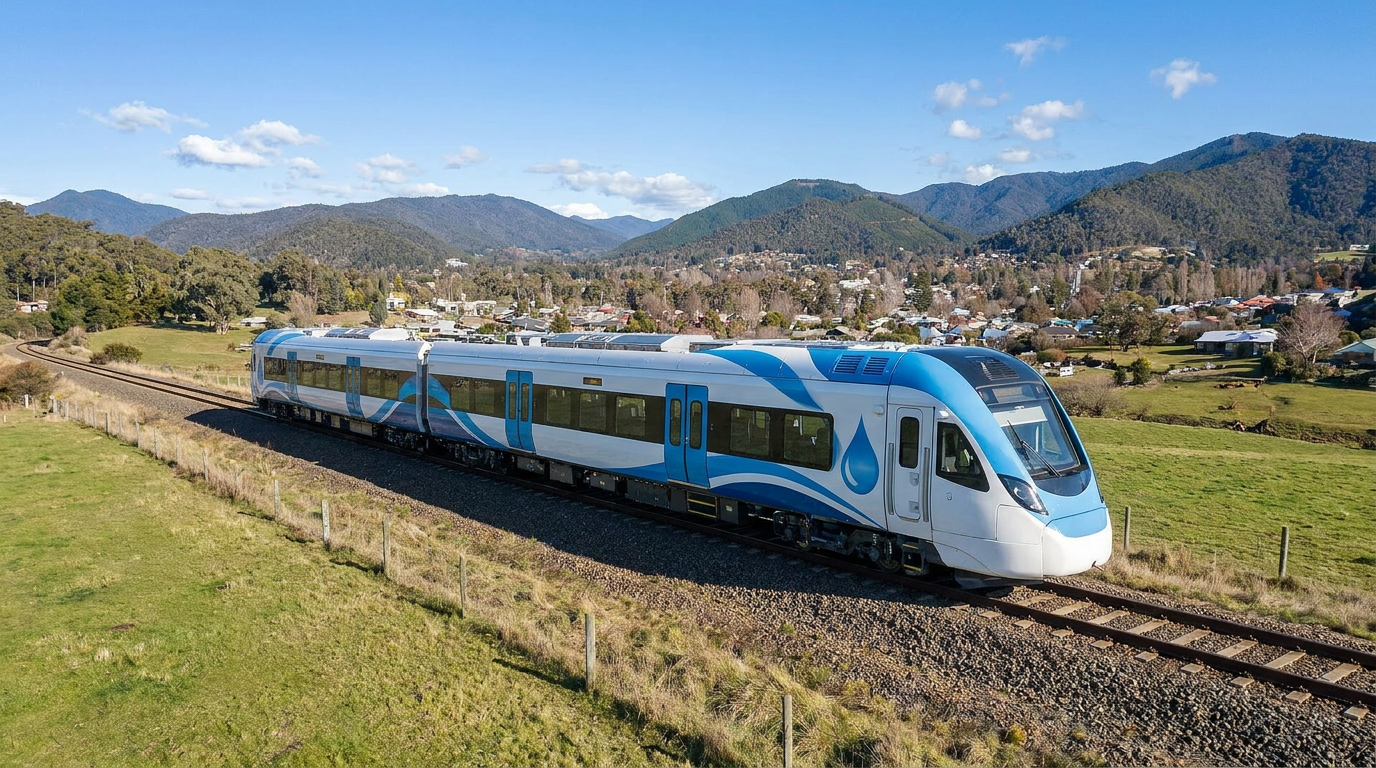
Enter "hydrail"—the hydrogen-powered train. Designed to bridge the gap between dirty diesel and expensive overhead electrification, hydrogen trains offer the smooth, quiet performance of an electric locomotive without the need for continuous power wires. By carrying their fuel onboard, these trains present a compelling solution to decarbonize the hardest-to-reach segments of the global rail network. The most prominent pioneer in this emerging space is the Alstom Coradia iLint, widely recognized as the world’s first passenger train powered entirely by a hydrogen fuel cell.[1][3]
Having entered commercial service in Germany and completed extensive demonstration trials across Europe and North America, the iLint represents a tangible, working shift toward zero-emission rail travel. To truly understand how these trains operate, it is essential to recognize that they are fundamentally electric vehicles. However, instead of drawing power continuously from overhead catenary cables or relying exclusively on massive, heavy battery packs, hydrogen trains generate their own electricity onboard while in motion, combining the best aspects of electric traction with the extended range of traditional liquid fuels.[1][3]

The core mechanism of a hydrogen train relies on a sophisticated device known as a fuel cell. Hydrogen gas, stored safely in high-pressure tanks located on the roof or integrated within the train's chassis, is steadily fed into the fuel cell. Inside this chamber, the hydrogen reacts with oxygen drawn directly from the ambient air. This electrochemical reaction splits the hydrogen molecules into electrons and protons. The electrons are forced through an external circuit, generating the electrical current needed to drive the train's powerful traction motors.[1][8]
Because this process relies on chemistry rather than combustion, the only byproducts generated are heat and pure water vapor, which is vented harmlessly into the atmosphere, leaving zero toxic tailpipe emissions behind. Most modern hydrogen trains do not rely on the fuel cell alone; they incorporate a hybrid energy system that pairs the fuel cell with a lithium-ion battery pack. This battery acts as a crucial energy buffer, storing excess electricity generated by the fuel cell and capturing kinetic energy that would otherwise be lost during regenerative braking.[1][4]
This hybrid approach is vital because rail traction is highly dynamic by nature. The battery handles the sudden, intense peaks in power demand—such as accelerating away from a station platform or climbing a steep gradient—while the fuel cell operates at a steady, highly efficient baseline to keep the battery charged and maintain cruising speeds over long distances. The environmental promise of hydrogen trains is immense, but it comes with an important caveat that industry experts frequently highlight: the climate benefit depends entirely on how the hydrogen fuel is produced.[3][4]
This hybrid approach is vital because rail traction is highly dynamic by nature.
Hydrogen is an energy carrier, not a primary energy source, meaning it must be manufactured before it can be used. Currently, the vast majority of the world's hydrogen is classified as "gray," meaning it is produced from natural gas in a process that releases significant amounts of carbon dioxide. For hydrogen trains to be truly zero-carbon on a comprehensive life-cycle basis, they must be fueled by "green hydrogen," which is created by using renewable energy sources like wind or solar power to split water molecules via electrolysis.[2][8]

When powered by green hydrogen, these trains offer a highly compelling alternative to diesel, particularly on long, rural routes where range anxiety is a significant operational factor. A modern hydrogen train, such as the Coradia iLint, can travel up to 1,000 kilometers on a single tank of fuel and can be completely refueled in less than 20 minutes. These impressive performance metrics closely match the operational tempo of traditional diesel locomotives, allowing transit operators to swap out old fleets without rewriting their timetables. Economically, the case for hydrogen hinges heavily on the Total Cost of Ownership (TCO) over the lifespan of the vehicle.[1][4]
While the initial capital expenditure for a hydrogen train and the construction of specialized refueling infrastructure is undeniably high, it successfully avoids the staggering costs of installing overhead catenary wires, which can easily run up to $1 million per kilometer of track. However, hydrogen trains do not exist in a vacuum; they face fierce and accelerating competition from rapidly improving battery-electric trains. Battery trains are mechanically simpler, possess fewer moving parts, and completely avoid the energy conversion losses associated with producing, compressing, transporting, and utilizing hydrogen gas.[3][4]
Converting electricity to hydrogen and then back into electricity yields a round-trip efficiency of roughly 30%, whereas direct electrification or battery storage is vastly more efficient. For shorter branch lines, commuter routes, or networks that can be partially electrified to allow trains to charge while moving, battery-electric trains are increasingly viewed by transit authorities as the more pragmatic and cost-effective choice. Where hydrogen retains its distinct edge is in heavy-duty applications and expansive long-distance corridors where battery weight and extended charging times become prohibitive.[3][8]

Hydrogen fuel cells offer a significantly higher energy density than current lithium-ion batteries, making them highly suitable for heavy freight operations and vast regional networks where charging infrastructure is sparse. Despite this potential, the rollout of hydrogen rail technology has not been without growing pains. While manufacturers have secured high-profile contracts across Germany, Italy, and France, early deployments have occasionally faced severe logistical hurdles. In some German regions, operators experienced service disruptions due to hydrogen delivery shortages and unexpected technical faults with the fuel-cell modules, forcing a temporary reversion to diesel.[2][4][7]
Furthermore, shifting government subsidies and political priorities have impacted development timelines. In late 2025, Alstom paused some of its advanced hydrogen research initiatives in France following the withdrawal of specific state funding, though the company strongly reaffirmed its commitment to fulfilling existing commercial orders and continuing rigorous testing programs in Italy and Germany. These challenges largely highlight the immaturity of the broader hydrogen supply chain rather than fundamental flaws in the train technology itself. As global investments in green hydrogen production scale up, localized fuel shortages are expected to steadily diminish.[2][5][7]
Ultimately, hydrogen trains are not intended to be a universal substitute for widespread rail electrification, which remains the gold standard for high-speed and densely trafficked corridors. Instead, they are a highly specialized, targeted tool designed for specific operational profiles: long, non-electrified corridors where diesel has historically been the only viable option. By replacing diesel engines on these hard-to-decarbonize routes, hydrogen trains represent a critical piece of the puzzle in achieving a fully net-zero global rail network. As the technology refines, these silent, water-emitting locomotives prove that the future of heavy transport can be remarkably clean.[3][6]
How we got here
2016
Alstom unveils the Coradia iLint, the world's first hydrogen fuel cell passenger train, at the InnoTrans trade fair in Berlin.
2018
The Coradia iLint enters commercial passenger service in Lower Saxony, Germany, marking a global first for hydrail technology.
2023
Hydrogen trains undergo their first successful passenger trials in North America, operating on a regional route in Quebec.
2025
Early European deployments face supply chain hurdles and funding shifts, prompting operators to treat hydrogen as a targeted tool rather than a universal diesel replacement.
Viewpoints in depth
Hydrogen Advocates
Argue that hydrogen is the only viable zero-emission replacement for diesel on long, non-electrified routes.
This camp emphasizes the operational flexibility of hydrogen. Because hydrogen trains can travel up to 1,000 kilometers and refuel in 20 minutes, they allow transit operators to maintain existing timetables without building expensive overhead catenary wires. They view the current supply chain bottlenecks as temporary hurdles that will vanish once the global green hydrogen economy scales up.
Direct Electrification Proponents
Argue that battery-electric trains and overhead wires are vastly more efficient than hydrogen.
Critics of hydrogen rail point to the physics of energy conversion. Creating hydrogen from electricity, compressing it, and converting it back to electricity onboard yields a round-trip efficiency of roughly 30%. This camp argues that directly electrifying tracks—or using battery trains that charge at stations—is a far better use of renewable energy, reserving hydrogen only for the heaviest freight applications where batteries are physically impossible.
Pragmatic Operators
Focus on the immediate logistical realities, costs, and reliability of running new train fleets.
Transit authorities and rail operators are caught in the middle. While they face strict mandates to phase out diesel, early hydrogen deployments have been plagued by fuel delivery shortages and technical faults, forcing some to temporarily revert to diesel. This camp prioritizes total cost of ownership (TCO) and reliable daily service, viewing hydrogen not as a silver bullet, but as one tool in a broader decarbonization toolkit.
What we don't know
- How quickly the global supply of 'green hydrogen' will scale to meet the demands of heavy transport.
- Whether battery technology will improve fast enough to make hydrogen obsolete for passenger rail before it achieves mass adoption.
- The final cost trajectory of hydrogen refueling infrastructure over the next decade.
Key terms
- Hydrail
- A broad term used to describe any rail vehicle powered by hydrogen, whether through fuel cells or internal combustion.
- Fuel Cell
- A device that generates electricity through an electrochemical reaction between hydrogen and oxygen, producing only water and heat as byproducts.
- Green Hydrogen
- Hydrogen fuel that is produced by splitting water molecules using electricity generated entirely from renewable sources, such as wind or solar.
- Catenary
- The system of overhead wires used to supply electricity to a locomotive, tram, or light rail vehicle.
- Bi-mode Train
- A train capable of running on direct overhead electric power where available, and switching to an onboard power source (like hydrogen or diesel) on non-electrified tracks.
Frequently asked
How fast can a hydrogen train go?
Modern hydrogen passenger trains, like the Alstom Coradia iLint, can reach maximum speeds of up to 140 km/h (87 mph), matching the performance of regional diesel trains.
Are hydrogen trains safe?
Yes. While hydrogen is highly combustible, it is much lighter than air. If a tank is punctured, the gas vents rapidly upward into the atmosphere, making it arguably safer than pooling diesel fuel.
Do hydrogen trains have combustion engines?
No. Most hydrogen trains use electrochemical fuel cells to generate electricity, which then powers electric traction motors. There is no combustion involved.
Why not just electrify all railway tracks?
Installing overhead catenary wires is incredibly expensive, often costing up to $1 million per kilometer. For rural or low-traffic routes, this infrastructure investment is economically unfeasible.
Sources
Source coverage
8 outlets
3 viewpoints surfaced








[1]AlstomHydrogen Advocates
Coradia iLint: The world's first hydrogen-powered passenger train
Read on Alstom →[2]World Economic ForumDirect Electrification Proponents
Hydrogen versus electric: The future of rail travel
Read on World Economic Forum →[3]IlluminemDirect Electrification Proponents
Hydrogen fuel cell trains vs electric trains: A decarbonization tool
Read on Illuminem →[4]IEA Advanced Motor FuelsHydrogen Advocates
Hydrogen-powered rail vehicles and Total Cost of Operation
Read on IEA Advanced Motor Fuels →[5]Railway TechnologyPragmatic Operators
Alstom’s hydrogen development plan under IPCEI 'Hy2Tech'
Read on Railway Technology →[6]Factlen Editorial TeamPragmatic Operators
Synthesis by Factlen editorial team
Read on Factlen Editorial Team →[7]Railway ProPragmatic Operators
Operational challenges across Europe for hydrogen deployments
Read on Railway Pro →[8]MediumHydrogen Advocates
Hydrogen Powered Trains Explained: Could They Be The Future Of Travel?
Read on Medium →
Every angle. Every day.
Get automotive stories with full source coverage and perspective breakdowns delivered to your inbox.