
Smart Bassinets vs. Standard Bassinets: The Trade-Offs for New Parents
High-tech smart bassinets promise to automate nighttime soothing, but standard models offer simplicity and foster independent sleep. Here is how to weigh the costs, benefits, and safety guidelines.
By Factlen Editorial Team
- Sleep Technologists
- Advocates for using responsive technology to mimic the womb and maximize parental rest.
- Pediatric Sleep Consultants
- Experts who caution against creating long-term motion dependencies.
- Medical Consensus
- Pediatricians focused strictly on the physiological safety of the sleep environment.
What's not represented
- · Low-Income Families
- · Postpartum Mental Health Specialists
Why this matters
Choosing the right bassinet dictates how much sleep a family will get during the grueling first months of parenthood. Understanding the trade-offs between automated soothing and independent sleep habits helps parents make a confident, safe, and financially sound decision.
Key points
- Both smart and standard bassinets must adhere to the AAP's 'Bare is Best' guidelines, requiring a firm, flat, and empty sleep surface.
- Smart bassinets use microphones and motors to automatically rock crying babies, mimicking the sensory environment of the womb.
- Standard bassinets cost significantly less and foster early independent sleep habits, but require parents to manually soothe the infant.
- Sleep consultants warn that automated rocking can create a motion dependency, making the transition to a stationary crib difficult.
- All babies must transition out of a bassinet by five to six months of age, limiting the lifespan of the investment.
Standing in the baby aisle or scrolling through endless pages of nursery gear can overwhelm any expectant parent. For decades, the traditional bassinet—essentially a cozy, elevated basket on legs—was the undisputed standard for a newborn’s first months. But recently, Silicon Valley has entered the nursery. The rise of the smart bassinet has transformed a passive piece of furniture into an active participant in nighttime parenting. These high-tech beds plug into the wall, connect to smartphone apps, and promise to soothe fussy infants back to sleep using algorithms and robotics. For exhausted new parents, the promise of an extra hour of uninterrupted rest is intoxicating. Yet, this technological leap forces families into a complex consumer decision, weighing steep financial costs and long-term sleep habits against immediate nighttime relief.[7]
At their core, both standard and smart bassinets serve the exact same primary function: providing a safe, dedicated sleep space for a newborn in the parents' room. The American Academy of Pediatrics strongly recommends room-sharing—but not bed-sharing—for at least the first six months of a baby's life, a practice shown to reduce the risk of Sudden Infant Death Syndrome by up to fifty percent. Whether a family spends $150 on a basic model or $1,695 on a premium robotic sleeper, the baseline safety requirements remain identical. Both must offer a firm, flat mattress and a tight-fitting sheet, completely free of loose blankets, pillows, or plush toys. The divergence between the two categories lies entirely in what happens when the baby wakes up crying at two in the morning.[1][6]
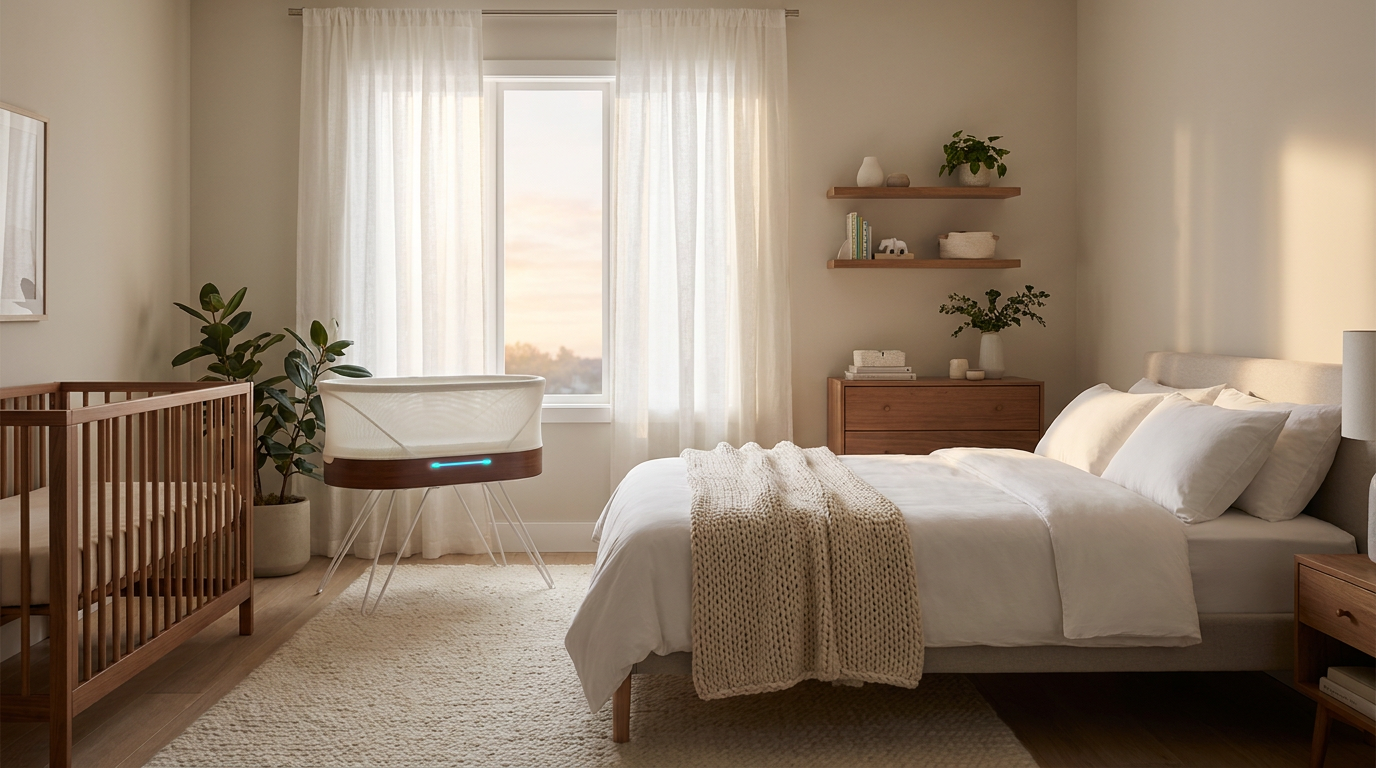
The argument for the smart bassinet centers on its ability to act as an extra set of hands during the most exhausting months of early parenthood. Premium models, most notably the SNOO Smart Sleeper developed by Dr. Harvey Karp, are designed to mimic the sensory environment of the womb. When a baby transitions from the tightly confined, noisy, and constantly moving environment of the uterus to a silent, stationary crib, the contrast can be jarring. Smart bassinets bridge this gap by providing continuous white noise and a gentle rocking motion. Proponents argue that this baseline level of sensory input helps newborns settle faster and stay asleep longer, effectively buying parents crucial hours of rest during a period notorious for severe sleep deprivation.[4][6]

The evidence supporting smart bassinets lies in their responsive technology. These devices are equipped with built-in microphones and sensors that actively monitor the infant's activity. When the bassinet detects fussing or crying, its algorithms automatically respond by increasing the volume of the white noise and escalating the speed of the rocking motion. If the baby is simply transitioning between sleep cycles—a common cause of brief nighttime wake-ups—the machine can often soothe them back to sleep without the parent ever needing to leave their bed. Only if the crying continues for several minutes, indicating a true need like hunger or a soiled diaper, will the machine stop and alert the parents via a smartphone notification.[2][6]
However, the argument against smart bassinets is anchored by two significant drawbacks: exorbitant cost and a highly limited lifespan. The industry-leading smart sleepers retail for nearly $1,700, a staggering investment for a piece of furniture that has a strict expiration date. Pediatric guidelines and manufacturer instructions dictate that babies must transition out of bassinets by the time they are five to six months old, or as soon as they can push up on their hands and knees. Spending premium prices for a device that will be packed away in less than half a year is a financial hurdle many families cannot justify, even when factoring in the robust resale market or monthly rental programs offered by some manufacturers.[2][4]
However, the argument against smart bassinets is anchored by two significant drawbacks: exorbitant cost and a highly limited lifespan.
Beyond the financial cost, pediatric sleep consultants frequently highlight a developmental argument against automated sleepers: the creation of a sleep prop dependency. While the constant rocking and shushing work wonders in the newborn phase, babies quickly learn to associate that specific motion with falling asleep. As infants approach three to four months of age, their sleep architecture matures, and they begin to wake more fully between sleep cycles. If a baby has never learned to fall asleep on a stationary surface, they may become entirely reliant on the smart bassinet's robotic intervention. Critics argue that this technology simply delays the inevitable work of teaching a child independent sleep skills.[4][5]

The evidence for this dependency becomes apparent during the weaning process. To transition a baby from a smart bassinet to a standard crib, parents must utilize weaning modes that gradually reduce the baseline motion. Even with these features, sleep consultants note that the transition can be highly disruptive. Babies who are accustomed to being rocked all night often struggle when placed in a motionless, silent wooden crib in their own nursery. For some families, the sleep gained during the first three months is paid back with interest during a difficult transition phase at month five, requiring formal sleep training to break the motion dependency that the smart bassinet created.[5][7]
Conversely, the argument for the standard bassinet champions simplicity, portability, and the early development of independent sleep habits. Traditional models, such as the widely popular Halo BassiNest or the Baby Delight Beside Me Dreamer, cost a fraction of their smart counterparts, typically ranging from $100 to $300. Because they lack heavy motorized bases, standard bassinets are often lightweight and highly portable. Many feature 360-degree swivel mechanisms, allowing a mother recovering from a C-section to effortlessly pull the sleep surface over her mattress for easy nighttime access, and then push it away to get out of bed.[2][3]
The evidence supporting standard bassinets highlights their role in fostering long-term sleep success. Because a traditional bassinet does not rock or shush the baby automatically, parents are forced to implement hands-on soothing techniques or allow the baby to practice self-soothing from day one. While this undoubtedly requires more effort from the parents in the immediate newborn phase, sleep experts note that babies who start on a stationary, flat surface often have a much smoother transition to a full-size crib later on. The sleep environment remains consistent, meaning the infant does not have to unlearn a motion dependency when they outgrow the bassinet weight limits.[4][5]

The primary argument against the standard bassinet is simply that the parent must serve as the engine. If a newborn wakes up at two in the morning and needs a gentle sway to connect their sleep cycles, the caregiver must physically lean over the bed or stand up to provide that motion. In a standard bassinet, the soothing stops the moment the parent's hand leaves the mattress. For families dealing with colic, reflux, or simply a highly sensitive sleeper, the lack of automated assistance can result in severely broken sleep for the adults, which carries its own well-documented risks for postpartum mental health and daytime functioning.[3][7]
Ultimately, this trade-off analysis requires families to weigh their immediate need for rest against their long-term sleep philosophies and financial realities. A smart bassinet fits well when parents have the disposable income or rental budget to afford it, when they lack nighttime support from a partner or family member, or when maximizing every possible minute of sleep in the first twelve weeks is the absolute highest priority. It is an incredibly effective tool for surviving the fourth trimester, provided parents are prepared to actively manage the weaning process before the six-month mark.[4][7]

On the other hand, a smart bassinet does not fit well when families are operating on a strict budget, when parents strongly prefer to establish independent, stationary sleep habits from birth, or when they want a lightweight, portable bed that can easily move from the bedroom to the living room during the day. A standard bassinet remains the most practical, cost-effective choice for the majority of families, offering a perfectly safe sleep environment without the complications of power cords, smartphone apps, or robotic dependencies. Regardless of the technology chosen, the safest bassinet is always the one that is firm, flat, and completely empty.[1][7]
How we got here
1990s
The 'Back to Sleep' campaign dramatically reduces SIDS rates by promoting supine sleep on firm surfaces.
2016
The SNOO Smart Sleeper launches, introducing robotic, responsive soothing technology to the consumer nursery market.
2022
The AAP updates its safe sleep guidelines, reinforcing the 'Bare is Best' rule and warning against inclined sleepers.
2026
New federal bassinet safety standards take effect, ensuring both smart and standard models meet rigorous structural requirements.
Viewpoints in depth
Sleep Technologists & Innovators
Advocates for using responsive technology to mimic the womb and maximize parental rest.
This camp argues that the modern nuclear family lacks the 'village' of support that historically helped soothe newborns. By using microphones and motors to mimic the constant motion and noise of the womb, smart bassinets act as a digital night nurse. They argue that maximizing parental sleep in the first three months is a critical health intervention that reduces the risk of postpartum depression and dangerous, accidental bed-sharing caused by sheer exhaustion.
Pediatric Sleep Consultants
Experts who caution against creating long-term motion dependencies.
While acknowledging the immediate relief smart bassinets provide, sleep consultants focus on the long-term developmental impact. They argue that babies must learn to self-soothe and connect their own sleep cycles. By outsourcing this process to a machine, parents often face a severe regression around four to six months when the baby outgrows the device. This camp advocates for establishing independent, stationary sleep habits from day one to avoid painful weaning transitions later.
Medical & Safety Consensus
Pediatricians focused strictly on the physiological safety of the sleep environment.
The medical consensus remains largely agnostic on the technology itself, focusing entirely on the structural safety of the sleep space. The American Academy of Pediatrics emphasizes that whether a bed rocks automatically or sits perfectly still, it must be firm, flat, and completely empty. Their primary concern is ensuring parents do not add aftermarket mattresses, loose blankets, or weighted swaddles to any bassinet, regardless of its price tag.
What we don't know
- Whether the long-term sleep architecture of babies raised in smart bassinets differs permanently from those raised in standard cribs.
- How upcoming 2026 federal safety standards might alter the design and availability of aftermarket smart bassinet accessories.
Key terms
- Sleep Prop
- Any external association, such as rocking, feeding, or a pacifier, that a baby relies on to fall asleep and connect sleep cycles.
- Sleep Architecture
- The structural organization of sleep, which in infants matures around 3 to 4 months of age, causing them to wake more fully between cycles.
- Weaning Mode
- A software setting on smart bassinets that gradually reduces the automated rocking motion to prepare the baby for a stationary crib.
- Bare is Best
- The AAP safety guideline mandating that an infant's sleep space contain only a firm mattress and a fitted sheet, with no loose items.
Frequently asked
Are smart bassinets safe for newborns?
Yes, provided they meet the AAP's 'Bare is Best' guidelines. They must have a firm, flat mattress, a tight-fitting sheet, and be completely free of loose blankets or pillows.
How long can a baby sleep in a bassinet?
Babies must transition out of any bassinet—smart or standard—by 5 to 6 months of age, or as soon as they can push up on their hands and knees.
Do smart bassinets cause sleep dependency?
They can. Because babies learn to associate the constant rocking with sleep, transitioning to a stationary crib often requires a gradual weaning process or formal sleep training.
Is room-sharing really necessary?
The AAP strongly recommends room-sharing (without bed-sharing) for at least the first six months, as it has been shown to reduce the risk of SIDS by up to 50%.
Sources
Source coverage
7 outlets
3 viewpoints surfaced







[1]American Academy of PediatricsMedical Consensus
Sleep-Related Infant Deaths: Updated 2022 Recommendations for Reducing Infant Deaths in the Sleep Environment
Read on American Academy of Pediatrics →[2]Forbes VettedSleep Technologists
Best Bassinets Tested 2025
Read on Forbes Vetted →[3]BabyGearLabMedical Consensus
The Best Bassinets | Tested & Ranked
Read on BabyGearLab →[4]The Baby Sleep SitePediatric Sleep Consultants
SNOO Smart Bassinet: Is It Really Worth It? And, Alternatives
Read on The Baby Sleep Site →[5]The Goodnight HousePediatric Sleep Consultants
How to wean your baby from the SNOO Smart Sleeper Bassinet
Read on The Goodnight House →[6]Happiest BabySleep Technologists
The State of Safe Sleep in 2025
Read on Happiest Baby →[7]Factlen Editorial TeamMedical Consensus
Synthesis by Factlen editorial team
Read on Factlen Editorial Team →

Every angle. Every day.
Get shopping stories with full source coverage and perspective breakdowns delivered to your inbox.