
The Science of Bioluminescent Beaches: How Microscopic Life Makes the Ocean Glow
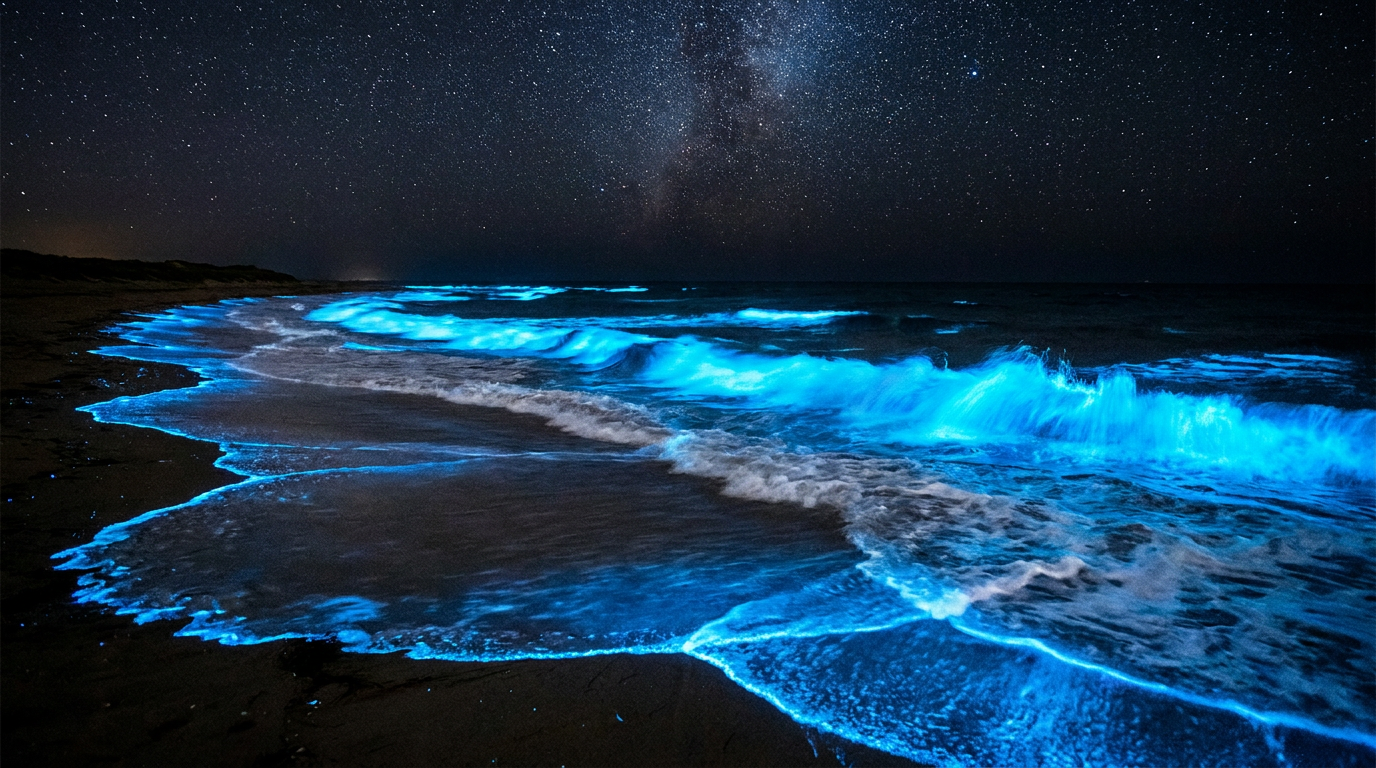
In a few rare locations around the world, the ocean lights up with a neon blue glow at night. This mesmerizing phenomenon is driven by microscopic plankton using chemical reactions to survive.
By Factlen Editorial Team
- Marine Biologists
- Focus on the ecological function of bioluminescence, the mechanics of dinoflagellates, and the monitoring of coastal ecosystems.
- Ecotourism Advocates
- View bioluminescent bays as magical, bucket-list travel destinations that drive local economies through noctourism.
- Conservationists
- Emphasize the fragility of bio bays and advocate for strict protections against light pollution, chemical runoff, and over-tourism.
What's not represented
- · Local residents living near bio bays
- · Commercial fishermen navigating red tides
Why this matters
Understanding how and why the ocean glows not only unlocks one of nature's most magical travel experiences, but also highlights the fragile balance of our coastal ecosystems. As climate change and coastal development threaten these rare bio bays, preserving them requires a delicate mix of responsible tourism and environmental protection.
Key points
- Bioluminescent beaches glow neon blue when microscopic marine organisms called dinoflagellates are agitated by movement.
- The light is produced by a chemical reaction and serves as a 'burglar alarm' defense mechanism against predators.
- Puerto Rico's Mosquito Bay holds the record for the brightest bioluminescence, sustained by a unique mangrove ecosystem.
- While some glowing waters are permanent bays, others are caused by unpredictable, temporary 'red tide' blooms.
- The delicate ecosystems are highly vulnerable to light pollution, chemical runoff, and climate change.
Imagine walking along a dark shoreline on a moonless night, only to watch the wet sand erupt in sparkling blue light with every footstep. Out in the surf, crashing waves glow like liquid neon, and fish darting through the shallows leave trails of electric fire in their wake. This is not a digital special effect, a trick of the light, or a scene from a science fiction novel; it is one of the ocean's most mesmerizing and accessible natural phenomena. Bioluminescent beaches transform ordinary coastlines into nocturnal light shows, drawing curious travelers, dedicated noctourists, and marine scientists alike to witness the water seemingly come alive in the dark.[6]
The secret behind this ethereal glow lies entirely in microscopic marine life. While many deep-ocean creatures possess the ability to produce light, coastal bioluminescence is most commonly caused by dinoflagellates—single-celled plankton that drift near the ocean's surface. These tiny, plant-like organisms are found in marine environments around the world, but they only create a visible spectacle when they gather in massive, dense concentrations. In the most vibrant bays, up to a million of these organisms can inhabit a single gallon of seawater, turning the ocean into a highly reactive canvas of light.[1][4]
The glow itself is the result of a precise and incredibly rapid chemical reaction occurring within the cell. Inside the dinoflagellate, a light-emitting molecule called luciferin reacts with oxygen, a process catalyzed by an enzyme known as luciferase. When the organism is physically agitated by the movement of a breaking wave, a kayak paddle, or a swimming predator, the cell membrane stretches. This mechanical stress instantly triggers the chemical reaction, resulting in a brilliant flash of blue-green light that lasts for just one-tenth of a second. Because millions flash simultaneously, the human eye perceives a continuous, shimmering glow.[4][5][6]

Marine biologists believe this spectacular light show serves a vital, life-or-death evolutionary purpose: survival. For a microscopic organism sitting at the very bottom of the food chain, bioluminescence acts as a biological 'burglar alarm.' When a small predator, such as a shrimp-like copepod, attempts to consume the dinoflagellate, the sudden, bright flash of light startles the attacker. More importantly, the neon glow illuminates the copepod in the dark water, effectively painting a glowing target on its back for larger, secondary predators to see and consume, thereby saving the dinoflagellate.[1][5]
The appearance and reliability of bioluminescence vary drastically depending on the geographic location and the specific species involved. In places like Southern California, the glow is often tied to unpredictable 'red tide' events. During the day, massive blooms of a dinoflagellate species called Lingulodinium polyedra swim toward the surface to photosynthesize. They contain a reddish-brown pigment that acts as a natural sunscreen, turning the daytime ocean a murky, uninviting rust color. But when the sun goes down, these same organisms switch on their bioluminescent capabilities, turning the murky red tide into a neon blue spectacle.[1]
These ephemeral Californian blooms can last anywhere from a few days to over a month, driven by complex ocean currents, water temperature shifts, and nutrient upwelling. Because they are highly unpredictable, catching a Pacific red tide requires a mix of vigilance and luck. To better understand them, institutions like the Scripps Institution of Oceanography deploy advanced underwater microscopes, called Imaging FlowCytobots. These devices continuously monitor the water and use machine learning algorithms to identify the specific plankton species present, helping scientists track and predict these elusive glowing blooms in real-time.[1]
These ephemeral Californian blooms can last anywhere from a few days to over a month, driven by complex ocean currents, water temperature shifts, and nutrient upwelling.
In stark contrast to the fleeting red tides of the open ocean, a few rare locations on Earth boast permanent bioluminescent bays. The most famous of these is Mosquito Bay on the Puerto Rican island of Vieques. Recognized by Guinness World Records as the brightest bio bay in the world, Mosquito Bay maintains a year-round glow due to its highly specific geography. The bay features a narrow inlet that prevents the dinoflagellates from washing out to sea, while dense surrounding mangrove forests drop nutrient-rich leaves into the water, providing a constant food source.[3][4]

Puerto Rico is actually home to three permanent bio bays—Mosquito Bay, Laguna Grande, and La Parguera—making the island a global epicenter for the phenomenon. In these protected, shallow waters, the concentration of dinoflagellates remains consistently high regardless of the season. Visitors can kayak through the dark, calm waters, watching their paddles drip with what looks like liquid stardust. The experience is so reliable and awe-inspiring that it has spawned a thriving local ecotourism industry entirely dedicated to nocturnal exploration and environmental education.[3]
Beyond the Caribbean, other global hotspots offer their own unique variations of the glowing sea. The Luminous Lagoon in Jamaica is another highly concentrated dinoflagellate bay where visitors can actually swim in the glowing water, leaving trails of light with every stroke. Meanwhile, in the Maldives, the famous 'Sea of Stars' on Vaadhoo Island is often caused by a different organism altogether: bioluminescent ostracods, or micro-shrimp. Unlike dinoflagellates, which flash for a fraction of a second, these tiny crustaceans can glow for up to a minute when disturbed, leaving long, glowing footprints in the wet sand.[4]
The growing popularity of these destinations has fueled a rising travel trend known as 'noctourism'—traveling specifically for nighttime natural phenomena, much like chasing a solar eclipse or the Northern Lights. For coastal communities, this influx of visitors provides a powerful economic incentive to protect their marine environments. Local guides and outfitters increasingly use clear-bottom kayaks and enforce strict environmental rules to ensure that the magical experience does not degrade the very ecosystem that creates it, proving that tourism and conservation can occasionally work hand in hand.[2][3]

However, the delicate balance of these bioluminescent ecosystems is under constant threat. Dinoflagellates are highly sensitive to microscopic changes in water chemistry and temperature. Chemical runoff from agriculture, boat fuel spills, and even the bug spray and sunscreen worn by tourists can prove highly toxic to the microorganisms. In 2014, Mosquito Bay famously 'went dark' for several months due to a combination of shifting weather patterns and environmental stress, serving as a stark, real-world reminder of how fragile these glowing bays truly are when pushed beyond their limits.[3][4]
Light pollution is another major adversary of the bioluminescent experience. The natural glow of the plankton is relatively faint compared to modern artificial lighting. As coastal development increases, the ambient light from beachfront hotels, streetlamps, and passing cars can easily wash out the natural blue luminescence, rendering it invisible to the human eye. Conservationists are actively working to establish dark-sky reserves around major bio bays, ensuring that the surrounding areas remain pitch black so the ocean's subtle light can continue to shine through the darkness.[2][3]
It is also important to note that not all glowing water is entirely benign. While the dinoflagellates in permanent, protected bio bays are generally harmless, some of the unpredictable red tides that occur in open coastal waters can be classified as Harmful Algal Blooms (HABs). Certain species of plankton produce potent neurotoxins that can accumulate in local shellfish, harm marine life, and even cause respiratory irritation for beachgoers when the crashing waves aerosolize the toxins. Local authorities closely monitor these blooms to ensure public safety before allowing swimmers into the water.[1][4]

For those hoping to witness the phenomenon firsthand, timing and environmental conditions are everything. The best viewing almost always occurs on warm, dark nights, preferably during a new moon when the sky is completely devoid of moonlight. Observers should allow their eyes at least twenty minutes to fully adjust to the darkness. Whether it is a fleeting red tide on the California coast or the reliable brilliance of a Caribbean mangrove bay, a bioluminescent beach remains one of the most profound reminders that the ocean is a living, breathing entity.[1][2][4][6]
How we got here
Early 1900s
Scientists at the Scripps Institution of Oceanography begin documenting predictable bioluminescent red tides off the coast of Southern California.
2008
Mosquito Bay in Puerto Rico is officially recognized by Guinness World Records as the brightest bioluminescent bay in the world.
2014
Mosquito Bay mysteriously 'goes dark' for several months due to environmental stress, sparking renewed conservation efforts.
2020
Massive red tide events in California create viral bioluminescence displays, popularizing the phenomenon globally on social media.
Viewpoints in depth
Marine Biologists
Focusing on the ecological function and mechanics of the glow.
For scientists, bioluminescence is less about magic and more about survival and ecosystem health. Researchers view the glow as a sophisticated biological 'burglar alarm' that helps microscopic plankton evade predators. Institutions like Scripps Oceanography use these blooms as indicators of broader ocean conditions, deploying advanced machine-learning cytobots to track the shifting populations of dinoflagellates and understand how climate change impacts these delicate cellular mechanisms.
Ecotourism Advocates
Viewing the bays as vital economic engines and bucket-list destinations.
The travel industry and local outfitters see bioluminescence as a cornerstone of 'noctourism.' For islands like Puerto Rico and the Maldives, the glowing waters draw thousands of visitors, providing a crucial source of income for local guides, hotels, and conservation programs. Advocates argue that when managed responsibly with clear-bottom kayaks and strict rules, tourism creates a financial incentive for communities to fiercely protect their coastal environments.
Conservationists
Warning of the extreme fragility of bioluminescent ecosystems.
Environmentalists emphasize that bio bays are incredibly sensitive to human interference. They point to instances where bays have temporarily 'gone dark' as proof that chemical runoff, boat fuel, and even the bug spray worn by tourists can devastate dinoflagellate populations. This camp pushes for stringent regulations, including bans on swimming in certain bays and the establishment of dark-sky reserves to prevent coastal light pollution from washing out the natural glow.
What we don't know
- Scientists do not fully understand the exact biochemical triggers that cause certain dinoflagellate populations to suddenly bloom into massive red tides.
- It remains unclear how long-term ocean warming and acidification will ultimately impact the global distribution of bioluminescent plankton.
Key terms
- Dinoflagellate
- A type of single-celled marine plankton responsible for most coastal bioluminescence.
- Luciferin
- The light-emitting molecule within the plankton that reacts with oxygen to produce a glow.
- Red Tide
- A massive bloom of algae that turns the ocean reddish-brown during the day and can glow blue at night.
- Noctourism
- A travel trend focused on visiting destinations specifically to experience nighttime natural phenomena.
- Harmful Algal Bloom (HAB)
- An overgrowth of algae that produces toxins harmful to marine life and humans.
Frequently asked
Why does the ocean glow blue at night?
The glow is a defense mechanism used by microscopic plankton called dinoflagellates. When disturbed by movement, they trigger a chemical reaction that emits a flash of blue light to startle predators.
Is it safe to swim in bioluminescent water?
In permanent bio bays, it is generally safe. However, some glowing waters are caused by 'red tides' that can produce harmful toxins, so it is always best to check local advisories before swimming.
Where is the brightest bioluminescent bay?
Mosquito Bay on the island of Vieques in Puerto Rico holds the Guinness World Record for the brightest bioluminescence, thanks to its unique geography and nutrient-rich mangroves.
When is the best time to see bioluminescence?
The phenomenon is best viewed on warm, dark nights during a new moon. The lack of moonlight makes the neon blue glow of the plankton stand out much more vividly.
Sources
Source coverage
6 outlets
3 viewpoints surfaced




[1]Scripps Institution of OceanographyMarine Biologists
FAQ: Red Tides and Bioluminescence off California
Read on Scripps Institution of Oceanography →[2]Marine Biological LaboratoryConservationists
America's 5 Best Bioluminescent Beaches
Read on Marine Biological Laboratory →[3]Discover Puerto RicoEcotourism Advocates
Exploring the Bioluminescent Bays of Puerto Rico
Read on Discover Puerto Rico →[4]Global RescueEcotourism Advocates
What Makes a Bioluminescent Beach Glow?
Read on Global Rescue →[5]SciShowMarine Biologists
Why Is (Almost) All Bioluminescence in the Ocean?
Read on SciShow →[6]Factlen Editorial TeamMarine Biologists
Synthesis by Factlen editorial team
Read on Factlen Editorial Team →



Every angle. Every day.
Get travel stories with full source coverage and perspective breakdowns delivered to your inbox.