
Algorithmic Determinism vs. Personal Curation: How Users Are Reclaiming Their Taste
As recommendation algorithms increasingly homogenize culture and dictate digital consumption, a growing movement of users is turning back to intentional, human-led curation to reclaim their personal taste.
By Factlen Editorial Team
- Cultural Critics
- Argue that algorithmic feeds flatten culture into a homogenized average and destroy the friction necessary to develop genuine taste.
- Human Curators
- View the flood of automated content as an opportunity, positioning human editorial judgment as an essential, premium service.
- Platform Engineers
- Argue that algorithms solve the problem of information overload and surface relevant content that users would otherwise miss.
- Everyday Users
- Caught between the convenience of the feed and the desire for authenticity, seeking tools to balance discovery with control.
What's not represented
- · Independent artists whose work is suppressed by algorithmic changes
- · Small business owners forced to adapt their aesthetics to platform algorithms
Why this matters
If you don't actively curate your own media, an algorithm designed to maximize platform engagement will do it for you, subtly shaping your hobbies, purchases, and worldview into a homogenized average. Understanding how these systems work is the first step to regaining control over your digital diet.
Key points
- Recommendation algorithms optimize for engagement, which critics argue leads to a homogenized, flattened culture.
- Developing genuine personal taste requires friction and intentionality, which automated feeds are designed to eliminate.
- A growing 'curation economy' is seeing users turn to human-led newsletters and podcasts for high-fidelity content filtering.
- While platforms like Meta offer chronological feed toggles, the default experience remains heavily algorithmic to drive ad revenue.
- Users are reclaiming their taste through digital literacy, intentional searching, and a return to physical media and slow hobbies.
The modern digital dilemma often begins with a simple realization: you open an app, scroll for twenty minutes, and suddenly notice your feed looks exactly like everyone else's. The Guardian recently posed the question that is quietly haunting the internet: "Have I been influenced, or is this actually me?" As social media platforms have perfected their recommendation engines, the line between genuine personal preference and algorithmic programming has blurred, sparking a cultural reckoning over how we discover what we love.[1][7]
For years, the promise of the algorithm was frictionless personalization. By analyzing billions of data points, platforms promised to serve users exactly what they wanted to see, eliminating the effort of searching. But as these systems have matured, critics and users alike are noticing a paradox: hyper-personalization has led to mass homogenization. When an algorithm optimizes for what is most broadly engaging, it inevitably flattens culture into a predictable aesthetic, stripping away the quirks and challenges that define true personal taste.[3][4][1]
To understand how taste became automated, it is necessary to look at the architecture of the modern feed. In the early days of social media, platforms operated on a deterministic chronological model. Users saw posts from people they followed in the exact order they were published. But as user bases swelled, platforms argued that chronological sorting led to information overload. In 2016, Instagram famously claimed that users were missing 70 percent of their feeds, using this as the primary justification to introduce algorithmic ranking.[6][5]

Today, those ranking systems are highly sophisticated machine learning models designed with a singular goal: maximizing engagement. The algorithm does not know if a piece of content is culturally significant, factually accurate, or artistically profound. It only knows how humans react to it. Every micro-interaction is tracked and quantified. If you pause on a video for an extra half-second, expand a caption, or tap a profile picture, the system registers a definitive signal of interest.[6]
These signals are fed into predictive models that weigh recency, relationship history, and profile authority. However, the heaviest weight is almost always given to watch time and virality. The result is a powerful feedback loop. If a specific style of video—say, a hyper-edited recipe or a particular interior design aesthetic—holds attention, the algorithm serves it to millions of similar users. Creators, seeing what the algorithm rewards, begin to mimic that exact style to chase reach, flooding the platform with identical content.[5][6][3]
Cultural critic Kyle Chayka refers to this phenomenon as "Filterworld." In this environment, culture is not pushed forward by bold, challenging ideas, but by whatever is most frictionless and transmissible across a network. The algorithm acts as a passive aggregator, crunching human behavior into an average and spitting it back out as a template for consumption. This is why coffee shops in Brooklyn, Berlin, and Tokyo suddenly share the exact same minimalist aesthetic, and why viral recipes often prioritize visual spectacle over actual flavor.[4][1]
The algorithm acts as a passive aggregator, crunching human behavior into an average and spitting it back out as a template for consumption.
The psychological toll of this automated curation is a subtle erosion of identity. Developing personal taste has historically been a slow, intentional process. It requires trial, error, curiosity, and occasionally, boredom. It involves encountering art, music, or fashion that you might initially dislike, only to find it growing on you over time. Algorithmic feeds remove this friction entirely, replacing the journey of discovery with a continuous drip of immediate, frictionless satisfaction.[1][3][4]

But a quiet rebellion is taking shape. Recognizing the limits of algorithmic discovery, a growing cohort of users is actively seeking to reclaim their digital autonomy. This pushback is driving the rise of the "Curation Economy"—a shift away from automated feeds and back toward high-fidelity human filters. Instead of relying on a "For You" page, users are turning to specialized newsletters, niche podcasts, and curated Discord communities to find recommendations with actual context and friction.[1][7][3]
The fundamental difference between an algorithm and a human curator lies in intent. An algorithm curates to keep you on the platform; a human curates to share a specific point of view. Human tastemakers can explain the history behind a trend, contextualize a piece of media, and most importantly, challenge their audience with something unexpected. In an era where generative AI threatens to flood the internet with an infinite volume of synthetic content, this human editorial judgment is rapidly becoming a premium commodity.[3][4][7]
Social media companies are not entirely blind to this shifting sentiment. Facing pressure from users and intensifying competition, platforms have begun offering tools to bypass the algorithm. Meta, for instance, rolled out updates allowing Facebook and Instagram users to toggle back to chronological feeds or create curated "Favorites" lists. These features are designed to address the growing complaint that users are missing updates from actual friends in favor of algorithmically injected viral content.[2]

Yet, these chronological toggles are often treated as secondary features rather than default experiences. On most platforms, the app will revert to the algorithmic feed upon a fresh launch. The business logic behind this is undeniable: internal studies have consistently shown that algorithmic feeds generate significantly more watch time, which translates directly into higher ad revenue. The platforms will offer chronological options as an escape valve for frustrated users, but the algorithm remains the financial engine.[6][5][2]
For everyday users, reclaiming taste does not necessarily require abandoning social media, but rather changing the terms of engagement. Digital literacy now involves treating the algorithm as a tool rather than an oracle. This means actively searching for specific topics rather than passively scrolling, aggressively pruning follower lists, and using chronological toggles when available. It also means recognizing when a feed is serving up homogenized trends and actively choosing to step away.[1][7][5][3]

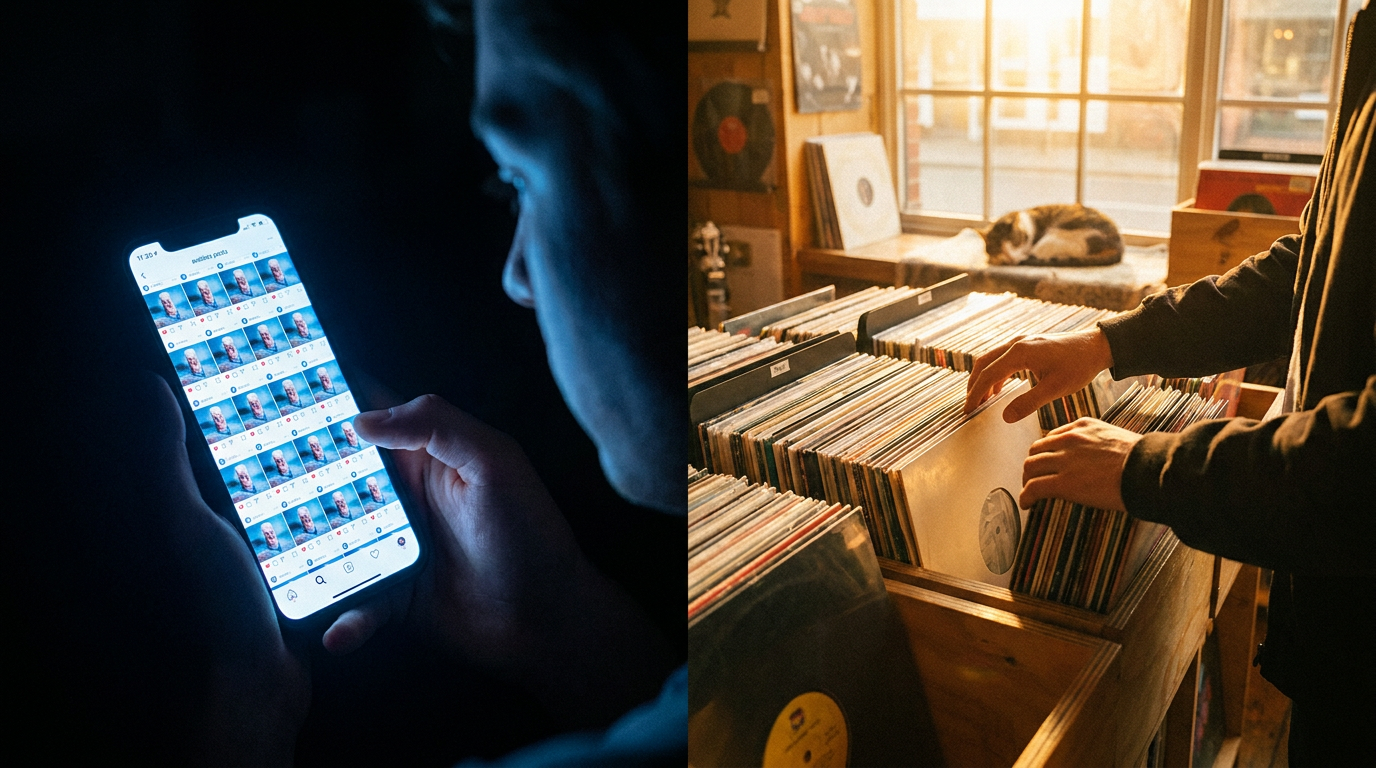
Beyond the screen, the most effective antidote to algorithmic determinism is a return to the physical and the intentional. Whether it is cooking a traditional family recipe instead of a viral hack, collecting physical media like vinyl records, or simply reading a book recommended by a friend, these slow hobbies build a repertoire that reflects genuine identity rather than internet whims. In an age of constant, automated novelty, cultivating your own taste has become a quiet but powerful act of resistance.[1][7]
How we got here
2010
Instagram launches with a purely chronological feed, displaying posts in the exact order they are published.
2016
Instagram switches to an algorithmic feed, citing information overload and claiming users missed 70 percent of their content.
2022
Meta reintroduces chronological toggles for Facebook and Instagram in response to user backlash over missed posts.
2024
The 'Curation Economy' accelerates as users increasingly seek out human-led newsletters and podcasts to bypass algorithmic feeds.
2026
Cultural pushback against AI-generated content drives a premium on authentic human taste and intentional media consumption.
Viewpoints in depth
Platform Engineers
Argue that algorithms solve the problem of information overload and surface relevant content that users would otherwise miss.
From an engineering perspective, the internet simply contains too much information for a chronological feed to be useful at scale. Platform developers argue that without recommendation algorithms, users would be buried under a mountain of irrelevant posts, missing major life updates from close friends or content that genuinely aligns with their interests. They view the algorithm not as a cultural dictator, but as a necessary utility that filters noise, aids discovery, and connects niche creators with audiences they could never reach organically.
Cultural Critics
Argue that algorithmic feeds flatten culture into a homogenized average and destroy the friction necessary to develop genuine taste.
Critics argue that because algorithms optimize strictly for engagement metrics—like watch time and shares—they inherently reward content that is frictionless, visually spectacular, or emotionally reactive. This creates a feedback loop where creators mimic whatever goes viral, leading to a flattening of aesthetics across fashion, food, and design. They contend that genuine personal taste requires the friction of encountering challenging or unfamiliar art, a process that is short-circuited when a machine constantly feeds users exactly what it thinks they want.
Human Curators
View the flood of automated content as an opportunity, positioning human editorial judgment as an essential, premium service.
As generative AI makes it possible to create infinite amounts of synthetic media, human tastemakers see their role becoming more critical than ever. Newsletter writers, niche podcasters, and specialized community leaders argue that an algorithm can only predict what you might click on, but a human curator can explain why something matters. They are building businesses on the premise that high-fidelity filtering, context, and a distinct point of view are the ultimate antidotes to algorithmic fatigue.
What we don't know
- Whether social media platforms will eventually be forced by regulators to make chronological feeds the default rather than an opt-in toggle.
- How the integration of generative AI directly into search and social feeds will further alter the landscape of cultural discovery.
- If the 'curation economy' can scale to reach mainstream audiences, or if it will remain a premium service for a niche demographic.
Key terms
- Algorithmic Determinism
- The concept that a user's digital experience and cultural consumption are entirely dictated by automated recommendation systems.
- Filter Bubble
- A state of intellectual isolation that can result from personalized searches and algorithms serving only information that aligns with a user's past behavior.
- Curation Economy
- An emerging digital landscape where value is placed on human-led filtering and selection of content amidst an overabundance of algorithmic media.
- Chronological Feed
- A social media display that shows posts in the exact order they were published, without algorithmic ranking or filtering.
- Engagement Metrics
- Data points like watch time, likes, comments, and shares that algorithms use to measure how effectively content holds a user's attention.
Frequently asked
Can I turn off the algorithm on Instagram or Facebook?
Yes, both platforms offer chronological toggles. On Instagram, you can select the 'Following' feed, and Facebook offers a 'Feeds' tab for chronological posts, though both default back to the algorithmic view upon a fresh launch.
What is the 'curation economy'?
It is a growing trend where users seek out human tastemakers—like newsletter writers, specialized podcasters, or niche community leaders—to filter content, rather than relying on automated recommendations.
How does a recommendation algorithm decide what I like?
It tracks your micro-interactions, such as how long you pause on a video, what you like or share, and the authority of the accounts you engage with, to predict what will keep you on the app longest.
What is 'Filterworld'?
A term coined by cultural critic Kyle Chayka to describe an environment where culture is flattened by algorithms, prioritizing content that is frictionless and broadly engaging over art that is challenging or unique.
Sources
Source coverage
7 outlets
4 viewpoints surfaced







[1]The GuardianEveryday Users
‘Have I been influenced, or is this actually me?’ How personal taste fell out of fashion
Read on The Guardian →[2]CBS NewsPlatform Engineers
As competition intensifies, Facebook offers chronological feed for friends' posts
Read on CBS News →[3]PR DispatchHuman Curators
Are Algorithms Ruining Personal Taste? How Tech Shapes What We Like
Read on PR Dispatch →[4]Behavioral ScientistCultural Critics
How to Cultivate Taste in the Age of Algorithms
Read on Behavioral Scientist →[5]UX CollectiveCultural Critics
It's (far past) time to control the algorithm
Read on UX Collective →[6]CodecademyPlatform Engineers
Instagram Chronological Feed Change: How Algorithm Works
Read on Codecademy →[7]Factlen Editorial TeamEveryday Users
Synthesis by Factlen editorial team
Read on Factlen Editorial Team →

Every angle. Every day.
Get technology stories with full source coverage and perspective breakdowns delivered to your inbox.