
How Local AI Tools Are Putting Private, Uncensored Intelligence on Your Laptop
The era of relying exclusively on cloud-based artificial intelligence is ending as powerful new hardware and streamlined software allow users to run advanced language models entirely on their own devices.
By Factlen Editorial Team
- Open-Source Developers & Enthusiasts
- This community values the democratization, transparency, and cost-efficiency of running models locally.
- Privacy Advocates & Regulated Industries
- This camp views local AI as the only viable path forward for integrating machine intelligence into sensitive workflows.
- Frontier AI Researchers & Cloud Providers
- This group acknowledges local AI's utility but emphasizes that the most advanced reasoning still requires massive cloud infrastructure.
What's not represented
- · Hardware Manufacturers
- · Cloud Service Providers
Why this matters
Running AI locally on your own hardware means your private data, sensitive documents, and daily queries never leave your device. It eliminates subscription fees, works entirely offline, and represents a massive shift in how everyday users control and interact with machine intelligence.
Key points
- Local AI allows users to run powerful language models directly on their laptops without an internet connection.
- Dedicated Neural Processing Units (NPUs) in modern laptops make this possible without draining battery life.
- Tools like Ollama and LM Studio have simplified the setup process into a frictionless, app-store-like experience.
- The shift guarantees absolute data privacy, making it ideal for healthcare, legal, and personal use.
- While cloud models still lead in complex reasoning, local models are highly capable for daily tasks.
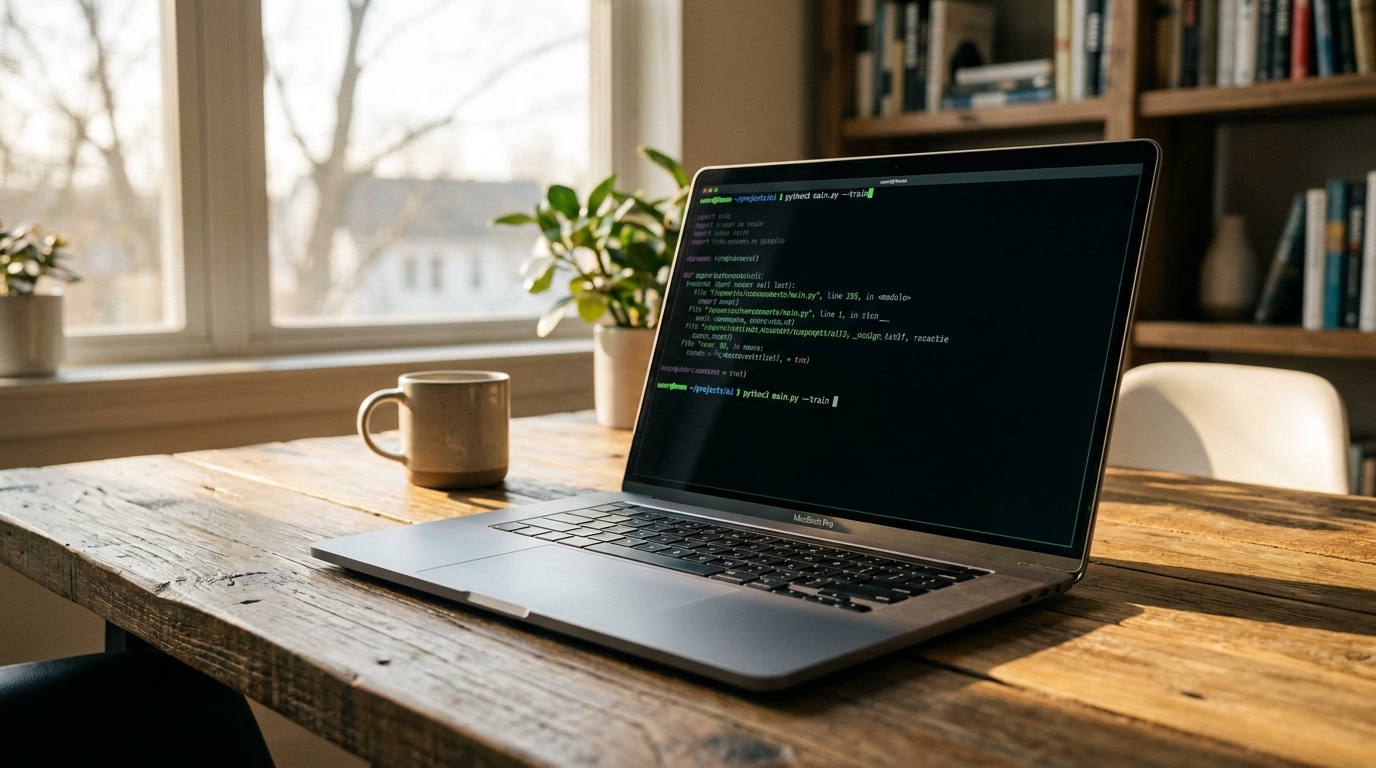
For the past three years, interacting with artificial intelligence meant sending your thoughts, data, and questions to a distant server farm. Whether drafting an email, writing code, or summarizing a sensitive document, the process required an internet connection and a leap of faith that the cloud provider would keep your data secure. But in 2026, a quiet revolution is shifting the center of gravity in the tech world. The most important AI trend isn't happening in a massive data center—it is happening directly on your laptop.[3]
This shift is known as "local AI," and it represents a fundamental democratization of machine intelligence. Instead of renting access to a proprietary model via an API, users are downloading open-weight models and running them entirely on their own hardware. The implications are profound: zero subscription fees, zero network latency, and absolute data privacy.[2]
To understand why this is suddenly possible, you have to look at the hardware. Until recently, running a highly capable Large Language Model (LLM) required a massive, power-hungry desktop graphics card. A standard thin-and-light laptop would simply freeze or drain its battery in minutes if asked to process billions of parameters.[5]
That hardware bottleneck has been shattered by the widespread adoption of Neural Processing Units (NPUs). In 2026, chips like Apple's M4, Qualcomm's Snapdragon X2, and AMD's Ryzen AI 400 series come equipped with dedicated silicon designed specifically for the matrix math that powers neural networks. These NPUs can process AI workloads using a fraction of the power required by a traditional CPU or GPU, enabling sustained, on-device AI without turning a laptop into a space heater.[5][6]

Microsoft's push for "Copilot+ PCs" set a baseline requiring NPUs capable of at least 40 Trillion Operations Per Second (TOPS). While initially marketed for background tasks like video blurring or live captioning, developers quickly realized this hardware was perfectly suited for running full-scale language models locally.[5][6]
But hardware is only half the story. The software ecosystem has matured at a staggering pace, transforming what was once a complex, command-line ordeal into a frictionless consumer experience. Two tools in particular—Ollama and LM Studio—have emerged as the undisputed gateways to local AI.[1][3]
Ollama is often described as the "Docker for AI." It operates as a lightweight background service, allowing developers and enthusiasts to download and run models with a single terminal command. It automatically detects the system's hardware, allocates memory, and exposes a local API, making it trivial to integrate private AI into custom applications or coding environments.[1]
For users who prefer a graphical interface, LM Studio acts like an "iTunes for AI." It provides a clean desktop application where users can browse, download, and chat with thousands of open-source models using simple sliders and buttons. Both tools utilize a technique called "quantization," which compresses the precision of a model's numerical weights so that a massive AI can fit comfortably within the 16GB or 32GB of RAM found in modern laptops.[1]

The models themselves have also crossed a critical threshold of capability. Open-weight models like Meta's Llama 3 series, Mistral, and Qwen are now highly sophisticated. While they may not match the absolute cutting-edge reasoning of the largest frontier cloud models, they easily handle the tasks that required GPT-4-class APIs just 18 months ago.[2][3]
The models themselves have also crossed a critical threshold of capability.
The most immediate and transformative benefit of this local ecosystem is privacy. When an AI model runs on your own silicon, your prompts, documents, and data never leave your device. There are no third-party API logs, no data processing agreements, and no risk of sensitive information being ingested into a future training run.[2][3]
This absolute data sovereignty is unlocking AI adoption in highly regulated industries. In healthcare, for example, researchers are successfully fine-tuning local Llama 3 models on hospital workstations to automatically generate physician letters and summarize patient histories. Because the inference happens entirely within the hospital's local IT infrastructure, it eliminates the HIPAA compliance risks associated with sending patient data to external cloud providers.[4]
Similar transformations are happening in the legal and financial sectors, where attorney-client privilege and proprietary data make cloud AI a non-starter. Local AI allows these professionals to leverage the power of language models to summarize contracts or analyze financial reports without ever exposing their data to the internet.[3]

Beyond privacy, local AI fundamentally changes the economics and reliability of machine intelligence. Cloud APIs charge per token, meaning high-volume tasks can quickly become prohibitively expensive. Local inference is entirely free after the initial hardware purchase. Furthermore, because the model lives on the device, it works flawlessly on an airplane, in a remote field location, or during a network outage.[2][3]
The elimination of network latency is another subtle but powerful advantage. Cloud AI inherently involves a delay of hundreds of milliseconds as data travels to a server and back. Local models respond almost instantly, making them vastly superior for real-time applications like voice assistants, live translation, and inline code completion.[2][3]
However, the local AI revolution does not spell the end of the cloud. Industry experts acknowledge a persistent gap: frontier cloud models still maintain a 3-to-6-month lead in complex reasoning, advanced coding, and multimodal capabilities. The future is widely expected to be hybrid.[3]
In this hybrid architecture, everyday tasks—drafting emails, summarizing local documents, and handling sensitive data—will default to the fast, private, and free local NPU. Only when a task requires massive, complex reasoning will the system seamlessly route the query to a heavy-duty cloud model.[3]

Ultimately, the rise of local AI represents a shift in power. By putting the weights and the compute directly into the hands of users, the technology industry is ensuring that artificial intelligence becomes a personal utility rather than a centralized service. It is a future where your AI works for you, on your machine, and keeps your secrets safe.[7]
How we got here
Early 2023
Open-source models begin leaking, sparking grassroots efforts to run them on consumer hardware.
Mid 2024
Microsoft introduces the "Copilot+ PC" standard, mandating NPUs capable of 40 TOPS for local AI tasks.
Late 2024
Tools like Ollama and LM Studio mature, replacing complex command-line setups with frictionless, one-click installations.
2025
Open-weight models like Llama 3 achieve performance parity with previous-generation frontier cloud models.
2026
Local AI becomes mainstream in regulated industries like healthcare and law, driven by strict data privacy requirements.
Viewpoints in depth
Privacy Advocates & Regulated Industries
This camp views local AI as the only viable path forward for integrating machine intelligence into sensitive workflows.
For healthcare providers, legal firms, and enterprise compliance officers, cloud-based AI represents an unacceptable data risk. They argue that sending proprietary data or patient records to third-party servers violates core confidentiality principles, even with enterprise agreements. This group champions local AI because it guarantees data sovereignty—the model weights live on the local machine, and the prompts never cross a network boundary.
Open-Source Developers & Enthusiasts
This community values the democratization, transparency, and cost-efficiency of running models locally.
Developers and tech enthusiasts celebrate local AI as a release from the "API tax" imposed by major tech conglomerates. By using tools like Ollama and LM Studio, they can experiment, build applications, and run thousands of queries without paying per-token fees. They prioritize the freedom to modify, fine-tune, and inspect open-weight models, viewing local execution as a safeguard against corporate censorship and sudden API deprecations.
Frontier AI Researchers
This group acknowledges local AI's utility but emphasizes that the most advanced reasoning still requires massive cloud infrastructure.
Researchers working on the bleeding edge of artificial general intelligence (AGI) point out that while local models are highly capable, they are fundamentally constrained by the memory and compute limits of consumer hardware. They argue that for complex, multi-step reasoning, advanced coding, and rich multimodal tasks, users will always need to rely on massive cloud clusters. In their view, local AI is a useful edge-computing tool, but the true breakthroughs will remain in the cloud.
What we don't know
- It remains unclear how quickly local hardware will scale to handle the massive memory requirements of next-generation multimodal models.
- The long-term business models of companies producing open-weight models without API revenue are still evolving.
- It is unknown if future operating system updates will lock down local AI capabilities to favor proprietary, built-in assistants.
Key terms
- Local AI
- The practice of running artificial intelligence models directly on personal hardware (like a laptop or phone) rather than relying on internet-connected cloud servers.
- NPU (Neural Processing Unit)
- A specialized microchip designed specifically to handle the complex mathematical operations required by AI models efficiently and with low power consumption.
- Quantization
- A compression technique that reduces the precision of an AI model's internal numbers, allowing massive models to fit into the limited memory of consumer laptops.
- Inference
- The process of an AI model generating a response or prediction based on a user's prompt, distinct from the initial training phase.
- Open-weight model
- An AI model whose core architecture and trained parameters (weights) are made publicly available for anyone to download, use, and modify.
Frequently asked
Do I need internet access to use local AI?
No. Once the model weights are downloaded to your device, local AI tools like Ollama and LM Studio run entirely offline, making them perfect for travel or secure environments.
Will running an AI model drain my laptop battery?
Older laptops using their CPU or GPU will drain quickly. However, modern laptops equipped with Neural Processing Units (NPUs) are designed to run these models highly efficiently, preserving battery life.
Are local models as smart as cloud models?
Local open-weight models like Llama 3 are highly capable and match the performance of cloud models from 12 to 18 months ago. While they trail the absolute cutting-edge cloud models in complex reasoning, they are more than sufficient for daily tasks.
Is it difficult to set up local AI?
Not anymore. Tools like LM Studio provide a simple, graphical interface similar to an app store, allowing anyone to download and chat with models without needing to use the command line.
Sources
Source coverage
7 outlets
3 viewpoints surfaced







[1]DEV CommunityOpen-Source Developers & Enthusiasts
Ollama vs. LM Studio: Your First Guide to Running LLMs Locally
Read on DEV Community →[2]CodecademyOpen-Source Developers & Enthusiasts
How to Run Llama 3 Locally
Read on Codecademy →[3]MindStudioFrontier AI Researchers & Cloud Providers
Local AI vs Cloud AI in 2026: When to Run Models on Your Own Hardware
Read on MindStudio →[4]FrontiersPrivacy Advocates & Regulated Industries
Fine-tuning a local LLaMA-3 large language model for automated privacy-preserving physician letter generation in radiation oncology
Read on Frontiers →[5]Local AI MasterOpen-Source Developers & Enthusiasts
NPU Comparison 2026: Intel vs Qualcomm vs AMD vs Apple
Read on Local AI Master →[6]JoybuyFrontier AI Researchers & Cloud Providers
AI Laptop Buyer's Guide 2026: A Technical Guide to Copilot+ PCs
Read on Joybuy →[7]Factlen Editorial Team
Synthesis by Factlen editorial team
Read on Factlen Editorial Team →

Every angle. Every day.
Get ai stories with full source coverage and perspective breakdowns delivered to your inbox.