
The End of the Password: Why Passkeys Are Actually Safer Than Your Longest Phrase
As passkey adoption hits 75% among consumers in 2026, cybersecurity experts explain why a simple face scan or device PIN offers mathematically stronger protection than a complex password.
By Factlen Editorial Team
- Cybersecurity Experts
- Focus on the mathematical superiority of public-key cryptography and the elimination of phishing vectors.
- Identity & Access Teams
- Prioritize deployment logistics, user friction, and secure account recovery flows when devices are lost.
- Everyday Consumers
- Value the convenience and speed of biometric logins over the technical mechanics of cryptography.
What's not represented
- · Legacy system administrators managing infrastructure that cannot support modern cryptographic authentication.
Why this matters
Passwords are the root cause of over 80% of basic web application breaches. Understanding how to transition to passkeys allows you to permanently eliminate the risk of your accounts being phished, guessed, or stolen in a corporate data leak.
Key points
- Passkeys replace passwords with a cryptographic key pair, keeping the private key locked on your device.
- Because no secret is shared with the server, passkeys are immune to corporate data breaches.
- Passkeys are inherently phishing-resistant because they are mathematically bound to the specific website domain.
- NIST guidelines now officially endorse passkeys and advise against forced 90-day password rotations.
- In 2026, 75% of internet users have enabled a passkey on at least one account.
- Cloud ecosystems like iCloud and Google Password Manager securely sync passkeys to prevent loss if a device is destroyed.
It is a question that reliably surfaces in technology forums and newspaper advice columns: How can a simple four-digit smartphone PIN or a quick facial scan possibly be more secure than a 16-character password packed with symbols and numbers? The intuition feels wrong. For decades, the public has been trained to believe that security equals complexity. Yet, in 2026, the global cybersecurity consensus has firmly shifted in the opposite direction, urging users to abandon passwords entirely in favor of passkeys.[1]
The fundamental flaw of the traditional password is that it relies on a "shared secret." When you create an account, you give the website a copy of your secret (or a mathematical hash of it). If a cybercriminal breaches that company's database, they steal your secret. If they build a fake website that looks identical to your bank and trick you into typing it in, they steal your secret. According to Verizon's 2025 Data Breach Investigations Report, 88% of basic web application attacks involved stolen credentials, and credential stuffing—where attackers test leaked passwords across thousands of sites—now accounts for nearly a fifth of all login attempts globally.[4]
Passkeys solve this vulnerability by eliminating the shared secret entirely. Developed by the FIDO Alliance—a consortium that includes Apple, Google, and Microsoft—passkeys rely on a foundational security concept known as public-key cryptography. When you register a passkey for a website, your device generates a unique, mathematically linked pair of keys: one private, one public.[2][5]
The private key is the critical component. It is generated locally and locked deep inside your device's secure hardware enclave. It never leaves your phone or computer, and it is never transmitted over the internet. The website only receives the public key, which is essentially a mathematical lock that can only be opened by your specific private key.[5][7]

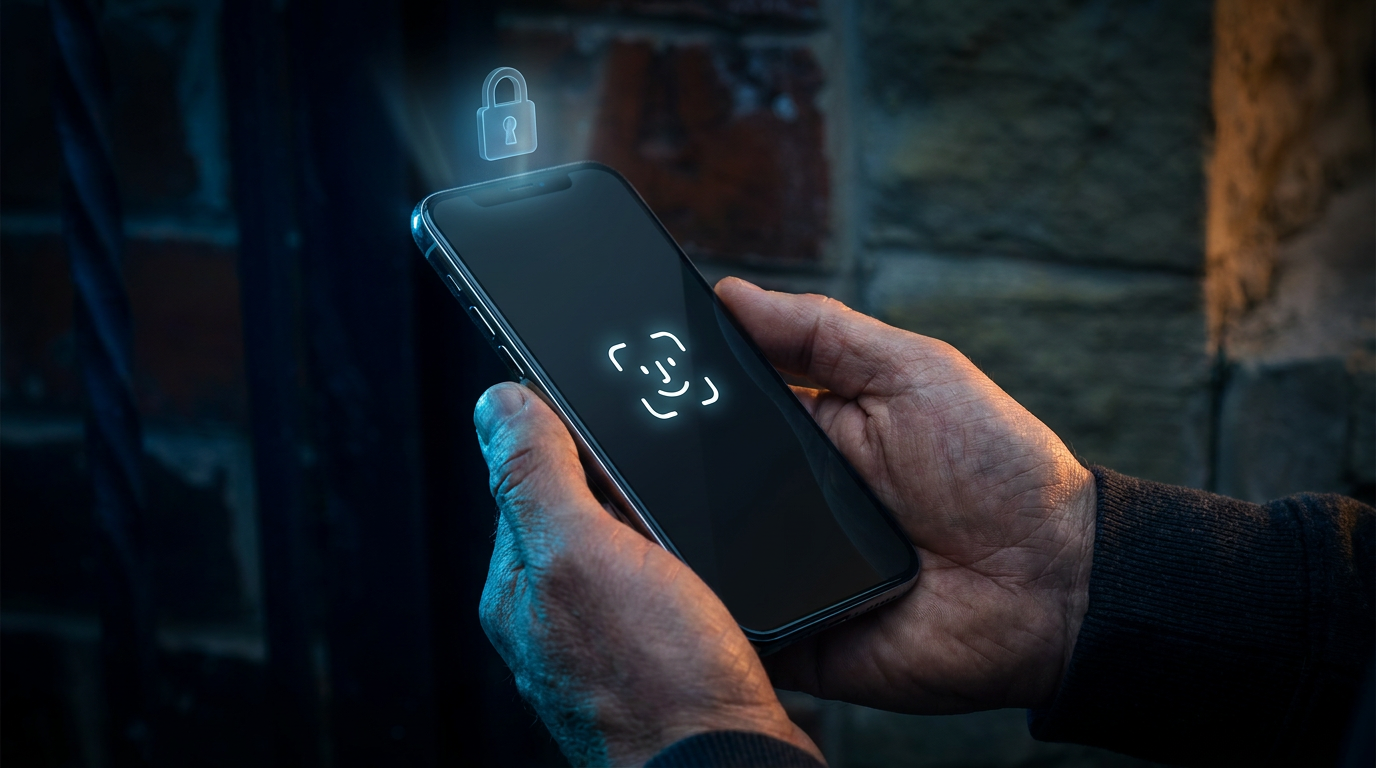
When you attempt to log in, the authentication ceremony is entirely localized. The website's server sends a cryptographic "challenge" to your device. Your device asks you to authorize the action—this is where your Face ID, Touch ID, or device PIN comes in. Once you prove you are the authorized user of the device, the private key signs the challenge and sends the signature back to the server. The server uses the public key to verify the signature, and you are logged in.[5][7]
This mechanism makes passkeys inherently phishing-resistant. Because the private key is mathematically bound to the specific domain where it was created, it cannot be tricked. If you click a malicious link that takes you to a convincing replica of your bank's website, your device's operating system will recognize that the domain does not match the original public key. The passkey simply will not engage, neutralizing the phishing attempt before it begins.[5][7]
This mechanism makes passkeys inherently phishing-resistant.
Passkeys are equally resistant to corporate data breaches. If a hacker compromises a company's servers and downloads its entire user database, they will only walk away with a list of public keys. Without the corresponding private keys—which remain safely locked in the pockets and on the desks of millions of individual users—the stolen data is mathematically useless.[5][7]

The security architecture is so robust that the National Institute of Standards and Technology (NIST) formally endorsed it in its SP 800-63B Revision 4 guidelines, finalized in mid-2025. NIST now classifies synced passkeys at Authentication Assurance Level 2 (AAL2) and hardware-bound passkeys at AAL3, the highest standard. Concurrently, NIST has actively advised organizations to stop forcing users to rotate their passwords every 90 days or use complex character rules, acknowledging that these legacy policies actually weaken security by encouraging users to write passwords down or make predictable variations.[3]
The real-world efficacy of this transition is already visible in the data. Google, which saw passkey sign-ins surpass one billion per month in late 2025, reports that accounts secured by passkeys experience a 99.9% lower compromise rate compared to those relying on traditional passwords. The friction of logging in is also significantly reduced, cutting authentication time in half.[5]
Consumers are rapidly adapting to the new standard. According to the FIDO Alliance's 2026 State of Passkeys report, consumer awareness has reached 90%, up from 75% just a year prior. More importantly, 75% of internet users have now enabled a passkey on at least one account, and 40% enable them habitually across most of their applications. The infrastructure is ready: over 15 billion accounts globally are now eligible to use passkeys.[2]
However, corporate adoption remains uneven, largely dictated by the financial stakes of account compromise. Industry benchmarks for 2026 show that the financial technology sector leads the transition, with roughly 60% of eligible users actively authenticating via passkeys. E-commerce follows at 35%, while media and streaming services trail significantly at just 18%. For banks, stopping a single account takeover saves immense fraud costs; for a streaming service, the urgency is lower.[6]

The most common hesitation among users is the fear of losing their device. If the private key is locked in a smartphone, what happens if that phone drops into a lake? The industry solved this by introducing "synced passkeys." Ecosystems like Apple's iCloud Keychain, Google Password Manager, and third-party managers like Bitwarden or 1Password securely sync your private keys across all your devices using end-to-end encryption. If you buy a new phone and sign into your cloud account, your passkeys are instantly restored.[2][5][7]
If a user loses access to their entire device ecosystem simultaneously, the recovery process falls back to legacy methods—typically an email reset link or an SMS code. Security experts acknowledge that this fallback remains the weakest link in the chain, as attackers can still attempt to compromise a user's email account to trigger a reset. However, by removing the password from the daily login flow, the overall attack surface is drastically reduced.[1][7]
For decades, the technology industry forced humans to act like computers—memorizing long, random strings of characters to prove their identity. Passkeys reverse that dynamic, allowing the computers to handle the complex cryptography invisibly in the background. The password is not just evolving; it is finally being retired, replaced by a system that is simultaneously easier to use and mathematically impossible to guess.[2][7]
How we got here
2012
The FIDO Alliance is founded to solve the world's password problem.
2019
The W3C approves WebAuthn as an official web standard, laying the groundwork for passkeys.
2022
Apple, Google, and Microsoft announce expanded support for the FIDO standard, coining the consumer term 'passkey'.
2025
NIST finalizes SP 800-63B Revision 4, officially endorsing synced passkeys for high-level authentication.
2026
Consumer passkey enablement reaches 75%, marking the transition from early adoption to mainstream standard.
Viewpoints in depth
Cybersecurity Experts
Security professionals view passkeys as the structural fix to the internet's oldest vulnerability.
For decades, the cybersecurity industry has tried to fix the password problem by treating the symptoms: enforcing complex character rules, mandating 90-day rotations, and adding SMS codes. Security experts argue that passkeys finally cure the disease by eliminating the 'shared secret' entirely. By relying on public-key cryptography, passkeys remove the human element from the security equation. Users can no longer be tricked into handing over their credentials to a phishing site, because the device's operating system handles the cryptographic challenge automatically and will refuse to authenticate a mismatched domain.
Identity & Access Teams
Corporate IT teams balance the security benefits of passkeys against the logistics of deployment and account recovery.
While IAM (Identity and Access Management) professionals universally acknowledge the security superiority of passkeys, their focus is on the operational realities of deployment. The primary challenge is no longer user awareness, but rather designing secure fallback mechanisms. If an employee loses their phone and laptop simultaneously, how do they regain access without falling back to an insecure email link? IAM teams are currently focused on building robust, identity-verified recovery flows to ensure that the fallback methods do not undermine the security gains provided by the passkeys themselves.
Everyday Consumers
General users appreciate passkeys primarily for eliminating the friction and frustration of forgotten passwords.
For the average internet user, the cryptographic mechanics of FIDO2 and WebAuthn are irrelevant. The appeal of passkeys is purely experiential. Consumers are fatigued by managing dozens of complex passwords and dealing with the friction of reset emails when they inevitably forget them. Passkeys transform the login process into a single, familiar action—glancing at a phone screen or tapping a fingerprint sensor. This alignment of high-grade security with extreme convenience is what has driven consumer enablement to 75% in 2026.
What we don't know
- How quickly legacy enterprise software and internal corporate networks will be able to upgrade their infrastructure to support passkeys.
- Whether the industry will standardize a universal, highly secure account recovery method for users who lose access to their entire device ecosystem.
Key terms
- Public-Key Cryptography
- A cryptographic system that uses pairs of keys: a public key which may be disseminated widely, and a private key which is known only to the owner.
- FIDO Alliance
- An open industry association launched to develop and promote authentication standards that help reduce the world's over-reliance on passwords.
- Credential Stuffing
- A cyberattack where hackers use lists of compromised user credentials (passwords) to breach into a system, assuming users have reused the same password across multiple sites.
- Phishing
- A fraudulent practice of sending emails or creating fake websites purporting to be from reputable companies in order to induce individuals to reveal personal information, such as passwords.
Frequently asked
Can a hacker steal my passkey?
No. The private half of the passkey is locked inside your device's secure hardware. Even if a hacker breaches the website you are logging into, they only get the public key, which is useless without your physical device.
What happens if I lose my phone?
If you use a cloud ecosystem like Apple iCloud, Google Password Manager, or a third-party manager, your passkeys are securely synced. When you get a new device and log into your cloud account, your passkeys are restored.
Can I use passkeys on a desktop computer?
Yes. Modern operating systems like Windows 11 and macOS natively support passkeys, allowing you to authenticate using Windows Hello (PIN/Face/Fingerprint) or Touch ID on a Mac.
Do I still need a password manager?
Yes. Password managers are evolving into 'credential managers.' They will store and sync your passkeys across different devices while continuing to manage traditional passwords for older sites that haven't upgraded yet.
Sources
Source coverage
7 outlets
3 viewpoints surfaced







[1]The GuardianEveryday Consumers
Readers reply: Experts say we should use passkeys, but can a smartphone pin really be safer than a password?
Read on The Guardian →[2]FIDO AllianceIdentity & Access Teams
The State of Passkeys 2026
Read on FIDO Alliance →[3]National Institute of Standards and Technology (NIST)Cybersecurity Experts
SP 800-63B Revision 4: Digital Identity Guidelines
Read on National Institute of Standards and Technology (NIST) →[4]VerizonIdentity & Access Teams
2025 Data Breach Investigations Report
Read on Verizon →[5]Google IdentityCybersecurity Experts
Passkeys: The future of authentication
Read on Google Identity →[6]MojoAuthIdentity & Access Teams
Passkey adoption rates by industry: 2026 benchmarks
Read on MojoAuth →[7]Factlen Editorial TeamCybersecurity Experts
Synthesis by Factlen editorial team
Read on Factlen Editorial Team →

Every angle. Every day.
Get technology stories with full source coverage and perspective breakdowns delivered to your inbox.