
Sponge Cities: How Urban Design is Absorbing Catastrophic Floods
As extreme weather overwhelms 20th-century concrete infrastructure, cities worldwide are redesigning themselves to absorb rainwater through nature-based 'sponge' solutions.
By Factlen Editorial Team
- Urban Ecologists
- Advocate for nature-based solutions to restore the hydrological cycle and provide ecological co-benefits.
- Municipal Policymakers
- Focus on the economic balancing act of funding green retrofits while managing immediate disaster risks.
- Traditional Civil Engineers
- Emphasize the physical limits of biological systems and the continued necessity of concrete flood defenses.
What's not represented
- · Insurance Underwriters
- · Real Estate Developers
Why this matters
With global extreme rainfall events quadrupling since 1980, traditional concrete drainage systems are failing. The transition to nature-based urban design not only protects homes and businesses from catastrophic flooding, but also cools neighborhoods and secures local water supplies during droughts.
Key points
- Traditional 'grey infrastructure' like concrete pipes is increasingly failing to manage the volume of 21st-century extreme rainfall.
- The 'sponge city' model replaces impermeable asphalt with porous surfaces, bioswales, and wetlands that naturally absorb and store stormwater.
- China has invested heavily in the concept, aiming for 80% of its urban areas to absorb 70% of local rainfall by 2030.
- Beyond flood mitigation, green infrastructure naturally cools urban neighborhoods, filters pollutants, and captures water for use during droughts.
- While highly effective for local runoff, sponge cities cannot entirely replace heavy infrastructure for catastrophic river flooding or storm surges.
For more than a century, modern urban design has treated rainwater as an enemy to be banished. The standard engineering playbook relied heavily on "grey infrastructure"—a vast, invisible network of concrete pipes, storm drains, and reinforced riverbanks designed to channel precipitation away from city streets as rapidly as possible. But as the climate warms and the atmosphere holds more moisture, this 20th-century paradigm is buckling under 21st-century extremes. Global floods and extreme rainfall events have surged at a rate four times higher than in 1980, routinely overwhelming legacy drainage systems. In heavily paved metropolitan areas, only 20 to 30 percent of rainwater naturally seeps into the ground, leaving the rest to flash-flood streets, inundate basements, and paralyze transit networks. The realization that we can no longer simply build bigger pipes has forced urban planners to rethink the fundamental relationship between cities and water.[6][8]
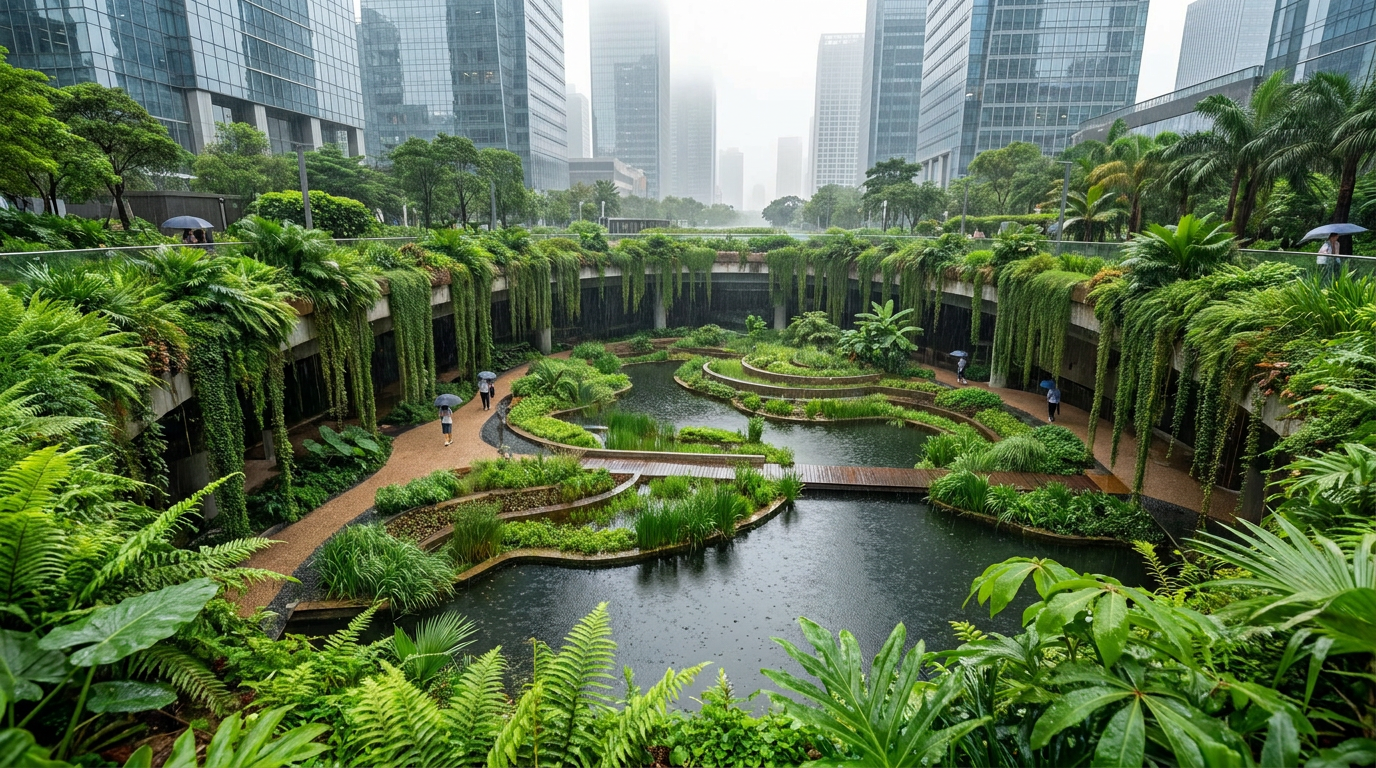
The solution gaining global momentum requires a radical philosophical shift: instead of fighting water and rushing it away, cities must be redesigned to absorb it. This is the core premise of the "sponge city," a nature-based urban planning model that integrates ecological infrastructure to capture, store, and purify stormwater onsite. By replacing impermeable asphalt and concrete with porous, biologically active landscapes, cities can mimic the natural hydrological cycle that existed before they were paved over. When heavy rains fall, these urban environments act exactly like a sponge—soaking up the deluge to prevent surface flooding, and then slowly releasing the stored water back into aquifers or municipal systems once the storm has passed.[1][2][8]
While the underlying principles of water-sensitive urban design have circulated for decades under various names, the specific "sponge city" framework was popularized in 2013 by Kongjian Yu, a prominent landscape architect and professor at Peking University. Yu drew inspiration from ancient Chinese agricultural practices, such as terraced farming, which naturally managed monsoon rains and prevented soil erosion. His concept gained urgent political traction following a catastrophic 2012 flash flood in Beijing that claimed 79 lives and caused an estimated $1.5 billion in economic damages. Facing the twin crises of severe urban flooding during the monsoon season and chronic groundwater shortages during the rest of the year, the Chinese government formally adopted Yu's framework as a national urban development policy.[2][4][8]

At the ground level, transforming a concrete metropolis into a sponge requires a comprehensive overhaul of surface materials. The most immediate intervention involves replacing traditional, impermeable asphalt with permeable pavements on sidewalks, parking lots, and low-traffic roads. These specialized materials allow rainwater to seep directly through the surface into a gravel sub-base and eventually into the native soil below. This simple substitution drastically reduces the volume of surface runoff that would otherwise rush into storm drains, while simultaneously filtering out heavy metals and motor oils that accumulate on roadways. By allowing water to infiltrate naturally, cities can begin to recharge their depleted groundwater aquifers, which are often dangerously low due to decades of over-extraction.[2][5][8]
Beyond permeable surfaces, sponge cities rely heavily on "blue-green infrastructure"—a network of engineered natural spaces designed to manage water dynamically. This includes bioswales, rain gardens, green roofs, and constructed wetlands. Unlike single-purpose concrete drains, these biological systems are inherently multifunctional. During a storm, a sunken park or a constructed wetland serves as a vital retention basin, safely holding thousands of gallons of excess water. During dry spells, these same spaces function as public amenities, providing vital habitats for urban wildlife and offering residents accessible green spaces that improve mental and physical well-being.[1][5][8]
One of the most innovative examples of this multifunctional approach can be found in Rotterdam, a low-lying Dutch delta city that has long battled the threat of rising seas and intense rainfall. In 2013, the city unveiled the Benthemplein "water square," a public plaza designed by the architectural firm De Urbanisten. During dry weather, the square functions as a vibrant community hub, featuring an amphitheater, a basketball court, and skateboarding ramps. But when heavy rains strike, the sunken basins of the square intentionally flood, transforming into a temporary reservoir capable of holding 1.7 million liters of stormwater. By retaining this massive volume of water above ground, the square prevents the local sewer system from overflowing into nearby basements, slowly releasing the water only after the storm has subsided.[3][8]

In 2013, the city unveiled the Benthemplein "water square," a public plaza designed by the architectural firm De Urbanisten.
While European cities like Rotterdam and Copenhagen have pioneered bespoke, high-design sponge projects, China has attempted to scale the concept to an unprecedented degree. In 2015, the Chinese government launched the Sponge City Initiative, selecting 30 pilot cities for massive ecological retrofitting. The financial commitment was staggering, with approximately $23 billion invested across more than 4,900 projects in the first few years alone. The government established an ambitious national mandate: by 2030, 80 percent of all urban areas in the country must be equipped with sponge infrastructure capable of absorbing and reusing at least 70 percent of annual stormwater runoff.[2][4][8]
Early performance data from these pilot programs indicates that the nature-based approach is yielding tangible results. In the dense pilot districts of Shanghai and Wuhan, researchers have documented significant reductions in both peak runoff volume and the frequency of severe waterlogging during standard monsoon events. But the benefits extend far beyond flood mitigation. In Wuhan, where 228 distinct sponge initiatives were implemented across public spaces and residential areas, the proliferation of blue-green infrastructure has noticeably altered the local microclimate. The lush vegetation in newly constructed sponge parks has lowered localized ambient temperatures by 2 to 3 degrees Celsius, providing a crucial buffer against the escalating urban heat island effect.[5][8]
The global adoption of sponge city principles highlights the diverse ways different geographies approach climate resilience. Some cities are naturally predisposed to sponginess; Auckland, New Zealand, for instance, ranks highly in global resilience metrics due to its abundant natural parks, deep water tables, and highly permeable sandy soils, which naturally drain excess rainfall. Conversely, cities like Copenhagen have had to proactively engineer their sponginess. Following a devastating 2011 cloudburst that inflicted nearly $2 billion in damages in just two hours, the Danish capital embarked on a comprehensive master plan to redesign its streets and parks, weaving engineered floodways and retention basins into the existing urban fabric to prepare for future millennium-scale storms.[1][8]

From an economic perspective, the transition to sponge infrastructure presents a compelling value proposition for municipal planners. Expanding traditional grey infrastructure to handle 21st-century storm volumes is often prohibitively expensive, requiring cities to excavate deep beneath densely populated streets to install massive concrete tunnels. In contrast, integrating green infrastructure at the surface level is frequently more cost-effective over the long term. While the upfront costs of retrofitting can be substantial, sponge cities generate immense secondary economic value by reducing the financial toll of flood damage, lowering the energy costs associated with wastewater treatment, and increasing surrounding property values through the creation of attractive public green spaces.[5][8]
Crucially, the sponge city framework addresses not just the threat of too much water, but also the growing crisis of too little. In many urban centers, drought is intensified by the rapid loss of rainwater; when precipitation is immediately flushed into the ocean via concrete sewers, it cannot replenish the local water table. By capturing and storing stormwater onsite, sponge cities create decentralized reservoirs that can be tapped during dry spells. This harvested rainwater can be repurposed for irrigating municipal parks, flushing toilets in public buildings, and maintaining street trees, significantly reducing the strain on municipal freshwater supplies during periods of prolonged drought.[4][8]
Despite its widespread acclaim, the sponge city model is not a panacea for all climate-driven water disasters. Hydrologists and civil engineers caution that biological systems have strict physical limits; once the soil in a rain garden or constructed wetland reaches total saturation, it can absorb no more. During catastrophic, multi-day deluge events, or in the face of massive riverine flooding and hurricane storm surges, green infrastructure will inevitably be overwhelmed. Consequently, experts emphasize that sponge cities must be viewed as a complementary strategy rather than a total replacement for grey infrastructure. Robust seawalls, levees, and high-capacity emergency pumps remain essential safeguards for coastal and river-adjacent populations facing extreme, low-probability disasters.[7][8]

The practical implementation of sponge city initiatives also faces significant logistical hurdles. Retrofitting the dense, highly developed cores of older cities requires navigating a labyrinth of existing underground utilities, competing zoning interests, and severe spatial constraints. Furthermore, unlike concrete pipes which require relatively predictable maintenance, green infrastructure relies on living biological systems. Bioswales and wetlands require continuous horticultural upkeep to prevent them from becoming clogged with sediment, overgrown with invasive species, or degraded by the very pollutants they are designed to filter. Ensuring that municipalities allocate sufficient, permanent funding for this specialized maintenance remains one of the greatest challenges to the long-term viability of the sponge city model.[7][8]
As the impacts of climate change accelerate, the necessity of adapting our urban environments is no longer a theoretical debate. The sponge city concept represents a profound maturation in how humanity interacts with the natural world—a shift from a posture of dominance and resistance to one of integration and resilience. By systematically unpaving our cities and inviting nature back into the urban grid, we can transform our greatest vulnerabilities into multi-functional assets. Ultimately, the transition toward sponginess is not just about preventing the next catastrophic flood; it is about fundamentally redesigning the modern city to be more livable, sustainable, and harmonious with the hydrological realities of the 21st century.[1][4][8]
How we got here
2011
A massive cloudburst hits Copenhagen, causing $2 billion in damage and prompting the city's radical green redesign.
2012
A catastrophic flash flood in Beijing claims 79 lives, exposing the severe limitations of China's urban drainage systems.
2013
Rotterdam unveils the Benthemplein water square, a public plaza that doubles as a 1.7-million-liter stormwater reservoir.
2015
China officially launches the Sponge City Initiative, investing $23 billion across 30 pilot cities to implement nature-based flood defenses.
2030
The target year for China to have 80% of its urban areas capable of absorbing and reusing 70% of annual stormwater runoff.
Viewpoints in depth
Urban Ecologists' View
Nature-based solutions should replace concrete as the primary defense against urban flooding.
This camp argues that 20th-century 'grey infrastructure'—concrete pipes, storm drains, and seawalls—is fundamentally flawed because it attempts to fight water rather than accommodate it. By sealing over natural landscapes with impermeable asphalt, cities have artificially accelerated runoff, overwhelming drainage systems during extreme weather. Urban ecologists advocate for 'sponginess'—restoring the natural hydrological cycle through permeable pavements, bioswales, and constructed wetlands. They point to the cascading co-benefits of this approach: beyond flood mitigation, green infrastructure naturally filters pollutants, recharges depleted groundwater aquifers, and significantly reduces the urban heat island effect by cooling surrounding neighborhoods.
Traditional Civil Engineers' View
Biological systems are insufficient for catastrophic, high-volume flood events.
While acknowledging the benefits of green infrastructure for routine stormwater management, traditional civil engineers caution against over-relying on 'sponge' concepts for extreme disasters. They argue that bioswales and permeable pavements have strict saturation limits; once the soil is fully waterlogged, runoff behaves exactly as it would on concrete. For catastrophic events—such as unprecedented hurricane storm surges, massive river crests, or dam failures—this camp maintains that heavy 'grey infrastructure' remains non-negotiable. They advocate for a hybrid approach, warning that nature-based solutions require immense spatial footprints that dense urban cores simply cannot accommodate, and demand continuous, complex biological maintenance that municipalities often underfund.
Municipal Policymakers' View
The transition to sponge cities is an economic and logistical balancing act.
For city planners and local governments, the sponge city concept presents a complex economic calculus. The long-term savings are clear: avoiding billions in disaster recovery and reducing the need for prohibitively expensive sewer expansions. However, retrofitting existing, densely populated urban grids with green infrastructure requires massive upfront capital and disruptive construction. Policymakers must navigate the realities of land scarcity, competing zoning interests, and the challenge of incentivizing private developers to incorporate permeable designs. They often favor multi-functional investments, such as Rotterdam's water squares, which justify their cost by serving as public recreational spaces during dry weather while acting as emergency reservoirs during storms.
What we don't know
- How well biological green infrastructure will survive the unprecedented temperature extremes projected for the late 21st century.
- The long-term municipal cost of maintaining decentralized, living biological systems compared to static concrete pipes.
- Whether private real estate developers can be effectively incentivized to retrofit existing properties with permeable materials at scale.
Key terms
- Grey Infrastructure
- Traditional, engineered water management systems built from concrete and steel, such as pipes, storm drains, and seawalls.
- Blue-Green Infrastructure
- A network of natural and semi-natural landscape elements, like parks and wetlands, designed to manage water and provide ecological benefits.
- Permeable Pavement
- Specialized surfacing materials that allow water to pass through the pavement and infiltrate the underlying soil, reducing surface runoff.
- Bioswale
- A vegetated, shallow landscape depression designed to capture, slow down, and filter stormwater runoff from adjacent impervious surfaces.
- Urban Heat Island Effect
- A phenomenon where urban areas experience significantly higher temperatures than surrounding rural areas due to dense concentrations of pavement and buildings.
Frequently asked
Can a sponge city prevent all types of flooding?
No. While highly effective at managing local flash floods and heavy rainfall runoff, sponge cities cannot stop catastrophic river crests or massive hurricane storm surges, which still require heavy grey infrastructure.
How does a sponge city help during a drought?
By capturing and storing rainwater onsite in underground aquifers and retention basins, sponge cities create local water reserves that can be used for irrigation and municipal needs during dry spells.
Are sponge cities more expensive to build than traditional sewers?
While retrofitting dense urban areas with green infrastructure requires high upfront capital, it is often cheaper in the long run than excavating and expanding massive concrete sewer tunnels, especially when factoring in avoided flood damage.
What happens when the ground is completely saturated?
Once the soil and retention basins reach their maximum absorption capacity, excess water will run off the surface just as it would on concrete, which is why emergency overflow drains are still necessary.
Sources
Source coverage
8 outlets
3 viewpoints surfaced








[1]World Economic ForumUrban Ecologists
How 'sponge cities' are using nature to tackle climate-driven floods
Read on World Economic Forum →[2]MDPIMunicipal Policymakers
Challenges in City Design: Realize the Value of Cities in Challenges
Read on MDPI →[3]PreventionWebMunicipal Policymakers
Rotterdam's water squares: Urban design meets flood protection
Read on PreventionWeb →[4]ICIMODMunicipal Policymakers
China's Sponge City Initiative: Nature-based solutions for urban water crises
Read on ICIMOD →[5]Scientific Research PublishingTraditional Civil Engineers
The Sponge City Initiative: Evaluating Green vs. Grey Infrastructure
Read on Scientific Research Publishing →[6]UK Research and InnovationUrban Ecologists
Nature-based solutions to reduce the impact of climate change in urban settings
Read on UK Research and Innovation →[7]IAHRTraditional Civil Engineers
Pilot Sponge City Construction in China: Findings and Suggestions
Read on IAHR →[8]Factlen Editorial TeamUrban Ecologists
Synthesis by Factlen editorial team
Read on Factlen Editorial Team →
Every angle. Every day.
Get environment stories with full source coverage and perspective breakdowns delivered to your inbox.