
Smart Ring vs. Smartwatch: Which Health Tracker Fits Your Goals in 2026?
As devices like the Oura Ring 4 and Apple Watch Series 11 dominate the market, choosing between a smart ring and a smartwatch comes down to whether you need an active fitness coach or a passive health observer.
By Factlen Editorial Team
- Passive Tracking Advocates
- Prioritize seamless, 24/7 data collection with minimal screen time, favoring the comfort and battery life of rings.
- Active Fitness Enthusiasts
- Rely on real-time metrics, GPS routing, and on-device coaching to actively guide their daily workouts.
- Ecosystem Integrationists
- Value having a connected extension of their smartphone for payments, calls, and notifications alongside health data.
What's not represented
- · Medical professionals prescribing wearables for remote patient monitoring
- · Budget-conscious consumers priced out of premium $300+ devices
Why this matters
Wearable health technology is a $200 to $500 investment that only works if you actually wear it. Understanding the physiological and lifestyle trade-offs between wrist and finger sensors ensures you buy a device that matches your daily habits rather than fighting them.
Key points
- Smart rings excel at passive tracking, offering superior comfort for overnight sleep monitoring and multi-day battery life.
- Smartwatches remain the best choice for active athletes who need real-time pacing, GPS, and heart rate zones during workouts.
- The finger's dense capillary network provides highly accurate resting data, but wrist sensors perform better during heavy motion.
- Using both devices within the same ecosystem can optimize data collection and extend smartwatch battery life by up to 30 percent.
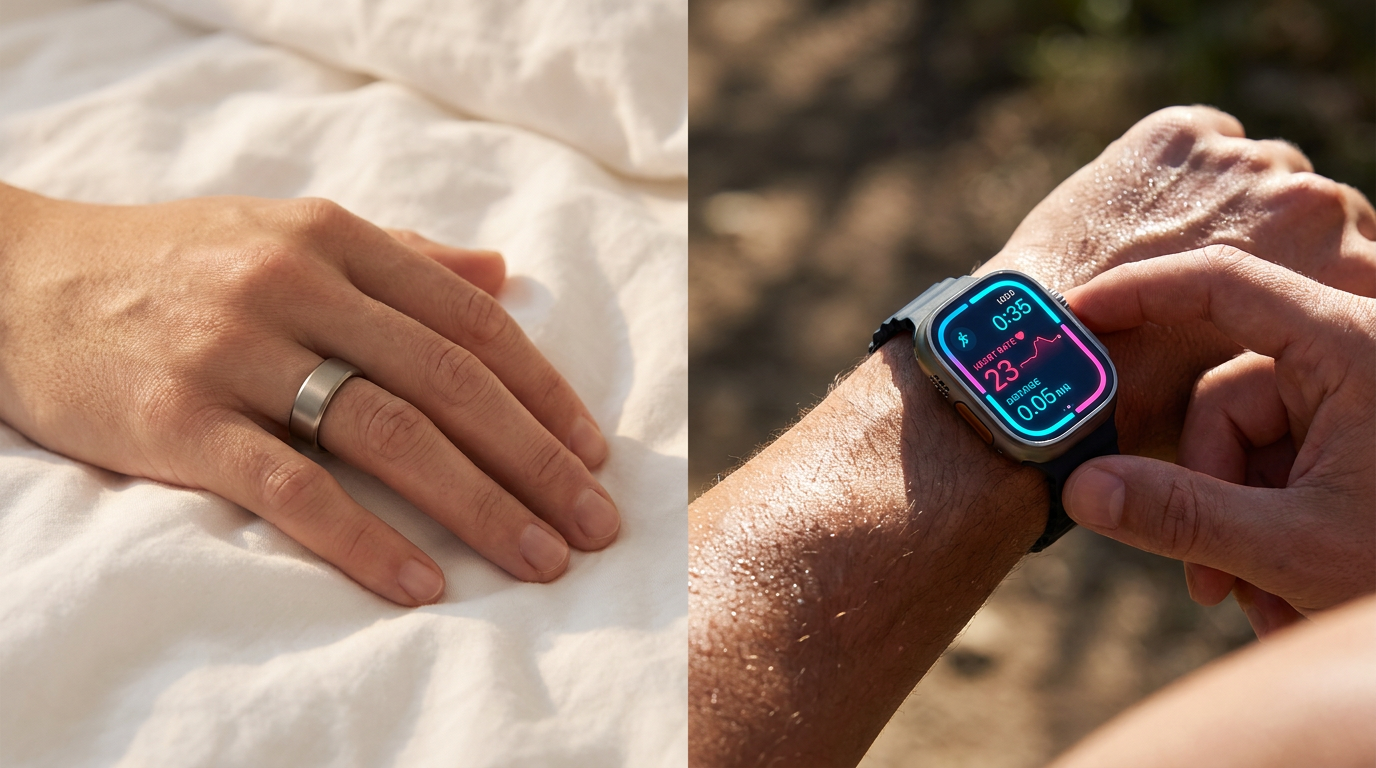
The wearable health technology landscape of 2026 has fractured into two distinct philosophies: the active wrist computer and the passive finger sentinel. With the arrival of the Oura Ring 4, the Apple Watch Series 11, and the Samsung Galaxy Ring 2, consumers are no longer just choosing a brand ecosystem. They are choosing between fundamentally different approaches to biometric data collection. A smartwatch is designed to be an active companion that demands interaction, while a smart ring is engineered to disappear into the background, quietly logging data without adding to daily screen fatigue.[1][5]
The argument for the smart ring centers entirely on comfort, compliance, and battery life. Weighing between three and eight grams, rings are significantly lighter than the 40 to 80 grams typical of a smartwatch. This weight difference becomes critical at night. Many users find bulky watches uncomfortable for sleep, leading to inconsistent overnight tracking. Rings solve this compliance issue by being unobtrusive. Furthermore, devices like the Oura Ring and Galaxy Ring boast battery lives of five to eight days, eliminating the daily "charger gap" that often results in missing data when a smartwatch is docked for its required daily recharge.[3][5][6]

The evidence supporting the smart ring's superiority in passive tracking is rooted in human anatomy. The finger contains dense capillary networks located close to the skin's surface, providing photoplethysmography sensors with a cleaner, more stable signal than the wrist, which is subject to more motion artifacts and ambient light interference. Independent testing in 2026 shows that smart rings achieve 92 to 95 percent accuracy compared to clinical polysomnography for sleep tracking. Because the finger remains relatively still during rest, rings excel at capturing nocturnal heart rate, skin temperature variations, and heart rate variability, which are crucial metrics for determining physical recovery and impending illness.[5][6][7]
However, the case against the smart ring becomes glaringly obvious the moment you begin an active workout. Rings lack screens, meaning they cannot provide real-time feedback on pacing, heart rate zones, or distance. Furthermore, they are poorly suited for certain types of exercise. Heavy weightlifting with a metal ring can be deeply uncomfortable as the barbell presses the device into the finger, and it can even warp the ring's internal sensors over time. Without built-in GPS, runners and cyclists must still carry their phones to map their routes, defeating the purpose of a standalone fitness tracker.[1][3][7]
Conversely, the argument for the smartwatch is built on real-time utility and comprehensive fitness coaching. Devices like the Apple Watch Series 11 and Samsung Galaxy Watch 7 are unparalleled for active training. They offer bright OLED displays that show live metrics, built-in GPS for phone-free routing, and on-wrist audio controls. For athletes who need to monitor their heart rate zones mid-run or receive haptic feedback during interval training, the smartwatch is an indispensable tool that actively guides the workout rather than just passively recording it for later review.[1][4][5]
Conversely, the argument for the smartwatch is built on real-time utility and comprehensive fitness coaching.
The evidence supporting smartwatch accuracy during high-intensity activity is robust. A recent clinical sleep and fitness study conducted with Stanford Health Care and The Wall Street Journal demonstrated that the Apple Watch Series 11 excelled across diverse physical activities. During bumpy outdoor bike rides and periods of high-intensity movement, wrist-based optical sensors on premium smartwatches maintained their lock on the user's heart rate, whereas finger-based sensors occasionally faltered due to the rapid hand movements. The study also noted that the latest Apple Watch matched clinical lab results for sleep duration down to the minute, proving that watches can still compete overnight if the user is willing to wear them.[2]

The primary case against the smartwatch remains its battery life and its contribution to digital noise. Even the most efficient flagship smartwatches in 2026 require charging every one to two days. More importantly, smartwatches are extensions of the smartphone. They buzz with text messages, calendar alerts, and app notifications. For users seeking a digital detox or those who already feel overwhelmed by screens, strapping another glowing, vibrating computer to their wrist is counterproductive to mental wellness and stress reduction.[3][5][7]
For those who refuse to compromise, a new "wear both" paradigm has emerged in 2026. Ecosystems like Samsung Health now allow the Galaxy Ring and Galaxy Watch to operate in a synchronized mode. The ring handles low-power, continuous background tracking and sleep monitoring, while the watch takes over the heavy lifting during active workouts. This dual-device approach actually extends the smartwatch's battery life by up to 30 percent, though it requires a combined hardware investment approaching $800.[4][7]
Ultimately, the smart ring fits well when your primary goals are sleep optimization, recovery tracking, and long-term health awareness without digital distractions. It is the ideal choice for users who want to wear traditional mechanical watches during the day or those who find wrist wearables uncomfortable at night. It does not fit well when you are a dedicated runner, cyclist, or data-driven athlete who relies on mid-workout pacing and live heart rate zones to guide your training.[5][7]
The smartwatch fits well when you train regularly, want to leave your phone at home during workouts, and value the convenience of wrist-based payments, alarms, and notifications. It is the ultimate all-in-one lifestyle and fitness hub. It does not fit well when you suffer from notification fatigue, hate charging devices daily, or simply cannot tolerate the feeling of a bulky device on your wrist while trying to fall asleep.[1][3][5]

Viewpoints in depth
The Passive Tracking View
Advocates for minimal digital intrusion and continuous, comfortable data collection.
This perspective argues that the best health tracker is the one you forget you are wearing. By removing the screen, smart rings eliminate notification anxiety and the temptation to constantly check metrics. Proponents emphasize that true health insights come from long-term baseline trends—like resting heart rate and temperature shifts over months—rather than obsessing over the exact number of calories burned during a single 30-minute workout. The multi-day battery life ensures there are no gaps in this long-term data.
The Active Training View
Focuses on actionable, real-time data to optimize athletic performance and daily convenience.
For athletes and fitness enthusiasts, health tracking is an active pursuit that requires immediate feedback. This camp views the smartwatch as an essential piece of training equipment. Without a screen to display interval timers, current pace, or heart rate zones, a wearable is virtually useless during a run or a cycling session. Furthermore, they value the safety and convenience features of smartwatches, such as fall detection, cellular connectivity for emergency calls, and the ability to leave a bulky smartphone at home while remaining reachable.
What we don't know
- Whether upcoming software updates will allow cross-brand synchronization (e.g., an Oura Ring sharing real-time data seamlessly with a Garmin watch).
- How quickly non-invasive blood glucose monitoring will be integrated into either form factor, which could dramatically shift the market balance.
Key terms
- Photoplethysmography (PPG)
- An optical sensor technology that uses light to measure changes in blood volume at the skin's surface, used by wearables to track heart rate.
- Heart Rate Variability (HRV)
- The measure of the time variation between consecutive heartbeats, used as a key indicator of physical recovery, stress, and overall nervous system health.
- Polysomnography
- A comprehensive, medical-grade sleep study used as the clinical gold standard to test the accuracy of consumer sleep trackers.
Frequently asked
Are smart rings as accurate as smartwatches?
For resting metrics like sleep stages, heart rate variability, and temperature, smart rings are often more accurate due to the dense capillaries in the finger. However, smartwatches are significantly more accurate during high-intensity exercise.
Can I wear a smart ring while lifting weights?
It is generally not recommended. The pressure of a heavy barbell against a metal ring can cause severe discomfort and may eventually damage the internal sensors of the device.
Do I need to pay a subscription for these devices?
It depends on the brand. The Oura Ring requires a monthly subscription to access full data, whereas the Samsung Galaxy Ring and Apple Watch currently provide their health insights without a recurring monthly fee.
Can I use both a ring and a watch together?
Yes. Some ecosystems, like Samsung Health, allow a smartwatch and smart ring to sync together, using the ring for continuous background tracking and the watch for active workouts, which can extend overall battery life.
Sources
Source coverage
7 outlets
3 viewpoints surfaced







[1]ForbesActive Fitness Enthusiasts
Oura Ring Vs. Apple Watch: Which Wearable Is Right For You?
Read on Forbes →[2]9to5MacActive Fitness Enthusiasts
Apple Watch performs favorably in WSJ health and fitness tracker showdown
Read on 9to5Mac →[3]WareableEcosystem Integrationists
Samsung Galaxy Ring vs Galaxy Watch 7: Which should you buy?
Read on Wareable →[4]SamsungEcosystem Integrationists
Smart ring vs smartwatch: what are the key differences?
Read on Samsung →[5]AskVoraPassive Tracking Advocates
Smart Ring vs Smartwatch: The 2026 Wearable Decision Guide
Read on AskVora →[6]JointCorpPassive Tracking Advocates
Smart Ring vs Fitness Tracker vs Smartwatch: Ultimate Comparison 2026
Read on JointCorp →[7]JC VitalPassive Tracking Advocates
Smart Ring vs Smartwatch 2026: Which Is Right for You?
Read on JC Vital →


Every angle. Every day.
Get shopping stories with full source coverage and perspective breakdowns delivered to your inbox.