
How Virtual Power Plants Are Turning Home Batteries Into the Grid's Secret Weapon
As electricity demand surges, utilities are networking thousands of residential solar panels, EVs, and smart thermostats to act as massive, decentralized power plants.
By Factlen Editorial Team
- Grid Operators & Utilities
- VPPs are a cost-effective tool to manage peak demand and defer expensive infrastructure upgrades.
- Participating Consumers
- VPPs transform homes from passive energy buyers into active, revenue-generating grid participants.
- Clean Energy Advocates
- VPPs are the fastest pathway to retiring highly polluting fossil-fuel peaker plants.
What's not represented
- · Renters without smart home devices
- · Rural cooperatives with limited broadband
Why this matters
By networking everyday smart devices, Virtual Power Plants allow consumers to earn money while preventing blackouts and accelerating the retirement of polluting fossil-fuel plants. This decentralized approach could save billions in grid infrastructure costs over the next decade.
Key points
- Peak electricity demand is surging due to AI data centers, manufacturing, and electrification.
- Virtual Power Plants (VPPs) aggregate consumer devices like home batteries and smart thermostats to act as a single power plant.
- The Department of Energy estimates that scaling VPPs could save utilities up to $10 billion annually by 2030.
- Consumers who enroll their devices in a VPP earn passive income while helping to prevent grid blackouts.
- States like New York and Illinois passed landmark legislation in 2026 mandating utility-run VPP programs.
The U.S. power grid is facing a mathematical crisis it hasn't encountered in decades. Driven by the explosive growth of artificial intelligence data centers, a resurgence in domestic manufacturing, and the rapid electrification of vehicles and home heating, peak electricity demand is surging. Grid operators are warning that without immediate intervention, the system will struggle to keep the lights on during extreme weather events. Historically, utilities solved rising demand with a brute-force approach: building massive, centralized fossil-fuel power plants and stringing thousands of miles of new high-voltage transmission lines to carry that power to cities.[1][3]
But the traditional playbook is no longer viable. Building a new natural gas plant or a nuclear facility takes the better part of a decade, and the queues to connect new infrastructure to the transmission grid are hopelessly backlogged. Furthermore, sizing the entire electric grid to handle the single hottest or coldest hour of the year means that the system operates at only about 55 percent of its full capacity on an average day. Consumers ultimately pay for this massive, underutilized infrastructure through ever-increasing utility bills.[1][2]
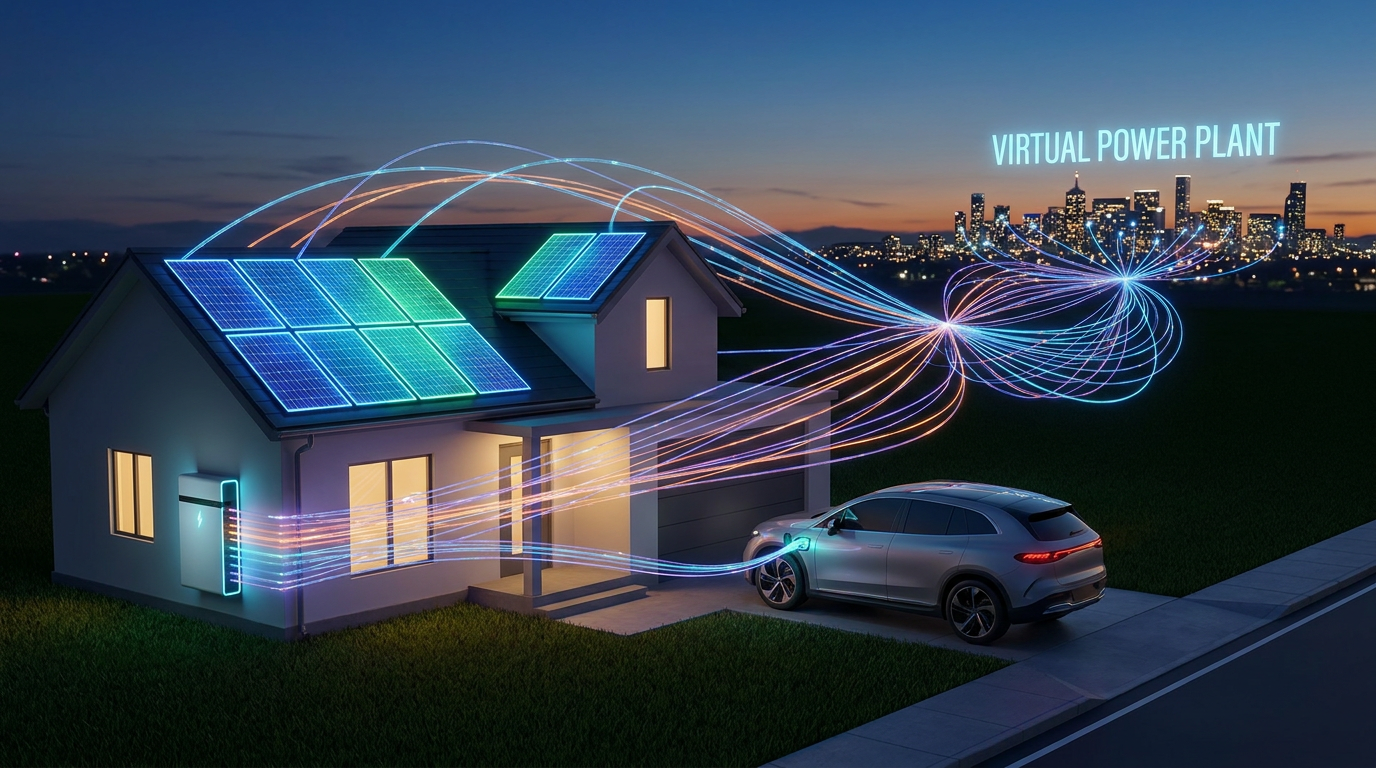
Enter the Virtual Power Plant, or VPP—a solution that treats the homes and businesses of everyday consumers as the grid's most valuable asset. Rather than pouring concrete and burning fuel at a single centralized location, a VPP is a sophisticated cloud-based network. It aggregates thousands of small, decentralized energy devices into a single, dispatchable resource that can be controlled remotely. These devices, known in the industry as Distributed Energy Resources (DERs), include residential solar panels, home battery storage systems, electric vehicle chargers, smart thermostats, and electric water heaters.[1][4]

The mechanism behind a VPP relies on high-speed, two-way communication between the grid operator and the consumer's home. When the grid approaches peak capacity—such as a sweltering July afternoon when millions of air conditioners kick on simultaneously across a region—the utility or a third-party aggregator sends a digital signal to the VPP network. In a matter of seconds, the software orchestrates a synchronized, microscopic response across thousands of households to instantly balance supply and demand without requiring a single turbine to spin up.[4]
During one of these peak events, the VPP might draw a few kilowatts of stored solar energy from ten thousand home batteries, pause electric vehicle charging in a specific zip code for an hour, and adjust participating smart thermostats by a single, barely noticeable degree. To the grid operator sitting in a control room, this coordinated, decentralized action looks and acts exactly like a traditional power plant ramping up production to meet a surge in demand. The difference is that it happens instantly, silently, and without burning a drop of fossil fuel.[2][4]
The scale of these digital networks is no longer experimental or confined to niche pilot programs. In early 2026, the energy software firm Lunar Energy raised $232 million to expand a VPP platform that already manages 650 megawatts of distributed devices globally. From a grid-planning perspective, 650 megawatts of dispatchable residential and commercial assets is equivalent to the output of a mid-sized traditional power plant. Meanwhile, in Texas, energy providers are currently building a massive 1-gigawatt VPP driven primarily by smart thermostat aggregation, proving that consumer devices can deliver utility-scale reliability.[2][6]

The scale of these digital networks is no longer experimental or confined to niche pilot programs.
The economic argument for scaling VPPs is staggering. According to the Department of Energy's 2025 and 2026 VPP Liftoff Report updates, deploying 80 to 160 gigawatts of VPP capacity by 2030 could cover up to 20 percent of the nation's peak load. Achieving that scale would save utilities—and by extension, everyday ratepayers—roughly $10 billion annually. These savings come directly from deferring the need for expensive new grid infrastructure, avoiding costly transmission upgrades, and drastically reducing the operation of highly expensive "peaker plants."[1]
Peaker plants are traditional fossil-fuel generators designed to run only during the few dozen hours a year when grid demand reaches its absolute maximum. Because they sit idle for the vast majority of the time, the electricity they produce is exceptionally expensive to generate. Furthermore, peaker plants are often older, highly polluting facilities located in lower-income communities. By replacing the need for these plants with VPPs, utilities can drastically reduce greenhouse gas emissions and local air pollution while simultaneously keeping electricity rates in check.[1][4]
For the everyday consumer, the appeal of a Virtual Power Plant is highly personal: it turns their home from a passive consumer of electricity into an active, revenue-generating participant in the energy market. Consumers who enroll their smart devices or home batteries in a VPP are compensated for their contribution. Depending on the specific program and region, this compensation can take the form of upfront rebates on equipment purchases, monthly utility bill credits, or direct cash payments for the energy they provide to the grid during peak events.[4]

Crucially, participation is designed to be entirely frictionless and invisible to the homeowner. Advanced artificial intelligence algorithms manage the energy flow to ensure that a home battery always retains enough reserve power to keep the lights on during a local blackout. If a homeowner is hosting a party and wants their house perfectly chilled, they can easily opt out of specific thermostat dispatch events via a smartphone app. The system is designed to empower consumers, not inconvenience them, ensuring that comfort and safety are never compromised for the sake of the grid.[4][7]
Recognizing this immense potential, state legislatures and regulators are moving aggressively to mandate VPP integration, shifting the technology from an optional utility perk to a core pillar of energy policy. In early 2026, New York passed the Grid Reliability and Energy Affordability Transition (GREAT) Act, a landmark bill requiring major utilities to establish statewide VPP programs and create specific incentives for home batteries and electric vehicles. The legislation signals a definitive shift toward treating decentralized consumer assets as critical public infrastructure.[5]
Illinois quickly followed suit with the Clean and Reliable Grid Affordability Act, which was signed into law in January 2026. The act mandates that utilities develop robust customer demand flexibility programs to help support the deployment of 3 gigawatts of grid-scale storage. By forcing utilities to incorporate VPPs into their long-term resource planning, these states are ensuring that the cheapest, cleanest capacity—the capacity already sitting in people's garages and living rooms—is utilized before any new fossil-fuel plants are approved.[5]

Despite the clear momentum, significant hurdles remain before VPPs can fully replace traditional infrastructure. Utilities, which have historically operated on a business model centered around owning and controlling massive, centralized assets, must undergo a profound cultural and operational shift. They must adapt their planning models to trust decentralized, customer-owned resources that they do not directly control. Additionally, standardizing the software protocols so that devices from dozens of different manufacturers can communicate seamlessly with utility networks remains a complex technical challenge.[3][7]
But as extreme weather events multiply and the energy demands of the artificial intelligence boom continue to test the absolute limits of the 20th-century grid, the transition to a decentralized, intelligent energy network is no longer optional. Virtual Power Plants represent a rare alignment of interests: they save utilities money, they pay consumers for their participation, and they accelerate the retirement of the dirtiest power plants. The power plant of the future isn't a towering smokestack on the edge of town—it is the collective, synchronized power of our own homes.[1][7]
How we got here
2021
Extreme weather events, like the Texas winter storm, highlight the fragility of centralized power grids and spark interest in decentralized backup power.
2023
The Department of Energy releases its first Liftoff Report, identifying Virtual Power Plants as a critical tool for grid modernization.
2024
Utilities across the U.S. begin launching pilot VPP programs, aggregating smart thermostats and home batteries to shave peak demand.
Early 2026
States like New York and Illinois pass landmark legislation mandating utilities to establish statewide VPP programs, moving the technology from pilot to permanent infrastructure.
Viewpoints in depth
Grid Operators & Utilities
VPPs are a cost-effective tool to manage peak demand and defer expensive infrastructure upgrades.
For grid operators facing the dual pressures of surging AI data center loads and extreme weather, VPPs offer a lifeline. Instead of spending billions of dollars and waiting years to build new natural gas peaker plants or high-voltage transmission lines, utilities can tap into existing consumer devices instantly. Industry groups emphasize that integrating these distributed resources into formal grid planning is essential to keeping electricity rates affordable while maintaining reliability during demand spikes.
Participating Consumers
VPPs transform homes from passive energy buyers into active, revenue-generating grid participants.
Homeowners view VPPs as a way to maximize the return on their investments in solar panels, home batteries, and electric vehicles. By allowing aggregators to manage their devices during peak events, consumers earn passive income through bill credits or direct payments. Crucially, consumer advocates stress that participation must remain voluntary and transparent, ensuring that homeowners always retain enough backup power to weather local outages and can opt out of specific events if they choose.
Clean Energy Advocates
VPPs are the fastest pathway to retiring highly polluting fossil-fuel peaker plants.
Environmental organizations champion VPPs because they directly displace the need for "peaker plants"—older, inefficient fossil-fuel generators that only run during peak demand and disproportionately pollute lower-income communities. Advocates argue that scaling VPPs to the Department of Energy's target of 160 gigawatts by 2030 is critical for achieving national decarbonization goals. They are actively pushing state legislatures to mandate VPP programs, ensuring that clean, distributed energy is prioritized over new fossil-fuel infrastructure.
What we don't know
- How quickly traditional utilities will adapt their business models to rely on decentralized, customer-owned assets.
- Whether cybersecurity standards can evolve fast enough to protect millions of interconnected home devices from coordinated hacking attempts.
- How the financial incentives for VPP participation will change as the market becomes saturated with millions of enrolled households.
Key terms
- Distributed Energy Resources (DERs)
- Small-scale energy generation or storage technologies located close to where electricity is used, such as home batteries and solar panels.
- Peaker Plant
- A traditional power plant, usually powered by natural gas, that only runs during times of exceptionally high electricity demand.
- Bidirectional Charging
- Technology that allows an electric vehicle not only to draw power from the grid to charge its battery, but also to send stored energy back to the grid or a home.
- Demand Response
- Programs that financially reward consumers for voluntarily reducing or shifting their electricity usage during peak periods.
Frequently asked
Will a VPP drain my home battery right before a blackout?
No. VPP software allows homeowners to set reserve limits, ensuring the battery always retains enough power to keep the home running during a local outage.
Do I have to give the utility total control of my thermostat?
Participation is voluntary, and users can easily opt out of specific energy-saving events through a smartphone app if they prefer not to adjust their temperature.
What devices do I need to participate in a VPP?
Eligibility varies by program, but common devices include home battery storage systems, smart thermostats, electric water heaters, and electric vehicles with bidirectional charging.
Sources
Source coverage
7 outlets
3 viewpoints surfaced






[1]Department of EnergyClean Energy Advocates
Virtual Power Plants: A Key Near-Term Solution to Existing Energy Challenges
Read on Department of Energy →[2]RMIGrid Operators & Utilities
Designing VPP Programs to Meet Utilities' Needs
Read on RMI →[3]Utility DiveGrid Operators & Utilities
In 2026, virtual power plants must scale or risk being left behind
Read on Utility Dive →[4]EnergySageParticipating Consumers
What is a virtual power plant?
Read on EnergySage →[5]Virtual PeakerClean Energy Advocates
Utility Regulatory Legislation Reshaping the Virtual Power Plant Market
Read on Virtual Peaker →[6]Keentel EngineeringGrid Operators & Utilities
Industry Update: Virtual Power Plants, Energy Storage, and Grid Resilience in 2026
Read on Keentel Engineering →[7]Factlen Editorial TeamClean Energy Advocates
Synthesis by Factlen editorial team
Read on Factlen Editorial Team →
Every angle. Every day.
Get energy stories with full source coverage and perspective breakdowns delivered to your inbox.