
JWST Solves the Ultimate Cosmic Mystery: Black Holes Came Before Galaxies
A groundbreaking measurement of a supermassive black hole just 700 million years after the Big Bang proves that the universe's most extreme objects formed before the stars that surround them.
By Factlen Editorial Team
- Direct Collapse Proponents
- Argue that the earliest supermassive black holes formed directly from massive clouds of pristine gas.
- Observational Astronomers
- Focus on the need for larger statistical samples to confirm if QSO1 is the rule or an exception.
- Stellar Seed Theorists
- Maintain that many black holes still originated from the deaths of the first generation of massive stars.
What's not represented
- · Theoretical physicists modeling alternative dark matter interactions in the early universe.
- · Cosmologists studying the role of dark energy in early galaxy formation.
Why this matters
This discovery rewrites the opening chapters of cosmic history, solving a decades-old mystery about how the universe's most extreme objects formed. It proves that our current space observatories can peer back to the dawn of time and fundamentally change our understanding of physics.
Key points
- Astronomers used the James Webb Space Telescope to measure the mass of a supermassive black hole just 700 million years after the Big Bang.
- The black hole in the galaxy Abell2744-QSO1 weighs 50 million solar masses and makes up at least two-thirds of the galaxy's total mass.
- This inverted mass ratio proves that the black hole formed before the surrounding galaxy of stars, solving a long-standing cosmological mystery.
- Evidence suggests the black hole formed via 'direct collapse' of a pristine gas cloud, bypassing the stellar phase entirely.
The ultimate chicken-or-egg question in astrophysics has perplexed scientists for decades: which came first, the supermassive black hole or the galaxy of stars surrounding it?[1][4]
For years, the standard model held that galaxies formed first. Giant clouds of gas birthed the first stars, and when the most massive of those stars died, they collapsed into "seed" black holes that slowly grew over billions of years by merging and consuming matter.[3][6]
But the James Webb Space Telescope (JWST) has upended that timeline. A new discovery, published in the journal Nature, provides the most definitive evidence yet that some supermassive black holes formed before their host galaxies.[2][4]
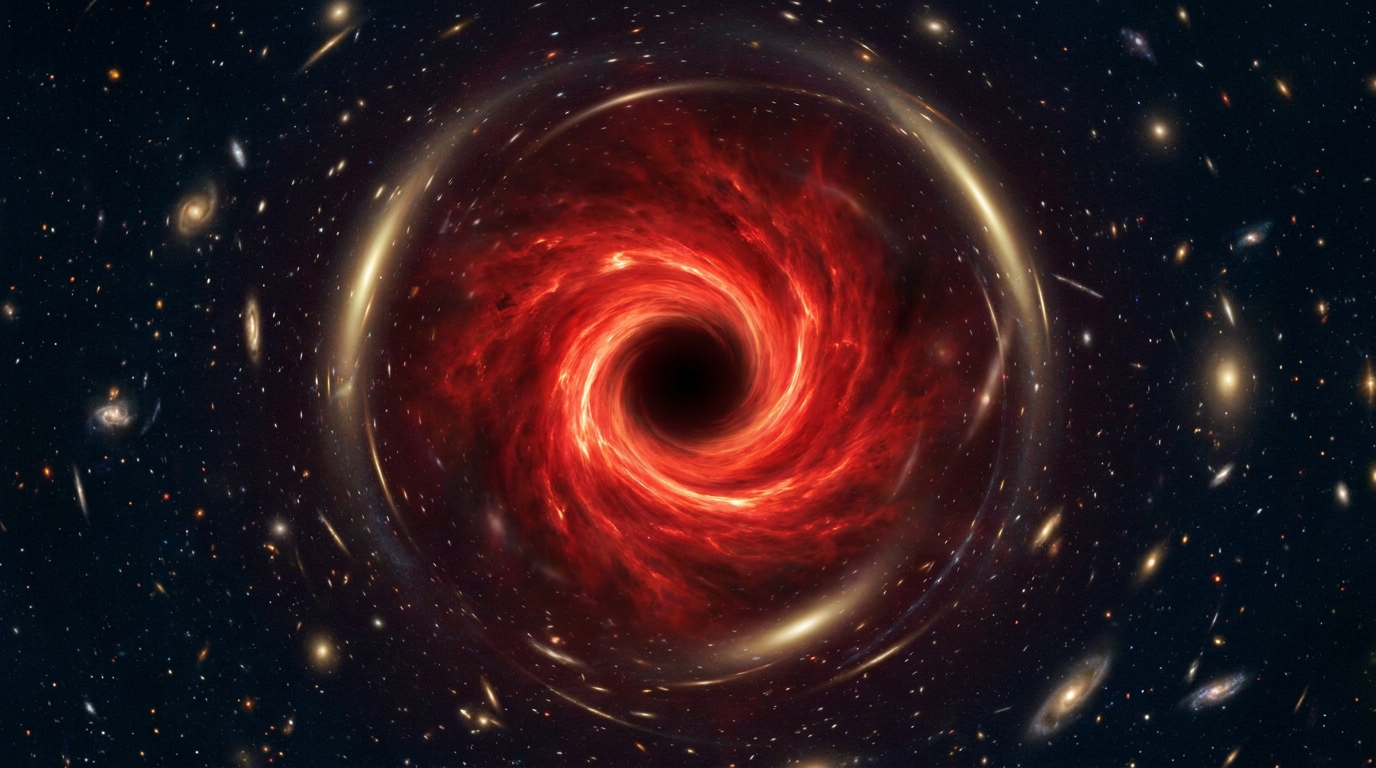
The breakthrough centers on a tiny, ancient object known as Abell2744-QSO1. Existing just 700 million years after the Big Bang, it belongs to a mysterious class of early-universe objects dubbed "Little Red Dots."[3][5]

Despite being only 1,300 light-years across, QSO1 is visible to JWST because it sits behind the massive galaxy cluster Abell 2744, also known as Pandora's Cluster. The cluster's immense gravity acts as a magnifying glass, bending and tripling the light from QSO1 in a phenomenon called gravitational lensing.[3][6]
By analyzing the spectrum of this magnified light, an international team of astronomers achieved a milestone: the first direct, dynamical measurement of a black hole's mass in the early universe.[2][5]
The results were staggering. The central black hole in QSO1 weighs in at roughly 50 million times the mass of our Sun.[2][3]
More importantly, the researchers measured the mass of the surrounding galaxy. In the modern universe, a supermassive black hole typically accounts for just a tiny fraction—about 0.1%—of its host galaxy's total mass.[5]
More importantly, the researchers measured the mass of the surrounding galaxy.
In QSO1, the ratio is entirely inverted. The black hole makes up at least two-thirds of the entire object's mass. The host galaxy contains very few stars, weighing less than half of the black hole itself.[2][3]

"It's a paradigm shift, a total revisiting of the classical scenarios of how black holes form and grow," noted Roberto Maiolino, a co-author of the study from the University of Cambridge.[3][5]
The evidence strongly supports an alternative theory known as "direct collapse." Instead of waiting for stars to live and die, vast, pristine clouds of hydrogen and helium gas in the early universe may have collapsed directly under their own immense gravity.[1][4]
This direct collapse would instantly forge a "heavy seed" black hole weighing tens of thousands of solar masses, bypassing the stellar phase entirely and giving the black hole a massive head start over its galaxy.[4][6]
A companion paper published in the Monthly Notices of the Royal Astronomical Society bolstered this mechanism. Composition maps of QSO1 revealed that the surrounding gas is almost entirely hydrogen and helium.[3][7]
Crucially, the gas lacks heavier elements like oxygen and carbon. Because heavy elements are forged in the cores of stars and scattered when they explode, their absence confirms that very few stars have ever existed in this pristine environment.[3][7]

The black hole is essentially sitting in a cocoon of raw, unburned fuel, consuming it at a ferocious rate. The intense radiation from this feeding frenzy is absorbed by the dense gas and re-emitted as the soft red glow that gives Little Red Dots their name.[4][5]
While the evidence for QSO1 is compelling, astronomers acknowledge transparent uncertainty. It remains unclear whether all supermassive black holes formed this way, or if direct collapse is a rare pathway reserved for the most extreme environments.[1][5]
Furthermore, measuring masses at such extreme distances relies on interpreting the velocity of swirling gas. While the Keplerian motion observed in QSO1 provides a highly accurate dynamical mass, further observations of other Little Red Dots are needed to refine the models and rule out selection biases.[2][5]
How we got here
13.8 billion years ago
The Big Bang initiates the expansion of the universe.
13.1 billion years ago
The 'Little Red Dot' Abell2744-QSO1 exists, hosting a 50-million-solar-mass black hole.
2021
The James Webb Space Telescope launches, equipped to see the faint, redshifted light of the early universe.
2022
JWST begins detecting a mysterious new population of compact, bright objects dubbed 'Little Red Dots.'
May 2026
Astronomers publish the first direct dynamical mass measurement of a Little Red Dot black hole, proving it outpaced its host galaxy.
Viewpoints in depth
Direct Collapse Advocates
Argue that the earliest supermassive black holes formed directly from massive clouds of pristine gas.
This camp points to the near-pristine hydrogen and helium environment of QSO1 as smoking-gun evidence. They argue that in the dense, hot conditions of the early universe, vast clouds of gas could collapse under their own weight without fragmenting into stars. This 'heavy seed' mechanism perfectly explains how black holes could reach 50 million solar masses just 700 million years after the Big Bang, bypassing the slow, incremental growth required by stellar collapse models.
Stellar Seed Theorists
Maintain that many black holes still originated from the deaths of the first generation of massive stars.
While acknowledging the groundbreaking nature of the QSO1 discovery, this perspective cautions against discarding the stellar seed model entirely. They suggest that direct collapse might be a rare pathway requiring highly specific conditions—such as an environment completely devoid of heavy elements—to prevent the gas cloud from cooling and forming stars. For the broader population of galaxies, they argue that rapid mergers of stellar-mass black holes could still play a significant role.
Observational Astronomers
Focus on the need for larger statistical samples to confirm if QSO1 is the rule or an exception.
Observers emphasize the transparent uncertainty inherent in studying the early universe. While the dynamical mass measurement of QSO1 is highly accurate, it represents a single data point magnified by a fortunate gravitational lens. This camp advocates for using JWST to find and measure dozens of other 'Little Red Dots' to determine whether the black-hole-first timeline is the standard blueprint for galaxy evolution or a cosmic outlier.
What we don't know
- Whether the 'direct collapse' mechanism is the standard pathway for all supermassive black holes, or a rare event requiring specific conditions.
- How exactly the immense gas clouds in the early universe managed to avoid fragmenting into stars before collapsing into black holes.
- Whether other 'Little Red Dots' discovered by JWST will show the same inverted mass ratio when measured dynamically.
Key terms
- Supermassive Black Hole
- A black hole containing millions to billions of times the mass of our Sun, typically found at the center of a galaxy.
- Direct Collapse
- A theoretical mechanism where a massive cloud of pristine gas collapses directly into a heavy black hole, bypassing the formation of stars.
- Gravitational Lensing
- The bending and magnifying of light from a distant source by the gravity of a massive object in the foreground.
- Redshift
- The stretching of light toward the red end of the spectrum as it travels across the expanding universe, used to measure cosmic distances.
- Keplerian Motion
- The predictable orbital movement of gas or objects around a central massive body, governed by gravity.
Frequently asked
What is a 'Little Red Dot'?
A class of compact, heavily obscured objects in the early universe discovered by JWST, believed to be supermassive black holes hidden inside dense cocoons of gas.
How did scientists measure the black hole's mass?
By analyzing the spectrum of light to measure the velocity of gas swirling around the center. The speed of the gas reveals the gravitational pull, and thus the mass, of the black hole.
What is gravitational lensing?
A phenomenon where the immense gravity of a massive foreground object, like a galaxy cluster, bends and magnifies the light of a more distant object behind it.
Why couldn't the black hole have formed from a star?
The black hole is simply too massive (50 million times the mass of our Sun) to have grown from a single collapsed star in the short 700 million years since the Big Bang.
Sources
Source coverage
7 outlets
3 viewpoints surfaced







[1]New ScientistStellar Seed Theorists
We may have finally solved cosmology's chicken-or-the-egg problem
Read on New Scientist →[2]NatureDirect Collapse Proponents
A direct black-hole mass measurement in a little red dot at high redshift
Read on Nature →[3]NASADirect Collapse Proponents
Webb Detects 'Little Red Dot' with Enormous Black Hole
Read on NASA →[4]Big ThinkObservational Astronomers
JWST proves that black holes really do come before galaxies
Read on Big Think →[5]Universe TodayObservational Astronomers
Scientists Found a Black Hole That Breaks The Rules of Astrophysics
Read on Universe Today →[6]EarthSkyObservational Astronomers
Black hole or galaxy: Which came 1st? A new study says the black hole did
Read on EarthSky →[7]Monthly Notices of the Royal Astronomical SocietyDirect Collapse Proponents
A black hole in a near pristine galaxy 700 Myr after the big bang
Read on Monthly Notices of the Royal Astronomical Society →

Every angle. Every day.
Get science stories with full source coverage and perspective breakdowns delivered to your inbox.