
How AI is Decoding the Secret Lives of Animals
Artificial intelligence is revolutionizing wildlife biology by automating the analysis of millions of images, GPS points, and audio recordings. From filtering camera traps to decoding whale dialects, machine learning is opening a new frontier in interspecies understanding.
By Factlen Editorial Team
- Behavioral Ecologists
- Emphasize AI's potential to decode complex animal communication and reveal hidden social structures.
- Conservation Technologists
- Focus on scaling up wildlife monitoring by automating the processing of massive visual and spatial datasets.
- Wildlife Ethicists
- Focus on the ethical implications of interspecies communication and the risk of poachers exploiting AI tracking data.
What's not represented
- · Indigenous Communities
- · Field Rangers
Why this matters
By removing the massive data bottlenecks that have historically slowed ecological research, AI allows scientists to predict migration patterns and decode animal communication in real-time. This technological leap provides conservationists with unprecedented tools to protect endangered species and understand the natural world on its own terms.
Key points
- AI models like MegaDetector are eliminating the need for biologists to manually sort through millions of empty camera trap photos.
- Machine learning is analyzing billions of GPS data points to predict animal migration and habitat use in real-time.
- Large language models are solving the 'cocktail party problem' in bioacoustics, isolating individual animal calls from noisy environments.
- Researchers are using AI to map the vocal repertoires of species like beluga whales, revealing distinct regional dialects.
- Conservationists are developing strict data protocols to prevent poachers from weaponizing open-source tracking algorithms.
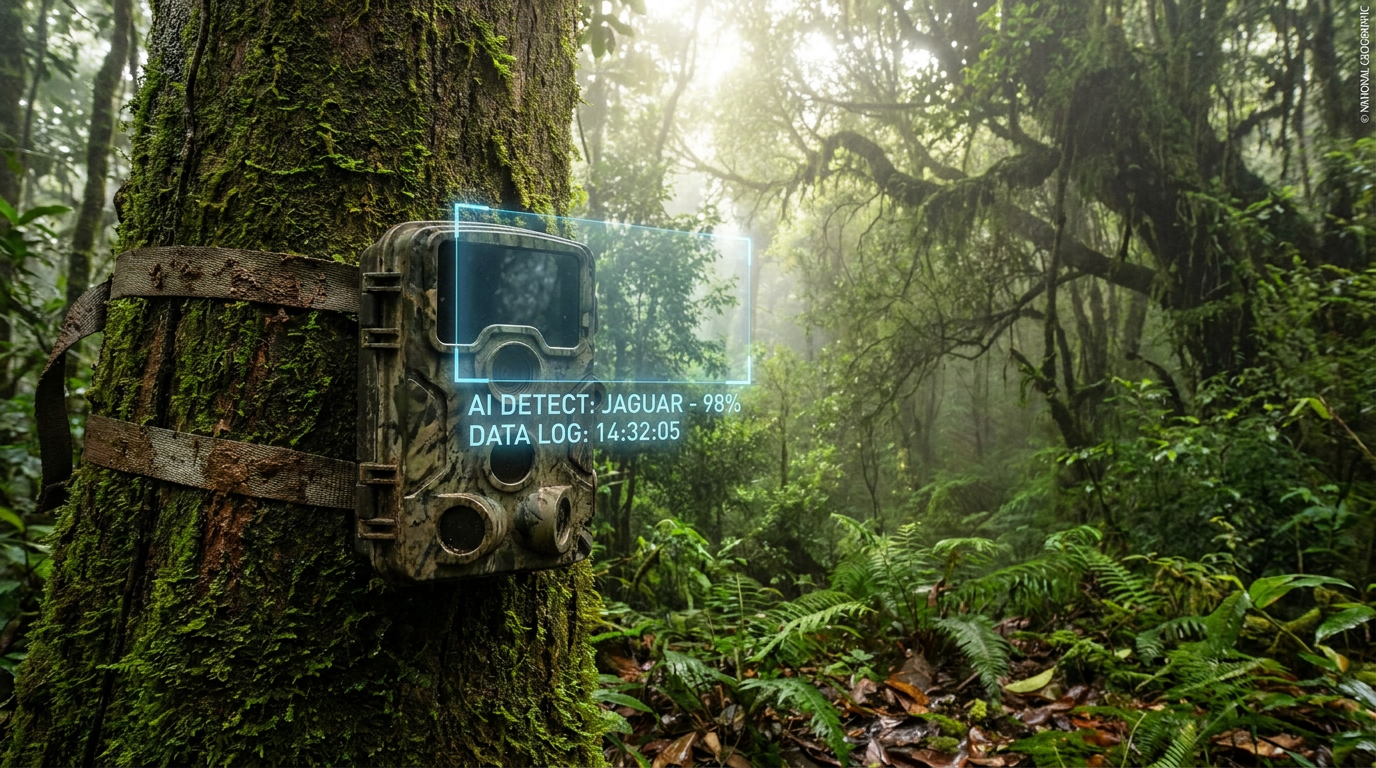
For decades, the greatest bottleneck in wildlife biology was not collecting data, but looking at it. A researcher studying snow leopards or forest elephants might hike for days to deploy a grid of motion-activated camera traps, only to return months later with a million photos. Because the sensors are triggered by swaying branches, falling leaves, and shifting sunlight, up to 95 percent of those images contain no animals at all. Biologists spent countless hours staring at empty forests on their monitors, a tedious manual sorting process that delayed actual scientific discovery by years.[1]
That era of manual observation is rapidly ending. Driven by exponential advances in machine learning, artificial intelligence is fundamentally reshaping behavioral ecology and conservation. As recently highlighted by the journal Nature, algorithms are now capable of tracing animal movements, mapping social networks, and even decoding the complex vocalizations of species ranging from hummingbirds to pumas. By automating the most labor-intensive aspects of field research, AI is allowing scientists to ask questions that were previously impossible to answer due to the sheer scale of the data.[1][5]
The most immediate transformation has occurred in visual processing. Microsoft's AI for Good Lab developed MegaDetector, an open-source object detection model specifically trained to find animals, people, and vehicles in camera trap images. Rather than identifying specific species, MegaDetector acts as a highly efficient first-pass filter. It scans millions of frames, draws bounding boxes around anything biological, and assigns a confidence score.[2]
The efficiency gains are staggering. In typical field deployments, MegaDetector can reduce the number of empty images requiring human review by 82 percent, while missing less than one percent of actual animal sightings. Once the empty frames are discarded, researchers can feed the remaining images into downstream, species-specific classifiers. This pipeline is now used by more than 80 conservation organizations worldwide, turning a multi-year data processing nightmare into a task that takes days.[2][5]

Beyond stationary cameras, AI is also revolutionizing how we understand animal movement across vast landscapes. The Max Planck Institute of Animal Behavior operates Movebank, a global repository for animal tracking data that currently houses over 6.5 billion location points from GPS collars and satellite tags. Historically, this data was used to draw simple lines on a map to show migration routes.[4]
Today, machine learning models ingest this massive spatial dataset to predict how animals interact with their dynamic environments. By overlaying Movebank's tracking data with real-time satellite imagery of weather patterns, vegetation growth, and human infrastructure, algorithms can identify the precise environmental triggers that prompt a herd to migrate or a predator to hunt. This predictive capability is crucial for dynamic conservation, allowing park rangers to anticipate where human-wildlife conflict is most likely to occur before it happens.[4][5]
Today, machine learning models ingest this massive spatial dataset to predict how animals interact with their dynamic environments.
But the most ambitious frontier of AI in ecology is not visual or spatial—it is auditory. The field of bioacoustics has long struggled with what researchers call the "cocktail party problem." In a dense rainforest or a coral reef, thousands of animals vocalize simultaneously against a backdrop of wind, rain, and human noise. Previously, researchers had to throw out up to 97 percent of their audio recordings because the overlapping sounds were too messy to isolate and analyze.[3]
The Earth Species Project (ESP), a non-profit research organization, is deploying large language models—similar to the architecture behind ChatGPT—to solve this. ESP has developed AI models capable of sophisticated source separation, isolating the call of a single individual from a cacophony of background noise. This breakthrough allows scientists to recover vast amounts of previously unusable data, opening a new window into the acoustic lives of ecosystems.[3][5]

With clean audio data, the next step is pattern recognition. ESP's flagship model, NatureLM-audio, is trained on massive datasets spanning human speech, music, and animal sounds. By analyzing the underlying structure of these vocalizations, the AI can automatically detect, classify, and cluster calls. Researchers are currently using these tools to map the vocal repertoires of endangered beluga whales in Canada, identifying distinct regional dialects that were previously indistinguishable to the human ear.[3]
The ultimate goal of this bioacoustic research is to build an "ethogram"—a complete inventory of a species' behaviors and their corresponding communications. While we are not yet at the point of translating a crow's caw into English, AI is revealing the complex grammar and social syntax embedded in animal communication. It suggests that the gap between human language and animal signaling may be narrower than historically assumed.[1][3]
However, this rapid technological acceleration carries significant ethical risks. The same algorithms that allow conservationists to track endangered rhinos or map elephant corridors could be weaponized by poachers. If real-time tracking data or highly accurate species detection models are left entirely open-source without safeguards, bad actors could exploit them to locate high-value targets.[2][5]

To mitigate these risks, the conservation technology community is developing strict data protocols. Platforms like Movebank often delay the public release of tracking data for sensitive species, while camera trap pipelines can be programmed to immediately flag and scrub images containing humans or vehicles in protected areas, alerting rangers to potential poachers without exposing the animals' locations.[2][4][5]
As these tools mature, they are shifting the fundamental paradigm of biology. For centuries, humans have studied animals primarily through observation and capture, imposing our own frameworks onto their behavior. By leveraging artificial intelligence to process the world exactly as animals navigate and vocalize within it, science is moving toward a model of deep listening. It is a technological leap that promises not just to protect the natural world, but to finally understand it on its own terms.[1][3][5]
How we got here
2008
Movebank is launched by the Max Planck Institute to host global animal movement data.
2018
The Earth Species Project is founded to apply artificial intelligence to non-human communication.
2020
Microsoft AI for Earth releases early versions of MegaDetector to automate camera trap sorting.
2023
Earth Species Project develops foundation models to solve the 'cocktail party problem' in bioacoustics.
June 2026
Nature publishes a comprehensive review on how AI is revealing the secret lives of animals.
Viewpoints in depth
Conservation Technologists
Focus on scaling up wildlife monitoring by automating the processing of massive visual and spatial datasets.
For technologists and data scientists, the primary value of AI in ecology is efficiency. By deploying models like MegaDetector and spatial algorithms on platforms like Movebank, researchers can eliminate the manual sorting of millions of empty camera trap frames and raw GPS pings. This camp argues that the sheer volume of data collected by modern sensors is useless without machine learning to filter, categorize, and predict patterns, turning raw environmental noise into actionable conservation strategies.
Behavioral Ecologists
Emphasize AI's potential to decode complex animal communication and reveal hidden social structures.
Biologists and bioacoustics experts view AI as a translation tool that can bridge the interspecies gap. Organizations like the Earth Species Project are using large language models to solve the 'cocktail party problem'—isolating individual animal calls from noisy environments. This perspective focuses on building comprehensive ethograms and mapping regional dialects, arguing that AI will eventually allow us to understand the complex grammar, social syntax, and cultural transmission embedded in animal communication.
Wildlife Ethicists
Focus on the ethical implications of interspecies communication and the risk of poachers exploiting AI tracking data.
Ethicists and frontline conservationists warn that the open-source nature of advanced AI models presents a dual-use dilemma. While algorithms can help rangers protect endangered species, the exact same tracking predictions and species-detection models could be weaponized by poachers to locate high-value targets like rhinos or elephants. This camp advocates for strict data protocols, such as blurring real-time GPS locations and filtering out human detections in sensitive areas, to ensure that technological advancement does not inadvertently facilitate ecological harm.
What we don't know
- Whether AI will ever be able to fully translate animal vocalizations into human-comprehensible language.
- How the widespread availability of open-source tracking models will impact the behavior of highly organized poaching syndicates.
- To what extent the complex 'dialects' observed in species like beluga whales correlate with specific social or cultural meanings.
Key terms
- Bioacoustics
- The scientific study of sound production, dispersion, and reception in animals.
- Camera Trap
- A remote camera triggered by motion or infrared sensors, used to capture images of wild animals with minimal human interference.
- Source Separation
- An AI technique used to isolate individual sounds (like a specific bird call) from a noisy background recording.
- Ethogram
- A comprehensive inventory or catalog of all the behaviors and actions exhibited by a specific animal species.
- Bounding Box
- A rectangular border drawn by an AI model around an object it has detected in an image, used to localize animals in camera trap photos.
Frequently asked
Can AI actually translate what animals are saying?
Not yet. Current AI models excel at separating sounds and identifying patterns, but mapping those sounds to specific meanings (an "ethogram") is still an ongoing scientific challenge.
How does MegaDetector know what an animal is?
It is trained on millions of annotated camera trap images to recognize the general shape and features of animals, humans, and vehicles, though it relies on secondary models to identify specific species.
Is there a risk of poachers using this technology?
Yes. Conservationists are actively developing safeguards, such as delaying the release of real-time tracking data and filtering out human detections in sensitive areas to protect endangered species.
What is the 'cocktail party problem' in bioacoustics?
It refers to the challenge of isolating a single animal's call from a noisy environment where wind, water, and hundreds of other animals are making sounds simultaneously.
Sources
Source coverage
5 outlets
3 viewpoints surfaced





[1]NatureBehavioral Ecologists
How AI is revealing the secret lives of animals from hummingbirds to pumas
Read on Nature →[2]Microsoft AI for Good LabConservation Technologists
MegaDetector: AI for camera traps
Read on Microsoft AI for Good Lab →[3]Earth Species ProjectBehavioral Ecologists
Decoding animal communication with advanced AI
Read on Earth Species Project →[4]Max Planck Institute of Animal BehaviorConservation Technologists
Movebank: Animal tracking and sensor data
Read on Max Planck Institute of Animal Behavior →[5]Factlen Editorial TeamWildlife Ethicists
Synthesis by Factlen editorial team
Read on Factlen Editorial Team →



Every angle. Every day.
Get science stories with full source coverage and perspective breakdowns delivered to your inbox.