
The Neuroscience of Minimalism: How Decluttering Lowers Cortisol and Frees Cognitive Load
Research reveals that physical and digital clutter act as a constant cognitive tax, elevating stress hormones and depleting working memory. By intentionally reducing possessions and digital inputs, individuals can measurably improve focus and lower daily anxiety.
By Factlen Editorial Team

- Cognitive Psychologists
- Focuses on how visual complexity and task-switching deplete working memory and executive function.
- Behavioral Health Experts
- Emphasizes the link between physical environments, cortisol levels, and chronic anxiety.
- Workplace Analysts
- Examines how environmental and digital clutter impacts professional output and decision fatigue.
- Digital Minimalists
- Advocates for intentional technology use to protect attention from algorithmic hijacking.
What's not represented
- · Interior Designers focusing on maximalism and curated complexity
- · Individuals living in multi-generational or high-density housing where physical minimalism is structurally difficult
Why this matters
Understanding the neurological impact of clutter shifts minimalism from a mere aesthetic choice to a vital mental health tool. By clearing physical and digital environments, readers can actively lower their daily stress levels, reclaim their attention span, and improve their decision-making capacity.
Key points
- Physical clutter actively competes for neural representation in the visual cortex, draining working memory and reducing focus.
- Studies show that individuals living in cluttered environments experience chronically elevated levels of the stress hormone cortisol.
- The Zeigarnik Effect causes the brain to perceive disorganized objects as unfinished tasks, leading to decision fatigue.
- The mere presence of a smartphone on a desk measurably reduces available cognitive capacity, even when powered off.
- Digital minimalism utilizes structural boundaries, like batched notifications, to protect the brain from context-switching fatigue.
Minimalism is often marketed as an aesthetic choice—stark white walls, sparse Scandinavian furniture, and perfectly curated capsule wardrobes. But beneath the glossy magazine spreads lies a profound neurological intervention. The deliberate reduction of physical and digital possessions is not merely about interior design; it is a scientifically validated method for reclaiming cognitive bandwidth. As modern environments become increasingly saturated with stimuli, researchers are discovering that the human brain treats excess physical objects and digital notifications not as harmless background decor, but as a constant, draining cognitive tax.[8]
To understand why a cluttered room feels exhausting, one must look at how the brain processes visual information. A landmark study by the Princeton Neuroscience Institute utilized functional magnetic resonance imaging (fMRI) to observe what happens when humans are surrounded by disorganized objects. The researchers found that multiple visual stimuli actively compete for neural representation in the visual cortex. Essentially, the brain cannot simply ignore the pile of mail on the counter or the scattered shoes by the door; it must actively work to filter them out, a process that continuously siphons energy away from working memory and executive function.[2]
This visual competition creates what psychologists call 'extraneous cognitive load.' When the visual field is crowded, the brain's processing capacity is artificially capped. People in orderly, simplified settings demonstrate a measurably higher capacity to focus, process information, and solve complex problems. By contrast, those navigating highly complex visual environments experience faster mental fatigue, as their neural networks burn through energy reserves simply trying to distinguish relevant targets from background noise.[2]

The toll of this cognitive load extends beyond mere distraction; it triggers a measurable physiological stress response. In a comprehensive study by UCLA’s Center on Everyday Lives of Families, researchers placed cameras in the homes of dual-income families and tracked their hormone levels. The data revealed a stark correlation: individuals—particularly women—who described their living spaces as 'cluttered' or 'unfinished' exhibited chronically elevated levels of cortisol, the body's primary stress hormone, throughout the entire day.[1]
Conversely, those who maintained simplified, organized homes experienced a natural drop in cortisol levels as the evening progressed. Behavioral health experts attribute this stress response partly to the Zeigarnik Effect, a psychological phenomenon where the mind fixates on incomplete tasks. To the subconscious brain, a cluttered room is not just messy; it is a visual to-do list. Every out-of-place item represents an unresolved decision—something that needs to be filed, cleaned, fixed, or discarded—keeping the nervous system in a low-grade state of 'fight or flight.'[1][5]
This constant demand for micro-decisions leads directly to decision fatigue. Every object a person owns requires a baseline level of management and attention. When a home or workspace is filled with excess items, the sheer volume of choices—what to wear, where to put a document, which mug to use—depletes the brain's finite daily reserve of decision-making power. By intentionally restricting options, minimalists bypass this fatigue, preserving their mental energy for higher-stakes professional or personal challenges.[3][5]
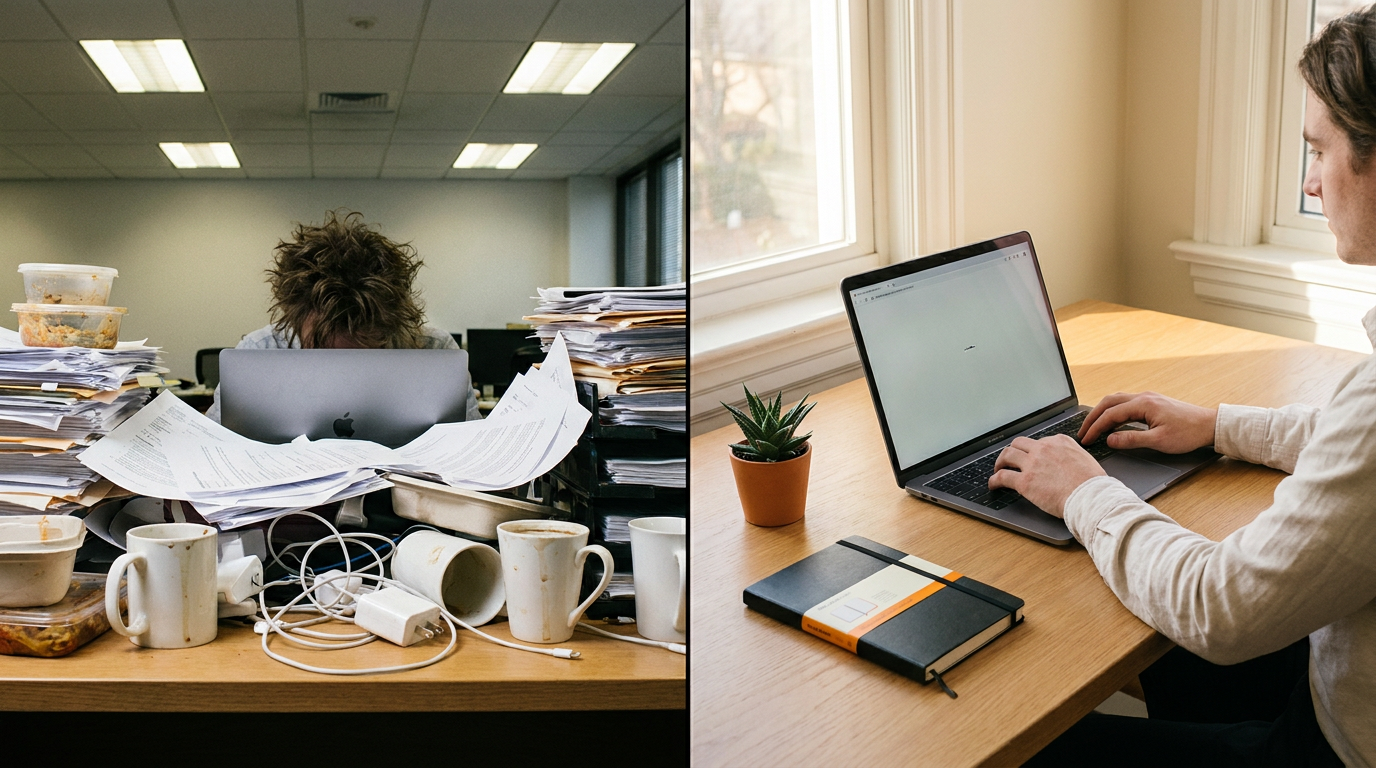
The consequences of environmental chaos are particularly evident in professional settings. The Journal of Environmental Psychology has documented how disorganized workspaces directly impair subjective well-being and increase negative emotions. Employees working in cluttered environments report feeling mentally overloaded, even when their actual task volume is manageable.[3]

The consequences of environmental chaos are particularly evident in professional settings.
Corporate analysts echo these findings, noting that physical clutter in the workplace can reduce productivity by an estimated 15 percent. A messy desk forces the brain to constantly scan and evaluate irrelevant objects, interrupting the deep focus required for complex problem-solving. By clearing the physical workspace, professionals effectively remove the friction that prevents them from entering a state of flow.[6]
Yet, in the twenty-first century, physical clutter is only half of the equation. The modern frontier of cognitive preservation is digital minimalism. The average adult touches, taps, or swipes their smartphone over 2,600 times a day, subjecting their brain to an unprecedented barrage of algorithmic interruptions. Digital clutter—dozens of open browser tabs, unread emails, and constant push notifications—triggers the exact same physiological stress response as a hoarding situation, but it happens invisibly on a glass screen.[8]
The mere presence of a smartphone is enough to degrade cognitive performance. A pivotal study conducted by the University of Texas at Austin tested participants' cognitive capacity while their phones were either on the desk face-down, in their pocket, or in another room. The researchers discovered a phenomenon they dubbed 'Brain Drain': participants whose phones were visible performed significantly worse on cognitive tests than those whose phones were in a different room, even when the devices were completely powered off.[4]
The brain, it turns out, has to exert active, continuous effort to ignore the smartphone and resist the urge to check it. This subconscious resistance consumes a portion of the brain's limited cognitive capacity. Digital minimalism advocates for the intentional curation of technology to combat this drain. It requires treating digital attention as a scarce and sacred resource, rather than a commodity to be freely harvested by app developers.[4][8]

The cost of failing to curate digital inputs is severe context-switching fatigue. The American Psychological Association has found that the human brain is incapable of true multitasking; instead, it rapidly switches between tasks. Each switch incurs a 'cognitive penalty,' and constant toggling between deep work and digital notifications can reduce overall productivity by up to 40 percent.[7]
Neurodivergent individuals, particularly those with ADHD, are uniquely vulnerable to this digital overload. Because ADHD involves dopamine dysregulation, the brain naturally seeks out highly stimulating environments. Smartphones, engineered to deliver unpredictable dopamine hits via intermittent reinforcement, easily hijack this neurological wiring. For these individuals, implementing strict digital minimalist systems—such as grayscale screens and batched notifications—is not just a productivity hack, but a vital mental health intervention.[8]
Implementing minimalism, whether physical or digital, relies on two primary mechanisms: shedding and preventing. Shedding involves the emotional labor of letting go of items that no longer serve a purpose, thereby instantly reducing the visual data the brain must process. Preventing is the structural defense—establishing strict boundaries on what is allowed into the home or onto the device in the first place, and assigning a permanent 'home' to every retained object to eliminate future decision fatigue.[5]
When these practices are applied, the neurological shift is palpable. As visual complexity drops, the amygdala—the brain's threat-detection center—quiets down. Simultaneously, the prefrontal cortex, responsible for planning and self-control, begins to function more efficiently. The environment transforms from a source of cognitive extraction into a sanctuary of attentional restoration.[2][8]
Ultimately, the science of minimalism proves that the lifestyle is not about deprivation, but about intentional reallocation. By ruthlessly eliminating the physical and digital noise that quietly drains our cortisol and working memory, we do not empty our lives. Instead, we clear the necessary bandwidth to focus deeply, connect authentically, and experience genuine psychological rest in an increasingly chaotic world.[8]

How we got here
2010
UCLA Center on Everyday Lives of Families publishes a landmark study linking household clutter to elevated cortisol levels in women.
2011
Princeton Neuroscience Institute maps how visual clutter actively overloads the visual cortex and depletes working memory.
2017
The University of Texas demonstrates the 'Brain Drain' effect, showing that the mere presence of a smartphone reduces cognitive capacity.
2019
Cal Newport publishes 'Digital Minimalism,' bringing the concept of intentional technology curation to mainstream audiences.
Viewpoints in depth
Cognitive Science Perspective
Focuses on how visual complexity and task-switching deplete working memory and executive function.
Cognitive psychologists and neuroscientists view minimalism primarily through the lens of brain bandwidth. Their research demonstrates that the human visual cortex has a finite processing capacity. When an environment is filled with disorganized stimuli, the brain must expend continuous energy to filter out irrelevant information. This extraneous cognitive load diminishes the brain's ability to focus, solve complex problems, and retain information, making a strong scientific case for simplified environments.
Behavioral Health Perspective
Emphasizes the link between physical environments, cortisol levels, and chronic anxiety.
Behavioral health experts analyze how our surroundings trigger physiological stress responses. They point to data showing that cluttered homes keep the nervous system in a low-grade state of 'fight or flight,' chronically elevating cortisol levels. From this viewpoint, decluttering is not about interior design, but about removing the subconscious triggers of the Zeigarnik Effect—the anxiety caused by the brain perceiving every out-of-place object as an unfinished task.
Digital Minimalism Advocates
Advocates for intentional technology use to protect attention from algorithmic hijacking.
This camp argues that the modern crisis of distraction is driven by the attention economy, where apps are engineered to exploit dopamine loops. Digital minimalists believe that relying on willpower is insufficient against supercomputers designed to addict us. Instead, they advocate for structural interventions—like deleting frictionless apps, batching notifications, and using grayscale screens—to intentionally curate digital inputs and reclaim cognitive autonomy.
What we don't know
- The long-term impact of digital minimalism on neuroplasticity and whether attention spans can fully recover after years of algorithmic conditioning.
- The exact threshold of visual complexity at which the brain transitions from feeling stimulated to feeling overwhelmed.
- How the cortisol response to clutter varies across different cultural backgrounds and socioeconomic living conditions.
Key terms
- Cognitive Load
- The total amount of mental effort being used in the working memory to process information.
- Cortisol
- The body's primary stress hormone, which increases in response to chaotic or overwhelming environments.
- Zeigarnik Effect
- A psychological tendency to remember interrupted or incomplete tasks better than completed ones, often triggered by visual clutter.
- Decision Fatigue
- The deteriorating quality of decisions made by an individual after a long session of managing choices and inventory.
- Digital Minimalism
- A philosophy of technology use that focuses online time on a small number of carefully selected, high-value activities.
Frequently asked
How does physical clutter affect the brain?
Clutter forces the visual cortex to constantly filter out irrelevant information, which drains working memory and increases the stress hormone cortisol.
What is the Zeigarnik Effect?
It is the brain's tendency to fixate on unfinished tasks. Clutter triggers this effect because the brain perceives out-of-place objects as unresolved chores.
Does digital clutter have the same impact as physical clutter?
Yes. Digital clutter, such as unread emails and constant notifications, causes context-switching fatigue and depletes cognitive capacity just like physical messes.
Do I have to throw everything away to be a minimalist?
No. True minimalism is about intentionality and reducing visual noise by giving items a designated 'home,' not about strict deprivation.
Sources
Source coverage
8 outlets
4 viewpoints surfaced








[1]UCLA Center on Everyday Lives of FamiliesBehavioral Health Experts
Life at Home in the Twenty-First Century: Clutter and Cortisol
Read on UCLA Center on Everyday Lives of Families →[2]Princeton Neuroscience InstituteCognitive Psychologists
Interactions of top-down and bottom-up mechanisms in human visual cortex
Read on Princeton Neuroscience Institute →[3]Journal of Environmental PsychologyBehavioral Health Experts
The dark side of home: Assessing possession 'clutter' on subjective well-being
Read on Journal of Environmental Psychology →[4]University of Texas at AustinCognitive Psychologists
Brain Drain: The Mere Presence of One’s Own Smartphone Reduces Available Cognitive Capacity
Read on University of Texas at Austin →[5]Psychology TodayBehavioral Health Experts
How Clutter Impacts Cortisol and Cognitive Load
Read on Psychology Today →[6]Harvard Business ReviewWorkplace Analysts
The Case for Finally Cleaning Your Desk
Read on Harvard Business Review →[7]American Psychological AssociationCognitive Psychologists
Multitasking: Switching costs
Read on American Psychological Association →[8]Factlen Editorial TeamDigital Minimalists
Synthesis by Factlen editorial team
Read on Factlen Editorial Team →
Every angle. Every day.
Get lifestyle stories with full source coverage and perspective breakdowns delivered to your inbox.