
How Thomas Tuchel Rewired England's Tactics for the 2026 World Cup
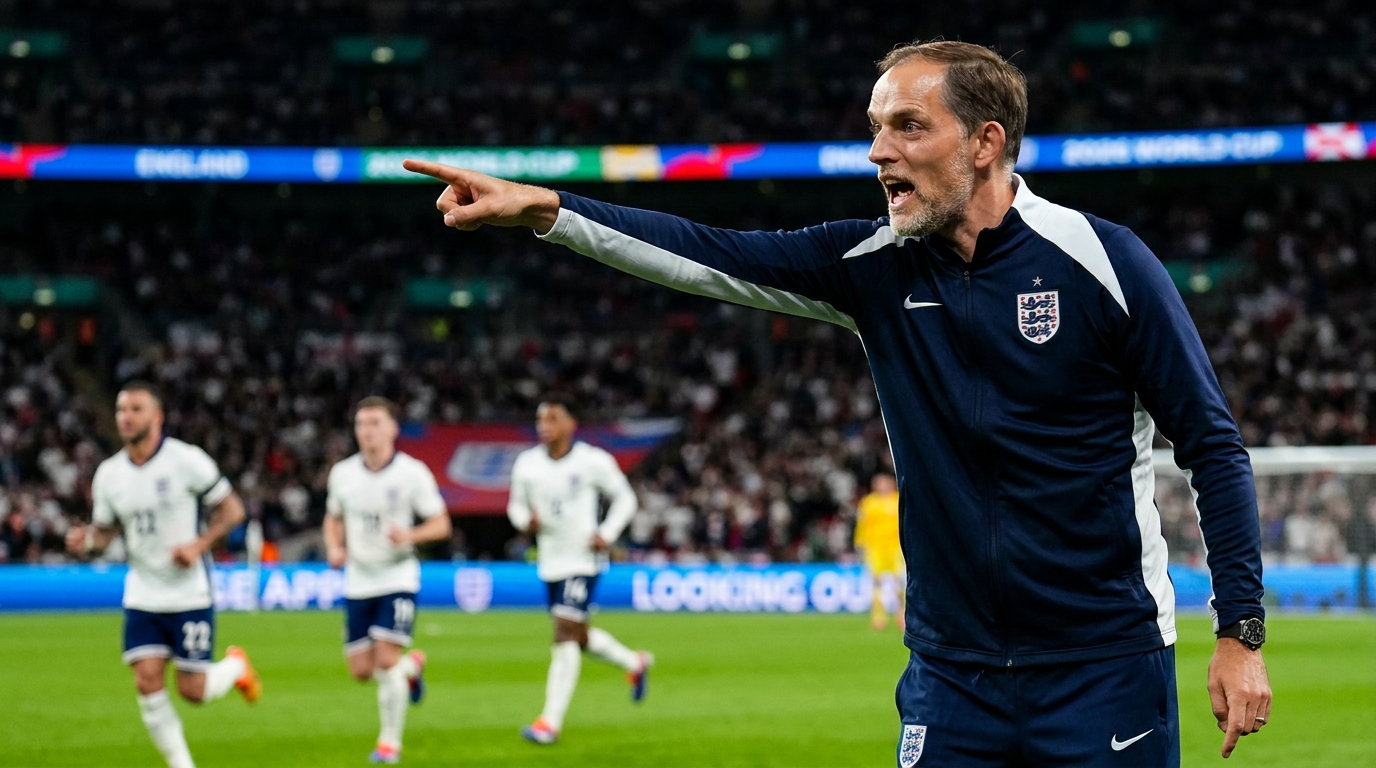
England enters the 2026 World Cup with a transformed tactical identity, abandoning cautious pragmatism for a highly structured, aggressive possession system under Thomas Tuchel.
By Factlen Editorial Team
- National Team Supporters
- Excited by the attacking fluidity, Bellingham's advanced role, and the departure from the previous era's conservatism.
- Tactical Analysts
- Focuses on the structural shifts, the 3-2-5 possession shapes, and the complex pressing triggers Tuchel has implemented.
- Pragmatic Observers
- Cautious about the vulnerabilities of a high defensive line and the challenge of balancing too many elite playmakers.
What's not represented
- · Opposing Managers
- · Omitted Elite Players
Why this matters
For decades, England's national team has struggled to maximize its world-class attacking talent due to conservative tactics. Tuchel's new aggressive, possession-based system finally unleashes players like Jude Bellingham and Harry Kane, making England one of the most structurally advanced and dangerous teams at the 2026 World Cup.
Key points
- Thomas Tuchel has shifted England from a conservative setup to an aggressive, possession-based system.
- The team transitions from a 4-2-3-1 into a 3-2-5 shape when building attacks.
- Inverted fullbacks move into midfield to create numerical superiority and protect against counters.
- Harry Kane operates as a false 9, dropping deep to create space for wingers to exploit.
- Jude Bellingham is given a free role as a No. 10, and was even tested as a striker in friendlies.
- The high defensive line leaves England vulnerable to rapid counter-attacks if their press is broken.
For years, the defining characteristic of the England national team was a cautious, risk-averse pragmatism. Under Gareth Southgate, the Three Lions reached consecutive European Championship finals, but critics continually lamented a perceived handbrake on a generation of world-class attacking talent. As the 2026 FIFA World Cup kicks off across North America, that handbrake has been emphatically removed. Manager Thomas Tuchel has rewired England’s tactical identity, replacing passive control with a highly structured, aggressive possession system designed to dominate opponents and dictate the tempo of the tournament.[6]
The foundation of this new era was laid during a flawless UEFA qualifying campaign. England swept Group K with eight consecutive victories, scoring 22 times and conceding zero goals against the likes of Serbia and Albania. While the opposition was rarely elite, the underlying metrics revealed a stark stylistic shift. England averaged over 70 percent possession across the campaign, utilizing complex positional rotations to suffocate teams in their own half rather than sitting back to absorb pressure.[2][3][6]
On paper, Tuchel’s England typically lines up in a 4-2-3-1 formation. However, modern international football is defined by what a team does when they have the ball, and Tuchel’s in-possession structure is where the tactical magic happens. As England builds from the back, the shape fluidly morphs into a 3-2-5 or an asymmetrical 3-4-2-1. This transformation is designed to create numerical superiority in the midfield and overwhelm the opposition's defensive line with five dedicated attackers.[2][3][6][7]
The key mechanism enabling this shift is the use of the inverted fullback. Depending on the personnel, players like Arsenal’s Myles Lewis-Skelly or Chelsea’s Reece James will tuck inside from the flank to join the midfield pivot. This allows the remaining three defenders to spread out and form a secure back three, ensuring England is protected against sudden counter-attacks while simultaneously giving the team an extra passing option in the center of the pitch.[2][6]

In the engine room, this structural tweak has liberated Declan Rice. For years, the Arsenal midfielder was tasked with being England’s primary defensive shield. Now, with an inverted fullback stepping alongside him, Rice is encouraged to push higher into the left half-spaces, operating as a dynamic box-to-box presence—a role that mirrors his highly effective club form.[3][6]
Finding the right partner for Rice was Tuchel’s biggest puzzle, and the answer arrived in the form of Nottingham Forest’s Elliot Anderson. Anderson has been a revelation, providing the press-resistance and deep-lying playmaking that England has historically lacked. By dropping deep to receive the ball under pressure, Anderson dictates the tempo and allows Rice the freedom to crash the opposition’s penalty area.[3]
At the sharp end of the pitch, the system relies heavily on the unique profile of captain Harry Kane. Rather than operating as a traditional target man, Kane functions as a "false 9," frequently dropping deep into the midfield to receive the ball. This movement serves a dual purpose: it gives England an extra body to help build passing sequences, and it drags opposing center-backs out of position, creating gaping holes in the defensive line.[6]
At the sharp end of the pitch, the system relies heavily on the unique profile of captain Harry Kane.
When Kane vacates the center forward space, Tuchel’s system demands that others ruthlessly exploit it. This is where the wide forwards—typically Bukayo Saka on the right and Anthony Gordon on the left—come alive. They are instructed to make aggressive, diagonal runs in behind the defense, transforming from traditional wingers into direct goal-scoring threats the moment Kane drops deep.[5][6]
Operating in the eye of this tactical storm is Jude Bellingham. The Real Madrid star is given immense freedom as the central No. 10, tasked with linking the midfield to the attack and arriving late into the box to finish cut-backs. Bellingham’s physical dominance and technical elegance make him the perfect fulcrum for Tuchel’s vertical passing sequences, allowing England to transition from patient build-up to lightning-fast attacks in a matter of seconds.[1][7]

Tuchel’s commitment to tactical flexibility was on full display during England’s final pre-tournament friendly, a commanding 3-0 victory over Costa Rica in Orlando. In a fascinating experiment, Tuchel deployed Bellingham as the No. 9, testing a striker-less system that prioritized fluid movement and relentless pressing from the front. While Kane remains the undisputed starter, the maneuver proved that England has viable, unpredictable alternatives if they need to chase a game or rest their captain.[4][5]
The sheer abundance of attacking talent at Tuchel’s disposal is both a blessing and a structural challenge. The squad is overflowing with elite No. 10s, including Phil Foden, Cole Palmer, and Morgan Rogers. Because the 4-2-3-1 system can realistically only accommodate one or two of these central creators without sacrificing defensive balance, Tuchel has had to make ruthless decisions, prioritizing tactical cohesion over simply fielding the most famous names.[3][7]

Despite the optimism, the system is not without its vulnerabilities. England’s aggressive 3-2-5 attacking shape requires the team to play with an exceptionally high defensive line. If the initial counter-press fails after losing the ball, the back three can be left exposed to quick, direct counter-attacks. Opponents with elite wingers will undoubtedly look to exploit the spaces left behind by England’s advancing fullbacks.[6]
Furthermore, the reliance on Kane’s deep-dropping movement means that if the Bayern Munich striker is neutralized or fatigued, the entire attacking mechanism can stall. Tuchel will need to ensure that his alternative plans—whether that involves Bellingham as a false 9 or utilizing a more traditional focal point like Ivan Toney—are seamlessly integrated if Plan A encounters friction.[3][4]

The ultimate test of this tactical evolution begins on June 17, when England faces Croatia at AT&T Stadium in Dallas. Croatia is renowned for their pragmatic resilience, tireless midfield work ethic, and ability to frustrate structurally complex opponents. It is exactly the type of high-stakes, tactical chess match that Gareth Southgate’s England often struggled to navigate.[1]
As the 2026 World Cup unfolds, Thomas Tuchel’s England represents a fascinating departure from the nation's historical footballing identity. By embracing a proactive, possession-heavy system that maximizes the strengths of their generational talents, the Three Lions have transformed from cautious contenders into a dynamic, unpredictable force. The tactical blueprint is set; now, it must survive the crucible of tournament football.
How we got here
July 2024
Gareth Southgate steps down as manager following back-to-back European Championship final defeats.
January 2025
Thomas Tuchel officially takes charge, promising a more aggressive, possession-based tactical approach.
November 2025
England completes a flawless World Cup qualifying campaign, winning all eight matches without conceding a goal.
June 10, 2026
England defeats Costa Rica 3-0 in their final pre-tournament friendly, experimenting with a fluid attacking shape.
June 17, 2026
England faces Croatia in Dallas for their opening match of the 2026 FIFA World Cup.
Viewpoints in depth
Tactical Analysts' view
Focuses on the mechanics of the 3-2-5 build-up and the importance of structural discipline.
Tactical purists are fascinated by Tuchel's implementation of the 3-2-5 in-possession shape, a hallmark of elite club football now translated to the international stage. They argue that the success of the system hinges entirely on the inverted fullbacks and the press-resistance of the midfield pivot. Analysts point to Elliot Anderson's emergence as the missing piece that allows Declan Rice to push forward, creating a perfectly balanced engine room that can suffocate opponents through sustained possession.
Pragmatic Observers' view
Highlights the risk of the high line and the challenge of leaving world-class talent on the bench.
More cautious observers warn that Tuchel's aggressive setup comes with inherent risks, particularly against elite counter-attacking teams. By committing five players forward and pushing the defensive line high up the pitch, England is highly vulnerable if their initial counter-press is bypassed. Furthermore, pragmatists note the immense pressure on Tuchel to maintain squad harmony when his strict structural requirements force him to bench generational talents like Phil Foden or Cole Palmer in favor of tactical balance.
National Team Supporters' view
Celebrates the ruthless, vertical attacking style and the liberation of England's star forwards.
For the fanbase, the tactical shift is a breath of fresh air after years of perceived conservatism. Supporters are thrilled by the sight of Jude Bellingham being given total freedom to dictate the final third, and by the aggressive, overlapping runs that define the new system. The 3-0 friendly win over Costa Rica, where Tuchel even experimented with Bellingham as a striker, is viewed as proof that England finally has a manager willing to take the handbrake off and overwhelm opponents with sheer attacking firepower.
What we don't know
- How the high defensive line will hold up against elite, pacey wingers in the knockout stages.
- Whether Tuchel can maintain squad harmony while inevitably benching several world-class No. 10s.
- How effectively the team can pivot to a 'Plan B' if Harry Kane is injured or neutralized.
Key terms
- Inverted Fullback
- A wide defender who moves into the central midfield when their team has the ball, creating a numerical advantage in the center of the pitch.
- False 9
- A striker who frequently drops deep into the midfield to link play and pull defenders out of position, rather than staying forward near the opponent's goal.
- Counter-press
- The immediate, aggressive attempt by a team to win the ball back within seconds of losing it high up the pitch.
- Double-pivot
- Two central defensive midfielders playing alongside each other to shield the defense and initiate attacking sequences.
Frequently asked
What formation does England play under Thomas Tuchel?
England nominally sets up in a 4-2-3-1, but fluidly transitions into an aggressive 3-2-5 or 3-4-2-1 when in possession of the ball.
Who partners Declan Rice in midfield?
Nottingham Forest's Elliot Anderson has emerged as the preferred partner, providing the deep-lying playmaking and press resistance the team needs.
Will Jude Bellingham play as a striker?
While Harry Kane is the starting striker, Tuchel tested Bellingham as a 'false 9' in a recent friendly against Costa Rica, offering a dynamic alternative.
When is England's first World Cup match?
England opens their 2026 World Cup campaign against Croatia on June 17 at AT&T Stadium in Dallas.
Sources
Source coverage
7 outlets
3 viewpoints surfaced







[1]GoalNational Team Supporters
England vs Croatia: Match context and tactical preview
Read on Goal →[2]ForbesTactical Analysts
Thomas Tuchel's First England Camp Reveals Tactical Shifts
Read on Forbes →[3]The GuardianPragmatic Observers
England World Cup 2026 preview: Tuchel's plan and the midfield question
Read on The Guardian →[4]MirrorNational Team Supporters
Jude Bellingham used as No.9 in move that shows Thomas Tuchel's new ways to win
Read on Mirror →[5]Deccan HeraldNational Team Supporters
England's dominant win over Costa Rica showcased Thomas Tuchel's attacking philosophy
Read on Deccan Herald →[6]Tactical Football AnalysisTactical Analysts
Thomas Tuchel England Tactics & Style Of Play Ahead Of 2026 World Cup
Read on Tactical Football Analysis →[7]Extra Time TalkPragmatic Observers
England World Cup 2026 Formation: Will It Change?
Read on Extra Time Talk →
More in sports
See all 8 stories →Standings
The 2026 Global Ice Hockey Championship Picture: Final Standings and Summer Stakes
0 sources

Injury
MLB Aces Complete Long Road Back: Cole, Musgrove Headline Wave of Successful UCL Recoveries
0 sources

Women's Boxing
The 3-Minute Round Debate Reshaping Women's Boxing
0 sources
Standings
Global Baseball Standings: Underdogs Surge and Juggernauts Pace the Leagues in June 2026
0 sources

Every angle. Every day.
Get sports stories with full source coverage and perspective breakdowns delivered to your inbox.