
How AI is Decoding the Secret Lives of Animals, From Pumas to Hummingbirds
Advances in machine learning are allowing ecologists to process millions of hours of audio and video, revealing the complex social structures and communication networks of wildlife.
By Factlen Editorial Team
- AI Conservationists
- Focus on the scalability of machine learning to process millions of images and audio files, enabling near real-time monitoring and rapid policy decisions.
- Bioacoustics Researchers
- Emphasize the use of self-supervised models to discover hidden syntax and individual identities within animal vocalizations, pushing beyond simple species identification.
- Field Ecologists
- Argue that AI models are only useful when grounded in rigorous field observation, requiring multimodal data (like drone video) to prove that acoustic patterns actually correlate with behavior.
What's not represented
- · Indigenous trackers whose traditional ecological knowledge often pre-dates digital findings
- · Policymakers who must decide how to integrate AI-generated data into legal conservation frameworks
Why this matters
For decades, human understanding of animal behavior was limited by our inability to process vast amounts of field data. By automating visual identification and finding hidden patterns in animal vocalizations, AI is fundamentally shifting ecology from passive observation to active decoding, enabling faster conservation decisions and a deeper understanding of non-human intelligence.
Key points
- AI models can now process millions of camera trap images in days rather than months, matching human accuracy in up to 90% of cases.
- Self-supervised bioacoustic models are identifying individual animals within noisy flocks, a task previously impossible at scale.
- Researchers are using AI to decode the complex communication of cooperative species like crows and orcas.
- Scientists stress that AI identifies patterns, not translations; these patterns must be linked to observed physical behavior to have meaning.
For centuries, organismal biology and ecology have been defined by what scientists could observe from the outside. Researchers mapped migration routes, measured metabolic rates, and sequenced genomes with clinical precision. Yet, the field remained largely locked out of the internal and social lives of its subjects, often treating animal behavior as reactive instinct rather than intentional choice. That wall is now crumbling as artificial intelligence begins to decode the vast, noisy datasets of the natural world.[1][5]
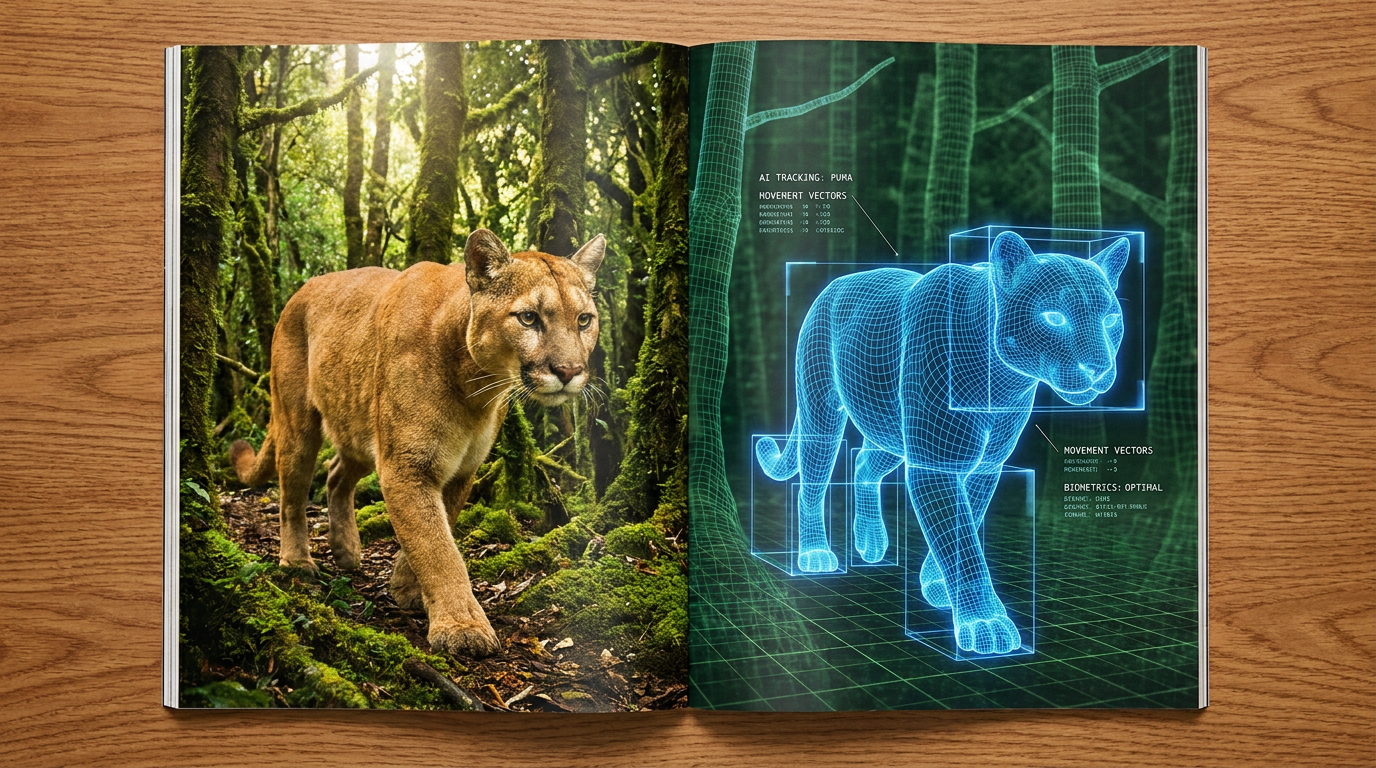
The shift, which accelerated rapidly through 2025 and early 2026, is moving ecology from an era of passive recording to one of active decoding. Advances in machine learning are allowing researchers to trace the movements, landmarks, and social practices of wildlife with unprecedented granularity. From tracking the silent, solitary paths of pumas to untangling the hyper-vocal chatter of hummingbirds, AI is revealing that nature is structurally complex and deeply communicative.[1]
The first major breakthrough has been in visual processing, solving a massive logistical bottleneck for field researchers. Camera traps—motion-activated cameras placed in forests and other habitats—have revolutionized wildlife monitoring. However, a single project can generate millions of images, historically requiring humans to manually review each frame to identify the species or filter out the 60 to 70 percent of photos that are entirely blank.[2][6]
A recent study published in the Journal of Applied Ecology demonstrated that fully automated AI pipelines can now replace human review for these massive datasets. Researchers from Washington State University and Google tested an AI model called SpeciesNet on millions of camera trap images from Washington, Montana’s Glacier National Park, and Guatemala’s Maya Biosphere Reserve. The results showed that the AI matched the scientific conclusions of human experts in 85 to 90 percent of cases.[2]

This automation cuts analysis time from months—or even years—down to mere days. For conservationists, this speed is transformative. It enables near real-time monitoring of vulnerable species, allowing wildlife managers to make rapid, evidence-based decisions regarding habitat protection and resource allocation for animals like jaguars, wolves, and grizzly bears.[2][6]
But AI's impact extends far beyond counting animals in photographs; it is now being used to decode the very structure of animal communication. In the past, ecology often treated animal sounds as simple, hardwired signals—fixed biological responses to hunger, fear, or mating. High-compute processing is revealing deep nuances that human ears and traditional spectrograms missed.[1][3]
Organizations like the Earth Species Project (ESP) are building generalizable bioacoustic models to analyze communications across various species. Rather than building a simple "Google Translate for Dogs," these models are designed to find repeated acoustic units and patterns in animal sounds, producing structured, testable hypotheses about what those signals predict and when they matter.[3][4][5]

Organizations like the Earth Species Project (ESP) are building generalizable bioacoustic models to analyze communications across various species.
One of the most significant recent milestones is the ability to identify individual animals within a noisy, dynamic group. In the wild, highly social species like zebra finches do not sing in isolation; they move through complex networks, calling and responding across space and time. Understanding this communication requires knowing exactly who is talking to whom.[4]
Using a self-supervised bioacoustic model called BirdAVES, researchers have successfully learned to recognize individual zebra finches from field recordings without relying on manually annotated data. This turns hours of chaotic audio into precise "who-sang-when" timelines, allowing ecologists to map how information flows through a flock and how individual relationships shape collective behavior.[4]

Similar techniques are being applied to cooperative-breeding species, where complex social coordination is required for survival. In northern Spain, scientists have spent decades studying carrion crows, a species where entire families—not just parents—raise chicks and protect nests. To understand how they coordinate these intricate tasks, researchers deployed audio recorders and biologgers.[3]
The sheer volume of data quickly became unmanageable, with each microphone capturing days of continuous audio. By collaborating with AI researchers to develop custom models, the team is now categorizing a vast dataset of crow calls, isolating the specific vocalizations that precede coordinated group actions. This approach is also being deployed underwater to understand how tight-knit pods of orcas use calls to move and hunt collectively.[3]
Despite these breakthroughs, researchers emphasize the necessity of transparent uncertainty in this emerging field. AI models are exceptionally good at finding patterns, but patterns alone do not equal meaning. To avoid anthropomorphism, scientists must link acoustic data to concrete behavioral context.[1][5]
This is why multimodal integration is becoming the gold standard in 2026. By synchronizing audio recordings with drone-captured video or GPS collar data, researchers can see exactly what an animal is doing while it vocalizes. If a specific sequence of sounds consistently predicts a collective movement or a change in foraging strategy, scientists can begin to assign provisional meaning to that sequence.[1][2]

The ultimate goal is not to force human language onto the animal kingdom, but to understand non-human communication on its own terms. By processing pitch, rhythm, and timbre simultaneously, AI is helping to build a rudimentary, revisable dictionary for the planet.[1][5]
As these tools become more accessible, they are democratizing wildlife research. Cloud-based platforms are now hosting regional AI computer vision models, allowing smaller conservation groups to upload their camera trap data and receive instant, highly accurate species identifications. This collaborative infrastructure is filling blank spaces in global biodiversity maps.[2][6]
The integration of artificial intelligence into ecology represents a profound shift in how humans relate to the natural world. By providing the tools to truly listen to and observe the intricate lives of other species, technology is fostering a deeper, evidence-based appreciation for the complexity of life on Earth.[1][5]
How we got here
Early 2000s
Digital camera traps become widely available, leading to a massive influx of visual data that overwhelms human researchers.
2024
Ecologists studying cooperative-breeding crows in Spain partner with the Earth Species Project to manage unprocessable amounts of audio data.
Late 2025
The BirdAVES model is introduced, proving that self-supervised AI can identify individual birds from field recordings without manual labeling.
May 2026
A landmark study in the Journal of Applied Ecology proves fully automated AI pipelines can replace human review for camera trap datasets.
Viewpoints in depth
AI Conservationists
Focus on the scalability of machine learning to process millions of images and audio files, enabling near real-time monitoring.
For technologists and data-driven conservationists, the primary value of AI is overcoming the human bottleneck. Historically, the sheer volume of data collected by camera traps and bio-loggers meant that actionable insights were delayed by months or years. By deploying models like SpeciesNet, conservationists argue that we can move to near real-time monitoring. This speed is critical for anti-poaching efforts, tracking the immediate impacts of climate change, and dynamically managing protected habitats for endangered species before it is too late.
Bioacoustics Researchers
Emphasize the use of self-supervised models to discover hidden syntax and individual identities within animal vocalizations.
Researchers focused on animal communication view AI not just as a sorting tool, but as a translation engine for the structure of nature. Because self-supervised models can analyze pitch, rhythm, and timbre simultaneously across millions of hours of audio, they can detect phonetic-like organization that human ears miss. These researchers are particularly excited about moving beyond species-level identification to tracking individual animals within a group, which opens the door to understanding how non-human societies share information, make collective decisions, and pass down cultural knowledge.
Field Ecologists
Argue that AI models are only useful when grounded in rigorous field observation and behavioral context.
Traditional field ecologists offer a necessary note of caution against digital over-reliance. They point out that while AI is exceptional at finding statistical patterns in audio or visual data, a pattern does not inherently carry biological meaning. Without multimodal integration—such as pairing audio with drone video to see what the animal is actually doing—there is a high risk of anthropomorphizing the data. For this camp, the algorithm is only as good as the muddy boots on the ground verifying the behavior in the wild.
What we don't know
- Whether AI models trained on specific regional ecosystems can accurately generalize to entirely different habitats without extensive retraining.
- How much of the structural complexity found in animal vocalizations represents intentional communication versus involuntary biological responses.
- The extent to which noise pollution from human activity is actively disrupting the complex communication networks these models are just beginning to uncover.
Key terms
- Bioacoustics
- The scientific study of sound production, dispersion, and reception in animals, increasingly analyzed using massive datasets.
- Self-supervised learning
- A type of machine learning where the AI finds patterns in raw, unlabeled data without needing humans to manually categorize the inputs first.
- Camera trap
- A remotely activated camera equipped with a motion sensor or infrared trigger, used to capture images of wild animals with minimal human interference.
- Cooperative breeding
- A social system in which individuals other than the biological parents help to care for and raise the young, requiring complex communication and coordination.
- Multimodal integration
- The practice of combining different types of data—such as audio recordings, drone video, and GPS tracking—to get a complete picture of animal behavior.
Frequently asked
Can AI translate what animals are saying into English?
No. AI does not produce human language translations. Instead, it identifies repeated structural patterns in animal sounds, allowing scientists to form hypotheses about what those sounds predict in the animal's behavior.
How accurate is AI at identifying animals in photos?
Recent studies show that fully automated AI models match the scientific conclusions of human experts in roughly 85 to 90 percent of cases when analyzing camera trap images.
Why is identifying individual animals important?
In highly social species, understanding communication requires knowing who is interacting with whom. Identifying individuals allows ecologists to map social networks and understand how information flows through a group.
How does AI handle the massive amount of blank camera trap photos?
Camera traps are motion-activated and often triggered by wind or falling leaves, resulting in 60 to 70 percent blank images. AI models can instantly filter these out, saving researchers months of manual review.
Sources
Source coverage
6 outlets
3 viewpoints surfaced






[1]NatureField Ecologists
How AI is revealing the secret lives of animals from hummingbirds to pumas
Read on Nature →[2]Journal of Applied EcologyAI Conservationists
Artificial intelligence can dramatically speed up the painstaking work of tracking wildlife with remote cameras
Read on Journal of Applied Ecology →[3]MongabayField Ecologists
From caws to code: AI helps decrypt animal communication
Read on Mongabay →[4]Earth Species ProjectBioacoustics Researchers
AI Learns to Recognize Individual Animals
Read on Earth Species Project →[5]A-Z AnimalsBioacoustics Researchers
The Global Think Tank Using AI to Understand Animal Communication
Read on A-Z Animals →[6]MarketInteloAI Conservationists
Wildlife Camera Trap Systems Market Analysis 2025-2034
Read on MarketIntelo →


Every angle. Every day.
Get science stories with full source coverage and perspective breakdowns delivered to your inbox.