
How Neuroaesthetics is Reshaping Interior Design for Mental Well-being
A new evidence-based approach to interior design uses neuroscience to create spaces that actively lower stress and improve cognitive health. By integrating biophilic elements and sensory-informed layouts, neuroaesthetics transforms homes into tools for preventive mental healthcare.
By Factlen Editorial Team
- Neuroscientists and Researchers
- Focuses on the measurable biological data behind aesthetic experiences.
- Architects and Interior Designers
- Focuses on the practical application of evidence-based design in real-world spaces.
- Public Health Advocates
- Focuses on the democratization of healthy spaces and preventive care.
What's not represented
- · Real Estate Developers balancing the cost of neuroaesthetic implementation with profit margins.
- · Neurodivergent individuals who require highly customized sensory environments.
Why this matters
Most people spend 90 percent of their day indoors, yet traditional design focuses primarily on visual appeal rather than biological impact. Understanding how room shapes, lighting, and textures affect the nervous system empowers individuals to design homes that actively reduce anxiety and foster emotional resilience.
Key points
- Neuroaesthetics studies how the brain and nervous system respond to aesthetic experiences and physical environments.
- The average person spends 90% of their time indoors, making home design a critical factor in mental health.
- Biophilic design, which brings natural elements indoors, is proven to lower cortisol and increase serotonin.
- Curvilinear shapes, dynamic natural light, and varied textures activate the brain's pleasure and comfort centers.
- Johns Hopkins University recently released a roadmap to integrate these neuroscientific findings into everyday architecture.
For decades, interior design has been treated as a purely visual discipline—a matter of matching colors, selecting furniture, and optimizing floor plans for aesthetic appeal. However, a quiet revolution is taking place at the intersection of architecture and brain science. Researchers are discovering that the spaces we inhabit do much more than reflect our personal style; they actively shape our biology. This emerging field, known as neuroaesthetics, studies how aesthetic experiences affect the human nervous system, revealing that design decisions trigger measurable physiological responses.[2][5]
The stakes are surprisingly high. The average person spends roughly 90 percent of their day indoors, meaning our built environments serve as the primary habitat for our brains. When spaces are purely functional or overly sterile, they risk dehumanizing their occupants, subtly elevating stress hormones and cognitive fatigue. Conversely, environments designed with neuroaesthetic principles can act as preventive mental healthcare, lowering blood pressure, slowing heart rates, and increasing the release of serotonin and dopamine.[4][5]
The science behind this phenomenon is rooted in our evolutionary history. The human brain evolved over hundreds of thousands of years in natural, outdoor environments. It is only in the last fraction of human history that we have migrated into dense urban centers and enclosed, artificial structures. Because our "old brains" are still wired to seek safety and sustenance in nature, environments that mimic natural settings unconsciously signal to our nervous system that we are secure, allowing our bodies to shift from a state of low-grade alertness into one of restoration.[4]
This biological reality is the foundation of biophilic design, a core component of neuroaesthetics that intentionally brings nature indoors. Coined in the 1980s by biologist Edward O. Wilson, "biophilia" describes humanity's innate affinity for the living world. In interior design, this translates to much more than simply placing a potted plant in a corner. It involves a comprehensive approach to integrating natural light, organic materials, water features, and botanical patterns into the structural fabric of a home.[5]

The evidence supporting biophilic interventions is robust. Studies utilizing functional magnetic resonance imaging and electroencephalography have demonstrated that exposure to natural elements—or even nature-themed imagery—directly impacts the orbitofrontal cortex, the brain region associated with emotional regulation and decision-making. When individuals spend time in biophilic spaces, their cortisol levels—a primary biomarker for stress—measurably decrease, while their cognitive clarity and problem-solving abilities improve.[2][4]
In January 2026, the International Arts + Mind Lab at Johns Hopkins University formalized this growing body of evidence by releasing the "Intentional Spaces Roadmap." This strategic framework aims to bridge the gap between neuroscientific research and real-world architectural practice. The roadmap argues that elements such as light, sound, texture, and form are not mere decorative choices, but biological interventions that can be optimized to support human health, learning, and emotional connection.[1]
One of the most critical biological interventions in home design is the management of light. Traditional artificial lighting, particularly the harsh fluorescent bulbs common in older construction, can disrupt the body's internal clock. Neuroaesthetic design prioritizes dynamic, diffuse natural light that changes intensity and color temperature throughout the day. Maximizing daylight through large windows or skylights helps regulate circadian rhythms, which in turn improves sleep quality, boosts daytime alertness, and mitigates symptoms of seasonal affective disorder.[1][5]
One of the most critical biological interventions in home design is the management of light.
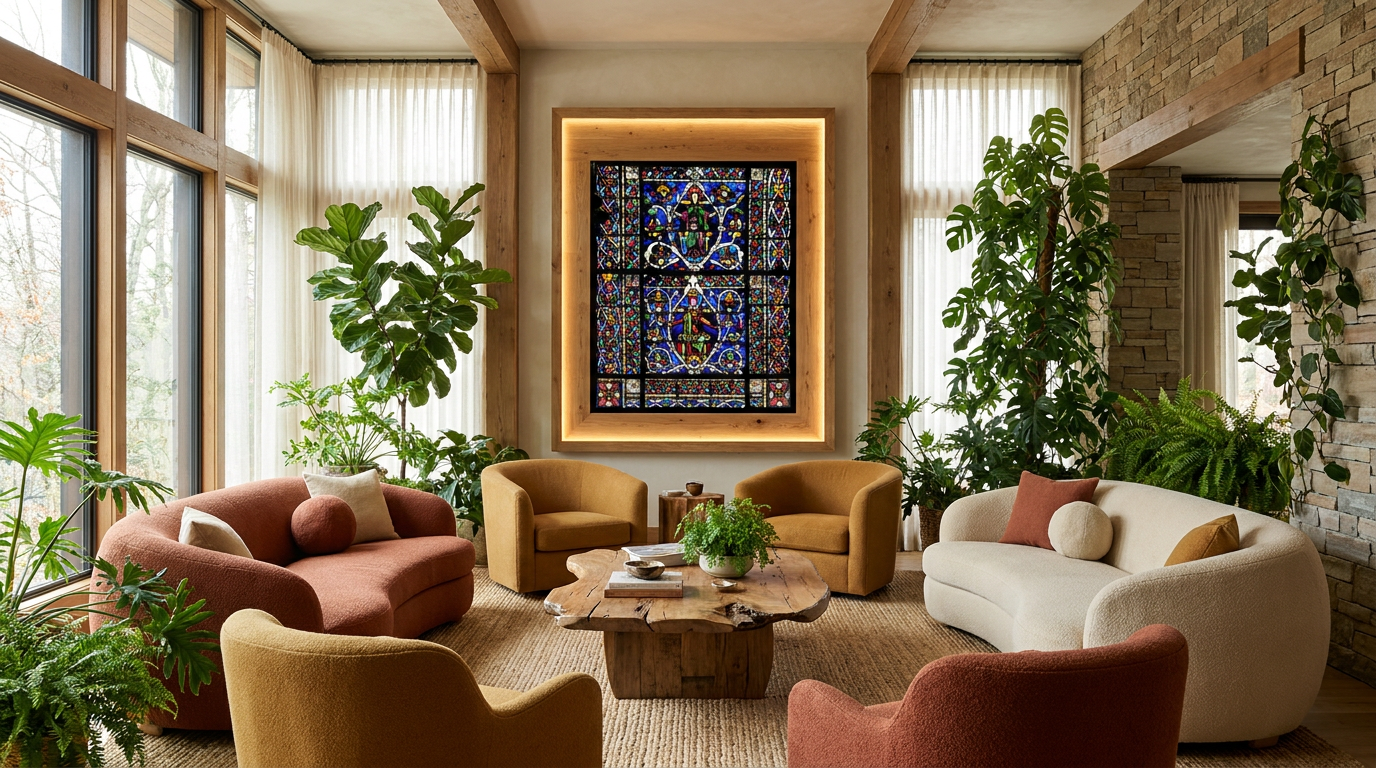
Beyond lighting, the physical shapes within a room profoundly influence neurological responses. Neuroscientific studies have found that curvilinear spaces and rounded furniture activate the brain's pleasure and comfort centers far more effectively than sharp, angular designs. The presence of organic, sweeping forms reminds the brain of evolutionary safe havens, generating an unconscious sense of refuge. In contrast, environments dominated by sharp edges and rigid geometry can subtly trigger the brain's threat-detection systems, maintaining a heightened state of vigilance.[3][5]

Tactile engagement is another crucial dimension of neuroaesthetics. The human sensory-motor network responds actively to the textures we touch and walk across. Incorporating varied, natural textures—such as exposed wood grain, woven textiles, or natural stone—creates depth and holds the brain's interest without causing sensory overload. These tactile variations provide grounding physical feedback, which is particularly beneficial in modern homes where occupants spend hours interacting with the smooth, frictionless glass of digital screens.[3][5]
Acoustic comfort, often overlooked in residential design, plays an equally vital role in mental well-being. Unpredictable or echoing noises elevate cortisol and maintain heightened stress states, a common issue in open-concept homes with hard flooring and minimal soft furnishings. Neuroaesthetic principles advocate for intentional acoustic zoning, utilizing sound-absorbing materials, strategic furniture placement, and even ambient water features to mask disruptive sounds and create a serene auditory environment.[3][5]

Despite the compelling data, researchers caution against treating neuroaesthetics as a rigid, one-size-fits-all formula. Human sensory processing is highly individualized, and what feels restorative to one person may feel under-stimulating or overwhelming to another. For instance, neurodivergent individuals may have entirely different thresholds for acoustic input or visual complexity. The goal of evidence-based design is not to prescribe a single universal aesthetic, but to provide a toolkit of biological insights that can be tailored to the specific needs and sensitivities of the occupants.[1][3]
As the wellness industry shifts its focus from reactive treatments to preventive, systems-based care, the home is increasingly recognized as the frontline of health. By moving beyond the superficial pursuit of trends, homeowners and designers can utilize the principles of neuroaesthetics to craft environments that actively nurture the nervous system. Ultimately, this science-backed approach empowers individuals to transform their living spaces from mere shelters into profound allies for human flourishing and emotional resilience.[1][2][5]
How we got here
1984
Biologist Edward O. Wilson publishes 'Biophilia', popularizing the concept of humanity's innate connection to nature.
1990s
Advancements in brain scanning technology allow researchers to measure real-time physiological responses to aesthetic stimuli.
2019
Google and Johns Hopkins debut 'A Space for Being' at Milan Design Week, using wearable tech to prove design alters biology.
Jan 2026
The International Arts + Mind Lab at Johns Hopkins releases the 'Intentional Spaces Roadmap' to standardize evidence-based design.
Viewpoints in depth
Neuroscientists and Researchers
Focuses on the measurable biological data behind aesthetic experiences.
For the scientific community, neuroaesthetics is a translational discipline that moves design from a subjective art to an objective science. Researchers utilize brain-mapping technologies like fMRI and EEG to track exactly how spatial stimuli affect the nervous system. Their primary argument is that environments are biological interventions; just as diet and exercise impact physical health, the light, acoustics, and shapes of a room directly modulate cortisol, serotonin, and cognitive fatigue.
Architects and Interior Designers
Focuses on the practical application of evidence-based design in real-world spaces.
Design professionals view neuroaesthetics as a powerful new toolkit that validates their intuitive understanding of space. Rather than abandoning aesthetics for clinical functionality, they seek to harmonize beauty with biological needs. This camp emphasizes the challenges of implementation—such as balancing the cost of natural materials and dynamic lighting systems with client budgets—while advocating for a shift toward spaces that prioritize long-term emotional well-being over fleeting visual trends.
Public Health Advocates
Focuses on the democratization of healthy spaces and preventive care.
Public health experts look at neuroarchitecture through the lens of equity and preventive medicine. They argue that if the built environment significantly impacts mental health, then access to natural light, acoustic comfort, and biophilic design should not be a luxury reserved for high-end real estate. This perspective pushes for neuroaesthetic principles to be integrated into building codes, affordable housing, and public infrastructure to support collective well-being at scale.
What we don't know
- How individual sensory processing differences, such as neurodivergence, alter the ideal neuroaesthetic baseline.
- The long-term, generational impact of growing up in highly optimized, neuroaesthetic environments versus traditional housing.
- How to effectively scale these evidence-based design principles into affordable housing and public infrastructure without prohibitive costs.
Key terms
- Neuroaesthetics
- The scientific study of how aesthetic experiences, such as art and architecture, affect the human brain, physiology, and behavior.
- Biophilic Design
- An architectural approach that seeks to connect building occupants more closely to nature through natural light, plants, and organic materials.
- Orbitofrontal Cortex
- A region of the brain involved in cognitive processing, decision-making, and emotional regulation, which is highly responsive to beautiful environments.
- Circadian Rhythm
- The body's internal 24-hour clock that regulates sleep and wakefulness, heavily influenced by exposure to natural daylight.
- Cortisol
- A primary stress hormone that can be elevated by sterile, noisy, or visually aggressive environments.
Frequently asked
What is the difference between neuroaesthetics and regular interior design?
Traditional interior design primarily focuses on visual appeal and functional layout. Neuroaesthetics uses scientific data to design spaces that actively lower stress, improve focus, and support biological health.
Do I need to buy new furniture to apply these principles?
No. You can apply neuroaesthetic principles by maximizing natural light, adding indoor plants, incorporating textured fabrics, and rearranging furniture to create a sense of refuge and acoustic comfort.
How does biophilic design go beyond just adding houseplants?
While plants are important, biophilic design also includes maximizing daylight, using natural materials like wood and stone, incorporating water features, and utilizing organic, curvilinear shapes that mimic nature.
Can neuroaesthetics help with productivity when working from home?
Yes. Studies show that environments with natural light, acoustic zoning, and views of nature significantly improve cognitive clarity, problem-solving abilities, and overall focus.
Sources
Source coverage
5 outlets
3 viewpoints surfaced





[1]Johns Hopkins IAM LabNeuroscientists and Researchers
Announcing the Intentional Spaces Roadmap
Read on Johns Hopkins IAM Lab →[2]ArchiExpo e-MagazineArchitects and Interior Designers
Neuroaesthetics Is Reshaping Wellness and the Built Environment
Read on ArchiExpo e-Magazine →[3]MDPINeuroscientists and Researchers
Exploring Neuroscientific Approaches to Architecture: Design Strategies of the Built Environment for Improving Human Performance
Read on MDPI →[4]The OverviewPublic Health Advocates
Neuroarchitecture: Spaces That Heal
Read on The Overview →[5]Factlen Editorial TeamArchitects and Interior Designers
Synthesis by Factlen editorial team
Read on Factlen Editorial Team →

Every angle. Every day.
Get home stories with full source coverage and perspective breakdowns delivered to your inbox.