
How Agrivoltaics is Turning a Land-Use Conflict into a Climate-Smart Synergy
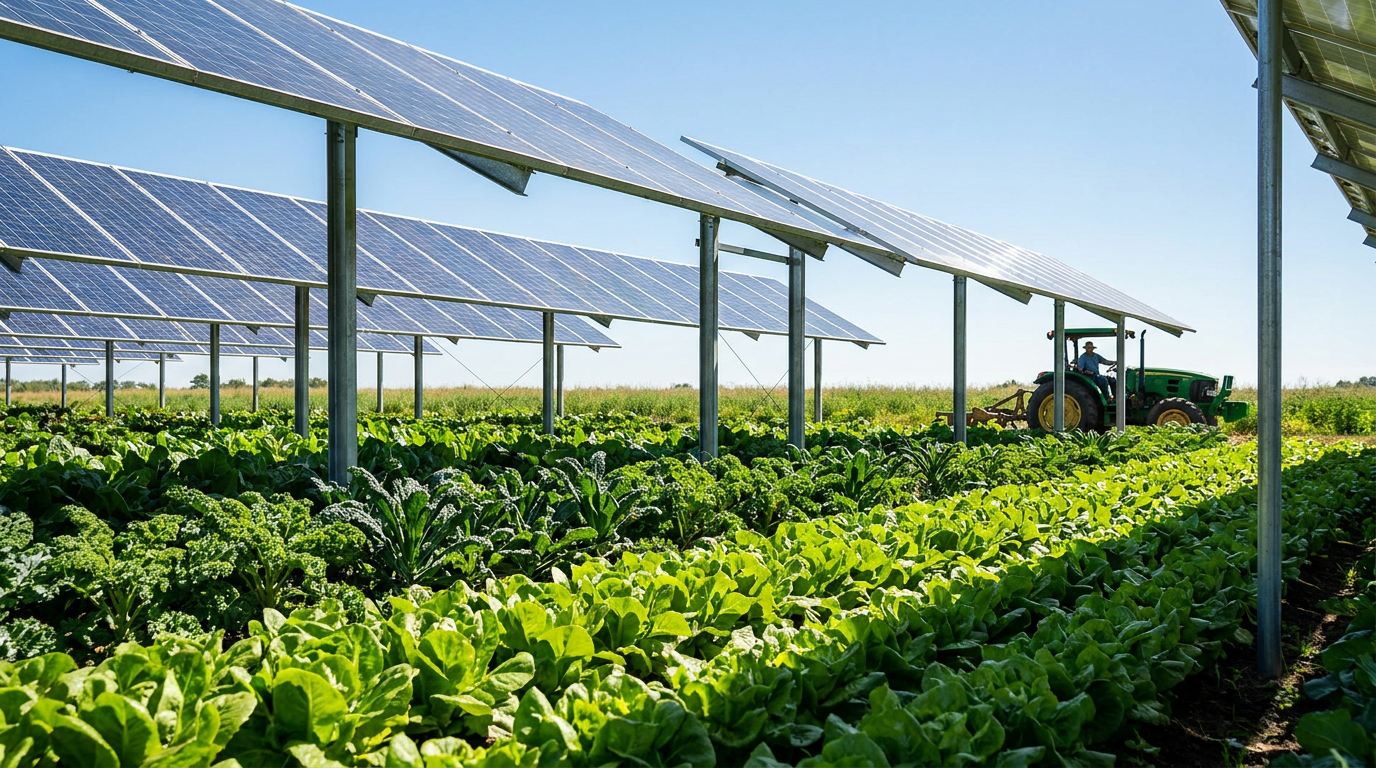
By elevating solar panels above agricultural fields, researchers are proving that energy and food production can mutually benefit each other, saving water and boosting crop yields.
By Factlen Editorial Team
- Agronomists & Soil Scientists
- Focused on the microclimate benefits and ecological health of the soil.
- Renewable Energy Developers
- Focused on scaling clean energy capacity and overcoming land-use opposition.
- Agricultural Economists
- Focused on the financial viability and risk mitigation for farming communities.
What's not represented
- · Traditional commodity crop farmers whose crops are incompatible with shading
- · Local zoning boards struggling to classify dual-use land
Why this matters
As the world races to build renewable energy, utility-scale solar often competes with agriculture for arable land. Agrivoltaics offers a blueprint to decarbonize the grid while actively protecting the food supply and increasing farmer revenues.
Key points
- Agrivoltaics involves elevating solar panels to allow agricultural production underneath, enabling dual-use of arable land.
- The partial shade from the panels reduces heat stress and cuts irrigation water needs by up to 30 percent.
- Plant transpiration cools the solar panels from below, increasing their electrical efficiency by 1 to 3 percent.
- While shade-tolerant crops see yield increases, sun-intensive commodity crops like corn experience significant yield drops.
The global push for renewable energy faces a geographic bottleneck: utility-scale solar requires massive amounts of land. As countries race to meet decarbonization targets, energy developers are increasingly eyeing flat, sun-drenched agricultural fields.[5]
This dynamic has historically forced a zero-sum choice between harvesting the sun for electricity or harvesting the soil for food. The resulting land-use competition has sparked zoning battles and pushback from rural communities concerned about losing productive farmland to seas of glass and steel.[2][5]
But an emerging agricultural science is proving that energy and food production do not have to compete. "Agrivoltaics"—the practice of co-locating elevated solar panels and crop cultivation on the same plot of land—is transforming a geographic conflict into a biological synergy.[2][7]
The core mechanism of agrivoltaics relies on the creation of a highly regulated microclimate. By raising solar arrays several feet above the ground and spacing them strategically, farmers can grow crops in the partial shade beneath the panels.[3][6]

This partial shading directly addresses one of modern agriculture's growing threats: heat stress. During peak summer months, excessive heat can reduce a plant's photosynthetic efficiency and cause leaf scorch.[3]
Research from the Fraunhofer Institute for Solar Energy Systems demonstrates that solar panels can lower ground surface temperatures by 3 to 5 degrees Celsius during the hottest parts of the day. In field trials, this cooling effect reduced leaf damage in tomatoes by 20 percent.[3]
The shade also acts as a shield against rapid water loss. By blocking direct midday sunlight, the panels significantly reduce soil evaporation rates. Data from 2026 industry analyses indicate that agrivoltaic systems can cut irrigation water requirements by 15 to 30 percent, a crucial adaptation for arid and drought-prone regions.[1][4]
The agronomic results depend heavily on crop selection. Shade-tolerant plants—such as lettuces, tomatoes, berries, and certain tubers—thrive in this buffered environment. Studies consistently show yield increases of 8 to 18 percent for these crops when grown under solar arrays compared to traditional open-field farming.[1][4]

The benefits of this co-location flow in both directions. Just as the panels protect the plants, the plants actively improve the performance of the solar panels.[4][7]
Just as the panels protect the plants, the plants actively improve the performance of the solar panels.
Solar photovoltaic cells are notoriously sensitive to heat; as temperatures rise above their optimal operating range, their ability to convert sunlight into electricity degrades.[2]
Crops growing beneath the arrays release water vapor through a process called transpiration. This evaporating moisture rises and cools the underside of the solar panels, acting as a natural air-conditioning system.[4]
Measurements by the National Renewable Energy Laboratory (NREL) reveal that this transpiration cooling effect can boost the annual electricity generation of an agrivoltaic system by 1 to 3 percent compared to a standard solar farm in the same location.[2]
To quantify the total efficiency of this dual-use model, researchers use a metric called the Land Equivalent Ratio (LER). If a farmer dedicates half their land to solar and half to crops, the LER is 1.0.[4]
However, because of the mutual benefits of microclimate cooling and heat stress reduction, agrivoltaic systems routinely achieve an LER of 1.35 to 1.73. This means that a 100-acre agrivoltaic farm produces the same combined volume of food and energy that would normally require 135 to 173 acres of separate land.[4]

Economically, the model offers farmers a powerful tool for financial resilience. By leasing vertical space to energy developers or owning the arrays outright, agricultural producers secure a weather-proof, year-round revenue stream that buffers against volatile crop prices and climate shocks.[1][5]
Despite the proven synergies, scaling agrivoltaics involves distinct engineering and biological challenges. The system is not a universal solution for all agriculture; sun-intensive commodity crops like corn and wheat suffer yield reductions of 25 to 40 percent under partial shade.[1]
Furthermore, the initial capital expenditure (CAPEX) for an agrivoltaic installation is 10 to 20 percent higher than a traditional solar farm. The steel racking must be built higher and stronger to accommodate the passage of standard agricultural machinery, such as tractors and harvesters.[1][6]
To optimize the balance between energy density and agricultural access, engineers are testing wide-row spacing and deploying bifacial solar panels, which capture both direct sunlight from above and light reflected off the crops from below.[3][6]
As the U.S. Department of Energy and international research bodies continue to fund large-scale pilot programs, the primary remaining hurdles are regulatory. Many local zoning laws and agricultural subsidies are still built for an "either/or" paradigm, lacking the frameworks to classify and incentivize dual-use land.[5][7]
By proving that clean energy infrastructure can actively enhance food and water security, agrivoltaics offers a blueprint for sustainable development. It demonstrates that with precise engineering and ecological awareness, the transition to a low-carbon grid can protect, rather than pave over, the agricultural foundation.[7]
How we got here
1981
The concept of co-locating solar and agriculture is first proposed by German researchers Adolf Goetzberger and Armin Zastrow.
2011
The term "agrivoltaics" is officially coined, and early pilot projects demonstrate the Land Equivalent Ratio concept.
2019
Landmark studies in Nature Sustainability quantify the mutual cooling benefits and water savings in dryland agrivoltaics.
2024
The U.S. Department of Energy expands funding for large-scale agrivoltaic field studies across diverse climates.
2026
Commercial adoption accelerates as advanced tracking algorithms and bifacial panels optimize light-sharing for crops.
Viewpoints in depth
Agronomists & Soil Scientists
Focused on the microclimate benefits and ecological health of the soil.
This camp emphasizes that agrivoltaics is primarily a climate-adaptation tool for agriculture. By reducing evapotranspiration and shielding soil from extreme heat, they argue that solar arrays can save water and prevent topsoil degradation in increasingly arid regions. Their research prioritizes crop health and soil moisture retention over maximizing megawatt output.
Renewable Energy Developers
Focused on scaling clean energy capacity and overcoming land-use opposition.
For energy developers, agrivoltaics is a strategic solution to the growing rural pushback against massive solar farms. By allowing land to remain agriculturally productive, developers can secure permits more easily and access land closer to grid infrastructure. They are primarily concerned with the engineering costs of elevating panels and optimizing the angle of the arrays to ensure the energy generation remains profitable.
Agricultural Economists
Focused on the financial viability and risk mitigation for farming communities.
Economists view agrivoltaics as a mechanism for rural financial resilience. Farming is highly vulnerable to weather shocks and commodity price fluctuations. By integrating a fixed, long-term revenue stream from solar leases or power sales, economists argue that dual-use systems can keep family farms solvent, even if the capital expenditure to build them is higher upfront.
What we don't know
- How the long-term changes in soil microbiology under permanent partial shade will affect crop rotation cycles over a 25-year solar lease.
- Whether local zoning boards and tax authorities will universally classify dual-use sites as agricultural land or commercial energy facilities.
Key terms
- Agrivoltaics
- The simultaneous use of areas of land for both solar photovoltaic power generation and agriculture.
- Land Equivalent Ratio (LER)
- A metric used to measure the productivity of dual-use land compared to growing crops and generating solar power on separate plots.
- Transpiration
- The process by which moisture is carried through plants from roots to small pores on the underside of leaves, where it changes to vapor and is released to the atmosphere.
- Bifacial Solar Panels
- Solar modules designed to capture sunlight on both their front and back sides, utilizing light reflected off the ground.
- Microclimate
- The distinct, localized climate conditions within a small area, which can differ significantly from the surrounding environment.
Frequently asked
Can you grow any crop under solar panels?
No. Shade-tolerant crops like leafy greens, tomatoes, and berries thrive, while sun-intensive crops like corn and wheat typically see reduced yields.
How do tractors fit under the solar panels?
Agrivoltaic systems use elevated steel racking and wider row spacing specifically engineered to allow standard agricultural machinery to operate safely underneath.
Does the shade hurt the solar panels' energy output?
The shade doesn't hurt the panels; in fact, the water vapor released by the crops cools the panels, which actually increases their electrical efficiency by 1 to 3 percent.
Sources
Source coverage
7 outlets
3 viewpoints surfaced







[1]Energy Solutions IntelligenceRenewable Energy Developers
Agrivoltaics 2026: Farming & Solar Dual Income
Read on Energy Solutions Intelligence →[2]National Renewable Energy LaboratoryRenewable Energy Developers
Agrivoltaics: Co-locating Solar and Agriculture
Read on National Renewable Energy Laboratory →[3]Fraunhofer Institute for Solar Energy SystemsAgronomists & Soil Scientists
Agrivoltaics: Opportunities for Agriculture and the Energy Transition
Read on Fraunhofer Institute for Solar Energy Systems →[4]Nature SustainabilityAgronomists & Soil Scientists
Agrivoltaics provide mutual benefits across the food–energy–water nexus in drylands
Read on Nature Sustainability →[5]U.S. Department of EnergyRenewable Energy Developers
Agrivoltaics Research and Dual-Use Solar
Read on U.S. Department of Energy →[6]Agricultural Systems JournalAgricultural Economists
Spaced out: An economic framework to explore the impacts of PV panel spacing on large-scale farming
Read on Agricultural Systems Journal →[7]Factlen Editorial TeamAgricultural Economists
Synthesis by Factlen editorial team
Read on Factlen Editorial Team →

Every angle. Every day.
Get environment stories with full source coverage and perspective breakdowns delivered to your inbox.