
Meta Quest 3 vs. Apple Vision Pro: Which Mixed Reality Headset Fits Your Needs?
The mixed reality market has split into two distinct lanes: Apple's premium spatial computer for productivity and Meta's accessible powerhouse for gaming. This side-by-side analysis breaks down the trade-offs to help you choose the right device.
By Factlen Editorial Team
- VR Gaming Enthusiasts
- Value tactile motion controllers, large game libraries, and the wireless freedom provided by the Quest ecosystem.
- Value-Conscious Consumers
- Maintain that the Quest 3 provides the vast majority of the premium mixed reality experience for a fraction of the cost.
- Spatial Computing Professionals
- Argue that the high cost of the Vision Pro is justified by its unparalleled display quality and ability to replace multiple physical monitors.
What's not represented
- · Cross-platform app developers
- · Educators using VR in classrooms
Why this matters
Choosing the right mixed reality headset dictates whether you get a $3,499 productivity tool that transforms how you work, or a $499 entertainment powerhouse that gets you active. Understanding these stark trade-offs ensures you don't overpay for features you won't use or miss out on the tactile gaming experiences you actually want.
Key points
- The Apple Vision Pro ($3,499) targets spatial computing professionals with 23 million pixels and seamless macOS integration.
- The Meta Quest 3 ($499) dominates the consumer market with a vast gaming library and tactile motion controllers.
- Apple's controller-free interface excels in menu navigation but lacks the haptic feedback required for active gaming.
- Meta's LCD pancake lenses provide sharp visuals but cannot match the photorealistic text clarity of Apple's micro-OLED displays.
- Buyers must choose between a premium productivity extension and an accessible, versatile entertainment powerhouse.
The mixed reality landscape in 2026 has matured into a highly competitive arena, moving past the experimental phases of early virtual reality into polished, consumer-ready hardware. Buyers looking to invest in a headset are no longer choosing between minor iterative upgrades; they are faced with a stark choice between two fundamentally different product philosophies. The market has bifurcated into distinct lanes, ensuring that both productivity professionals and gaming enthusiasts have devices tailored to their exact needs. At the center of this technological divide stand two titans: Apple and Meta.[1][5]
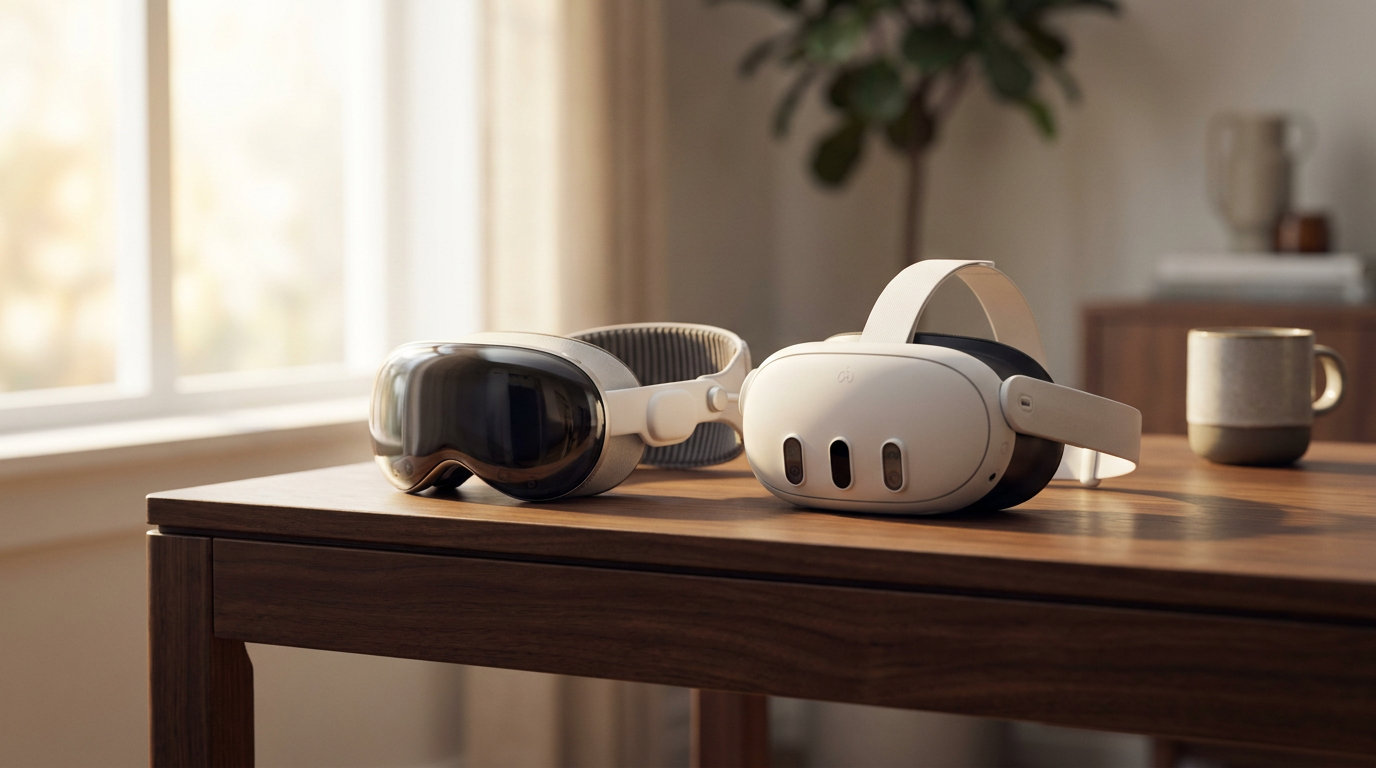
The Apple Vision Pro and the Meta Quest 3 represent the absolute pinnacle of their respective categories, yet they share almost no common ground in how they approach the user experience. Apple has positioned its device as a luxury spatial computer, prioritizing industrial-grade build quality, seamless ecosystem integration, and high-end productivity. Conversely, Meta has focused its efforts on creating an accessible, versatile powerhouse designed primarily for gaming, fitness, and mass-market entertainment. Understanding the vast differences between these two approaches is crucial for anyone navigating the modern wearable technology market.[4][8]
The most immediate and consequential trade-off between the two headsets is the financial investment required. The Apple Vision Pro demands a staggering $3,499 entry price, placing it firmly in the realm of professional equipment and luxury tech. In stark contrast, the Meta Quest 3 starts at a highly accessible $499. This seven-fold price difference dictates the entire value proposition for prospective buyers. For the cost of a single Vision Pro, a consumer could purchase five Quest 3 units along with premium comfort accessories and a massive library of software.[6][8]

The case for the Apple Vision Pro centers entirely on its unparalleled display technology and frictionless integration into the broader Apple ecosystem. It is designed from the ground up to be a natural extension of the user's digital life, particularly for those already invested in MacBooks, iPhones, and iCloud. The operating system, visionOS, allows users to pull multiple virtual displays into their physical environment, creating a massive, customizable workspace that travels anywhere. For remote workers and creative professionals, this capability alone often justifies the premium price tag.[2][4]
The evidence for this premium experience lies directly in the hardware specifications. The Vision Pro utilizes dual micro-OLED displays that push an astonishing 23 million total pixels, delivering roughly 4K resolution to each eye. This immense pixel density eliminates the screen door effect common in older headsets, allowing virtual screens and augmented reality overlays to appear virtually indistinguishable from physical objects. When reading fine text in a virtual document or reviewing high-resolution architectural models, the photographic clarity provided by these displays remains entirely unmatched in the consumer market.[7][8]
However, the case against the Vision Pro involves significant compromises regarding its weight, its reliance on an external battery, and its lack of tactile inputs. The headset itself weighs between 600 and 650 grams, heavily concentrated on the front of the user's face due to the aluminum and glass construction. Furthermore, it requires a tethered 353-gram battery pack that must be kept in a pocket or resting on a desk. Physics ultimately works against long-term comfort, making extended multi-hour sessions fatiguing for many users despite the premium materials.[4][7]
Furthermore, the Vision Pro's controller-free interface—which relies entirely on advanced eye tracking and subtle hand gestures—can feel incredibly limiting for interactive entertainment. While pinching a thumb and forefinger feels like pure magic when navigating menus or resizing windows, the complete absence of physical haptic feedback severely hampers precision in fast-paced applications. Popular virtual reality games that require swinging a virtual tennis racket, aiming a digital bow, or feeling the impact of a virtual sword are fundamentally compromised without the tactile resistance provided by traditional physical motion controllers.[4][8]

Ultimately, the Apple Vision Pro fits well when the user requires multiple high-resolution virtual monitors, demands seamless integration with a MacBook, or needs photographic-quality passthrough for enterprise applications. High-end real estate developers, for instance, utilize the headset to walk clients through pre-construction condominiums, where the visual fidelity must match the luxury brand signal. In these specific professional environments, the device functions perfectly as a high-powered spatial computer that enhances existing workflows and delivers an unparalleled visual experience.[2][7]
Conversely, the Apple Vision Pro does not fit when the primary goal is active gaming, daily fitness routines, or budget-friendly household entertainment. The lack of dedicated motion controllers, combined with a relatively sparse library of native immersive games, creates a significant barrier for traditional virtual reality enthusiasts. Additionally, the sheer cost of the device makes it an impractical choice for casual users who simply want to experience mixed reality without making a massive financial commitment to a first-generation computing platform.[4][8]
Conversely, the Apple Vision Pro does not fit when the primary goal is active gaming, daily fitness routines, or budget-friendly household entertainment.
The case for the Meta Quest 3 relies heavily on its massive, mature content library, its tactile motion controllers, and its exceptional overall value. Meta has spent years cultivating a robust ecosystem of developers, resulting in thousands of optimized games, fitness applications, and social experiences. It delivers a highly capable, fully standalone mixed reality experience without requiring a professional-grade budget or tethering to an external computer, making it the definitive choice for the vast majority of everyday consumers entering the space.[1][3]
The evidence supporting the Quest 3 is found in its sheer versatility and gaming performance. Powered by the Qualcomm Snapdragon XR2 Gen 2 chip, the headset handles complex standalone gaming effortlessly. More importantly, it ships with Touch Plus controllers that provide the crucial haptic feedback necessary for truly immersive gameplay. Whether a user is slicing blocks in a rhythm game or navigating the terrifying environments of a survival horror title, the physical controllers anchor the experience, providing a level of tactile immersion that hand-tracking alone simply cannot replicate.[1][5]

The case against the Quest 3 comes down to its display limitations and occasional ecosystem friction. The headset utilizes LCD panels paired with pancake lenses, pushing roughly 9 million total pixels. While this provides a sharp, clear image that represents a massive leap over previous generations, the visual fidelity falls short of the photorealism required for reading fine text all day. It cannot comfortably replace a premium physical monitor for eight hours of continuous spreadsheet work or intricate video editing.[7][8]
Additionally, while the Quest 3's full-color passthrough is a transformative upgrade that enables genuine mixed reality experiences, it still exhibits noticeable limitations. Users often report slight distortion around moving objects, graininess in low-light environments, and a higher latency compared to the near-instantaneous, high-fidelity rendering of its premium rival. For casual gaming and basic web browsing, these visual compromises are easily ignored, but they become apparent when attempting to blend virtual objects seamlessly into the physical world for professional or enterprise applications.[7]
The Meta Quest 3 fits well when the user wants to play active virtual reality games, engage in high-intensity virtual fitness routines, or explore a vast library of accessible entertainment. Its lightweight plastic construction—weighing 515 grams with the battery built directly into the headset—makes it highly portable and easy to share among family members. For anyone looking to experience the thrill of modern virtual reality without the friction of external battery packs or massive price tags, the Quest 3 remains the undisputed champion of the consumer market.[3][4]

It does not fit when the user needs to read small text for an entire workday, requires frictionless, native integration with macOS, or demands the absolute highest visual fidelity available on the market. Buyers looking for a true laptop replacement or a luxury spatial computing experience will find the Quest's LCD displays and plastic build quality lacking compared to premium alternatives. It is fundamentally an entertainment device that can do some work, rather than a dedicated work device that can play some games.[2][7]
Ultimately, the decision between these two headsets in 2026 is less about which device is objectively superior and more about honestly assessing the intended use case. The Apple Vision Pro is a marvel of display engineering built for the spatial computing professional, while the Meta Quest 3 is a triumph of accessible design built for the active entertainment enthusiast. By clearly defining whether the priority is frictionless productivity or tactile gaming, buyers can confidently choose the headset that perfectly aligns with their digital lifestyle.[5][6]
How we got here
Oct 2023
Meta launches the Quest 3, establishing a new baseline for consumer mixed reality.
Feb 2024
Apple releases the Vision Pro, introducing high-end spatial computing to the market.
Late 2024
Software updates for both platforms enhance multi-monitor support and passthrough quality.
Early 2026
The market solidifies into distinct productivity and gaming tiers, with both headsets dominating their respective niches.
Viewpoints in depth
Spatial Computing Professionals
Enterprise users and developers who view headsets as serious productivity tools.
For this camp, the Apple Vision Pro is not an overpriced toy, but a legitimate replacement for a multi-monitor workstation. They point to the 23-million-pixel micro-OLED displays as the only technology currently capable of rendering text sharply enough for eight-hour workdays. In industries like high-end real estate and industrial design, the photographic quality of the passthrough justifies the $3,499 investment, as it allows clients to view digital models with perfect clarity.
VR Gaming Enthusiasts
Players who prioritize active, immersive entertainment and tactile feedback.
Gaming enthusiasts argue that a virtual reality headset is only as good as its interactive capabilities. They view the Vision Pro's lack of motion controllers as a fatal flaw for entertainment, noting that popular titles like Beat Saber and Walkabout Mini Golf rely entirely on haptic feedback and precise tracking. For this group, the Meta Quest 3 is the undisputed champion, offering a massive library of optimized games and the physical inputs necessary to actually play them.
Value-Conscious Consumers
Everyday buyers looking for the best balance of price and performance.
This perspective focuses heavily on the law of diminishing returns. While acknowledging that Apple's hardware is technically superior, they argue that the Meta Quest 3 delivers 80 to 90 percent of the experience for roughly 15 percent of the cost. For the price of a single Vision Pro, a family could outfit their entire household with Quest headsets. They view Meta's offering as the definitive consumer device, perfectly balancing affordability with highly capable mixed reality features.
What we don't know
- Whether Apple will eventually introduce physical motion controllers to expand the Vision Pro's gaming capabilities.
- How quickly Meta can bridge the visual fidelity gap in future iterations without drastically increasing the price.
- The long-term impact of third-party comfort accessories on the adoption rates of both headsets.
Key terms
- Spatial Computing
- A term for technology that blends digital content with the physical world, allowing users to interact with virtual elements as if they were real.
- Micro-OLED
- An advanced display technology that packs millions of pixels into a tiny screen, providing exceptionally high resolution and deep contrast.
- Passthrough
- A feature that uses external cameras on a headset to display the real world inside the screens, enabling mixed reality experiences.
- Pancake Lenses
- A type of optical lens used in modern headsets that folds light to reduce the physical bulk of the device while maintaining visual clarity.
- Haptic Feedback
- Physical sensations, such as vibrations, transmitted through controllers to simulate the feeling of interacting with virtual objects.
Frequently asked
Can I use the Apple Vision Pro for gaming?
Yes, but it is limited mostly to Apple Arcade titles and lacks the physical motion controllers required for popular active VR games.
Does the Meta Quest 3 require a PC to work?
No, the Quest 3 is a standalone device that runs games and apps directly on its internal processor, though it can connect to a PC for higher-end gaming.
Which headset is better for working from home?
The Apple Vision Pro is superior for productivity due to its high-resolution text clarity and seamless integration with Mac computers.
Can I wear glasses with these headsets?
The Meta Quest 3 accommodates most glasses, while the Apple Vision Pro requires users to purchase custom Zeiss optical inserts.
Sources
Source coverage
8 outlets
3 viewpoints surfaced








[1]PCMagValue-Conscious Consumers
The Best VR Headsets for 2026
Read on PCMag →[2]Tom's GuideValue-Conscious Consumers
The best VR headsets in 2026
Read on Tom's Guide →[3]PC GamerVR Gaming Enthusiasts
The best VR headset in 2026
Read on PC Gamer →[4]ZDNETSpatial Computing Professionals
Meta Quest 3 vs Apple Vision Pro: Which headset is right for you?
Read on ZDNET →[5]Reality AtlasValue-Conscious Consumers
Best VR headsets of 2026 compared
Read on Reality Atlas →[6]VR.orgValue-Conscious Consumers
Best VR Headsets 2026 Comparison
Read on VR.org →[7]R2USpatial Computing Professionals
Apple Vision Pro vs Meta Quest for real estate sales
Read on R2U →[8]NordLabs GamingVR Gaming Enthusiasts
Apple Vision Pro vs Meta Quest 3/3S: The Ultimate VR Headset Comparison Guide
Read on NordLabs Gaming →
Every angle. Every day.
Get meta stories with full source coverage and perspective breakdowns delivered to your inbox.