
How 'Libraries of Things' and Repair Cafés Are Rewiring Local Communities
A growing global movement of community-run tool libraries and repair hubs is helping neighborhoods reduce waste, save money, and combat social isolation.
By Factlen Editorial Team
- Community Organizers
- Focus on social cohesion, mutual aid, and building 'soft infrastructure' to combat isolation.
- Environmental Advocates
- View these hubs primarily as circular-economy engines that divert waste from landfills and reduce carbon emissions.
- Municipal Planners
- See sharing libraries as cost-effective civic amenities that improve public mental health and require minimal physical footprint.
- Economic Pragmatists
- Emphasize the direct cost savings for households and the lowering of barriers for local tradespeople and entrepreneurs.
What's not represented
- · Commercial manufacturers whose sales may be impacted by the right-to-repair and sharing economy.
- · Insurance providers tasked with underwriting the unique liability risks of community tool lending.
Why this matters
As the cost of living remains high and social isolation deepens, these grassroots hubs offer a practical blueprint for neighborhood resilience. They prove that sharing resources not only saves money and reduces waste, but also rebuilds the essential human connections that make communities thrive.
Key points
- Libraries of Things and Repair Cafés are rapidly expanding, shifting communities from individual ownership to shared access.
- These hubs provide significant environmental benefits by diverting tonnes of e-waste and textiles from landfills.
- During cost-of-living pressures, borrowing and repairing items saves households thousands of dollars annually.
- City planners recognize these spaces as vital 'third places' that combat social isolation and improve public mental health.
- The movement is evolving to include 'skill-share libraries,' where neighbors swap time and expertise instead of cash.
The traditional public library is undergoing a quiet but profound revolution. Instead of just checking out books, residents in thousands of neighborhoods are now borrowing power drills, camping tents, and sewing machines. This shift from individual ownership to community access is being driven by the rapid expansion of 'Libraries of Things' (LoTs) and Repair Cafés—hyper-local hubs that are redefining civic engagement and mutual aid in 2026. By pooling resources, neighborhoods are discovering that they can live more abundantly while consuming significantly less.[7]
The concept is straightforward but transformative. A Library of Things operates on the traditional mechanics of a public library, pushing the boundaries of what can be collectively stewarded. Today, there are roughly 2,000 formal LoTs operating worldwide, alongside countless informal neighborhood networks. These spaces allow residents to access equipment they might only need once or twice a year, eliminating the financial and spatial burden of buying and storing it. From carpet cleaners to specialized baking pans, the inventory reflects the practical, everyday needs of the surrounding community.[1]
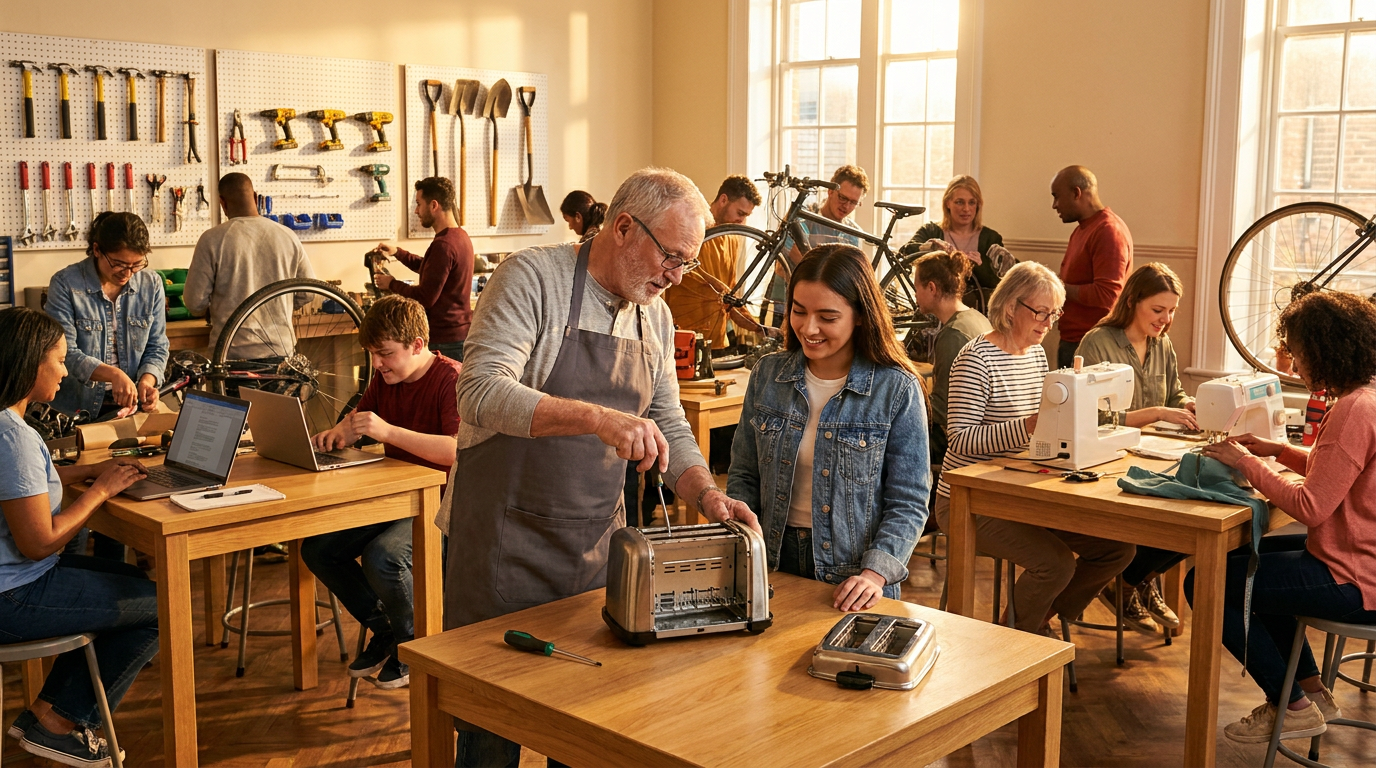
Running parallel to the borrowing model is the Repair Café movement. Rather than throwing away a broken toaster or a torn winter jacket, residents bring them to community halls where volunteer 'fixers' help them repair the items for free. The focus is heavily on collaborative learning—visitors do not just drop off their broken goods and leave; they sit with the volunteers, participating in the process and gaining the confidence to tackle future repairs themselves. This hands-on approach demystifies technology and restores a culture of maintenance.[6]
The environmental impact of these grassroots initiatives is substantial. By keeping consumer goods in circulation and out of landfills, communities are actively driving a localized circular economy. In its first six months of operation, the Henley Repair Café in the UK successfully fixed 73% of the 266 items brought through its doors, preventing an estimated 4.6 tonnes of CO₂ emissions that would have resulted from manufacturing replacements. Multiply that impact across thousands of similar hubs globally, and the carbon savings become a meaningful piece of the climate puzzle.[4]

Long-term data reinforces this environmental dividend. The Chiswick Repair Café recently reported that over a three-year period, its volunteers repaired more than 2,100 items. This sustained effort diverted 3.8 tonnes of waste from landfills and avoided carbon emissions equivalent to 35 tonnes of CO₂. Across the broader network, established hubs like the Farnham Repair Café have diverted up to 7.5 tonnes of waste over a decade of continuous operation. These metrics prove that collective, small-scale actions can aggregate into massive ecological benefits.[5][6]
Beyond sustainability, these hubs provide a critical economic buffer during periods of persistent cost-of-living pressure. By repairing rather than replacing, the Chiswick initiative alone saved its visitors an estimated £75,000 over three years. For households managing tight budgets, the ability to fix a vacuum cleaner or borrow a pressure washer instead of purchasing a new one represents immediate, tangible financial relief. It allows families to redirect their limited funds toward essential expenses like housing, healthcare, and groceries, proving that the sharing economy can function as a genuine safety net.[5]
The economic benefits also extend to local workforce development. Shared tool inventories lower the barrier to entry for independent tradespeople, landscapers, and small-scale entrepreneurs who cannot afford expensive commercial equipment upfront. In the United States, the Minneapolis Tool Library has utilized municipal Community Development Block Grants to support homeowners maintaining properties in blighted neighborhoods, while simultaneously operating a robust trades program. By democratizing access to the means of production and maintenance, these libraries empower residents to improve their own economic standing and invest sweat equity into their homes and businesses.[1]
The economic benefits also extend to local workforce development.
Yet, municipal planners are increasingly recognizing that the most profound impact of these spaces may be psychological. As rates of social isolation remain a pressing public health concern, non-commercial gathering places serve as vital 'social infrastructure.' Research indicates that when residents have access to safe, welcoming environments designed for interaction, the risk of chronic stress and depression decreases significantly. In an era where many public spaces have been heavily commercialized, a free community hub offers a rare sanctuary for connection without the expectation of spending money.[3]
Cities like Toronto and Seattle have begun piloting approaches that reimagine underutilized civic buildings and parks as intentional community hubs. By co-designing these spaces with residents and integrating amenities like tool libraries or community kitchens, municipalities are seeing measurable improvements in community engagement and self-reported mental well-being. The shared task of fixing a bicycle or learning to use a jigsaw naturally bridges generational and cultural divides, creating organic opportunities for neighbors to converse and bond over a shared goal.[3]

The movement is now evolving beyond physical objects into the realm of intangible assets. 'Skill-share libraries' are emerging as a lightweight twist on the model, allowing neighbors to lend their expertise the way they lend tools. Instead of exchanging cash, residents swap time and knowledge—trading an hour of beginner language practice for help troubleshooting a vegetable garden, or offering budgeting advice in exchange for smartphone setup assistance. This peer-to-peer exchange validates the diverse talents that exist within every neighborhood.[2]
Community organizers describe this phenomenon as building 'soft infrastructure.' While roads, bridges, and buildings represent a town's visible framework, skill-shares and repair hubs build the invisible scaffolding of trust, capability, and mutual aid. By converting hidden neighborhood capacity into visible, accessible support, communities become significantly more resilient to economic shocks and natural disasters. When a crisis hits, a neighborhood that already knows how to share resources and fix its own infrastructure is vastly better equipped to recover.[2]
Despite their widespread success, these initiatives face structural hurdles that threaten their long-term viability. Because they rely almost entirely on volunteer labor, organizer burnout is a persistent risk. Finding affordable, accessible, and permanent physical space to store inventory and host events is another major challenge, particularly in dense urban environments where commercial real estate is prohibitively expensive. Many hubs are forced to operate out of basements, temporary pop-ups, or borrowed church halls, limiting their capacity to grow.[1][7]

Liability and maintenance also require careful, ongoing management. Tool libraries must implement rigorous safety checks for power equipment, while Repair Cafés navigate the complexities of fixing electrical appliances without assuming legal risk if an item later malfunctions. Successful hubs mitigate these issues through clear liability waivers, strict operational boundaries—such as refusing to repair complex electronics like smartphones—and partnerships with established anchor institutions like public libraries or schools to provide an umbrella of legitimacy and insurance.[2][7]
Looking ahead, advocates are pushing to integrate these sharing models directly into urban planning and housing development. Future projects, particularly affordable housing complexes, are beginning to incorporate built-in Libraries of Things to expand access to essential equipment without increasing household debt. By normalizing shared resources in everyday settings, the movement aims to make community reliance as seamless and convenient as commercial consumption, embedding the circular economy into the very blueprints of future cities.[1][3]
Ultimately, the rapid growth of Repair Cafés and tool libraries signals a broader cultural pivot. In an era defined by digital abstraction, hyper-consumerism, and disposable goods, people are actively seeking out physical spaces where they can work with their hands, help their neighbors, and build something lasting. It is a powerful reminder that sometimes, the most valuable and underutilized resource a community possesses is the community itself. As these hubs continue to scale, they offer a hopeful vision for the future: one where sustainability and social connection are woven seamlessly into the fabric of everyday neighborhood life.[7]
How we got here
2009
The first official Repair Café is organized in Amsterdam by Martine Postma, sparking a global movement.
2013
The Buy Nothing Project launches, popularizing hyper-local gift economies on social media.
2024
The Tool Library Alliance is formed to support the growing network of over 2,000 formal lending hubs worldwide.
2026
Municipalities increasingly integrate sharing hubs into urban planning and affordable housing developments to combat cost-of-living pressures.
Viewpoints in depth
Community Organizers
Focus on social cohesion, mutual aid, and building 'soft infrastructure' to combat isolation.
For local organizers, the physical items being repaired or borrowed are secondary to the human connections being forged. They argue that modern neighborhoods suffer from a deficit of 'soft infrastructure'—the invisible networks of trust and capability that make a town resilient. By creating spaces where people must interact, ask for help, and share expertise, these hubs combat the epidemic of social isolation. Organizers emphasize that a successful hub doesn't just provide a service; it empowers residents to realize how much hidden capacity already exists within their own community.
Environmental Advocates
View these hubs primarily as circular-economy engines that divert waste from landfills and reduce carbon emissions.
Environmental groups champion the Repair Café and Library of Things models as highly effective, localized climate action. They point to the staggering amount of e-waste and textile waste generated by the 'take-make-dispose' economy. By extending the lifespan of everyday items and reducing the demand for new manufacturing, these hubs offer measurable reductions in carbon emissions. Advocates argue that scaling these networks is essential for transitioning to a true circular economy, where repair is the default rather than the exception.
Municipal Planners
See sharing libraries as cost-effective civic amenities that improve public mental health.
City planners and public health officials increasingly view non-commercial gathering spaces as vital tools for improving community well-being. Unlike massive infrastructure projects, a tool library or repair pop-up requires minimal capital investment and can be integrated into existing spaces like traditional libraries, schools, or parks. Planners note that these hubs naturally facilitate intergenerational mingling and provide safe, inclusive environments that have been shown to lower rates of chronic stress and depression among urban populations.
What we don't know
- How these volunteer-reliant models will secure long-term, sustainable funding as they scale to meet increasing demand.
- Whether liability insurance markets will adapt to offer affordable coverage for community-led repair and lending initiatives.
- The exact degree to which informal, neighborhood-level sharing networks outnumber the formally registered hubs.
Key terms
- Library of Things (LoT)
- A community lending hub where residents can borrow physical goods, tools, and equipment rather than purchasing them.
- Circular Economy
- An economic model focused on minimizing waste and making the most of resources by repairing, reusing, and recycling products.
- Soft Infrastructure
- The invisible networks of trust, community relationships, and shared capabilities that make a neighborhood resilient.
- Third Place
- A social environment separate from the two usual social environments of home ('first place') and the workplace ('second place'), crucial for community building.
Frequently asked
What is a Library of Things?
A Library of Things is a community-based lending system that operates like a traditional public library, but instead of books, residents can borrow physical items like power tools, camping gear, and kitchen appliances.
How does a Repair Café work?
Repair Cafés are free, volunteer-led events where residents bring broken household items. Instead of a drop-off service, visitors sit with skilled volunteers to collaboratively fix the item and learn repair skills.
Are these services free to use?
Most Repair Cafés offer their services for free, though they often accept voluntary donations to cover the cost of spare parts and venue hire. Libraries of Things typically operate on a low-cost membership model or sliding scale.
What items cannot be fixed at a Repair Café?
While policies vary by location, many hubs cannot repair complex electronics like smartphones, laptops, or printers due to the specialized micro-components and data privacy concerns.
Sources
Source coverage
7 outlets
4 viewpoints surfaced





[1]ShareableEconomic Pragmatists
Library of Things Toolkit: A Step-by-Step Guide
Read on Shareable →[2]Momentum WhangamatāCommunity Organizers
Why “skill-share libraries” are trending in community development
Read on Momentum Whangamatā →[3]CityGovMunicipal Planners
The Mental Health Impact of Social Infrastructure and Third Spaces
Read on CityGov →[4]Henley Town CouncilEnvironmental Advocates
Henley Repair Café Saves 4.6 Tonnes of CO₂ in First Six Months
Read on Henley Town Council →[5]Chiswick Repair CafeEnvironmental Advocates
Three Years of Impact! Chiswick Repair Cafe's Biggest Year Yet
Read on Chiswick Repair Cafe →[6]Repair Cafe InternationalEnvironmental Advocates
Farnham Repair Café celebrates a decade of community service
Read on Repair Cafe International →[7]Factlen Editorial TeamCommunity Organizers
Synthesis by Factlen editorial team
Read on Factlen Editorial Team →


Every angle. Every day.
Get culture stories with full source coverage and perspective breakdowns delivered to your inbox.