
Fact-Checking Ranked-Choice Voting: Does the Evidence Match the Hype?
As ranked-choice voting expands to reach 14 million Americans, academic research reveals a nuanced reality behind claims that it reduces polarization and boosts turnout.
By Factlen Editorial Team
- Academic Researchers
- Political scientists emphasize that while RCV has measurable benefits, its effects on deep polarization are complex.
- Electoral Reform Advocates
- Advocates argue RCV is a necessary structural change to fix a broken, hyper-partisan system.
- System Skeptics
- Critics argue RCV is an overly complex scheme that disenfranchises voters and obscures true electoral preferences.
What's not represented
- · Local election administrators implementing the systems
- · Third-party candidates who rely on alternative voting methods
Why this matters
The way we vote dictates who governs us. Understanding the actual empirical data behind electoral reforms helps voters separate partisan talking points from proven civic improvements.
Key points
- Ranked-choice voting is now used in 49 U.S. jurisdictions, reaching nearly 14 million voters.
- Academic research confirms RCV measurably decreases negative campaigning and toxic political rhetoric.
- Studies show RCV increases voter turnout, particularly in municipal elections and among younger demographics.
- Critics argue the system's complexity can lead to 'exhausted ballots' where a voter's choices are entirely eliminated.
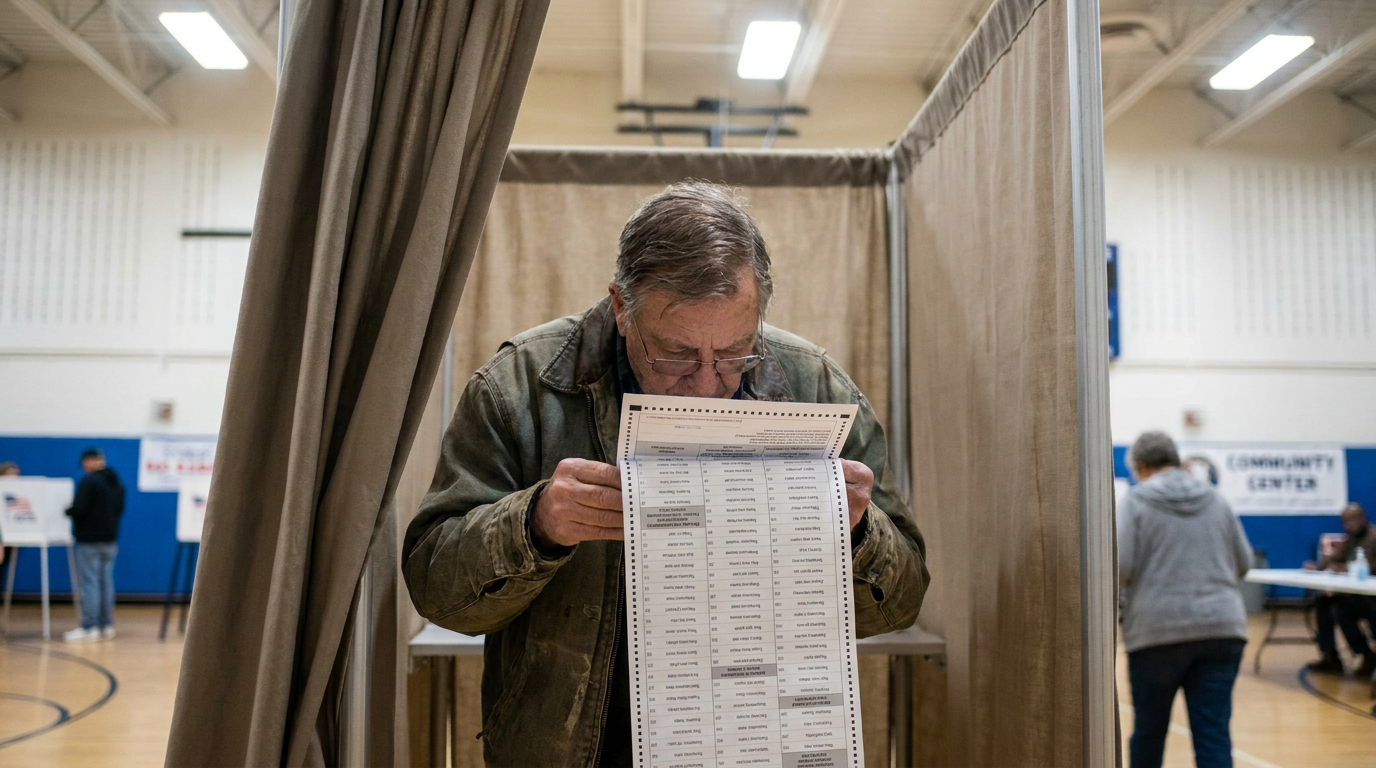
Ranked-choice voting (RCV) is rapidly transitioning from a niche political science concept to a mainstream fixture of American democracy. As of 2026, the system is utilized in 49 jurisdictions across the United States, reaching nearly 14 million voters in municipal, state, and federal elections. Proponents hail the system as a desperately needed antidote to toxic political polarization, arguing it eliminates the "spoiler effect" and forces candidates to build broad coalitions. Conversely, critics dismiss it as an overly complex scheme that confuses voters and artificially manipulates outcomes. With the system now battle-tested in states like Alaska and Maine, as well as major cities like New York and San Francisco, a robust body of empirical evidence has emerged to test these competing claims.[5][7]
At its core, the mechanics of single-winner ranked-choice voting—often called instant-runoff voting—are straightforward, even if the tabulation process requires a paradigm shift for voters accustomed to plurality elections. Instead of selecting a single candidate, voters rank the field in order of preference: first, second, third, and so on. If a candidate secures an outright majority of first-preference votes, they win immediately. If no candidate breaches the 50 percent threshold, the candidate with the fewest first-preference votes is eliminated. The ballots cast for that eliminated candidate are then instantly transferred to those voters' second choices. This elimination and transfer process repeats in rounds until one candidate secures a mathematical majority of the remaining active ballots.[2][7]
The primary appeal of this mechanism is its theoretical ability to eradicate the "spoiler effect"—the phenomenon where a third-party or independent candidate siphons votes away from a major-party candidate with a similar ideological profile, inadvertently handing victory to their mutual ideological opponent. By allowing voters to rank their true favorite first without fear of wasting their vote, RCV advocates argue the system frees the electorate to vote their conscience. However, skeptical organizations argue that this mechanical shift fundamentally alters the nature of representation, sometimes elevating a broadly tolerable compromise candidate over a candidate who commanded a passionate, albeit slightly smaller, plurality of the base.[5][6][7]

The most prominent claim surrounding ranked-choice voting is that it actively reduces political polarization and disincentivizes negative campaigning. The theoretical mechanism here is rooted in candidate strategy: in a plurality election, candidates often win by mobilizing their base and relentlessly attacking their primary opponent. Under RCV, candidates must compete not only for first-place votes but also for the second- and third-place preferences of their opponents' supporters. A candidate who runs a scorched-earth, highly negative campaign risks alienating the very voters they might need to push them over the 50 percent threshold in later tabulation rounds.[2][5]
Empirical research largely validates this theory of improved campaign civility. A comprehensive 2025 review by the American Bar Association analyzed peer-reviewed literature and found measurable decreases in negative campaigning in RCV jurisdictions. Surveys of voters in cities utilizing the system consistently report higher satisfaction with the tone of local campaigns, noting a distinct drop in candidate criticism and toxic rhetoric compared to neighboring cities using traditional plurality rules. Candidates are mathematically incentivized to find common ground, leading to phenomena like cross-endorsements, where rival candidates publicly ask voters to rank them first and their opponent second.[1][5]
Beyond the campaign trail, there is emerging evidence that RCV influences how politicians govern once elected. Data from Maine and Alaska—the two states utilizing RCV for federal elections—suggests a correlation between the voting system and legislative bipartisanship. Following Maine's adoption of the system, researchers tracked a measurable increase in bipartisan bill co-sponsorship in the state's swing congressional district. Similarly, Alaska's implementation of open primaries and RCV general elections coincided with the formation of cross-party majority caucuses in both the State House and State Senate, suggesting that candidates elected by broad coalitions are more likely to govern through consensus.[5]
However, academic researchers caution that ranked-choice voting is not a magical cure for deep-seated ideological polarization. A rigorous study published by NYU Law demonstrated a non-monotonic relationship between polarization and representative outcomes under RCV. The researchers found that in highly polarized electorates, a moderate compromise candidate—who might be the second choice of almost every voter—can actually be eliminated in the very first round if they fail to secure enough first-place votes from a dedicated base. In these highly fractured environments, RCV can still produce extreme winners, indicating that the system's moderating effects require at least a baseline level of voter willingness to cross partisan lines.[3]
However, academic researchers caution that ranked-choice voting is not a magical cure for deep-seated ideological polarization.
The second major claim evaluated by political scientists is the assertion that ranked-choice voting increases voter turnout and civic engagement. Advocates argue that by providing a wider array of viable candidates and eliminating the fear of a wasted vote, RCV draws disillusioned voters back into the democratic process. Furthermore, by combining primary and runoff elections into a single "instant runoff" on general election day, the system inherently avoids the massive drop-off in voter participation that traditionally plagues delayed runoff elections held weeks or months later.[2][7]

The empirical data on turnout presents a generally positive, though nuanced, picture. A 2025 study published in Social Science Quarterly analyzed individual-level turnout data across multiple jurisdictions and found that RCV is indeed associated with increased voter participation, particularly in odd-year municipal elections. The researchers attributed this bump not just to the ballot structure itself, but to the altered campaign dynamics: because candidates must cast a wider net to secure secondary preferences, they engage in significantly more direct voter contact and grassroots mobilization, which organically drives up turnout.[1][4]
This mobilization effect appears particularly potent among younger demographics. The American Bar Association's review highlighted research showing that youth voter turnout is measurably higher in cities utilizing RCV compared to demographically matched plurality cities. Young voters, who consistently express higher levels of dissatisfaction with the traditional two-party system and the status quo, appear more motivated to participate when presented with a ballot that allows them to express a wider range of political preferences without the strategic burden of the spoiler effect.[1][5]
Despite these positive indicators, system skeptics raise valid concerns about the potential for ballot complexity to inadvertently disenfranchise certain voters. Organizations like the Center for Election Confidence argue that the cognitive load of researching and ranking multiple candidates can overwhelm low-information voters, leading them to skip the ballot entirely or make errors that invalidate their vote. Critics point to specific municipal elections where turnout appeared to dip following the implementation of RCV, arguing that the system's complexity creates an artificial barrier to entry for marginalized communities.[6]
A central pillar of this skeptical argument is the phenomenon of the "exhausted ballot." An exhausted ballot occurs when a voter chooses to rank only one or two candidates, and all of their selected candidates are eliminated in the early rounds of tabulation. Because the voter provided no further preferences, their ballot cannot be transferred and is mathematically excluded from the final round that determines the winner. Critics note that in some highly fractured races, up to 27 percent of ballots have been exhausted, meaning the ultimate victor was chosen by a majority of the remaining ballots, but not a majority of the total ballots originally cast.[6][7]

The final major claim surrounding ranked-choice voting is its impact on the demographic diversity of elected officials. Proponents argue that the traditional plurality system, heavily managed by party gatekeepers, often pressures women and candidates of color to "wait their turn" to avoid splitting the vote of a specific constituency. By removing the spoiler effect, RCV theoretically lowers the barrier to entry, allowing multiple candidates from similar demographic or ideological backgrounds to run simultaneously without cannibalizing each other's chances of victory.[2][7]
Empirical evaluations of this claim show promising, if evolving, results. The Social Science Quarterly study specifically examined whether the complexity of RCV widened participation gaps among racial groups. The researchers found the opposite: voters of color utilized the ranking feature at equal or higher rates than white voters, directly challenging the narrative that the system is too complex for diverse electorates. Furthermore, the American Bar Association noted that the implementation of RCV frequently leads to an initial surge in the number of candidates running for office, which naturally produces more diverse candidate pools and has been correlated with increased electoral success for women and minority candidates in several major municipal markets.[1][4]

Ultimately, the academic consensus suggests that while ranked-choice voting is not a utopian fix for all the structural ailments of American democracy, it delivers on several of its core promises. The empirical evidence strongly supports the conclusion that RCV improves the civility of political campaigns, eliminates the spoiler effect, and prevents the steep drop-off in turnout associated with traditional runoff elections. As the system continues to expand its footprint across the United States, ongoing research will be vital to understanding how voters and candidates adapt their strategies to this fundamentally different way of measuring the public will.[2][7]
How we got here
2004
San Francisco implements ranked-choice voting for municipal elections, sparking a wave of local adoptions.
2018
Maine becomes the first state to use ranked-choice voting for federal congressional elections.
2022
Alaska implements a top-four open primary system combined with a ranked-choice voting general election.
2026
Ranked-choice voting expands to reach nearly 14 million voters across 49 U.S. jurisdictions.
Viewpoints in depth
Electoral Reform Advocates
Advocates argue RCV is a necessary structural change to fix a broken, hyper-partisan system.
Organizations like FairVote contend that the traditional plurality voting system is fundamentally flawed because it forces voters to choose the 'lesser of two evils' and punishes candidates who try to build consensus. They point to data showing that RCV campaigns are measurably more positive, as candidates must court the second-choice votes of their rivals' supporters. By eliminating the spoiler effect, advocates argue RCV creates a more vibrant, competitive, and representative democracy where elected officials actually reflect the will of the majority.
Academic Researchers
Political scientists emphasize that while RCV has measurable benefits, its effects on deep polarization are complex.
Researchers from institutions like the University of Chicago and NYU Law approach RCV with empirical caution. While they validate claims that RCV improves campaign civility and prevents the drop-off in turnout seen in traditional runoffs, they warn against viewing it as a panacea. Mathematical modeling shows that in highly polarized environments, RCV can actually eliminate moderate compromise candidates in the first round if they lack a passionate base. Academics stress that the system's success depends heavily on the specific political context and the electorate's willingness to cross partisan lines.
System Skeptics
Critics argue RCV is an overly complex scheme that disenfranchises voters and obscures true electoral preferences.
Conservative organizations and system skeptics, such as the Center for Election Confidence, argue that RCV solves a non-existent problem while introducing severe complications. They highlight the issue of 'exhausted ballots,' where voters who only rank one or two candidates have their votes discarded in the final rounds of tabulation. Skeptics argue this means the ultimate winner often lacks a true mandate from the total voting population. Furthermore, they contend that the cognitive burden of researching and ranking multiple candidates depresses turnout among low-information and marginalized voters.
What we don't know
- How ranked-choice voting will impact long-term two-party dynamics if adopted on a national scale.
- Whether the initial surge in candidate diversity seen in early RCV adoptions will sustain itself over multiple election cycles.
Key terms
- Ranked-Choice Voting (RCV)
- An electoral system where voters rank candidates by preference rather than selecting just one.
- Instant-Runoff Voting (IRV)
- The most common form of single-winner RCV, where the lowest-polling candidates are eliminated and votes transferred until someone reaches a majority.
- Spoiler Effect
- When a third-party or minor candidate draws votes away from a major candidate with similar politics, inadvertently helping their mutual opponent win.
- Exhausted Ballot
- A ballot that can no longer be counted in the final rounds of an RCV tally because all the voter's ranked choices have been eliminated.
- Condorcet Winner
- A candidate who would win a one-on-one matchup against every other candidate in the race.
Frequently asked
What is an exhausted ballot in ranked-choice voting?
An exhausted ballot occurs when all the candidates a voter ranked have been eliminated before the final round of tabulation, meaning their vote does not count toward the ultimate winner.
Does ranked-choice voting favor Democrats or Republicans?
Research indicates RCV does not inherently favor either major party. Instead, it tends to favor candidates who can build broad coalitions and appeal to the political center of their specific electorate.
Does ranked-choice voting increase voter turnout?
Studies show RCV generally increases turnout, particularly in odd-year municipal elections and among younger voters, largely because candidates are incentivized to engage in more direct voter contact.
Sources
Source coverage
7 outlets
3 viewpoints surfaced





[1]American Bar AssociationAcademic Researchers
What We Know About Ranked Choice Voting, Updated for 2025
Read on American Bar Association →[2]University of Chicago Center for Effective GovernmentAcademic Researchers
Ranked-Choice Voting: Promise of the Reform
Read on University of Chicago Center for Effective Government →[3]NYU LawAcademic Researchers
Ranked Choice Voting and Political Polarization
Read on NYU Law →[4]Social Science QuarterlyAcademic Researchers
Is Ranked-Choice Voting Associated With Turnout Across Race/Ethnic Groups?
Read on Social Science Quarterly →[5]FairVoteElectoral Reform Advocates
Ranked choice voting lowers polarization in politics
Read on FairVote →[6]Center for Election ConfidenceSystem Skeptics
Ranked-Choice Voting: Lack of Evidence
Read on Center for Election Confidence →[7]Factlen Editorial Team
Synthesis by Factlen editorial team
Read on Factlen Editorial Team →
More in news politics
See all 5 stories →Middle East Diplomacy
The US-Iran Peace Agreement: Inside the Deal and the Growing Rift with Israel
0 sources

Immigration Law
Supreme Court to Decide if Immigrants Can Be Held Indefinitely Without Bond Hearings
0 sources
Labor Policy
Fact-Checking the 4-Day Workweek: What the Policy Trials Actually Prove
0 sources

Every angle. Every day.
Get news politics stories with full source coverage and perspective breakdowns delivered to your inbox.