
How Enhanced Geothermal Systems Are Unlocking 24/7 Clean Energy
By borrowing advanced drilling techniques from the oil and gas industry, next-generation geothermal technology is turning hot, dry rock into a near-limitless source of firm, carbon-free electricity.
By Factlen Editorial Team
- Clean Energy Advocates
- Viewing EGS as the ultimate missing piece for a fully decarbonized grid.
- Tech & AI Industry
- Viewing geothermal as the most viable path to power massive data centers.
- Fossil Fuel Transitioners
- Viewing EGS as a lifeline for the oil and gas workforce.
- Water & Conservation Watchdogs
- Raising concerns about the water intensity of hydraulic fracturing in arid regions.
What's not represented
- · Local communities near drilling sites
- · Traditional nuclear power advocates
Why this matters
Wind and solar power are cheap but intermittent, leaving power grids vulnerable when the sun sets or the wind dies. Enhanced geothermal systems provide the missing piece of the clean energy puzzle: a reliable, 24/7 baseload power source that can scale to meet the massive energy demands of the AI revolution without emitting carbon.
Key points
- Enhanced Geothermal Systems (EGS) use advanced drilling to create artificial underground reservoirs in hot, dry rock.
- The technology provides 24/7, carbon-free baseload power, solving the intermittency issues of wind and solar energy.
- EGS borrows horizontal drilling and hydraulic fracturing techniques directly from the oil and gas industry.
- The U.S. Department of Energy estimates next-generation geothermal could supply up to 90 gigawatts of power by 2050.
- Tech companies are heavily backing EGS to secure reliable, clean electricity for massive artificial intelligence data centers.
The global transition to clean energy is colliding with the unprecedented power demands of the artificial intelligence boom. While wind and solar power have become remarkably cheap, they share a fundamental flaw: they only generate electricity when the weather cooperates. As tech giants build massive data centers that require hundreds of megawatts of continuous power, the limitations of an intermittent grid have become glaringly obvious. The world desperately needs a source of clean energy that runs 24 hours a day, seven days a week.[1][4]
Historically, the options for "firm" baseload power have been limited. Nuclear energy is carbon-free but notoriously slow and expensive to build, while natural gas plants are cheap but emit greenhouse gases. Now, a breakthrough technology is emerging from an unlikely source: the oil and gas industry. By repurposing the advanced drilling techniques developed during the shale boom, engineers are unlocking a near-limitless source of clean energy right beneath our feet.[4][7]
Conventional geothermal energy has been used for over a century, but its reach is severely limited. Traditional geothermal plants require a rare geological trifecta: extreme underground heat, naturally occurring water, and highly permeable rock that allows the water to flow freely. Because these conditions only exist in specific volcanic regions—like Iceland, Kenya, or the geyser fields of California—conventional geothermal accounts for less than half a percent of the U.S. energy mix.[3][5]
Enhanced Geothermal Systems (EGS) remove the geographic lottery from the equation. Instead of hunting for natural underground hot springs, EGS technology creates its own. The fundamental premise is simple: the Earth's crust is universally hot if you drill deep enough. By engineering artificial reservoirs in hot, dry rock—often referred to as "tight rock"—EGS can theoretically be deployed almost anywhere on the planet.[5][6]
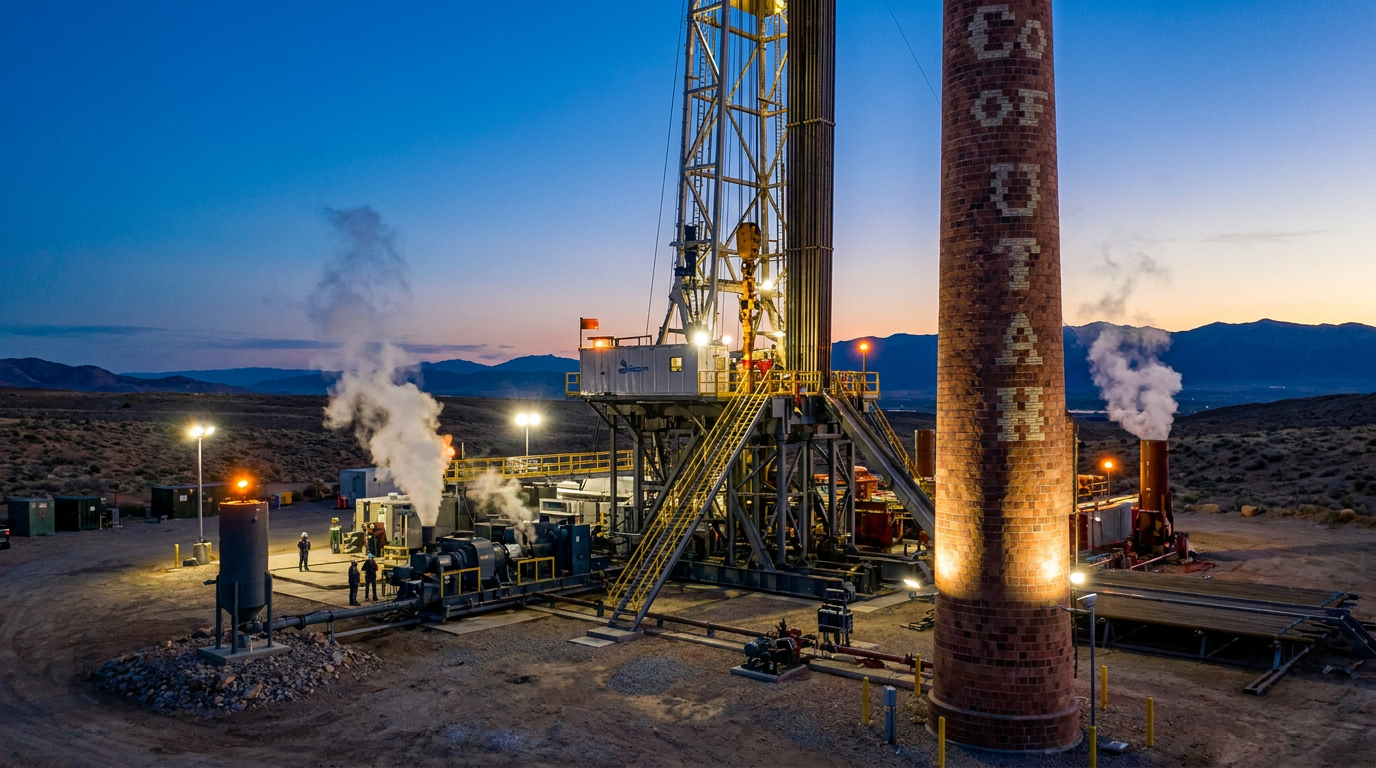
The mechanism behind EGS relies heavily on horizontal drilling and hydraulic fracturing, the exact technologies that revolutionized oil and gas extraction over the past two decades. Drillers use specialized polycrystalline diamond compact (PDC) bits to bore thousands of feet straight down into hard, crystalline rock, before turning the drill bit 90 degrees to drill horizontally for miles.[1][3]
Once the well is drilled, engineers pump millions of gallons of water down the shaft at extremely high pressure. This fluid forces open tiny, pre-existing fractures in the subterranean rock, creating a massive, highly permeable artificial reservoir. Unlike fossil fuel fracking, which uses chemicals to extract trapped hydrocarbons, EGS uses water to create a sprawling underground radiator.[2][5]

The system operates as a continuous loop. Cold water is pumped down an "injection well" into the newly created fracture network, where it absorbs the intense ambient heat of the Earth. The superheated fluid is then drawn back to the surface through a separate "production well." At the surface, the heat is extracted to flash water into steam, which spins a traditional turbine to generate electricity. The cooled water is then reinjected underground to repeat the cycle.[2][3]
Cold water is pumped down an "injection well" into the newly created fracture network, where it absorbs the intense ambient heat of the Earth.
The potential scale of this technology is staggering. According to the U.S. Department of Energy, next-generation geothermal could expand the country's geothermal capacity from a mere 4 gigawatts today to 90 gigawatts by 2050. High-end estimates suggest that if drilling costs fall rapidly, EGS could eventually provide up to 300 gigawatts—roughly a quarter of total U.S. electricity capacity.[3][4]

This is no longer just a theoretical exercise. In early 2026, Fervo Energy, a leading EGS developer, secured $421 million in financing to rapidly expand its Cape Station project in southwest Utah. The facility is slated to deliver 100 megawatts of continuous, carbon-free power to the grid by the end of the year, with plans to scale up to 500 megawatts by 2028.[1][7]
The urgency to scale EGS is being driven largely by the technology sector. Generative AI models require exponentially more computing power than traditional software, prompting tech leaders to sound the alarm over grid capacity. As OpenAI CEO Sam Altman testified to Congress, the future abundance of artificial intelligence will be strictly limited by the abundance of energy. Data center developers are now actively seeking out geothermal power purchase agreements to meet their climate pledges without sacrificing reliability.[1][4]

The federal government is also heavily invested in proving the technology's viability. The Department of Energy operates the Frontier Observatory for Research in Geothermal Energy (FORGE) in Milford, Utah—a dedicated field laboratory where scientists from national labs and universities test cutting-edge drilling techniques, reservoir stimulation methods, and fiber-optic monitoring systems.[2][7]
To accelerate commercialization, the Department of Energy has launched the "Enhanced Geothermal Shot," an ambitious initiative aimed at reducing the cost of EGS by 90 percent. The goal is to bring the levelized cost of energy down to $45 per megawatt-hour by 2035, which would make enhanced geothermal fully cost-competitive with both natural gas and utility-scale solar.[2][7]

Beyond its climate benefits, EGS offers a unique socioeconomic advantage: it provides a direct transition path for the fossil fuel workforce. The geothermal industry utilizes the same drilling rigs, the same steel casing, and the same petroleum engineers as the oil and gas sector. As the world gradually shifts away from fossil fuels, EGS offers a way to repurpose decades of subsurface expertise toward a zero-carbon future.[1][3]
Despite the immense promise, the industry faces several significant hurdles. The most pressing is water consumption. Creating and maintaining artificial underground reservoirs requires substantial amounts of water. Because the most accessible high-temperature rock in the U.S. is located in the arid West, developers must navigate complex water rights and prioritize highly efficient closed-loop systems to avoid straining local aquifers.[4][7]
Another challenge is induced seismicity. The process of fracturing deep underground rock can trigger micro-earthquakes. While these tremors are typically too small to be felt at the surface, developers must deploy extensive seismic monitoring networks and carefully manage fluid injection pressures to ensure that the stimulation process does not activate larger fault lines.[6][7]
As drilling costs continue to fall and the demand for firm clean power skyrockets, enhanced geothermal systems are rapidly transitioning from experimental pilot projects to a highly bankable asset class. By turning the Earth itself into a massive, inexhaustible battery, next-generation geothermal may ultimately prove to be the linchpin of a fully decarbonized global economy.[1][7]
How we got here
1970s
The concept of Enhanced Geothermal Systems is first proposed and tested by the U.S. government at Fenton Hill, New Mexico.
2022
The U.S. Department of Energy launches the 'Enhanced Geothermal Shot' to reduce EGS costs by 90% by 2035.
2023
Fervo Energy successfully completes 'Project Red' in Nevada, proving that commercial-scale EGS can deliver continuous carbon-free power.
2025
OpenAI CEO Sam Altman testifies that the future of AI is bottlenecked by energy, accelerating tech industry investment in geothermal.
Early 2026
Fervo Energy secures $421 million in financing to scale its Cape Station project in Utah, signaling EGS's transition to a bankable asset class.
Viewpoints in depth
Clean Energy Advocates
Viewing EGS as the ultimate missing piece for a fully decarbonized grid.
Environmental and clean energy groups argue that while wind, solar, and battery storage are crucial, they cannot economically provide 100% of the grid's needs during prolonged weather lulls. They view enhanced geothermal as the 'holy grail' of firm, dispatchable clean energy that can finally allow utilities to retire coal and natural gas plants without risking blackouts.
Tech & AI Industry
Viewing geothermal as the most viable path to power massive data centers.
Technology giants are facing a severe energy bottleneck as generative AI requires exponentially more power than traditional computing. With nuclear restarts proving slow and natural gas conflicting with corporate climate pledges, the tech sector sees EGS as the only technology that can be deployed fast enough—and at sufficient scale—to meet their 24/7 power demands.
Fossil Fuel Transitioners
Viewing EGS as a lifeline for the oil and gas workforce.
Industry veterans and labor advocates point out that EGS relies on the exact same skills, supply chains, and equipment as shale fracking. They argue that next-generation geothermal offers a seamless transition for drillers, petroleum engineers, and rig operators, allowing them to apply their expertise to a zero-carbon industry without massive retraining.
Water & Conservation Watchdogs
Raising concerns about the water intensity of hydraulic fracturing in arid regions.
Conservationists caution that EGS requires millions of gallons of water to stimulate the underground fracture networks. Because the most promising geothermal resources are located in the drought-prone American West, these groups argue that developers must prioritize water recycling and closed-loop systems to avoid exacerbating regional water scarcity.
What we don't know
- Whether the cost of drilling deep into hard crystalline rock can be reduced fast enough to meet the DOE's $45/MWh target by 2035.
- How the long-term thermal depletion of artificial reservoirs will affect the lifespan of EGS power plants over several decades.
- Exactly how much water will be required to maintain pressure in these systems as they scale to the gigawatt level in drought-prone states.
Key terms
- Enhanced Geothermal System (EGS)
- A human-made underground reservoir created by injecting fluid into hot, dry rock to extract heat for electricity generation.
- Baseload Power
- The minimum amount of electric power needed to be supplied to the electrical grid at any given time, requiring power plants that can run 24/7.
- Hydraulic Fracturing
- The process of injecting high-pressure fluid into subterranean rocks to force open existing fissures and extract energy—used in both oil/gas and EGS.
- Permeability
- The ability of a rock formation to allow fluids (like water) to pass through it, a crucial factor in extracting geothermal heat.
Frequently asked
Is enhanced geothermal the same as fracking for oil?
It uses similar drilling and fluid-injection techniques to crack underground rock, but instead of extracting fossil fuels, it circulates water to harvest the Earth's natural heat.
Can EGS be built anywhere?
Theoretically, yes, if you drill deep enough to reach hot rock. However, early commercial projects are focusing on the western U.S., where the Earth's crust is thinner and hot rock is closer to the surface.
Does EGS cause earthquakes?
Creating underground fractures can cause micro-seismicity (tiny tremors). Developers use advanced seismic monitoring to manage fluid pressures and prevent larger, felt earthquakes.
How much power can one EGS plant generate?
Modern commercial projects, like Fervo's Cape Station, are being designed to generate up to 500 megawatts—enough to power hundreds of thousands of homes or a massive AI data center.
Sources
Source coverage
7 outlets
4 viewpoints surfaced







[1]Fervo EnergyTech & AI Industry
Poised to Power the Future of AI
Read on Fervo Energy →[2]U.S. Department of EnergyFossil Fuel Transitioners
Enhanced Geothermal Systems
Read on U.S. Department of Energy →[3]World Resources InstituteClean Energy Advocates
How Do Next-Generation Geothermal Technologies Work?
Read on World Resources Institute →[4]McKinsey & CompanyTech & AI Industry
Next-generation geothermal energy
Read on McKinsey & Company →[5]Berkeley LabWater & Conservation Watchdogs
Discover the difference between conventional and enhanced geothermal systems
Read on Berkeley Lab →[6]MIT Energy InitiativeWater & Conservation Watchdogs
Next-generation geothermal
Read on MIT Energy Initiative →[7]Factlen Editorial TeamClean Energy Advocates
Synthesis by Factlen editorial team
Read on Factlen Editorial Team →



Every angle. Every day.
Get guides stories with full source coverage and perspective breakdowns delivered to your inbox.