
The Science of Umami: How to Build Meaty Flavor in Vegetarian Cooking
By understanding the molecular biology of taste receptors, home cooks can use umami synergy to create deep, savory plant-based meals without relying on meat.
By Factlen Editorial Team
- Recipe Developers
- Focusing on practical flavor building in the kitchen.
- Culinary Scientists
- Focusing on the molecular mechanisms of taste receptors.
- Public Health Nutritionists
- Focusing on umami as a tool for dietary intervention and salt reduction.
What's not represented
- · Commercial food manufacturers
- · Traditional meat farmers
Why this matters
Understanding the science of umami synergy allows home cooks to build restaurant-quality depth in plant-based meals without relying on meat. It also offers a scientifically proven method to reduce sodium intake without sacrificing flavor.
Key points
- Umami is the fifth basic taste, signaling the presence of proteins and amino acids.
- Umami synergy occurs when glutamates combine with nucleotides, amplifying flavor up to 30 times.
- Because the nucleotide inosinate is found mostly in meat, vegetarian cooks must rely on guanylate from dried mushrooms.
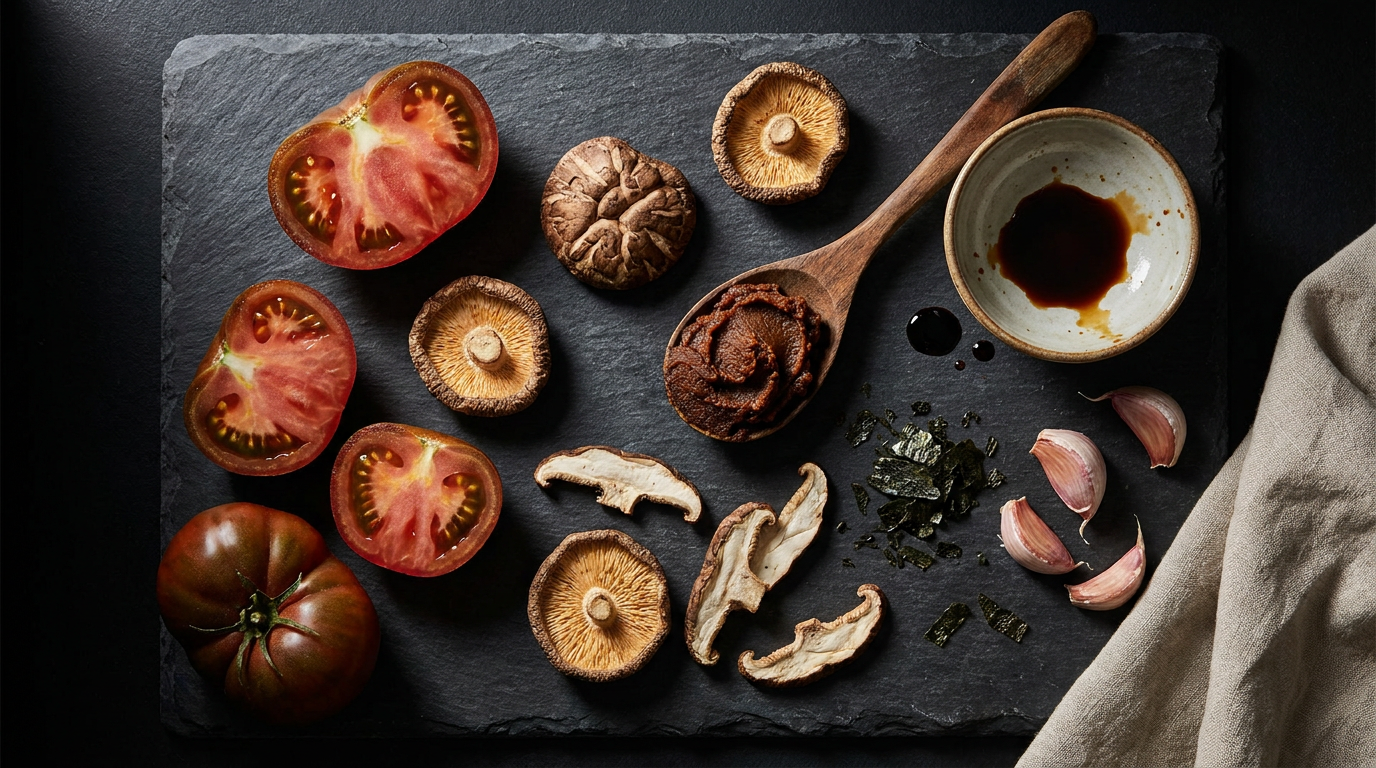
- Combining tomato paste or soy sauce with dried shiitake or porcini mushrooms creates a profound, meatless savory depth.
Plant-based cooking often faces a persistent critique: it can feel like it lacks the deep, lingering satisfaction of meat-based dishes. When a vegetable stew or a meatless pasta sauce tastes thin or watery, home cooks frequently try to compensate by adding more salt or fat.[6]
But the secret to building profound, mouth-coating depth doesn't lie in the salt shaker. It lies in mastering the fifth basic taste: umami.[3]
First identified in 1908 by Japanese chemist Kikunae Ikeda, umami translates roughly to "pleasant savory taste." Evolutionarily, our tongues developed umami receptors to detect the presence of vital proteins and amino acids in our food.[3]
However, achieving restaurant-quality savoriness requires more than just adding a single umami-rich ingredient. It relies on a biological phenomenon known as "umami synergy," a chemical reaction that exponentially multiplies flavor.[1]

Umami synergy occurs when two distinct families of molecules—glutamates and nucleotides—are consumed at the same time.[1]
Glutamates are naturally occurring amino acids found abundantly in both the plant and animal kingdoms. Ingredients like ripe tomatoes, soy sauce, miso, and seaweed are packed with free glutamates, providing the baseline savory taste in a dish.[3][6]
Nucleotides, specifically inosinate and guanylate, are the second half of the equation. On their own, nucleotides do not taste like much. But when they encounter glutamates on the human tongue, they amplify the umami sensation by 15 to 30 times.[1][2]
The science behind this amplification happens at the microscopic level. The human umami receptor, designated as T1R1/T1R3, features a unique hinged structure known to molecular biologists as the "Venus flytrap domain."[2]
When a glutamate molecule enters this domain, the "trap" closes, sending a baseline flavor signal to the brain. But when a nucleotide enters alongside it, it acts as a molecular wedge, essentially locking the trap shut. This causes the receptor to fire stronger and longer, creating a lingering savory finish.[2]

When a glutamate molecule enters this domain, the "trap" closes, sending a baseline flavor signal to the brain.
Here lies the central challenge for vegetarian cooking: while glutamates are plentiful in plants, the nucleotide inosinate is found almost exclusively in animal muscle tissue, which is why beef and fish naturally taste so savory.[1][3]
To achieve umami synergy without meat, plant-based cooks must turn to the other primary nucleotide: guanylate.[1][7]
Guanylate is found in massive concentrations in dried mushrooms, particularly shiitake and porcini varieties. The dehydration process breaks down the mushroom's cellular RNA, converting it into the highly potent nucleotide.[1][6]
Professional recipe developers frequently leverage this exact chemical reaction to build meatless depth from scratch.[4][6]
For example, to create a vegetarian alternative to fish sauce, the culinary team at America's Test Kitchen simmers soy sauce—which is packed with glutamates—alongside dried shiitake mushrooms, which provide the guanylate. The resulting liquid mimics the savory punch of fermented anchovies.[6]

In their award-winning vegetarian chili recipe, they skip the beef entirely. Instead, they rely on a concentrated puree of tomato paste and soy sauce, mixed with finely chopped dried porcini mushrooms, to trigger a massive synergistic reaction.[4]
Fermentation serves as another critical tool in the vegetarian umami arsenal. Ingredients like miso, tamari, and nutritional yeast undergo microbial processes where enzymes break down complex proteins into free amino acids, maximizing their available glutamate content.[5]
Beyond culinary delight, mastering umami synergy has significant implications for public health and dietary sustainability.[5]
Because umami compounds activate specific taste receptors that enhance overall flavor perception and increase satiety, they allow cooks to drastically reduce sodium levels without making the food taste bland or unappealing.[5]

How we got here
1908
Japanese chemist Kikunae Ikeda identifies glutamate as the source of the savory taste in kombu broth, naming it 'umami'.
1913
Shintaro Kodama discovers that the nucleotide inosinate in dried bonito flakes also contributes to umami.
1957
Akira Kuninaka identifies guanylate in dried shiitake mushrooms and discovers the phenomenon of umami synergy.
2002
Scientists identify the specific T1R1/T1R3 taste receptors on the human tongue, proving umami is a distinct biological taste.
Viewpoints in depth
Culinary Scientists
Focusing on the molecular mechanisms of taste receptors.
For food scientists and molecular biologists, umami is a mechanical process. They study how the T1R1/T1R3 taste receptors function, specifically focusing on the allosteric enhancement caused by nucleotides. By mapping the 'Venus flytrap domain' of the receptor, researchers have proven that umami synergy is an objective biological reality, not just a subjective culinary preference. This camp views ingredient pairing as a chemical equation.
Recipe Developers
Focusing on practical flavor building in the kitchen.
Test kitchen chefs and culinary instructors approach umami as a structural building block for recipes. Rather than isolating compounds in a lab, they look for accessible, supermarket-friendly ways to layer glutamates and nucleotides. For this camp, the goal is solving the 'meat gap' in vegetarian cooking—using ingredients like tomato paste, soy sauce, and dried mushrooms to build a savory backbone that prevents plant-based dishes from tasting thin or watery.
Public Health Nutritionists
Focusing on umami as a tool for dietary intervention.
Dietitians and public health advocates view umami primarily as a lever for sodium reduction. Because umami compounds naturally enhance the perception of saltiness and increase satiety, they offer a way to make low-sodium diets more palatable. This perspective emphasizes that leveraging natural glutamates can help combat the global overconsumption of salt, making heart-healthy vegetarian diets easier to sustain long-term.
What we don't know
- Scientists are still researching exactly how individual genetics influence the sensitivity of the T1R1/T1R3 umami receptors.
- The long-term evolutionary reason why humans developed such a strong synergistic response specifically to the combination of glutamates and nucleotides remains a subject of biological debate.
Key terms
- Umami
- The fifth basic taste, alongside sweet, sour, salty, and bitter, characterized by a deep, savory, or meaty flavor.
- Glutamate
- An amino acid found abundantly in protein-rich foods that serves as the primary trigger for the umami taste.
- Nucleotides
- Molecules (specifically inosinate and guanylate) that do not taste like much on their own but drastically amplify umami when combined with glutamates.
- Umami Synergy
- The biological phenomenon where combining glutamates and nucleotides multiplies the intensity of the savory taste by up to 30 times.
- T1R1/T1R3 Receptor
- The specific protein structure on the human tongue responsible for detecting umami compounds.
- Venus Flytrap Domain
- The hinged section of the umami receptor that closes around a glutamate molecule and gets locked shut by nucleotides.
Frequently asked
What is MSG and is it vegan?
Monosodium glutamate (MSG) is simply the sodium salt of glutamic acid, a naturally occurring amino acid. It is entirely vegan and is typically produced through the fermentation of plant-based starches like sugar beet or corn.
Why do dried mushrooms have more umami than fresh ones?
The drying process breaks down the mushroom's cellular structure and RNA, converting it into the nucleotide guanylate. This makes dried mushrooms significantly more potent umami boosters than their fresh counterparts.
Can I get the nucleotide inosinate from plants?
Inosinate is found almost exclusively in animal muscle tissue, which is why meat and fish are so savory. For plant-based cooking, chefs rely on guanylate (from mushrooms) to provide the necessary nucleotide for umami synergy.
Does umami have a smell?
No, umami is strictly a taste detected by receptors on the tongue. However, umami-rich foods often contain complex aromatic compounds from fermentation or roasting that our brains associate with savory flavors.
Sources
Source coverage
7 outlets
3 viewpoints surfaced







[1]Serious EatsRecipe Developers
Maximizing Umami Taste: Umami Synergy
Read on Serious Eats →[2]FEBS JournalCulinary Scientists
Molecular mechanism of the allosteric enhancement of the umami taste sensation
Read on FEBS Journal →[3]Umami Information CenterCulinary Scientists
What is Umami: Critical to delicious cooking
Read on Umami Information Center →[4]America's Test KitchenRecipe Developers
The Best Vegetarian Chili: No Meat Required, Full of Flavor
Read on America's Test Kitchen →[5]FoodTimesPublic Health Nutritionists
Umami flavour as a lever for salt reduction
Read on FoodTimes →[6]WABERecipe Developers
'Test Kitchen': How To Make Vegetarian Dishes Pop With A Little Umami
Read on WABE →[7]Factlen Editorial TeamPublic Health Nutritionists
Synthesis by Factlen editorial team
Read on Factlen Editorial Team →


Every angle. Every day.
Get food drink stories with full source coverage and perspective breakdowns delivered to your inbox.