
At-Home Brain-Computer Interfaces Cross a Threshold as ALS Patient Logs 3,800 Hours of Independent Use
A breakthrough clinical trial demonstrates that patients with severe paralysis can now operate brain-computer interfaces independently at home, marking a critical shift from controlled lab experiments to practical daily use.
By Factlen Editorial Team
- Neurotechnology Researchers
- Focused on the unprecedented volume of high-resolution neural data and the leap to real-world utility.
- Patient Advocacy Groups
- Emphasizing the restoration of autonomy and digital inclusion for those with severe motor impairments.
- Commercial BCI Developers
- Driving rapid iteration through competing surgical and technological approaches.
- Bioethics & Accessibility Advocates
- Raising concerns about the long-term cost, maintenance, and equitable access to proprietary neural devices.
What's not represented
- · Insurance providers who will eventually need to determine coverage for these expensive devices.
- · Caregivers whose daily responsibilities are directly impacted by the patient's restored independence.
Why this matters
For the millions of people worldwide living with severe paralysis or neurodegenerative diseases, the ability to communicate and control digital devices independently restores fundamental autonomy and significantly improves quality of life.
Key points
- A man with ALS successfully used a brain-computer interface at home for nearly two years without researcher assistance.
- The patient logged 3,800 hours of independent use, generating the largest single-neuron dataset ever recorded.
- Advanced algorithms translated his neural signals into text and cursor movements with over 96% accuracy.
- The milestone marks a critical shift for BCIs from controlled laboratory experiments to practical daily assistive tools.
- Commercial competitors are simultaneously advancing both invasive and minimally invasive BCI technologies.
For decades, brain-computer interfaces (BCIs) have been confined to highly controlled laboratory settings. Patients with severe paralysis could move cursors or spell words with their minds, but only while tethered to massive machines and surrounded by teams of neuroscientists calibrating the software.[5]
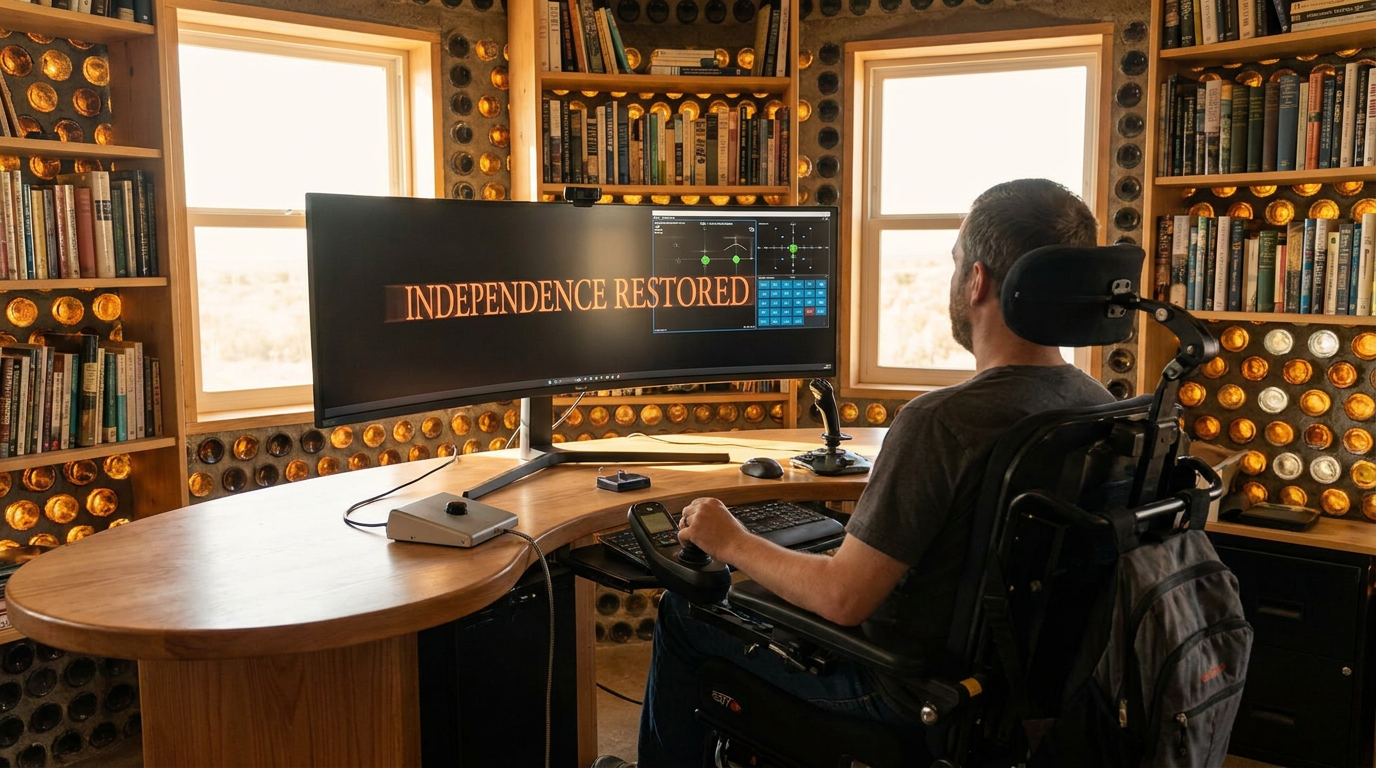
That paradigm has officially shifted. A landmark study published today in Nature Medicine details how a man with amyotrophic lateral sclerosis (ALS) successfully used a fully implanted BCI in his own home for nearly two years, communicating and operating digital devices completely unassisted.[1][2]
The patient, Casey Harrell, logged over 3,800 hours of independent use, marking the largest individual brain recording dataset with single-neuron resolution ever collected. This transition from proof-of-concept to daily utility represents a watershed moment for neuroprosthetics.[2]
The system, developed by researchers at UC Davis, Brown University, and Mass General Brigham, relies on microelectrode arrays implanted in the brain's motor cortex. When the user attempts to speak or move, the arrays capture the electrical firing of individual neurons.[2][5]

These neural signals are then fed into advanced machine-learning algorithms that decode the intended action. The software translates the brain activity into text on a screen or cursor movements, allowing the user to browse the internet, send emails, and hold real-time conversations via text-to-speech synthesis.[2]
The primary claim of the UC Davis study is that high-accuracy decoding can be maintained in a real-world environment without constant expert intervention. Historically, BCI algorithms suffered from "signal drift," requiring daily recalibration by technicians as the brain's electrical environment shifted.[2][5]
The new algorithms demonstrate remarkable stability. According to the data, the system maintained a task success rate exceeding 96 percent over prolonged periods, allowing Harrell to use the device for up to 12 straight hours on his own terms.[2]
This academic milestone arrives alongside a surge of commercial BCI development. Elon Musk's Neuralink recently implanted its proprietary device in multiple patients with spinal cord injuries and ALS, focusing on high-bandwidth data transfer via ultra-thin flexible threads inserted directly into the cortex.[4]
This academic milestone arrives alongside a surge of commercial BCI development.
Meanwhile, competitors like Synchron are taking a different physiological route. Synchron's "Stentrode" device avoids open brain surgery entirely, entering the body through the jugular vein and expanding inside a blood vessel adjacent to the motor cortex.[3]

While the endovascular approach yields a lower-resolution signal than direct cortical implants, Synchron's clinical trials have proven sufficient for basic digital communication, highlighting a critical trade-off between surgical risk and data bandwidth.[3][5]
Despite these breakthroughs, the long-term viability of implanted BCIs remains an open question. The brain is a hostile environment for electronics; over time, the body's immune response often forms scar tissue around implanted electrodes, which can degrade the signal quality.[5]
It is currently unknown whether the high-resolution decoding observed in the UC Davis study will persist a decade from now, or if the hardware will eventually require surgical replacement.[5]

Furthermore, the scalability of the technology poses a significant hurdle. Current BCI systems are bespoke, requiring custom-fitted hardware and highly individualized algorithm training. Translating this success to the estimated 8 million Americans living with paralysis will require massive advancements in automated calibration and manufacturing.[5]
For patients facing the progressive loss of voluntary muscle control—often culminating in "locked-in syndrome"—the ability to maintain digital agency is life-altering. The evidence now clearly indicates that independent, at-home BCI use is not just theoretically possible, but practically achievable.[1][5]
As commercial entities and academic institutions race to refine the hardware, the focus is rapidly shifting from proving the technology works to making it durable, accessible, and seamlessly integrated into the daily lives of those who need it most.[5]
How we got here
2004
The first human receives a long-term Utah Array implant, demonstrating basic cursor control in a lab setting.
2021
Synchron receives FDA approval to begin human trials for its minimally invasive endovascular BCI.
2024
Neuralink implants its first device in a human patient, enabling thought-controlled video gaming.
June 2026
UC Davis researchers publish data showing an ALS patient successfully using a BCI independently at home for 3,800 hours.
Viewpoints in depth
Neurotechnology Researchers
Focused on the unprecedented volume of high-resolution neural data and the leap to real-world utility.
For the scientific community, the most significant outcome of the UC Davis trial is the sheer volume of data collected outside a laboratory. By logging 3,800 hours of single-neuron resolution activity in a dynamic home environment, researchers can now study how the brain's electrical signals adapt to daily stressors, fatigue, and varied tasks. This dataset is expected to accelerate the development of more robust, self-calibrating algorithms that don't require daily expert tuning.
Patient Advocacy Groups
Emphasizing the restoration of autonomy and digital inclusion for those with severe motor impairments.
Advocates for patients with ALS and spinal cord injuries view this milestone as a fundamental restoration of human rights. The ability to independently control a computer means the ability to work, manage finances, send private messages, and participate in the digital public square without relying on a caregiver. For these groups, the success of at-home BCIs shifts the narrative from managing decline to actively restoring agency.
Commercial BCI Developers
Driving rapid iteration through competing surgical and technological approaches.
The private sector is aggressively pursuing different pathways to commercialization. Companies like Neuralink argue that direct cortical implantation is necessary to achieve the high bandwidth required for fluid, complex digital control. Conversely, companies like Synchron believe that avoiding open brain surgery via endovascular implants will lead to faster regulatory approval and broader patient adoption, even if the initial signal resolution is lower.
Bioethics & Accessibility Advocates
Raising concerns about the long-term cost, maintenance, and equitable access to proprietary neural devices.
As BCIs move closer to commercial reality, bioethicists are sounding the alarm about the digital divide. These systems require highly specialized hardware, continuous software updates, and sophisticated medical support—resources that are inherently expensive. Advocates warn that without proactive policy interventions, life-altering neuroprosthetics could become a luxury available only to the wealthy, leaving marginalized patients behind.
What we don't know
- Whether the implanted electrodes will succumb to scar tissue and lose signal quality over a span of 5 to 10 years.
- How quickly the manufacturing and calibration processes can be automated to make the technology affordable at scale.
- The long-term psychological impacts of being permanently tethered to a digital interface for basic communication.
Key terms
- Brain-Computer Interface (BCI)
- A system that translates brain activity into commands for external devices, bypassing paralyzed muscles.
- Amyotrophic Lateral Sclerosis (ALS)
- A progressive neurodegenerative disease that destroys motor neurons, leading to severe paralysis and loss of speech.
- Motor Cortex
- The region of the brain responsible for planning, controlling, and executing voluntary movements.
- Signal Drift
- The degradation or shifting of neural signals over time, which historically required BCIs to be frequently recalibrated by experts.
- Endovascular Implant
- A medical device inserted through the blood vessels rather than through open surgery, used by some BCI companies to reach the brain.
Frequently asked
Does the patient need a researcher present to use the device?
No. The breakthrough of the UC Davis study is that the patient can operate the BCI independently at home, turning it on and off whenever they choose.
Does this require open brain surgery?
The UC Davis and Neuralink systems require surgical implantation into the cerebral cortex. However, competitors like Synchron use a minimally invasive approach through the jugular vein.
Can the BCI synthesize speech?
Yes. Advanced decoding algorithms translate the user's attempted speech into text, which can then be read aloud by a computer, allowing for real-time conversation.
Is the technology available to the public yet?
Not yet. These devices are still in the clinical trial phase, and researchers are working to ensure long-term safety and reliability before seeking broad commercial approval.
Sources
Source coverage
5 outlets
4 viewpoints surfaced





[1]NatureNeurotechnology Researchers
At-home brain implant gives man with motor neuron disease his daily life back
Read on Nature →[2]UC Davis HealthNeurotechnology Researchers
Brain-computer interface enables independent, accurate communication for man living with ALS
Read on UC Davis Health →[3]SynchronCommercial BCI Developers
The Endovascular Brain-Computer Interface
Read on Synchron →[4]NeuralinkCommercial BCI Developers
Pioneering Brain Computer Interfaces
Read on Neuralink →[5]Factlen Editorial TeamPatient Advocacy Groups
Synthesis by Factlen editorial team
Read on Factlen Editorial Team →
Every angle. Every day.
Get science stories with full source coverage and perspective breakdowns delivered to your inbox.