
How Scientists Are Using Underwater Soundscapes to Resurrect Dead Coral Reefs
Marine researchers are broadcasting the crackles and purrs of healthy reefs through underwater speakers to lure coral larvae back to degraded habitats. The technique, known as acoustic enrichment, is showing remarkable success in field trials, boosting coral settlement rates by up to seven times.
By Factlen Editorial Team
- Marine Biologists & Acousticians
- Focuses on the biological mechanisms of larval navigation and the empirical data proving sound accelerates settlement.
- Conservation Technologists
- Highlights the innovative deployment of 3D-printed sculptures, solar-powered speakers, and the scaling of acoustic interventions.
- Climate Realists
- Cautions that acoustic enrichment is only a temporary fix unless global carbon emissions and ocean temperatures are stabilized.
What's not represented
- · Local coastal fishing communities
- · Marine policy regulators
Why this matters
Coral reefs support a quarter of all marine life and provide food security for half a billion people, but they are dying at an unprecedented rate. If acoustic enrichment can be scaled, it offers a powerful new tool to accelerate reef recovery and buy these vital ecosystems time against climate change.
Key points
- Marine researchers are using underwater speakers to broadcast the sounds of healthy reefs into degraded habitats to attract marine life.
- A landmark study found that 'acoustic enrichment' increases coral larval settlement rates by up to seven times within the first 36 hours.
- Coral larvae lack ears but use tiny hair-like cilia to detect the low-frequency vibrations of snapping shrimp and feeding fish.
- Field trials in Jamaica and the Maldives are successfully combining 3D-printed ceramic reef sculptures with solar-powered acoustic playback systems.
- While highly effective for local restoration, scientists warn that acoustic enrichment cannot protect reefs from the broader threats of climate change and ocean warming.
A healthy coral reef is a cacophony of biological noise. Beneath the waves, thriving marine ecosystems are characterized by the continuous, frying-bacon crackle of snapping shrimp, underscored by the low-frequency grunts, purrs, and clicks of fish feeding, socializing, and defending their territories. This vibrant acoustic signature is a hallmark of a functioning habitat. However, as climate change, ocean acidification, and severe bleaching events devastate these delicate ecosystems, the reefs are growing eerily quiet. When the foundational coral dies, the diverse communities of marine life that rely on it for food and shelter abandon the area, leaving behind a silent graveyard of bleached white skeletons.[1][5]
This silence creates a deadly ecological feedback loop that prevents the reef from naturally regenerating. For decades, marine biologists assumed that coral larvae—the microscopic, free-swimming early life stage of corals—drifted passively on ocean currents until they randomly bumped into a suitable surface. Recent scientific discoveries, however, have fundamentally rewritten our understanding of coral reproduction. Researchers have revealed that these tiny organisms actively navigate the water column, using the acoustic signatures of thriving reefs as a homing beacon to find a safe place to settle and grow. Without the auditory cues provided by a bustling community of fish and crustaceans, the drifting larvae simply bypass the degraded reefs, severely limiting the ecosystem's ability to recover even after the initial stressors have passed.[3][7]
When a reef dies and loses its soundtrack, it effectively becomes invisible to the next generation of coral and fish. To break this cycle, an interdisciplinary coalition of marine biologists, acousticians, and environmental artists is deploying a radical intervention: playing the sounds of healthy reefs through underwater speakers to trick larvae into coming home. This approach operates on the premise that if you can recreate the auditory illusion of a thriving ecosystem, the foundational building blocks of the reef will return, eventually turning the acoustic illusion into a biological reality. By artificially restoring the soundscape, conservationists hope to jump-start the natural recruitment process, drawing in the exact species needed to clean the dead coral and prepare the surface for new growth.[1][4]
The technique, known formally as acoustic enrichment, is rapidly moving from theoretical laboratory research to real-world deployment. In recent field trials spanning the Great Barrier Reef, the coastal waters of the Maldives, and the Caribbean Sea, researchers have demonstrated that broadcasting a healthy reef's acoustic signature can dramatically accelerate ecosystem recovery. What began as a niche experiment in sensory ecology has evolved into one of the most promising new tools in the global marine conservation arsenal, offering a scalable method to support traditional restoration efforts. By leveraging relatively inexpensive audio technology, scientists can influence the behavior of millions of microscopic organisms simultaneously, covering far more area than manual coral planting alone.[5][6]

A landmark study conducted by researchers at the Woods Hole Oceanographic Institution (WHOI) quantified just how powerful this auditory lure can be. In a series of controlled experiments, the scientists exposed multiple species of coral larvae to the recorded sounds of a vibrant, healthy reef. The results were unprecedented: researchers found that acoustic enrichment increased coral settlement rates by up to seven times compared to silent control sites. This massive boost in recruitment provides a critical advantage for degraded reefs struggling to maintain their populations. The WHOI team demonstrated that this behavioral response is not limited to a single species; both brooding corals and broadcast-spawning corals exhibited a strong preference for the acoustically enriched environments, suggesting that sound is a universal settlement cue across diverse coral taxa.[1][7]
The timing of this acoustic intervention, however, is highly specific and biologically constrained. The WHOI researchers discovered that the coral larvae are most responsive to the acoustic cues during a narrow developmental window—specifically, their first 36 hours in the water column. During this brief period, the larvae are actively searching for a permanent home and are highly attuned to environmental signals. After that critical window closes, the presence of sound has a negligible effect on their settlement decisions, highlighting the need for precise timing when deploying acoustic restoration tools in the wild. This temporal limitation means that acoustic enrichment systems must be strategically positioned and activated to coincide with mass coral spawning events, ensuring that the maximum number of larvae are exposed to the auditory beacon precisely when they are most receptive to it.[7]
The precise biological mechanism behind this phenomenon is a marvel of evolutionary adaptation, and one that scientists are still working to fully unravel. Coral larvae lack a central nervous system, ears, or any traditional auditory organs. Instead, they possess tiny, hair-like structures called cilia covering their exterior. These microscopic appendages are incredibly sensitive to particle motion and low-frequency vibrations in the water. As the sound waves from snapping shrimp and grunting fish travel through the dense aquatic medium, the larvae's cilia detect the physical displacement of the water molecules, allowing them to literally feel the noise and swim toward its source. This tactile form of hearing allows the larvae to navigate complex ocean currents and locate the specific acoustic frequencies associated with healthy, hard-bottom habitats, avoiding muddy or sandy areas where they would quickly perish.[8]
The precise biological mechanism behind this phenomenon is a marvel of evolutionary adaptation, and one that scientists are still working to fully unravel.
Beyond the controlled confines of the laboratory, acoustic enrichment is currently being tested in ambitious, large-scale field projects. Off the northern coast of Jamaica, the "Coral Sonic Resilience" initiative has merged marine science with environmental art to rebuild severely degraded habitats. This project represents a new paradigm in conservation, bringing together diverse disciplines to tackle the coral crisis from multiple angles. By treating the reef as a public square that needs to be repopulated, the initiative is proving that creative technological applications can have a profound impact on ecological restoration. The Jamaican waters, which have suffered extensively from overfishing and recent marine heatwaves, provide a rigorous testing ground for the technology, challenging the researchers to see if sound can overcome the compounding stressors of a heavily impacted ecosystem.[2][4]

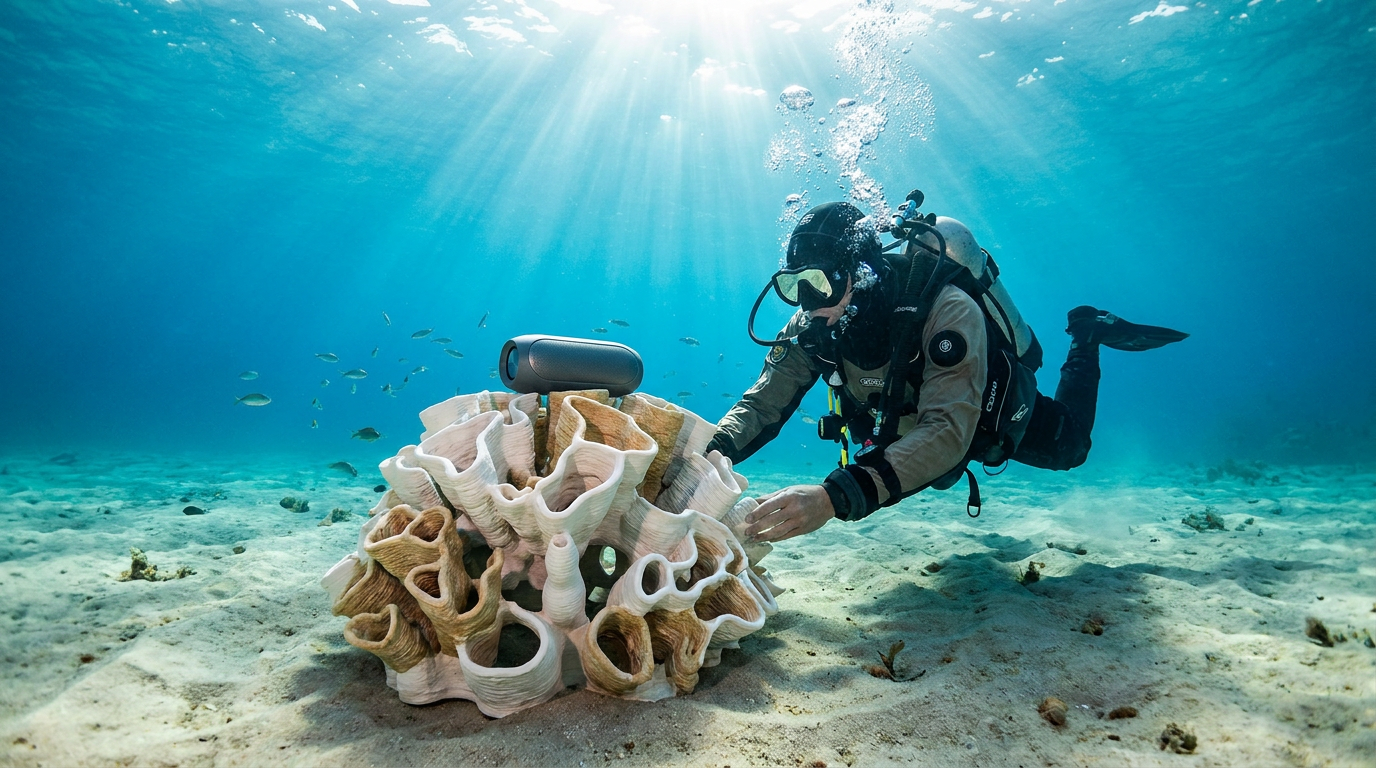
Led by Italian artist Marco Barotti and marine scientist Timothy Lamont, the Jamaican project utilizes 3D-printed ceramic sculptures designed to mimic the complex physical structure of a natural reef. These artificial habitats serve a dual purpose: they provide the necessary hard substrate for coral larvae to attach to, and they act as underwater boomboxes. The sculptures are crowned with waterproof, solar-powered speakers that broadcast a continuous loop of healthy reef audio, creating an inviting acoustic environment that signals safety and abundance to passing marine life. The solar panels, floating on the surface above, provide a reliable and renewable power source, allowing the acoustic systems to operate continuously for 14 hours a day without the need for battery replacements or disruptive maintenance dives.[3][4]
The audio tracks themselves are carefully curated and highly engineered. Researchers do not simply drop a microphone into the ocean and hit play. Instead, they record 48 to 96 hours of audio from pristine, isolated reef environments. They then meticulously scrub the digital files of any anthropogenic noise—such as the roar of boat engines, the hum of industrial shipping, or the clatter of coastal construction. Only the pure, biological symphony of the reef is retained, ensuring that the broadcasted soundscape provides clear, unambiguous settlement cues to the larvae. This acoustic purification is essential, as previous studies have shown that human-made noise pollution can mask natural biological sounds, confusing larvae and actively deterring them from settling in otherwise suitable habitats.[4]
The results of these field deployments have been striking, offering a rare bright spot in the often-bleak landscape of marine conservation. In the Jamaican trials, early data indicates that coral settlement rates are up to three times higher in the acoustically enhanced zones compared to silent control areas. These findings build upon foundational experiments conducted on the Great Barrier Reef in 2019, which showed that acoustic enrichment doubled the total number of juvenile fish arriving at a degraded site within just 40 days, while also increasing overall species richness by 50 percent. The rapid return of diverse marine life demonstrates that acoustic enrichment does not just attract a few stray individuals; it actively rebuilds the complex, multi-tiered food webs that are necessary for a reef to function and thrive.[2][9]
The return of these fish populations plays a crucial role in the broader recovery of the ecosystem. While attracting fish to a dead reef will not magically bring the coral back to life, the fish provide essential maintenance services. Herbivorous fish, in particular, graze on the thick mats of macroalgae that quickly overgrow dead coral skeletons. By constantly trimming back this algae, the fish create the clean, hard surfaces that coral larvae require to attach and grow, effectively preparing the biological canvas for the next generation of the reef. Without this constant grazing pressure, the algae would completely smother the newly settled coral polyps, starving them of sunlight and space, and rendering any larval recruitment efforts ultimately futile.[9]

To maximize the ecological impact, acoustic enrichment is increasingly being paired with other advanced restoration techniques. In the Maldives, researchers have successfully combined underwater soundscapes with "Coral IVF." In this process, scientists collect coral eggs and sperm during mass spawning events, fertilize them in the lab, and rear the larvae in floating, predator-free nurseries. Once the larvae reach the critical settlement stage, they are released directly over reefs that are actively broadcasting healthy acoustic signals, combining the high survival rates of captive breeding with the targeted precision of acoustic homing. This synergistic approach ensures that a massive concentration of healthy larvae is delivered exactly where they are needed, while the soundscape provides the final behavioral nudge required to initiate settlement.[5]
Monitoring the success of these interventions has also driven technological innovation in how scientists study the ocean. Traditional visual surveys, conducted by scuba divers with clipboards, are labor-intensive, limited in scope, and often miss the full picture of ecosystem recovery. Instead, scientists are now utilizing Passive Acoustic Monitoring (PAM) and advanced machine learning algorithms to track the returning biological sounds. By analyzing the frequency and complexity of the underwater soundscape over time, researchers can effectively listen to the reef heal itself, using the returning noise as a proxy for returning biodiversity. This acoustic monitoring provides a continuous, non-invasive stream of data, allowing conservationists to evaluate the success of their restoration efforts in real-time and make rapid adjustments to their strategies based on the auditory feedback of the ecosystem.[6]
Despite the profound promise of acoustic enrichment, marine scientists are careful to manage expectations and avoid framing the technology as a standalone cure. Underwater speakers, no matter how advanced, cannot lower global ocean temperatures, reverse the devastating effects of ocean acidification, or filter out agricultural runoff and plastic pollution. If the fundamental environmental conditions that killed the reef in the first place are not addressed, the newly settled corals will inevitably face the same lethal stressors as their predecessors. Acoustic enrichment is a powerful tool for localized ecological repair, but it is ultimately a biological band-aid; it cannot shield the reef from the systemic, planetary-scale threats driven by human activity.[3][9]

If global carbon emissions continue unabated and the frequency of severe marine heatwaves intensifies, the corals lured in by the underwater speakers will simply bleach and die. Conservationists stress that acoustic rewilding must be viewed as one component of a much broader environmental strategy. It is designed to be deployed in tandem with aggressive emissions reductions, the establishment of robust marine protected areas, and sustainable fisheries management. Without these foundational protections, acoustic restoration is merely treating the symptoms of a terminal ecological illness. The technology works best in areas where the water quality remains high and the primary cause of degradation—such as a localized storm or a historical blast-fishing event—has already passed, giving the new corals a genuine chance at long-term survival.[3][9]
Ultimately, researchers view acoustic enrichment as a vital way to buy time for the world's oceans. By accelerating the natural recruitment process and rapidly rebuilding the foundational communities of fish and coral, these underwater soundscapes offer a critical lifeline for vulnerable marine ecosystems. As the global community races to transition away from fossil fuels and stabilize the climate, innovations like acoustic rewilding ensure that when the oceans finally begin to cool, there will still be living, breathing coral reefs left to save. The fusion of art, acoustics, and marine biology represents a hopeful new chapter in conservation—one that proves human technology can be used not just to extract from nature, but to actively listen to it, understand its language, and help it heal.[2][4]
How we got here
2019
Researchers demonstrate that playing healthy reef sounds on the Great Barrier Reef doubles juvenile fish recruitment within 40 days.
2023
A record marine heatwave devastates Caribbean corals, accelerating the search for scalable, tech-assisted restoration tools.
2024
The Woods Hole Oceanographic Institution publishes a landmark study showing acoustic enrichment increases coral larval settlement by up to seven times.
2026
The 'Coral Sonic Resilience' project successfully deploys 3D-printed acoustic sculptures in Jamaica, merging environmental art with marine science.
Viewpoints in depth
Marine Biologists' View
Sound is a fundamental, previously overlooked driver of marine ecosystem recruitment.
For decades, the scientific consensus held that coral larvae were passive drifters, entirely at the mercy of ocean currents. The discovery of acoustic navigation has upended this model. Biologists now argue that the acoustic landscape is just as critical to a reef's survival as water temperature or light penetration. By proving that larvae use their cilia to detect low-frequency vibrations from snapping shrimp and fish, researchers have opened an entirely new frontier in sensory ecology, suggesting that 'acoustic bleaching'—the loss of biological sound—is a primary reason degraded reefs fail to recover naturally.
Conservation Technologists' View
Technology and art can be merged to create scalable, automated restoration tools.
Technologists and environmental artists view the coral crisis as a design challenge. Traditional restoration methods, such as manually planting coral fragments, are highly labor-intensive and difficult to scale across vast ocean tracts. By utilizing 3D-printed ceramic substrates and solar-powered acoustic playback systems, this camp advocates for automated, tech-assisted rewilding. They argue that creating 'acoustic life rafts' allows conservationists to influence the behavior of millions of organisms simultaneously, providing a highly efficient, scalable complement to manual reef-building efforts.
Climate Realists' View
Acoustic enrichment is a localized band-aid that cannot outpace global ocean warming.
While acknowledging the impressive settlement data, climate scientists and policy advocates caution against technological techno-optimism. They point out that luring coral larvae to a reef is futile if the water temperature remains fatally high. This camp stresses that acoustic enrichment does not address the root causes of coral mortality: greenhouse gas emissions, ocean acidification, and agricultural runoff. They argue that funding for acoustic interventions must not detract from the urgent, systemic political work required to transition away from fossil fuels, framing the speakers as a way to buy time rather than a permanent cure.
What we don't know
- It remains unclear how long the acoustically attracted corals will survive if local water temperatures continue to rise.
- Scientists are still determining whether certain coral species are entirely deaf to acoustic cues, which could skew the biodiversity of restored reefs.
- The long-term durability and maintenance requirements of deploying thousands of underwater solar-powered speakers at a global scale have yet to be proven.
Key terms
- Acoustic Enrichment
- The practice of broadcasting recorded sounds from healthy ecosystems into degraded areas to attract wildlife and encourage settlement.
- Coral Larvae
- The microscopic, free-swimming early life stage of corals before they attach to a hard surface and grow into stationary polyps.
- Passive Acoustic Monitoring (PAM)
- The use of underwater microphones to record and analyze the sounds of marine environments without disturbing the ecosystem.
- Coral Bleaching
- A stress response where corals expel the symbiotic algae living in their tissues, turning completely white and risking starvation.
- Coral IVF
- A restoration technique where coral eggs and sperm are collected, fertilized, and reared in protected nurseries before being released onto reefs.
Frequently asked
How do coral larvae hear without ears?
While they lack a central nervous system or traditional ears, coral larvae possess tiny hair-like structures called cilia that can detect low-frequency vibrations and particle motion in the water.
What does a healthy coral reef sound like?
A healthy reef is surprisingly loud, characterized by the continuous crackling of snapping shrimp and the grunts, purrs, and clicks of feeding and socializing fish.
Can underwater speakers cure coral bleaching?
No. Acoustic enrichment attracts larvae and accelerates local recovery, but it cannot lower ocean temperatures or protect the newly settled corals from future marine heatwaves.
Sources
Source coverage
9 outlets
3 viewpoints surfaced








[1]Earth.OrgConservation Technologists
Can Soundscapes Save Coral Reefs?
Read on Earth.Org →[2]Civil ParleyClimate Realists
Sound Waves Save Reefs: Jamaica's Acoustic Innovation Shows Promise in Marine Restoration
Read on Civil Parley →[3]KarmactiveConservation Technologists
3D Sound Sculptures Boost Coral Settlement 7x as Global Reefs Face 63% Biodiversity Loss Since 1950s
Read on Karmactive →[4]Climate CentralClimate Realists
Sounds of the Sea: Can Underwater Speakers Save the World's Dying Coral Reefs?
Read on Climate Central →[5]Make Water FamousConservation Technologists
Documentary sounds out baby coral breakthrough
Read on Make Water Famous →[6]bioRxivMarine Biologists & Acousticians
Coral restoration alters reef soundscapes but machine learning and manual analyses suggest different recovery rates
Read on bioRxiv →[7]ScienceDailyMarine Biologists & Acousticians
Researchers use the sounds of healthy coral reefs to encourage growth of a new species of coral larvae
Read on ScienceDaily →[8]The Journal of the Acoustical Society of AmericaMarine Biologists & Acousticians
SoundGarden: Applying healthy soundscapes to support coral reef restoration
Read on The Journal of the Acoustical Society of America →[9]SciTechDailyMarine Biologists & Acousticians
New Hope for Coral Reef Restoration From Playing Sounds of Healthy Reefs on Loudspeakers
Read on SciTechDaily →
Every angle. Every day.
Get environment stories with full source coverage and perspective breakdowns delivered to your inbox.