
Smart Ring vs. Smartwatch: The 2026 Health Tracking Comparison
As wearable technology bifurcates, smart rings and smartwatches offer fundamentally different approaches to health tracking. We compare the anatomical science, sleep accuracy, and active performance trade-offs to help you choose the right device.
By Factlen Editorial Team
- Passive Tracking Advocates
- Prioritize continuous, frictionless data collection over real-time interaction.
- Active Performance Advocates
- Value real-time feedback, GPS tracking, and actionable workout metrics.
- Clinical Accuracy Analysts
- Focus on sensor validation, anatomical advantages, and data integrity.
What's not represented
- · Traditional mechanical watch enthusiasts who adopt rings purely to avoid wearing two watches.
- · Medical professionals who rely on these consumer devices for remote patient monitoring.
Why this matters
Choosing the wrong wearable form factor is a $300 mistake that often results in the device sitting unused in a drawer. Understanding the scientific differences in sensor placement ensures you invest in a tool that actually matches your daily habits and health goals.
Key points
- Smart rings excel at passive, continuous tracking, particularly for sleep and recovery metrics.
- Smartwatches dominate active performance tracking, offering GPS and real-time workout feedback.
- Finger-based PPG sensors capture cleaner cardiovascular data at rest than wrist-based sensors.
- Smart rings boast 5 to 12 days of battery life, while most smartwatches require daily charging.
- Many users are adopting a dual-device strategy: a watch for the day and a ring for the night.
The wearable health technology market in 2026 has officially bifurcated into two distinct philosophies: the active companion and the passive observer. For years, consumers assumed that tracking their health required strapping a glowing screen to their wrist. Today, the rapid miniaturization of biometric sensors has elevated the smart ring from a niche gadget to a mainstream health essential. This evolution has left millions of consumers facing a fundamental choice between two very different form factors. A smartwatch demands interaction, while a smart ring operates entirely in the background. Neither approach is objectively superior, but they serve entirely different goals. Understanding the anatomical, technological, and practical trade-offs between the finger and the wrist is the key to choosing the right wearable for your specific health objectives.[1][5]
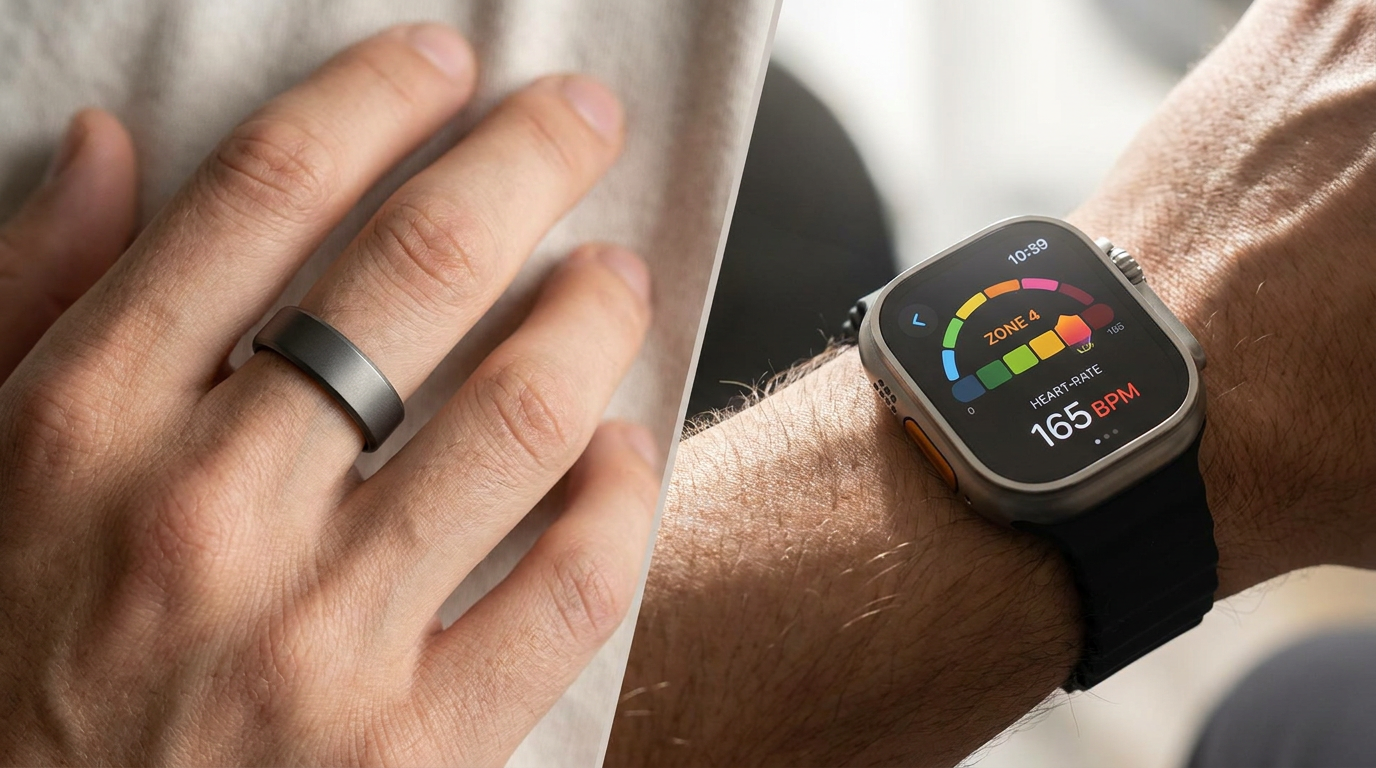
A smartwatch is fundamentally designed as an active dashboard for your daily life. Devices like the Apple Watch Series 11 or the latest Garmin models are built to deliver real-time data exactly when you need it. They feature bright displays that show your heart rate zones during a sprint, provide turn-by-turn GPS navigation on a hiking trail, and vibrate to alert you of incoming messages. This active interaction makes the smartwatch an unparalleled tool for athletes and individuals who want their health metrics to be visible, actionable, and immediate. It is a device that actively coaches you through your day.[2][4]
In stark contrast, a smart ring is designed to be a passive, invisible observer. Devices like the Oura Ring 4 or the Samsung Galaxy Ring 2 lack screens, buttons, and vibration motors. They sit quietly on your finger, continuously collecting a massive stream of biometric data—heart rate, skin temperature, blood oxygen, and movement—and quietly syncing it to your smartphone for later review. The philosophy behind the smart ring is that health tracking should not introduce more digital noise into your life. It is built for users who want deep insights into their physical state without the constant distraction of a glowing screen on their wrist.[1][3]

The core technological difference between the two devices lies in how and where they deploy their optical sensors. Both smart rings and smartwatches rely on photoplethysmography (PPG), a technique that shines green and red LED lights into the skin and uses a photodiode to measure the light that bounces back. As your heart beats, the volume of blood in your vessels changes, altering the light absorption. While the underlying technology is identical, the anatomical location of the sensor dramatically impacts the quality of the data it can collect.[2][7]
From a purely physiological standpoint, the finger offers a significant advantage over the wrist for capturing cardiovascular data. The skin on the palm side of the finger is relatively thin, and the underlying capillary network is incredibly dense and located close to the surface. Furthermore, the finger contains fewer muscles and tendons that flex and shift during normal movement. This allows the ring's sensors to capture a remarkably clean, high-fidelity signal with minimal noise, particularly when the body is at rest. The wrist, by comparison, is a complex joint with thicker tissue and constant rotational movement.[1][7]
This anatomical advantage makes smart rings the undisputed champions of sleep tracking. Clinical validation studies conducted in 2025 and 2026 have repeatedly demonstrated that top-tier smart rings achieve a 96 to 98 percent correlation with medical-grade polysomnography equipment for identifying light, deep, and REM sleep stages. Because the ring maintains a snug, circumferential grip on the finger, the sensors rarely lose contact with the skin, providing an uninterrupted stream of high-quality data throughout the night.[4][6]
Smartwatches, despite featuring highly advanced algorithms, generally hover around an 85 to 90 percent accuracy rate for sleep staging. The primary culprit for this discrepancy is positional drift. As users toss and turn in bed—particularly those who sleep on their sides—the watch band often shifts, causing the optical sensors to temporarily lose optimal contact with the skin. These micro-gaps in the data force the watch's software to guess or interpolate the missing information, slightly degrading the overall accuracy of the sleep and recovery analysis.[6][7]

Smartwatches, despite featuring highly advanced algorithms, generally hover around an 85 to 90 percent accuracy rate for sleep staging.
Beyond raw sensor accuracy, smart rings dominate the sleep category due to a much simpler factor: user compliance. A typical smart ring weighs between four and eight grams, making it virtually imperceptible once worn. Users naturally leave them on around the clock. Smartwatches, which can weigh between 40 and 80 grams and often feature bulky casings, are frequently removed before bed because they are uncomfortable to sleep in. The most sophisticated sleep tracking algorithm in the world is entirely useless if the device is sitting on a nightstand charger.[4][5]
However, the moment the user wakes up and begins intense physical activity, the smartwatch decisively reclaims the crown. Smart rings struggle significantly with motion artifacts during exercise. When you grip a barbell, squeeze bicycle handlebars, or swing a tennis racket, the muscles and tendons in your finger contract, temporarily restricting blood flow and disrupting the PPG signal. For high-intensity interval training or heavy weightlifting, a smart ring simply cannot maintain the consistent sensor contact required for accurate active heart rate monitoring.[2][7]
Smartwatches are purpose-built for active performance tracking. Because they sit higher up on the arm, they are less affected by grip-related blood flow restrictions. More importantly, they offer the processing power and hardware required for serious athletic training. Built-in GPS allows runners and cyclists to track their pace, distance, and route without carrying a smartphone. The screen provides crucial real-time feedback, allowing athletes to adjust their effort to stay within specific heart rate zones. For active workouts, the smartwatch remains an indispensable tool.[1][4]
Battery life represents another massive divergence between the two form factors, directly impacting the continuity of your health data. A flagship smartwatch, burdened by a bright OLED display, GPS chips, and constant Bluetooth communication with a phone, typically requires charging every one to two days. This frequent charging cycle inevitably creates gaps in your health data. Most users charge their watches during their morning routine or right before bed, which means they are regularly missing crucial baseline metrics.[1][4]

Smart rings, completely unburdened by power-hungry displays and active notifications, boast vastly superior endurance. Most premium smart rings in 2026 routinely last between five and twelve days on a single charge. This extended battery life enables true, uninterrupted 24/7 continuous monitoring. Because the device rarely leaves the finger, it can capture a much more complete and accurate picture of long-term trends, such as subtle shifts in resting heart rate, skin temperature deviations, and heart rate variability (HRV).[3][6]
The economics of these devices also differ significantly over time, and buyers must look beyond the initial retail price. While the upfront hardware costs are generally comparable—typically ranging between $250 and $500 for both premium rings and watches—the long-term ownership costs can diverge sharply. Smartwatches are generally a one-time purchase, with users only paying extra if they choose to subscribe to premium third-party fitness applications or cellular data plans.[5]
Conversely, the smart ring market has historically relied heavily on subscription models. Several popular brands lock their deepest health insights, personalized recovery scores, and historical data trends behind monthly fees ranging from $10 to $20. Over a three-year lifespan, this subscription can effectively double the total cost of the device. However, the landscape is shifting in 2026, with newer competitors introducing subscription-free models that provide full data access out of the box, forcing consumers to carefully weigh upfront costs against ongoing fees.[3][5]

Ultimately, choosing between a smart ring and a smartwatch requires an honest assessment of your daily habits and health goals. A smart ring fits well when your primary objectives are sleep optimization, tracking recovery via HRV, and maintaining long-term health awareness without adding digital distractions to your life. It is the ideal choice for minimalists, people who prefer wearing traditional mechanical watches, and anyone who finds sleeping with a bulky wrist wearable uncomfortable. It does not fit well if you need real-time pacing data during a marathon.[1][8]
A smartwatch fits well when you train regularly and require immediate, glanceable feedback during your workouts. It is the superior choice if you want the safety of built-in GPS, the convenience of on-wrist notifications, and the ability to leave your phone at home during a run. It does not fit well if you suffer from screen fatigue or demand multi-day battery life. For an increasing number of health-conscious consumers in 2026, the ultimate solution is not choosing at all: they wear a smartwatch to conquer the day, and a smart ring to measure the recovery at night.[3][8]
How we got here
2015
The Apple Watch launches, establishing the wrist as the primary real estate for consumer health tracking.
2018
Oura releases its second-generation ring, proving that miniaturized finger sensors can accurately track sleep stages.
2024
Major tech companies like Samsung enter the smart ring market, validating the form factor for mainstream consumers.
2026
The market solidifies into a dual-device ecosystem, with users increasingly pairing active watches with passive rings.
Viewpoints in depth
Passive Tracking Advocates
Prioritize continuous, frictionless data collection over real-time interaction.
This camp argues that the best health tracker is the one you forget you are wearing. They emphasize that recovery and sleep are the foundation of health, and that rings capture this data far more accurately because users actually wear them to bed. They view smartwatch screens as unnecessary distractions that induce anxiety rather than wellness.
Active Performance Advocates
Value real-time feedback, GPS tracking, and actionable workout metrics.
For athletes and active individuals, health tracking is an active pursuit, not just a passive background process. This group argues that a wearable must provide in-the-moment guidance—like heart rate zones during a run or pacing data—to be truly useful. They view rings as incomplete tools that fail exactly when the body is working its hardest.
Clinical Accuracy Analysts
Focus on sensor validation, anatomical advantages, and data integrity.
Researchers and data scientists evaluate these devices strictly on signal quality. They point out that finger-based PPG sensors inherently capture cleaner cardiovascular data at rest due to capillary density, while wrist-based sensors suffer from positional drift. However, they also caution that neither device can fully replace medical-grade polysomnography for diagnosing sleep disorders.
What we don't know
- Whether upcoming non-invasive blood glucose monitoring sensors will require the larger footprint of a smartwatch or can be miniaturized for rings.
- How long-term consumer retention rates for smart rings will compare to smartwatches over a five-year horizon.
- Whether health insurance providers will begin subsidizing smart rings for preventative care as heavily as they currently subsidize smartwatches.
Key terms
- Photoplethysmography (PPG)
- An optical measurement technique that uses light to detect changes in blood volume, used by both rings and watches to calculate heart rate.
- Heart Rate Variability (HRV)
- The variation in time between consecutive heartbeats, used as a key indicator of physical recovery and nervous system stress.
- Positional Drift
- When a wearable device shifts away from its optimal placement on the skin, causing gaps or inaccuracies in sensor readings.
- Polysomnography
- A comprehensive, medical-grade sleep study that monitors brain waves, oxygen levels, and heart rate to diagnose sleep disorders.
Frequently asked
Can a smart ring track my runs without my phone?
No. Smart rings lack built-in GPS and screens, meaning you cannot track route maps or see real-time pacing without carrying a connected smartphone.
Do I have to pay a monthly fee to use a smart ring?
It depends on the brand. Some popular rings require a $10 to $20 monthly subscription to access detailed health data, while others offer subscription-free models.
Which device is better for tracking heart rate variability (HRV)?
Smart rings generally provide more accurate HRV data because they capture a cleaner signal during sleep, which is the optimal time to measure baseline recovery.
Can I wear a smart ring while lifting weights?
While physically possible, gripping heavy weights can scratch the ring and disrupt the optical sensors, leading to inaccurate heart rate readings during the workout.
Sources
Source coverage
8 outlets
3 viewpoints surfaced








[1]Vora BlogPassive Tracking Advocates
Smart Ring or Smartwatch? How to Choose the Right Wearable in 2026
Read on Vora Blog →[2]RunmefitActive Performance Advocates
Smart Rings vs. Smart Watches: Pros, Cons & Future Trends
Read on Runmefit →[3]JCVitalPassive Tracking Advocates
Smart Ring vs Smartwatch 2026: Which Is Right for You?
Read on JCVital →[4]J-StyleActive Performance Advocates
Smart Ring vs Fitness Tracker vs Smartwatch: Ultimate Comparison 2026
Read on J-Style →[5]RingConnPassive Tracking Advocates
Smart Ring vs Smartwatch: Which One Is Actually Worth Your Money in 2026?
Read on RingConn →[6]KnowWave JournalClinical Accuracy Analysts
Smartwatch Vs Ring Health Tracking-what Wins In 2026?
Read on KnowWave Journal →[7]Live ScienceClinical Accuracy Analysts
How accurate are smart rings, and how do they compare to fitness watches?
Read on Live Science →[8]Factlen Editorial TeamClinical Accuracy Analysts
Synthesis by Factlen editorial team
Read on Factlen Editorial Team →

Every angle. Every day.
Get shopping stories with full source coverage and perspective breakdowns delivered to your inbox.