
How Avatar Concerts Are Rewriting the Rules of Live Music
Driven by motion-capture technology and massive bespoke arenas, virtual concerts have evolved from pandemic novelties into a billion-dollar live entertainment industry.
By Austin Blake

When the legendary rock band KISS finished their final farewell concert at Madison Square Garden, the physical band walked off the stage—and towering, fire-breathing digital avatars took their place. The crowd watched as the meticulously rendered digital versions of the band's younger personas launched into an encore, signaling the end of a fifty-year physical touring career and the beginning of a radical new experiment in live music. It was a seamless transition from human performers to immortal digital entities, broadcast on massive screens above the arena floor.[1]
This wasn't just a flashy encore or a temporary gimmick; it was a permanent handover. KISS has officially crossed into the digital realm, following the massive, unprecedented success of ABBA Voyage in London. By embracing avatar technology, these legacy acts are proving that a band's touring life no longer has to end when the musicians decide to retire from the road. Instead, they are laying the groundwork for a future where iconic artists can perform indefinitely, unconstrained by physical aging or the grueling logistics of global travel.[1]
For decades, the music industry viewed virtual concerts as a novelty or a pandemic-era stopgap meant to tide fans over until real venues reopened. Today, they represent a permanent, highly lucrative evolution of live entertainment. This new medium merges the blockbuster visual effects of modern cinema with the communal, high-decibel energy of a live gig. Producers are no longer trying to simply livestream a performance; they are creating bespoke, immersive art installations that demand to be experienced in person alongside thousands of other fans.
Creating these digital performers—dubbed "ABBAtars" in the case of the Swedish pop group, or simply avatars—requires a monumental technological lift that begins with the artists themselves. To ensure the digital models move with perfect authenticity, the original band members must perform their sets in specialized motion-capture suits. For ABBA Voyage, the four original members spent five grueling weeks in a studio, performing their entire setlist so that every subtle dance move and physical quirk could be recorded and digitized.
The visual effects heavy lifting is handled by Industrial Light & Magic (ILM), the George Lucas-founded visual effects giant famous for its work on Star Wars and the Marvel Cinematic Universe. During the ABBA motion-capture sessions, ILM deployed 160 cameras to capture every facial expression and physical mannerism from multiple angles. Afterward, a team of over 1,000 visual artists spent months translating those human nuances into hyper-realistic digital models, effectively de-aging the performers to their 1970s prime.[2]
Despite popular belief and frequent media shorthand, these shows do not use sci-fi holograms projecting into thin air. The core visual component is actually a massive, ultra-high-resolution 2D LED screen. In the ABBA Arena, the central screen boasts 65 million pixels, providing a canvas so sharp that the human eye struggles to distinguish the digital figures from reality. The avatars are rendered in real-time or pre-rendered in stunning 3D, but they are ultimately displayed on a flat surface hidden seamlessly within the stage design.[2]
The true magic of the illusion lies in precise geometry and a modern adaptation of the 19th-century "Pepper's Ghost" theatrical trick. Producers meticulously calculate sight lines, the rake of the stage, and the exact distance between the audience and the screens to force a three-dimensional perspective. By controlling the viewing angles and keeping the audience below the primary lighting rigs, the production tricks the brain into perceiving depth where none exists, making the avatars appear as physical bodies occupying real space.[2]
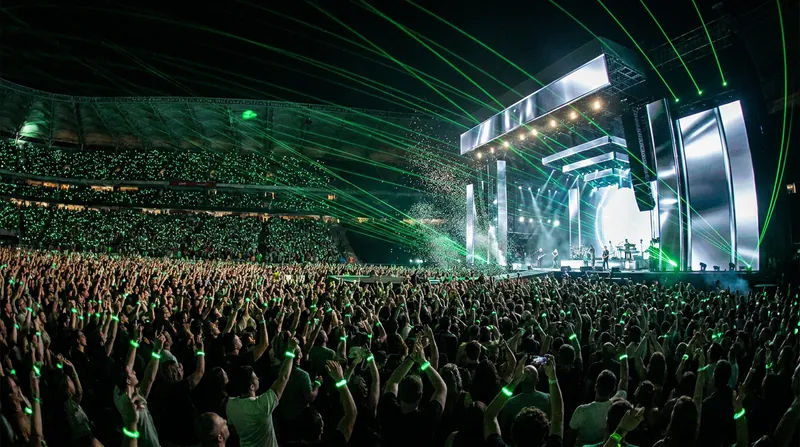
To further blur the line between the digital and physical worlds, the lighting rigs inside the virtual animation are perfectly synchronized with the massive physical lighting rigs in the arena. When a digital spotlight flares on the LED screen, a corresponding physical light blinds the audience in the real world. This seamless blending of practical and virtual effects—combined with a live 10-piece band playing alongside the digital vocals—creates an overwhelming sensory experience that grounds the avatars in reality.
This extreme level of technical precision is exactly why these avatar shows cannot easily be packed up and taken on a traditional global tour. The illusion requires a highly controlled environment. To make ABBA Voyage a reality, producers had to construct a bespoke, purpose-built arena in London's Queen Elizabeth Olympic Park. The venue was designed from the ground up specifically to house the massive screens, the complex lighting geometry, and the unique acoustic requirements of a hybrid digital-live performance.
The financial barrier to entry for this kind of production is staggering—ABBA Voyage reportedly cost $175 million to develop—but the returns are actively reshaping music industry economics. Because the digital performers never tire, the show can run multiple times a week without risking vocal strain or fatigue. The London venue currently operates at 99% capacity night after night, generating an estimated $2 million per week in ticket and merchandise sales, proving that audiences are willing to pay premium prices for virtual acts.
The ripple effect on the local economy is equally massive, turning these bespoke arenas into highly coveted urban developments. In its first year of operation, ABBA Voyage contributed a staggering £322.6 million to London's economy. The ongoing residency has generated over 5,000 jobs across hospitality, transit, and venue operations, while drawing hundreds of thousands of international tourists to the area. For city planners, these permanent virtual concerts offer the economic benefits of a major music festival, but sustained year-round.[3]
Seeing this highly lucrative blueprint, other legacy acts are rushing to secure their digital futures. Following their final physical show, KISS finalized the sale of their music catalog, likeness, and iconic makeup rights to Pophouse Entertainment—the lead investor behind ABBA Voyage. The deal, estimated to be worth $300 million, gives Pophouse the total creative control needed to build the next generation of avatar concerts, ensuring the KISS brand continues to generate revenue long after the founders have retired.
Pophouse is currently deep in development on the KISS avatar experience, which is slated to debut in Las Vegas in 2028. Unlike the ABBA show, which aims for photorealism of the band's 1979 era, the KISS production is expected to lean into the band's comic-book superhero personas, featuring avatars that can fly, shoot fire, and perform superhuman feats. The band members have already completed their motion-capture sessions, laying the digital foundation for a show that promises to be more of an immersive experience than a traditional concert.
The long-term vision for this technology breaks the physical limits of touring entirely, offering unprecedented scalability. As Pophouse CEO Per Sundin recently noted, avatar technology theoretically allows a band to perform in three different cities, across three different continents, on the exact same night. Once the digital assets are finalized, promoters can franchise the production globally, building identical bespoke arenas in Tokyo, Las Vegas, and London to run the exact same show simultaneously, multiplying revenue streams exponentially without any additional wear and tear on the artists.
While traditionalists may always prefer the sweat, unpredictability, and spontaneity of a live human being on stage, the avatar concert has proven it can deliver genuine emotional resonance. Fans are leaving these arenas in tears, fully bought into the illusion and the shared communal experience of the music. It is no longer a question of whether virtual concerts will catch on with the public, but rather which iconic artist will be the next to step into the motion-capture suit and secure their digital immortality.
Key points
- Avatar concerts use motion-capture technology to create hyper-realistic digital versions of legacy artists.
- The illusion relies on massive 2D LED screens, precise geometry, and synchronized lighting rather than sci-fi holograms.
- ABBA Voyage generates an estimated $2 million per week and contributed £322.6 million to London's economy in its first year.
- KISS has sold their rights to Pophouse Entertainment to launch their own avatar experience in Las Vegas in 2028.
What we don’t know
- Whether audiences will embrace avatar concerts for artists who are no longer living.
- How the technology will scale to smaller, non-bespoke arenas in the future.
- If the superhero-style fantasy avatars planned for KISS will resonate as well as the photorealistic ABBA avatars.
How we got here
2016
Development begins on ABBA Voyage, with the band secretly performing in motion-capture suits.
May 2022
ABBA Voyage officially opens in a purpose-built arena in London's Queen Elizabeth Olympic Park.
December 2023
KISS concludes their final physical tour and debuts their digital avatars at Madison Square Garden.
April 2024
KISS finalizes the sale of their catalog and likeness rights to Pophouse Entertainment for an estimated $300 million.
2028
The projected launch date for the fully realized KISS avatar concert experience in Las Vegas.
- Music Industry Executives
- Investors and promoters see virtual residencies as a highly scalable, unprecedented revenue engine.
- VFX & Tech Innovators
- Visual effects studios and producers view avatar concerts as a new art form that merges cinema and live music.
- Local Economies
- City planners and tourism boards value bespoke virtual residencies for their long-term economic stability.
Perspectives this story doesn't cover
- Live Music Traditionalists
- Touring Crew & Roadies
Sources
Source coverage
3 outlets
3 viewpoints surfaced



- [1]The GuardianMusic Industry Executives
Knicks to follow up Trump boos at Madison Square Garden with White House visit, says Dolan
Read on The Guardian → - [2]IngeniaVFX & Tech Innovators
How ABBA Voyage was made
Read on Ingenia → - [3]VOILocal Economies
ABBA Voyage Avatar Concert Boosts London's Economy, Donates 322.6 Million Turnover
Read on VOI →
More in Entertainment
See all →Ticketing Monopoly
The Imminent Breakup of Live Nation and Ticketmaster: What a Forced Divestiture Means for Concertgoers
4 sources
Live Music Tech
How Synchronized LED Wristbands Turn Concert Crowds Into Massive Video Screens
6 sources
Concert Tech
Inside the Technology Powering the Future of Immersive Concerts
7 sources
Sustainable Touring
How Major Stadium Tours Are Decoupling Live Music from Carbon Emissions
4 sources
Comments
Every angle. Every day.
Get Entertainment stories with full source coverage and perspective breakdowns, free every day.