
At-Home Brain Implant Restores Speech and Autonomy for Man with ALS
A landmark study reveals that a patient with severe paralysis has successfully used a brain-computer interface independently at home for nearly two years, achieving 97% speech decoding accuracy without daily researcher intervention.
By Factlen Editorial Team
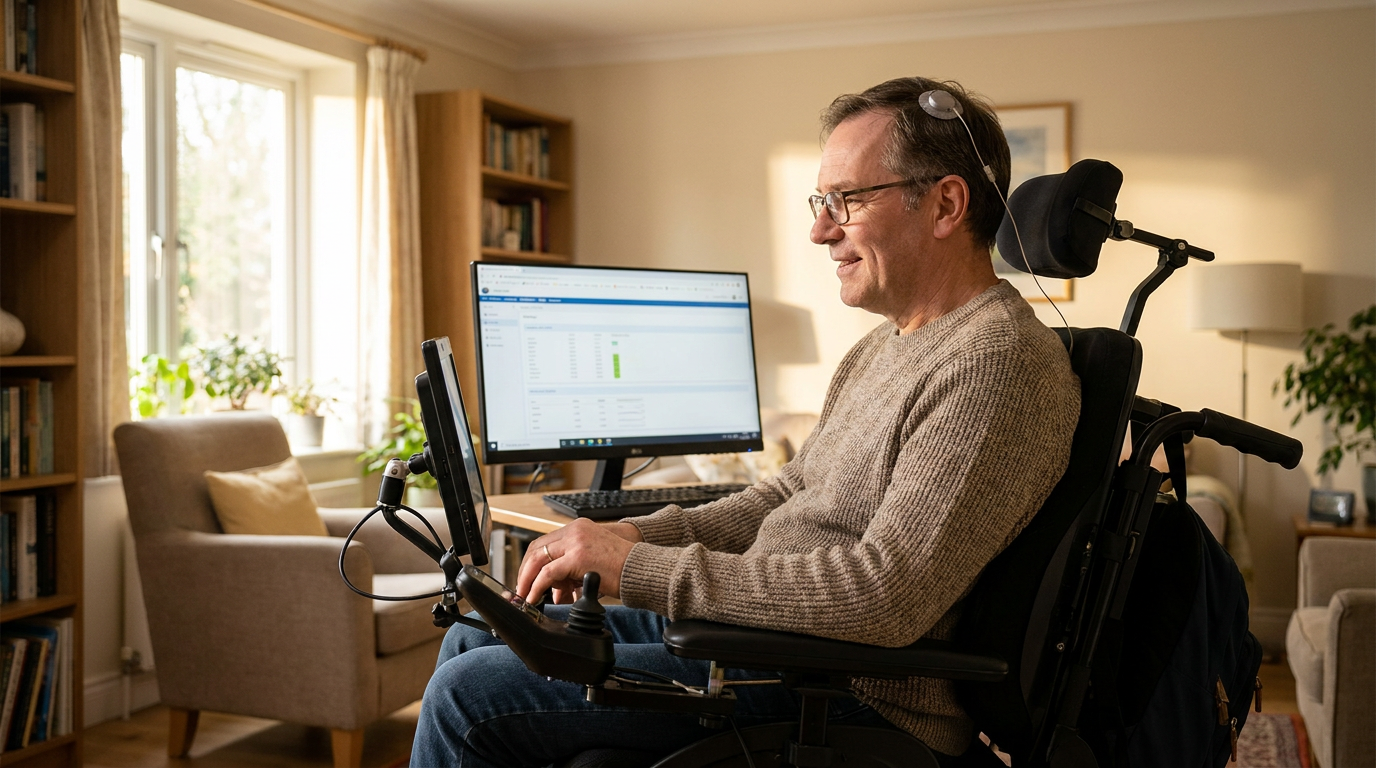
- Patient Advocates & Clinicians
- Emphasize the restoration of autonomy, emotional expression, and quality of life.
- Neurotechnology Researchers
- Focus on the algorithmic stability and the milestone of unassisted home use.
- Bioethicists & Health Economists
- Highlight concerns regarding surgical risks, long-term device degradation, and equitable access.
What's not represented
- · Patients who have experienced adverse effects or device failures in previous BCI trials
- · Insurance providers who will eventually be tasked with covering the costs of neuroprosthetics
Why this matters
For decades, brain-computer interfaces were confined to laboratories and required constant engineering support. Proving that a severely paralyzed individual can use a high-bandwidth neural implant independently at home paves the way for commercial neuroprosthetics that could restore autonomy to millions living with locked-in syndrome, strokes, and spinal cord injuries.
Key points
- A 47-year-old man with ALS has successfully used a brain-computer interface (BCI) independently at home for nearly two years.
- The system translates attempted speech into text and synthesized audio with 97% accuracy.
- Unlike previous BCIs, the new deep-learning algorithms do not require daily recalibration by a team of engineers.
- The AI-driven text-to-speech software was trained on old recordings to recreate the patient's exact pre-ALS voice.
- While a major breakthrough, the technology still requires invasive open-brain surgery and faces long-term durability questions.
For years, the promise of brain-computer interfaces (BCIs) has been confined to highly controlled laboratory settings, requiring teams of engineers to calibrate algorithms while patients remained tethered to bulky equipment. Today, that paradigm shifts. A landmark study published in Nature Medicine details the case of Casey Harrell, a 47-year-old man with amyotrophic lateral sclerosis (ALS), who has successfully used an implanted BCI to communicate and operate digital devices independently in his own home for nearly two years.[1][3]
The breakthrough represents a critical inflection point in neuroprosthetics. While previous milestones proved that brain signals could be translated into text, this is the first peer-reviewed demonstration of a severely paralyzed patient using a high-bandwidth BCI system for daily life without ongoing researcher intervention. Harrell, a former climate activist who lost his ability to speak clearly due to the progressive muscle weakness of ALS, can now converse with his family, send emails, and participate in video calls.[1][3][6][7]
"Not being able to communicate is so frustrating and demoralizing. It is like you are trapped," Harrell noted using the system. "Something like this technology will help people back into life and society." The restoration of his autonomy highlights the primary goal of the BrainGate clinical trial consortium, a multi-institutional effort involving researchers from UC Davis, Brown University, and Mass General Brigham.[3][4]
The evidence for the system's efficacy is anchored in its remarkable decoding accuracy. According to foundational data published in The New England Journal of Medicine, the neuroprosthesis achieved a 97 percent word-accuracy rate within its first few weeks of use. This performance rivals commercial smartphone voice-to-text applications, a staggering achievement for a system interpreting raw neural electrical activity.[2][4]

The mechanism driving this accuracy relies on an array of 256 microelectrodes surgically implanted into Harrell's left precentral gyrus, the region of the brain responsible for coordinating speech and upper limb movement. Manufactured by Blackrock Neurotech, these silicon sensors—each just 1.5 millimeters long—penetrate the cortex to record the firing of individual neurons.[4][5]
When Harrell attempts to speak, he is not merely imagining a conversation; his brain is sending actual motor commands to his lips, tongue, and jaw. Because ALS damages the peripheral nerves connecting the brain to the muscles, those commands never reach their destination. The BCI intercepts these signals at the source, translating the neural firing patterns into phonemes—the fundamental building blocks of speech.[3][4][6]
A crucial innovation in this trial is the integration of advanced deep-learning algorithms that process these phonemes in real-time. The system boasts a vocabulary of over 125,000 words, allowing for spontaneous, unconstrained conversation rather than forcing the user to select from a pre-programmed list of phrases.[2][7]
Beyond mere text generation, the system restores the emotional resonance of human speech. Researchers utilized artificial intelligence to analyze audio recordings of Harrell from his days as an activist, training a text-to-speech synthesizer to recreate his exact pre-ALS voice. The software even captures natural rhythms, adjusting pitch automatically when he asks a question or makes a statement.[8]
Beyond mere text generation, the system restores the emotional resonance of human speech.
The Nature Medicine data pack provides a transparent look at the system's long-term stability, a historical vulnerability for invasive BCIs. Over the course of 84 data collection sessions spanning 32 weeks, Harrell used the speech BCI in self-paced conversations for more than 248 hours. Crucially, the algorithms maintained their high accuracy without requiring daily recalibration by a technician.[1][4]

This "plug-and-play" capability is what enables true home use. Previous iterations of the technology suffered from signal drift; as the brain shifted slightly inside the skull or scar tissue formed around the electrodes, the algorithms would lose their baseline and output gibberish. The new deep-learning models are robust enough to adapt to these micro-changes automatically.[1][3][7]
The system also functions as a movement BCI, allowing Harrell to control a computer cursor. By attempting to move his hands, he can navigate operating systems, click on web browsers, and operate smart home devices. This dual-modality—combining speech and motor decoding—transforms the BCI from a pure communication tool into a comprehensive digital interface.[1][3][7]
Despite these profound successes, the evidence pack also surfaces transparent uncertainties regarding the technology's scalability. The primary limitation remains the invasive nature of the hardware. Implanting the NeuroPort arrays requires open-brain surgery, carrying inherent risks of infection, bleeding, and surgical complications that may preclude medically fragile patients from participating.[5][7]

Furthermore, the long-term durability of the electrodes is not fully known. While Harrell's system has functioned reliably for nearly two years, historical data from other BCI trials suggests that the brain's immune response eventually encapsulates the sensors in glial scar tissue, degrading signal quality over a period of five to ten years.[5][7]
Cost and accessibility present another massive hurdle. The hardware, surgical implantation, and customized software engineering currently represent millions of dollars in research funding per patient, supported in part by grants from the ALS Association. Transitioning this bespoke prototype into a scalable, FDA-approved medical device that insurance companies will cover remains a daunting regulatory and economic challenge.[6][7]
There is also the question of cognitive fatigue. Operating a BCI requires intense concentration, and while Harrell has reported using the system for up to 12 hours a day, other trial participants in the broader BCI field have noted that continuous neural control can be exhausting. The field must still determine how these systems perform as a patient's underlying neurodegenerative disease progresses into its final stages.[2][6][7]
Nevertheless, the data published today definitively answers the field's most pressing question: can a high-performance BCI function outside the lab? The answer is an unequivocal yes. By decoupling the technology from the constant supervision of neuroscientists, the UC Davis and Brown University teams have proven that independent, at-home neuroprosthetics are a viable reality.[1][4]
For the estimated 30,000 Americans living with ALS, and the millions more globally suffering from locked-in syndrome, severe strokes, or spinal cord injuries, the implications are life-altering. The ability to independently call for help, express complex thoughts, or simply say "I love you" in one's own voice fundamentally shifts the trajectory of severe paralysis.[4][6][8]
As the BrainGate consortium continues to enroll new patients, the next phase of research will focus on miniaturizing the external hardware. Currently, the system relies on physical pedestals protruding from the skull, which connect via cables to a computer. The ultimate goal is a fully implantable, wireless system that communicates via Bluetooth, rendering the technology entirely invisible.[2][7]

Until then, Casey Harrell's daily life serves as the ultimate proof of concept. He continues to work, parent his daughter, and engage with the world, not as a passive observer trapped in a failing body, but as an active participant empowered by his own neural signals. The era of the at-home brain-computer interface has officially begun.[1][3][7][8]
How we got here
2004
The BrainGate consortium implants its first BCI in a human, allowing a paralyzed patient to control a computer cursor.
2014
Casey Harrell is diagnosed with ALS and begins experiencing progressive muscle weakness.
July 2023
Surgeons implant four microelectrode arrays into Harrell's brain as part of the BrainGate clinical trial.
August 2023
The system is activated, achieving 99.6% accuracy on a 50-word vocabulary within its first sessions.
August 2024
Foundational data on the speech neuroprosthesis is published in The New England Journal of Medicine.
June 2026
Nature Medicine publishes the landmark study confirming nearly two years of independent, unassisted home use.
Viewpoints in depth
Neurotechnology Researchers
Focus on the algorithmic stability and the milestone of unassisted home use.
For the engineering and neuroscience communities, the primary victory is algorithmic. Previous BCIs required constant recalibration because the brain's electrical environment is noisy and dynamic. Researchers emphasize that the deep-learning models' ability to maintain 97% accuracy over 32 weeks without daily technician intervention is the technical leap that makes commercialization possible.
Patient Advocates & Clinicians
Emphasize the restoration of autonomy, emotional expression, and quality of life.
Advocacy groups and neurologists view the technology through the lens of patient dignity. The ability to speak in one's own synthesized voice, rather than a robotic default, restores a profound sense of identity. Clinicians note that independent home use allows patients to maintain employment, participate in family life, and make their own medical decisions, fundamentally altering the psychological burden of locked-in syndrome.
Bioethicists & Health Economists
Highlight concerns regarding surgical risks, long-term device degradation, and equitable access.
While celebrating the breakthrough, ethicists warn of a looming 'neuro-divide.' The bespoke nature of these implants, combined with the necessity of open-brain surgery, means the technology will likely be restricted to well-funded clinical trials for the foreseeable future. Economists question how healthcare systems will absorb the costs of hardware, surgery, and lifelong technical support once these devices seek FDA approval for the broader paralyzed population.
What we don't know
- How long the microelectrode arrays will continue to function before the brain's immune response degrades the signal.
- Whether the deep-learning algorithms can maintain accuracy as the patient's underlying neurodegenerative disease progresses.
- The timeline and cost structure for transitioning this bespoke clinical trial prototype into an FDA-approved, commercially available medical device.
Key terms
- Amyotrophic Lateral Sclerosis (ALS)
- A progressive neurodegenerative disease that destroys the nerve cells responsible for controlling voluntary muscles, eventually leading to severe paralysis.
- Neuroprosthesis
- A device that connects to the nervous system to replace or enhance sensory, motor, or cognitive functions lost to injury or disease.
- Precentral Gyrus
- A prominent structure on the surface of the brain's frontal lobe that houses the primary motor cortex, responsible for executing voluntary movements.
- Phoneme
- The smallest unit of sound in speech that distinguishes one word from another, such as the 'p' sound in 'tap'.
- Glial Scar Tissue
- The body's natural healing response in the central nervous system, which can encapsulate implanted electrodes and degrade their ability to record clear signals.
Frequently asked
What is a brain-computer interface (BCI)?
A BCI is a system that records electrical signals from the brain and translates them into commands that control external devices, such as computers, robotic limbs, or speech synthesizers.
How does the system know what the patient wants to say?
The implant records signals from the motor cortex. When the patient attempts to move their lips and tongue to speak, the BCI decodes those neural patterns into phonemes and words.
Does the patient sound like a robot?
No. Researchers used artificial intelligence to analyze old audio recordings of the patient's voice, creating a custom text-to-speech synthesizer that sounds exactly like he did before his diagnosis.
Is this technology available to the public?
Not yet. It is currently part of an ongoing clinical trial and requires invasive brain surgery. It will likely take years of further testing and regulatory review before it becomes widely available.
Sources
Source coverage
8 outlets
3 viewpoints surfaced








[1]Nature MedicineNeurotechnology Researchers
Independent home use of a speech and motor brain-computer interface by a person with ALS
Read on Nature Medicine →[2]The New England Journal of MedicineNeurotechnology Researchers
An Accurate and Rapidly Calibrating Speech Neuroprosthesis
Read on The New England Journal of Medicine →[3]UC Davis HealthPatient Advocates & Clinicians
Brain-computer interface enables independent, accurate communication for man living with ALS
Read on UC Davis Health →[4]Brown UniversityPatient Advocates & Clinicians
Brain-computer interface allows man with ALS to 'speak' again
Read on Brown University →[5]Blackrock NeurotechNeurotechnology Researchers
NeuroPort Array Specifications and Clinical Applications
Read on Blackrock Neurotech →[6]ALS AssociationPatient Advocates & Clinicians
Assistive Technology Grants and BCI Research
Read on ALS Association →[7]Factlen Editorial TeamBioethicists & Health Economists
Synthesis by Factlen editorial team
Read on Factlen Editorial Team →[8]SciencePatient Advocates & Clinicians
A brain implant helped him sing again
Read on Science →
More in science
See all 6 stories →Amazon Tipping Point
The Amazon Can Survive Global Warming, But Only If Deforestation Stops
0 sources

Neuroprosthetics
At-Home Brain Implant and AI Voice Synthesizer Restore Speech for Man with ALS
0 sources
Cosmology
Which Came First, the Galaxy or the Black Hole? JWST Finally Has an Answer
0 sources

Neuroprosthetics
How a New At-Home Brain Implant is Restoring Independence for Patients with ALS
0 sources
Every angle. Every day.
Get science stories with full source coverage and perspective breakdowns delivered to your inbox.