
How a New At-Home Brain Implant is Restoring Independence for Patients with ALS
A breakthrough brain-computer interface allows a man with severe paralysis to communicate and control digital devices independently from his home, marking a major milestone in neuroprosthetics.
By Factlen Editorial Team
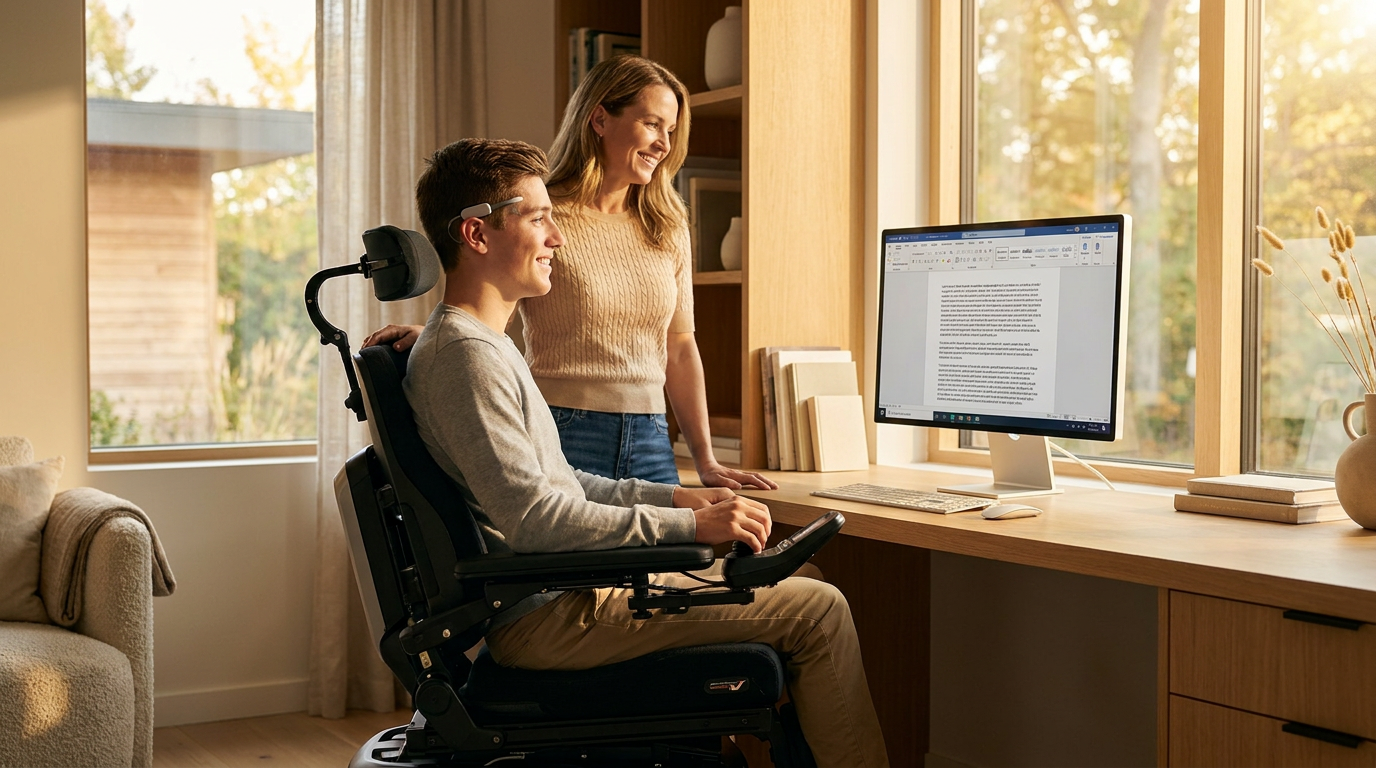
- Neuroprosthetics Researchers
- Scientists focused on advancing BCI decoding algorithms and hardware reliability.
- Clinical Trial Consortia
- Collaborative networks managing the safety, ethics, and regulatory pathways of experimental implants.
- Patient Advocacy & Public Health
- Organizations dedicated to improving the quality of life and accessibility for individuals with severe neurological disorders.
- Independent Analysts
- Editorial voices synthesizing the broader impact and future trajectory of the technology.
What's not represented
- · Insurance providers evaluating coverage
- · Caregivers managing the daily hardware setup
Why this matters
For decades, brain-computer interfaces have been confined to highly controlled laboratory settings. This breakthrough proves the technology can function reliably as an independent, everyday tool, offering a realistic path to restoring autonomy for millions suffering from severe paralysis and speech loss.
Key points
- A new brain-computer interface (BCI) allows a man with ALS to speak and use a computer independently at home.
- The system uses 256 microelectrodes implanted in the brain's motor cortex to intercept signals intended for speech muscles.
- Advanced AI translates these neural signals into phonemes and words with 97.5% accuracy.
- A custom voice synthesizer reads the text aloud using audio recordings of the patient's voice from before his illness.
- The ability to operate the system without a team of researchers present marks a major leap toward making BCIs a standard medical treatment.
Amyotrophic lateral sclerosis (ALS) is a progressive neurodegenerative disease that systematically destroys the nerve cells responsible for voluntary muscle movement. As the disease advances, patients experience a profound loss of motor control, eventually losing the ability to walk, eat, and breathe independently. Perhaps the most devastating consequence of ALS is the loss of speech. Patients often develop severe dysarthria, a condition where the muscles of the mouth, face, and respiratory system become too weak to articulate words. This cognitive isolation—frequently described as being "locked in"—leaves individuals fully aware and conscious but entirely unable to communicate their thoughts, needs, or emotions to the outside world. For decades, the medical community has sought technological interventions to bridge this communication gap, relying on eye-tracking software and rudimentary spelling devices that are notoriously slow and exhausting to use.[5]
Casey Harrell, a 45-year-old man diagnosed with ALS, experienced this exact trajectory. As his condition progressed, he developed tetraparesis—weakness in all four limbs—and his speech deteriorated to the point where it was nearly impossible for others to understand him without a dedicated interpreter. The frustration of losing his voice was profound; Harrell described the experience as feeling entirely trapped within his own body, cut off from the spontaneous, flowing conversations that define human relationships. His situation highlighted the urgent need for a more direct, high-bandwidth method of communication that could bypass the damaged motor pathways and tap directly into the brain's intact intent to speak.[2]
A landmark study published in the journal Nature on June 15, 2026, has fundamentally altered the landscape of assistive technology for patients like Harrell. The research details the successful, long-term deployment of a highly advanced brain-computer interface (BCI) that Harrell has been using in his own home. Unlike previous iterations of this technology, which required a sterile laboratory environment and a team of engineers to operate, this new system allows Harrell to communicate independently. We are witnessing a pivotal transition in neuroprosthetics: the leap from tightly controlled clinical experiments to practical, daily utility that genuinely restores a patient's agency.[1][7]
The significance of this "at-home" milestone cannot be overstated. For years, brain-computer interfaces have existed as brilliant but fragile proof-of-concept devices. They could achieve remarkable feats of neural decoding, but they were tethered to massive computing racks and required constant recalibration by specialized technicians. Real-world adoption has historically been bottlenecked by the dual challenges of independent operation and reliable, long-term performance without expert supervision. By overcoming these barriers, the UC Davis Health team and their collaborators have demonstrated that BCIs can function as reliable, everyday medical devices, empowering individuals with severe paralysis to speak and interact on their own terms.[1][2]

The foundation of this achievement was laid in July 2023, when Harrell underwent a specialized neurosurgical procedure at UC Davis. Dr. David Brandman, a neurosurgeon and co-director of the UC Davis Neuroprosthetics Lab, implanted an investigational BCI device into Harrell's brain. The hardware consists of four microelectrode arrays—tiny grids containing a total of 256 microscopic cortical electrodes. These arrays were carefully positioned on the surface of the brain to capture the electrical impulses generated by individual neurons, providing a high-resolution, high-bandwidth stream of neural data that serves as the raw input for the system.[2][4]
The specific placement of these microelectrodes was critical to the system's success. The surgical team targeted the left precentral gyrus, a region of the cerebral cortex that plays a primary role in executing voluntary motor movements. More specifically, they focused on the area responsible for coordinating the complex, high-speed muscle contractions of the jaw, lips, tongue, and larynx required for speech. By tapping directly into this motor command center, the BCI intercepts the brain's instructions before they reach the damaged spinal cord and peripheral nerves, effectively bypassing the physiological roadblock created by ALS.[2][6]
It is a common misconception that these devices "read thoughts" or decode a patient's internal monologue. In reality, the technology is highly specific to motor intent. When Harrell attempts to speak a word, his brain fires the exact sequence of electrical signals that would normally move his vocal tract. The microelectrode arrays capture this distinct pattern of neural activity. The system is essentially eavesdropping on the brain's mechanical instructions, translating the physical effort of attempted speech rather than the abstract concept of thought, which ensures a high degree of privacy and intentionality for the user.[2][7]
It is a common misconception that these devices "read thoughts" or decode a patient's internal monologue.
The translation of these raw neural signals into coherent language relies on sophisticated artificial intelligence. The researchers utilized advanced machine learning algorithms designed to recognize phonemes—the fundamental units of sound that make up spoken language, such as the "k" sound in "cat" or the "b" sound in "bat." By decoding phonemes rather than attempting to map entire words to specific brain patterns, the AI dramatically reduces the complexity of the task. The system then rapidly assembles these phonemes into complete words and sentences, utilizing predictive language models similar to those found in modern smartphones to ensure grammatical accuracy.[1][2]

To make the experience as natural and restorative as possible, the decoded text is not merely displayed on a screen; it is read aloud by a highly personalized voice synthesizer. Before his ALS progressed to the point of severe dysarthria, Harrell had recorded audio samples of his natural speaking voice. The research team used these archival recordings to train an AI audio model, allowing the BCI to output speech that sounds exactly like Harrell did before his illness. Hearing his own voice restored brought Harrell and his loved ones to tears, underscoring that this technology restores not just utility, but personal identity.[2]
The performance metrics of the UC Davis system represent a staggering leap forward for the field. Following an initial calibration period, the BCI achieved a word decoding accuracy rate of 97.5%. Furthermore, the system provides Harrell with a functional vocabulary of over 125,000 words, allowing for rich, unconstrained expression rather than forcing him to choose from a limited menu of pre-programmed phrases. To put this in perspective, the system's error rate is lower than that of many commercially available voice-to-text applications used by able-bodied individuals on their smartphones.[1][2]
What truly distinguishes the findings published in June 2026 is the system's durability and independence. The study reports on data collected over an extended period, confirming that Harrell can turn the system on and initiate conversations without a researcher present to troubleshoot or recalibrate the algorithms. The software continuously updates and adapts in the background, maintaining its high accuracy rate even as tiny shifts in the brain's environment occur over time. This self-sustaining capability is the holy grail of neuroprosthetics, transforming a laboratory experiment into a viable home appliance.[1][2]
The extent of Harrell's independent usage is unprecedented in the literature. The study documents that he has used the speech BCI in self-paced conversations for more than 248 hours. He utilizes the system to communicate face-to-face with his family, participate in social gatherings, and even conduct video chats over the internet. The speed and fluidity of the decoding allow him to interject, tell jokes, and participate in the natural back-and-forth rhythm of human conversation, effectively breaking the silence that ALS had imposed upon him.[1][2]

Beyond restoring his voice, the BCI system also functions as a powerful digital interface. The microelectrode arrays capture neural signals associated with attempted hand and arm movements, which the system translates into cursor control on a computer screen. This "movement BCI" functionality allows Harrell to navigate operating systems, browse the internet, send emails, and interact with digital platforms entirely unassisted. By combining speech synthesis with full computer access, the technology provides a comprehensive suite of tools for maintaining employment, managing personal affairs, and staying connected to the broader world.[2][3]
This breakthrough is the culmination of years of collaborative effort across multiple elite institutions. The UC Davis Neuroprosthetics Lab, co-directed by Dr. Brandman and Dr. Sergey Stavisky, conducted the research as part of the broader BrainGate consortium. BrainGate is a multi-institutional clinical trial network that includes researchers from Brown University, Mass General Brigham, and the Department of Veterans Affairs. Under the direction of Dr. Leigh Hochberg at Brown University, the consortium has spent over two decades pioneering the foundational science of intracortical neural interfaces, paving the way for the high-performance systems we see today.[2][3][6]
The hardware at the heart of this success relies on the NeuroPort array, a technology that has been rigorously tested in the BrainGate2 clinical trials. While the current results are overwhelmingly positive, the widespread clinical adoption of such devices still faces hurdles. The requirement for open brain surgery carries inherent risks of infection and tissue damage. Furthermore, researchers are continuously monitoring how the brain's immune response might cause scar tissue to form around the microelectrodes over several years, which could potentially degrade the quality of the neural signals and necessitate future interventions.[3][4][7]

Despite these challenges, the trajectory of the field is unmistakably clear. We are moving rapidly toward an era where motor-speech BCIs will transition from experimental trials to standard-of-care treatments. The success of the UC Davis study provides a robust blueprint for future commercialization, demonstrating that the combination of high-density microelectrodes and advanced AI decoding can yield a reliable, life-changing product. As surgical techniques become less invasive and algorithms become even more resilient, the potential patient population will expand dramatically.[7]
The implications extend far beyond ALS. The same fundamental technology could eventually be adapted to restore communication and mobility for individuals suffering from a wide range of severe neurological conditions, including brainstem strokes, severe cerebral palsy, and high-level spinal cord injuries. By proving that a patient can independently operate a high-performance BCI from the comfort of their living room, this research has shattered the final major barrier to real-world utility, offering profound hope to millions of people who have been silenced by neurological disease.[2][7]
How we got here
2004
The first human receives a long-term intracortical brain-computer interface as part of early clinical trials.
July 2023
Casey Harrell undergoes surgery at UC Davis to implant 256 microelectrodes into his brain's speech center.
August 2024
Initial laboratory results demonstrate the system can decode Harrell's intended speech with 97% accuracy.
June 2026
Nature publishes findings confirming the system's successful, independent use in a home environment without researcher supervision.
Viewpoints in depth
Neuroprosthetics Researchers
Scientists and engineers focused on advancing BCI decoding algorithms and hardware.
This camp views the transition from lab-based proof-of-concept to independent home use as the critical threshold for neuroprosthetics. They emphasize the technical achievements—such as maintaining 97.5% accuracy over months without constant recalibration—and the integration of AI to decode phonemes rather than full words. Their primary goal is to refine the hardware to be less invasive and the software to be more robust, eventually making motor-speech BCIs a standard clinical tool.
Patient Advocacy & Public Health
Organizations dedicated to improving the quality of life for individuals with severe neurological disorders.
For patient advocates, the focus is entirely on autonomy and psychological well-being. They highlight the devastating isolation of "locked-in" syndrome and dysarthria, arguing that restoring a patient's original voice is as much about identity as it is about utility. This group pushes for broader clinical trials, insurance coverage frameworks, and ensuring that life-changing technologies do not remain exclusive to well-funded research participants.
Clinical Trial Consortia
Collaborative networks managing the safety, ethics, and regulatory pathways of experimental implants.
Consortia like BrainGate prioritize rigorous, multi-site evaluation of the technology's safety profile. They are concerned with the long-term viability of implanted microelectrodes, monitoring for tissue scarring, signal degradation, and infection risks at the surgical site. Their mandate is to build a comprehensive evidence base that satisfies regulatory bodies like the FDA, ensuring that the transition from experimental device to approved medical product is both safe and scientifically sound.
What we don't know
- How long the microelectrode arrays can remain implanted before the brain's natural immune response degrades the signal quality.
- When this technology will receive full FDA approval for widespread commercial availability outside of clinical trials.
- The ultimate cost of the hardware, surgery, and AI software suite once it reaches the commercial medical market.
Key terms
- Brain-Computer Interface (BCI)
- A system that translates brain activity into commands for external devices, such as computers or speech synthesizers.
- Amyotrophic Lateral Sclerosis (ALS)
- A progressive neurodegenerative disease that affects nerve cells in the brain and spinal cord, leading to severe loss of muscle control.
- Microelectrode Array
- A tiny grid of sensors implanted in the brain to detect electrical signals from individual neurons.
- Precentral Gyrus
- A region of the brain's cerebral cortex primarily responsible for executing voluntary motor movements, including those required for speech.
- Phoneme
- The smallest unit of sound in speech that distinguishes one word from another, which the AI uses to decode language.
Frequently asked
Does the brain implant read the patient's thoughts?
No. The device captures the neural commands the brain attempts to send to the muscles used for speech, rather than decoding abstract internal thoughts.
How does the synthesized voice sound like the patient?
Researchers trained an artificial intelligence text-to-speech program using audio recordings of the patient's voice from before his ALS diagnosis.
Can the patient use the device without doctors present?
Yes. The latest milestone is that the patient can operate the system independently at home to communicate and control a computer without researcher supervision.
Is this technology available to the public?
Not yet. It is currently part of the BrainGate2 clinical trial, which is evaluating the safety and efficacy of the system in a small group of participants.
Sources
Source coverage
7 outlets
4 viewpoints surfaced







[1]NatureNeuroprosthetics Researchers
At-home brain implant gives man with motor neuron disease his daily life back
Read on Nature →[2]UC Davis HealthNeuroprosthetics Researchers
Brain-computer interface enables independent, accurate communication for man living with ALS
Read on UC Davis Health →[3]BrainGate ConsortiumClinical Trial Consortia
BrainGate2 Neural Interface System
Read on BrainGate Consortium →[4]ClinicalTrials.govClinical Trial Consortia
BrainGate2: Feasibility Study of an Intracortical Neural Interface System for Persons With Tetraplegia
Read on ClinicalTrials.gov →[5]National Institute of Neurological Disorders and StrokePatient Advocacy & Public Health
Amyotrophic Lateral Sclerosis (ALS) Fact Sheet
Read on National Institute of Neurological Disorders and Stroke →[6]Brown University Carney InstituteNeuroprosthetics Researchers
BrainGate Research at Brown University
Read on Brown University Carney Institute →[7]Factlen Editorial TeamIndependent Analysts
Synthesis by Factlen editorial team
Read on Factlen Editorial Team →

Every angle. Every day.
Get science stories with full source coverage and perspective breakdowns delivered to your inbox.