
OLED vs. Mini-LED: The 2026 TV Buying Guide
Choosing between OLED and Mini-LED in 2026 comes down to a strict trade-off between perfect dark-room contrast and overpowering bright-room luminance.
By Factlen Editorial Team
- Cinematic Purists
- Argues that absolute black levels and pixel-level contrast are the only metrics that matter for true picture quality.
- Bright-Room & HDR Enthusiasts
- Argues that peak brightness and glare reduction are the most practical metrics for real-world living rooms.
- Value & Large-Format Buyers
- Focuses on the price-to-size ratio, noting that Mini-LED allows buyers to afford massive screens that would be prohibitively expensive in OLED.
What's not represented
- · Micro-LED Early Adopters
- · Projector Enthusiasts
Why this matters
Choosing the right TV in 2026 comes down to a high-stakes battle between two mature technologies. Picking the wrong panel for your living room's lighting can mean washing out a premium investment with glare, or suffering through eye fatigue in a dark home theater.
Key points
- OLED televisions use self-emissive pixels to achieve perfect black levels and infinite contrast, making them ideal for dark rooms.
- Mini-LED televisions use thousands of microscopic backlights to produce massive peak brightness, excelling in sunlit living rooms.
- While OLEDs have a slight risk of burn-in from static images, Mini-LEDs are immune to permanent image retention.
- Mini-LED remains significantly more cost-effective for buyers seeking massive 85-inch or 98-inch screen sizes.
The 2026 television market has crystallized into a two-horse race for premium living rooms: OLED and Mini-LED. While older standard LED panels have been relegated to budget tiers, these two flagship technologies force buyers to make a definitive choice about their viewing environment. The decision is no longer about which technology is universally better, but rather which set of physical trade-offs aligns with a specific room's lighting and a viewer's habits.[1][4]
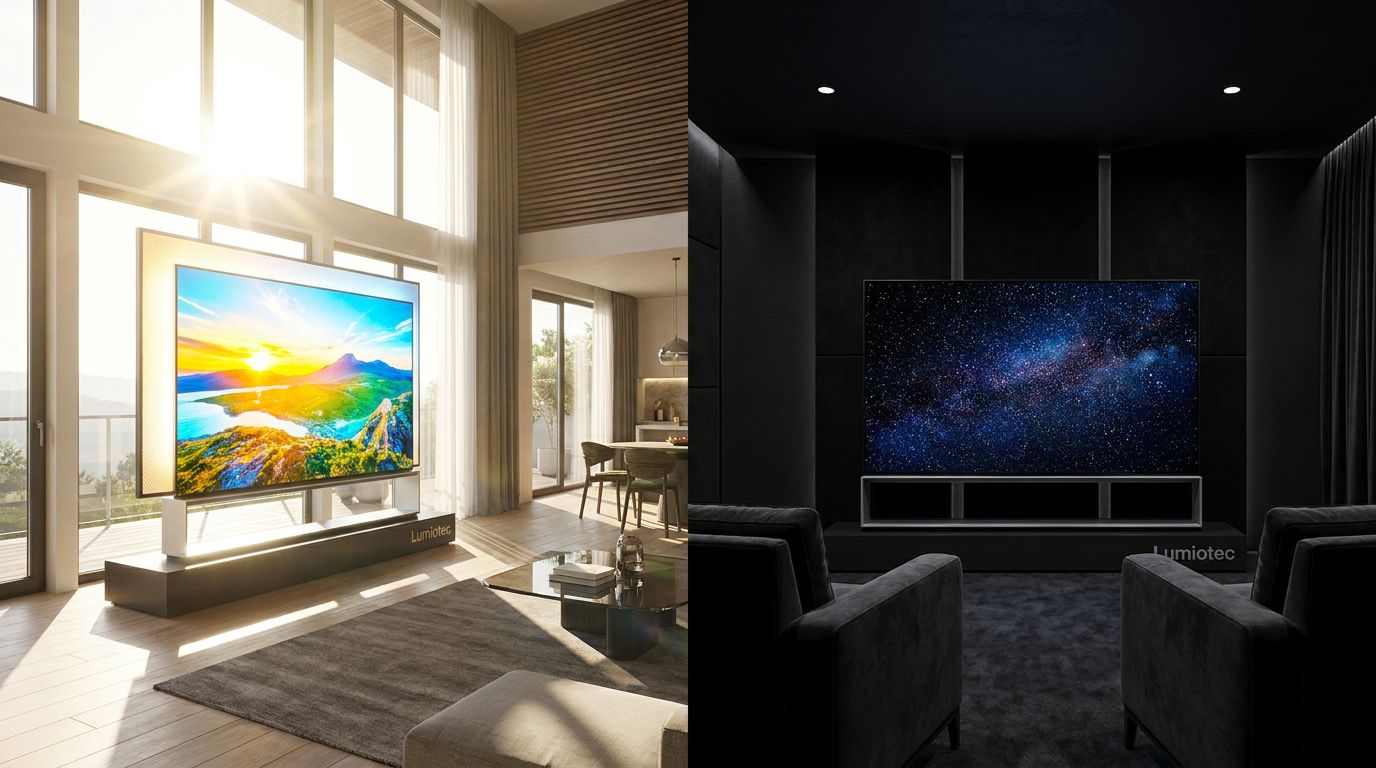
The case for OLED (Organic Light-Emitting Diode) is built entirely on pixel-level precision. Because OLED panels lack a traditional backlight, each of the display's 8.3 million pixels generates its own light and can turn off completely. This self-emissive nature allows OLEDs to achieve an absolute black level of zero nits, resulting in mathematically infinite contrast. For cinematic purists watching in dark, light-controlled rooms, this translates to a flawless image where bright stars sit against the pitch-black vacuum of space without any light bleeding into the darkness.[2][6]
The argument against OLED, however, centers on its physical limitations with brightness and static images. While 2026 advancements like Tandem OLED and QD-OLED have pushed peak HDR highlights past 1,500 nits, OLED panels still struggle to maintain high full-screen brightness due to heat dissipation and the nature of organic materials. When a scene requires the entire screen to be bright—like a hockey game or a snow-covered landscape—an OLED will aggressively dim itself to protect the panel. Furthermore, while modern pixel-shifting algorithms have drastically reduced the risk, OLEDs still carry a slight susceptibility to permanent burn-in if exposed to static logos or news tickers for thousands of hours.[3][5]

The case for Mini-LED relies on overwhelming luminance and sheer durability. Instead of self-illuminating pixels, Mini-LED televisions use a liquid crystal display (LCD) illuminated by thousands of microscopic LED backlights. By grouping these tiny lights into thousands of independent local dimming zones, the television can selectively dim dark areas of the screen while blasting bright areas with intense light. The primary advantage is raw power: premium 2026 Mini-LED models can sustain full-screen brightness well above 1,000 nits and push peak HDR highlights between 2,000 and 5,000 nits.[2][7]
The argument against Mini-LED focuses on its inability to achieve perfect pixel-level control. Even with 5,000 local dimming zones, a single zone still illuminates thousands of pixels at once. When a bright object moves across a dark background—such as white subtitles on a black cinematic letterbox—the backlight zone must turn on, creating a faint halo or "blooming" effect around the text. While 2026 algorithms have minimized this artifact, Mini-LED cannot match the absolute zero-nit black levels of an OLED, and its native static contrast ratio typically hovers around 5,000:1 compared to OLED's infinite ratio.[1][5]
The argument against Mini-LED focuses on its inability to achieve perfect pixel-level control.
The evidence in the brightness battle heavily favors Mini-LED for daytime viewing. In living rooms bathed in natural sunlight, a television must overpower ambient glare to maintain color saturation and visibility. Measurements indicate that Mini-LEDs offer a three-fold brightness redundancy over OLEDs in high average-picture-level scenes. This makes Mini-LED the undisputed champion for Sunday afternoon sports or casual daytime viewing, where an OLED's perfect black levels would be washed out by the sun anyway.[2][4]

Conversely, the evidence in the dark-room contrast battle firmly supports OLED. When ambient light is removed, the human eye becomes incredibly sensitive to elevated black levels and backlight blooming. In a basement home theater, the intense peak brightness of a Mini-LED can actually become fatiguing, while the OLED's ability to place a 1,000-nit highlight directly next to a zero-nit black pixel creates a three-dimensional depth that LCD technologies cannot replicate.[1][6]
For gamers, the trade-offs require careful consideration of play styles. OLED panels offer a near-instantaneous pixel response time of 0.03 milliseconds, resulting in unparalleled motion clarity for fast-paced competitive shooters. However, PC gamers who leave static HUDs, taskbars, or strategy game interfaces on screen for eight hours a day often gravitate toward Mini-LED to completely eliminate burn-in anxiety. Both technologies now universally support 4K resolution at 120Hz to 144Hz, variable refresh rates, and auto low-latency modes.[4][5]

The 2026 hardware landscape has introduced new variables to this comparison. LG's Tandem OLED architecture stacks multiple emissive layers to boost brightness and lifespan, while Samsung and Sony's QD-OLEDs use quantum dots to maintain pure color saturation at higher luminance levels. On the Mini-LED side, brands like TCL and Hisense have democratized massive screen sizes, offering 85-inch and 98-inch Mini-LED panels at prices where OLED simply cannot compete, making Mini-LED the default choice for buyers prioritizing sheer scale per dollar.[7]
Ultimately, OLED fits well when the primary viewing environment is a dimly lit room, the content consists heavily of prestige movies and single-player cinematic games, and the buyer prioritizes absolute picture perfection over daytime visibility. It does not fit well in sun-drenched living rooms, for users who leave news channels running all day, or for buyers seeking a massive 85-inch screen on a strict budget.[1][6]
Mini-LED fits well when the television sits in a bright, open-concept living room, the household watches a lot of daytime sports or news, and the user wants a massive, punchy HDR experience without ever worrying about panel degradation. It does not fit well for dedicated, windowless home theaters where backlight blooming will be visible, or for videophiles who demand the absolute deepest black levels for their 4K Blu-ray collections.[4][7]
How we got here
2013
First commercial OLED TVs hit the market, establishing a new benchmark for perfect black levels.
2019
Mini-LED technology is introduced to consumer televisions, drastically increasing local dimming zones.
2022
QD-OLED technology launches, combining quantum dots with OLED for brighter, more accurate colors.
2025
Tandem OLED panels arrive in consumer living rooms, stacking emissive layers to push OLED brightness to new heights.
Viewpoints in depth
Cinematic Purists
Advocates for prioritizing absolute black levels and pixel-level contrast above all other metrics.
This camp argues that the foundation of a great image is its black level. Because OLED panels can turn off individual pixels, they achieve a mathematically infinite contrast ratio. Cinematic purists point out that in a dark room, the intense peak brightness of a Mini-LED can actually become fatiguing to the eyes, and any backlight blooming around subtitles or stars completely shatters the illusion of depth. For this group, the slight risk of burn-in is a fair trade-off for flawless picture quality.
Bright-Room Viewers
Advocates for prioritizing peak brightness, glare reduction, and panel durability for everyday living spaces.
This perspective emphasizes real-world viewing conditions over theoretical dark-room perfection. Most consumers watch television in rooms with windows, lamps, and ambient sunlight. In these environments, an OLED's perfect black levels are washed out by glare, while a Mini-LED's ability to push 3,000+ nits of brightness cuts through the light to deliver a punchy, vibrant image. Furthermore, this camp values the peace of mind that comes with Mini-LED's immunity to burn-in, making it the safer choice for households that leave news channels or video games running all day.
Value & Large-Format Buyers
Focuses on the price-to-size ratio, noting that Mini-LED allows buyers to afford massive screens.
For this group, immersion is driven by sheer screen size rather than microscopic pixel perfection. While OLED prices have fallen for standard 55-inch and 65-inch models, the cost of manufacturing 85-inch and 98-inch OLED panels remains astronomically high. Mini-LED technology scales much more cost-effectively, allowing consumers to build massive home theaters for a fraction of the cost of an equivalent OLED, without sacrificing modern features like 144Hz gaming and HDR.
What we don't know
- How quickly the cost of massive 85-inch and 97-inch OLED panels will drop to compete with large-format Mini-LEDs.
- Whether emerging Micro-LED technology will become affordable enough to replace both OLED and Mini-LED before the end of the decade.
Key terms
- OLED (Organic Light-Emitting Diode)
- A display technology where each individual pixel generates its own light and can turn off completely to create perfect black.
- Mini-LED
- An LCD television that uses thousands of microscopic LED backlights divided into local dimming zones to achieve high brightness and contrast.
- Local Dimming Zones
- Specific areas of a TV's backlight that can dim or brighten independently to improve contrast on LCD and Mini-LED screens.
- Blooming (Halo Effect)
- A visual artifact on LED TVs where light bleeds from a bright object into the surrounding dark areas of the screen.
- Nits
- A unit of measurement for brightness. A higher number of nits means the television can output a brighter image.
- Burn-in
- Permanent image retention on a screen caused by displaying static elements, such as logos or HUDs, for prolonged periods.
Frequently asked
Does OLED still suffer from burn-in in 2026?
While the risk is vastly reduced by pixel-shifting and panel cooling technologies, OLEDs can still experience burn-in if static images like news tickers are displayed for thousands of hours.
What is Tandem OLED?
Tandem OLED is a newer architecture that stacks multiple light-emitting layers, significantly boosting the panel's brightness and lifespan compared to older single-layer OLEDs.
Why do Mini-LED TVs have blooming?
Because Mini-LEDs use backlight zones rather than individual pixels, a bright object on a dark background can cause the light from that zone to bleed into the surrounding dark pixels.
Which TV is better for a bright living room?
Mini-LED is the superior choice for bright rooms because it can sustain much higher full-screen brightness to overpower sunlight and glare.
Sources
Source coverage
7 outlets
3 viewpoints surfaced







[1]RTINGS.comCinematic Purists
Mini LED vs. OLED TVs: Which One Is The Best?
Read on RTINGS.com →[2]DisplayModuleValue & Large-Format Buyers
OLED vs Mini LED | Contrast, Brightness & Use
Read on DisplayModule →[3]PatSnapBright-Room & HDR Enthusiasts
Mini LED vs OLED: Brightness and Efficiency Comparison
Read on PatSnap →[4]CNETCinematic Purists
Mini-LED vs. OLED: Which TV Tech Should You Get?
Read on CNET →[5]UniluminValue & Large-Format Buyers
Mini LED vs. OLED: A Comparative Analysis
Read on Unilumin →[6]The Good GuysBright-Room & HDR Enthusiasts
Which Television is right for you? | TV buying guide
Read on The Good Guys →[7]Data Wire SolutionsBright-Room & HDR Enthusiasts
Best TVs for 2026: 10 OLED and Mini-LED Picks by Room, Brightness, and Install Reality
Read on Data Wire Solutions →

Every angle. Every day.
Get guides stories with full source coverage and perspective breakdowns delivered to your inbox.