
How AI Satellites Are Learning to Think for Themselves in Orbit
A new generation of Earth observation satellites is using onboard "edge computing" to analyze imagery in space, beaming down critical disaster and climate insights in minutes rather than days.
By Factlen Editorial Team
- Space Agencies & First Responders
- Focus on the life-saving potential of reducing latency from days to minutes during natural disasters.
- Hardware & Cloud Providers
- View low Earth orbit as the next frontier for distributed computing and data center infrastructure.
- Algorithmic Researchers
- Focus on the technical challenges of building lightweight, unsupervised AI models that can operate in constrained environments.
What's not represented
- · Privacy advocates concerned about autonomous orbital surveillance
- · Developing nations lacking access to proprietary orbital intelligence
Why this matters
When natural disasters strike, the speed of intelligence dictates the survival rate. By giving satellites the ability to think for themselves, emergency responders will receive exact coordinates of fires and floods in minutes rather than days, fundamentally changing how humanity manages crises.
Key points
- Earth observation satellites are now using onboard AI to analyze imagery directly in space.
- This "edge computing" approach reduces the time needed to detect disasters from days to minutes.
- By transmitting only actionable insights, satellites compress data requirements from gigabytes to kilobytes.
- NASA and the European Space Agency are actively deploying these systems to aid emergency responders.
- Hardware limitations are being overcome by new radiation-hardened processors and orbital data centers.
In April 2026, an Earth observation satellite achieved a quiet but monumental milestone: it looked down at the planet, found exactly what it was looking for, and reported its findings back to Earth entirely on its own. For decades, satellites have functioned essentially as orbiting digital cameras. They capture massive, high-resolution images of the Earth's surface and blindly beam terabytes of raw data down to ground stations.[1][2]
This traditional architecture creates a severe bottleneck. Once the raw imagery reaches Earth, it must be processed, cleaned, and analyzed by human experts or ground-based algorithms. By the time a critical insight is extracted—such as the exact perimeter of a wildfire or the extent of a flash flood—hours or even days may have passed. For emergency responders dealing with rapidly unfolding crises, that latency can render the intelligence practically useless.[2][6]
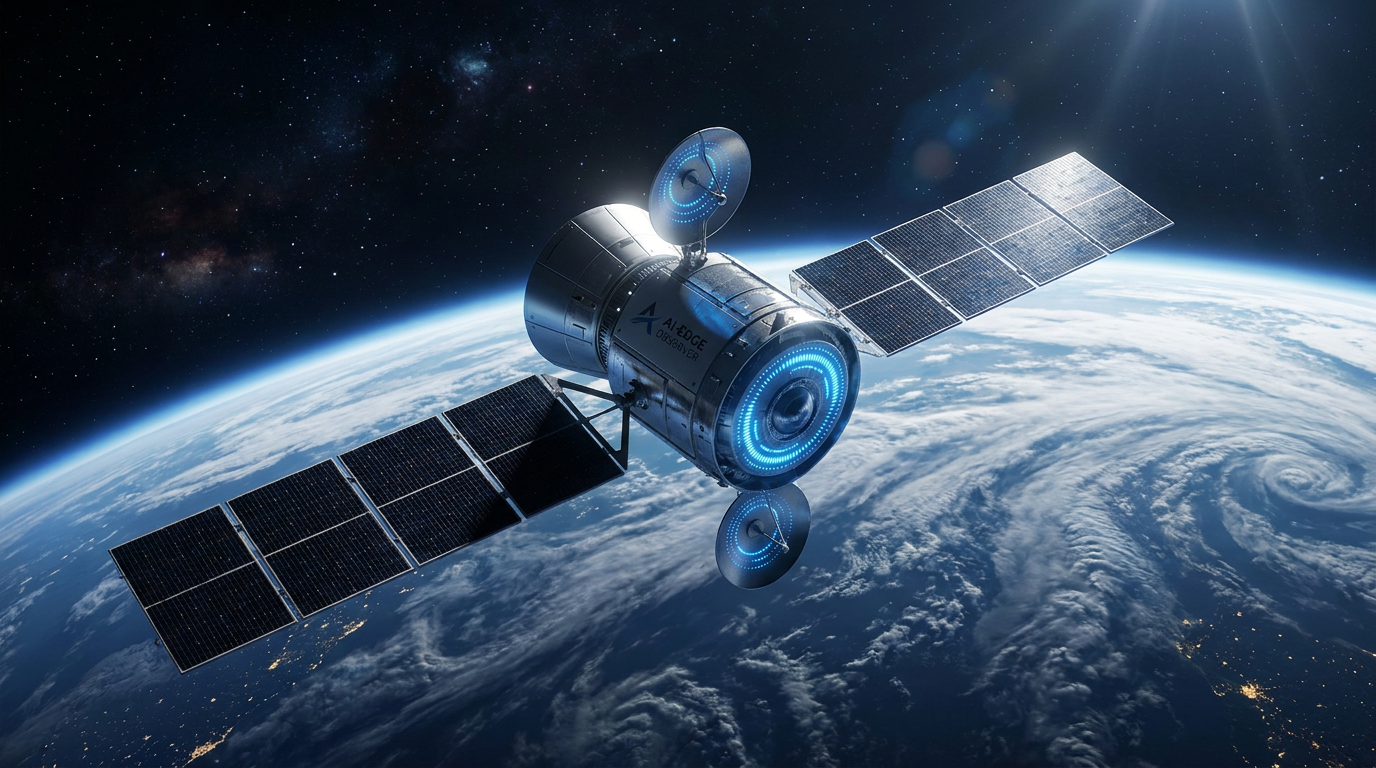
The solution to this bottleneck is a concept known as "edge computing," which is now being aggressively adapted for the vacuum of space. Instead of sending the entire haystack down to Earth so humans can look for the needle, aerospace engineers are equipping satellites with onboard artificial intelligence processors. These AI-enabled satellites run lightweight neural networks directly in orbit, allowing them to analyze the imagery the moment it is captured.[1][7]

The mechanism fundamentally changes how orbital data is handled. When an autonomous satellite passes over a disaster zone, its onboard GPU processes the visual or radar data to identify anomalies, such as smoke plumes, flood lines, or structural damage. Once the AI extracts the relevant insight, it discards the heavy, raw image files and transmits only the critical metadata down to emergency teams.[4][7]
This selective transmission compresses the required bandwidth from gigabytes down to mere kilobytes. The European Space Agency (ESA) is currently pioneering this approach through its Ciseres project, which integrates AI as a sophisticated filter to scan enormous data streams in real-time. By compressing and transmitting only the essential details, ESA aims to alert government officials and first responders within minutes of a disaster occurring.[4]
Real-world testing has already proven the viability of this orbital intelligence. In a recent collaboration between NASA's Jet Propulsion Laboratory and the satellite intelligence startup Ubotica, an AI-driven system called Dynamic Targeting was deployed on the CogniSAT-6 satellite. Operating without human oversight, the satellite successfully processed data onboard during the devastating Valencia floods, instantly calculating that 21 percent of the observed area was underwater and beaming that precise metric back to Earth.[2]
The same system demonstrated its value during the Palisades Fire in Los Angeles. By autonomously identifying smoke plumes as they developed, the satellite provided emergency teams with immediate updates on the fire's trajectory, bypassing the traditional delays of ground-based image processing.[2]

The same system demonstrated its value during the Palisades Fire in Los Angeles.
The push for autonomous observation is a global race. In early 2026, China launched the "Hong Kong Youth Scientific Innovation" satellite, which it described as the world's first large-scale AI model Earth observation satellite. Designed specifically for sustainable urban development and disaster response, the satellite's ability to process data in real-time is intended to drastically accelerate the mobilization of resources during regional emergencies.[5]
Making this work requires significant algorithmic ingenuity. Space is a highly constrained environment, meaning onboard AI cannot rely on the massive server farms that power terrestrial chatbots. Researchers are developing highly efficient frameworks, such as the "Shield" system, which allows satellites to detect disaster-affected areas using only a single post-disaster image. By comparing the new image against lightweight, pre-loaded distributions of the normal landscape, the AI can measure deviations and map the damage instantly.[3][6]
However, these algorithms still have limitations. Current unsupervised change-detection models rely on recognizing the underlying geography to spot anomalies. Experiments have shown that if a catastrophic event—like a massive landslide or unprecedented flooding—alters more than 50 percent of the observed scene, the AI loses its baseline reference points and the detection method becomes largely ineffective.[3]
The physical hardware also presents a formidable challenge. Standard silicon chips are highly vulnerable to the extreme radiation and thermal fluctuations of low Earth orbit. Historically, radiation-hardened processors were too weak to run complex machine learning models. But a new generation of space-grade GPUs and orbital data centers is bridging the gap, providing the necessary compute power while surviving the harsh realities of space.[6][7]

As this hardware matures, the applications for autonomous satellites are expanding far beyond disaster response. Environmental agencies are preparing to use edge AI to continuously monitor methane leaks from oil pipelines, instantly flagging massive emissions that would otherwise go unnoticed. Maritime authorities plan to use the technology to autonomously track illegal fishing vessels that turn off their standard tracking transponders.[6][7]
The ultimate vision for this technology is a fully autonomous, interconnected orbital network. If an AI-powered satellite detects a nascent wildfire, it will soon have the capability to communicate directly with other satellites in a constellation. It could autonomously task a neighboring high-resolution satellite to zoom in on the exact coordinates, coordinating a real-time response entirely independent of ground control.[2]
We are witnessing a fundamental shift in our relationship with orbital infrastructure. For the first half-century of the space age, satellites were passive observers, recording the Earth and waiting for humans to make sense of the pictures. By giving these machines the ability to think and filter at the edge of space, they are transforming from simple cameras into an active, intelligent planetary defense system.[1][7]

The economic implications of this shift are also profound. Launching data to space and beaming it back down is incredibly expensive, largely due to the limited number of ground stations and the narrow windows in which satellites can communicate with them. By processing data at the edge, satellite operators can drastically reduce their downlink bandwidth costs, making Earth observation commercially viable for a much wider range of industries, from agriculture to supply chain logistics.[6]
Ultimately, the transition to edge computing in space mirrors the evolution of computing on Earth. Just as smartphones evolved from simple communication devices into powerful, independent computers, satellites are undergoing their own cognitive revolution. As they learn to find things on their own, the gap between an event happening on Earth and humanity's ability to respond to it is shrinking from days to mere minutes.[1][7]
How we got here
2018
Early deep learning algorithms are successfully tested on ground-based computers to estimate disaster damage from satellite imagery.
2023
The first experimental demonstrations of onboard AI are launched, proving satellites can perform simple tasks like detecting cloud cover.
October 2024
The European Space Agency kicks off the Ciseres project to integrate AI into small satellites for rapid crisis response.
2025
NASA and Ubotica successfully test the Dynamic Targeting system, autonomously processing flood data onboard during the Valencia floods.
April 2026
Earth observation satellites successfully demonstrate the ability to autonomously find targets and transmit insights without human intervention.
Viewpoints in depth
Space Agencies & First Responders
For emergency teams, the value of orbital AI is measured purely in time saved.
Agencies like NASA and ESA view edge computing as the ultimate solution to the 'data bottleneck.' During a wildfire or flood, terabytes of high-resolution imagery are useless if they take 24 hours to download and analyze. By shifting the analysis to the satellite itself, first responders receive actionable coordinates and damage assessments in minutes, allowing them to deploy rescue teams and resources while the crisis is still unfolding.
Hardware & Cloud Providers
The tech industry sees low Earth orbit as the ultimate edge-computing environment.
For infrastructure companies, the challenge is physical rather than algorithmic. Space is a hostile environment that destroys standard silicon. Cloud providers and hardware manufacturers are racing to develop radiation-hardened GPUs and orbital data centers. They envision a future where satellites don't just process their own data, but act as a distributed, interconnected computing network that extends terrestrial cloud services into space.
Algorithmic Researchers
Scientists are focused on making AI models smaller, smarter, and less reliant on ground data.
Running a neural network on a satellite requires extreme efficiency. Researchers are developing 'unsupervised' models that don't need constant updates from Earth. Instead, these algorithms use lightweight baselines to detect anomalies—like a sudden flood line—from a single image. However, researchers acknowledge that these models still struggle with catastrophic events that alter more than half of a landscape, as the AI loses its geographical reference points.
What we don't know
- How quickly regulatory frameworks will adapt to fully autonomous satellites making real-time decisions without human oversight.
- Whether the high cost of radiation-hardened AI processors will limit this technology to government agencies and massive tech conglomerates.
- How onboard AI models will handle unprecedented, large-scale geological events that completely erase baseline reference points.
Key terms
- Edge Computing
- The practice of processing data near where it is generated—in this case, on the satellite itself—rather than in a centralized data center.
- Earth Observation (EO) Satellite
- A satellite specifically designed to monitor and capture high-resolution imagery of the Earth's surface for environmental, military, or disaster-response purposes.
- Downlink Bandwidth
- The capacity of the communication link used to transmit data from a satellite in orbit down to a ground station on Earth.
- Radiation-Hardened Processor
- A computer chip specifically designed and manufactured to withstand the extreme radiation and thermal fluctuations of outer space.
- Unsupervised Change Detection
- An AI technique where the algorithm autonomously identifies anomalies or damage by comparing a new image against a learned baseline, without needing human labeling.
Frequently asked
What is edge computing in space?
Edge computing in space means processing data directly on the satellite using onboard AI processors, rather than sending raw data down to Earth for analysis.
How does this help during a natural disaster?
It reduces the time it takes to get actionable intelligence from hours or days down to minutes. Satellites can autonomously detect floods or fires and instantly beam the exact coordinates to first responders.
Why can't satellites just send all their pictures to Earth?
High-resolution imagery creates terabytes of data. Transmitting that much raw data requires massive bandwidth and relies on limited ground stations, creating a severe bottleneck.
Can the onboard AI make mistakes?
Yes. Current models rely on comparing new images to baseline landscapes. If a disaster alters more than 50% of the area, the AI can lose its reference points and fail to accurately map the damage.
Sources
Source coverage
7 outlets
3 viewpoints surfaced







[1]TechCrunchAlgorithmic Researchers
A satellite just learned to find things on its own — here's what that means
Read on TechCrunch →[2]Fast CompanySpace Agencies & First Responders
NASA's new AI satellites could revolutionize disaster response
Read on Fast Company →[3]Journal of Remote SensingAlgorithmic Researchers
Single-temporal High-spatial resolution image Individual unsupervised change Detection (Shield)
Read on Journal of Remote Sensing →[4]European Space AgencySpace Agencies & First Responders
Ciseres: AI-powered satellites for rapid disaster response
Read on European Space Agency →[5]CGTNAlgorithmic Researchers
China launches new AI-powered Earth observation satellite
Read on CGTN →[6]JLLHardware & Cloud Providers
Data centers in space - 2026 Edition
Read on JLL →[7]spaceNEXTHardware & Cloud Providers
AI at the Edge: The Future of Autonomous Space Missions
Read on spaceNEXT →


Every angle. Every day.
Get technology stories with full source coverage and perspective breakdowns delivered to your inbox.