
How AI is Decoding the Secret Lives of Animals
Machine learning algorithms are processing millions of hours of audio and video to track endangered species and decode animal communication, transforming conservation into a real-time science.
By Factlen Editorial Team
- Conservation Technologists
- Argue that AI's primary value is processing massive visual and acoustic datasets to track populations without invasive physical tagging.
- Bioacoustics Researchers
- Focus on using large language models to decode the actual syntax, dialects, and social structures of animal communication.
- Ecological Ethicists
- Warn that decoding animal language requires strict regulations to prevent exploitation by poachers or commercial industries.
- Scientific Publishers
- Highlight the broad paradigm shift AI brings to field biology, moving it from manual observation to predictive data science.
What's not represented
- · Indigenous Communities
- · Local Field Guides
Why this matters
By giving scientists the tools to process petabytes of natural data, AI is enabling non-invasive tracking and interspecies communication that could prevent extinctions and reshape humanity's relationship with the natural world.
Key points
- AI is processing millions of hours of environmental audio and video to track wildlife.
- Computer vision allows researchers to identify individual animals by their unique markings, replacing physical tags.
- Bioacoustic AI can isolate specific animal calls from noisy, overlapping forest and ocean soundscapes.
- Projects are using Large Language Models to decode the syntax and dialects of animal communication.
- Ethicists warn that decoded animal signals must be regulated to prevent exploitation by poachers.
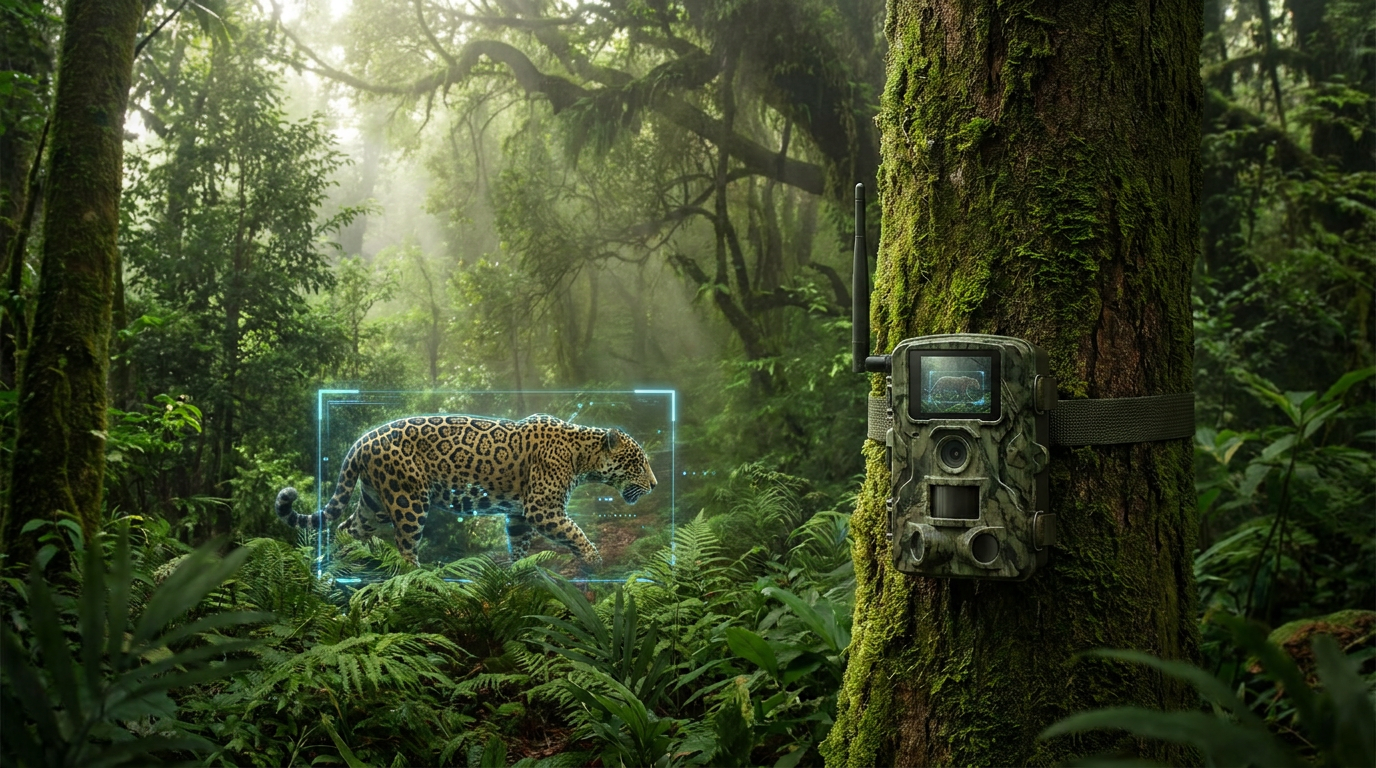
The natural world is broadcasting a continuous, massive stream of data. From the high-frequency clicks of beluga whales navigating icy waters to the subtle rosette patterns on a jaguar's coat, the wilderness is rich with information. For centuries, human biologists could only capture a tiny fraction of this data, relying on physical tags, manual transcriptions, and thousands of hours of patient, quiet observation in the field.
The bottleneck was never the animals; it was our capacity to process their signals. Today, the deployment of cheap, autonomous sensors—camera traps, drones, and bioacoustic recorders—has flooded conservationists with petabytes of raw environmental data. The challenge has rapidly shifted from gathering information to making sense of it before endangered populations vanish entirely.
Enter artificial intelligence. In a paradigm shift for field biology, machine learning algorithms are now being deployed to decode the secret lives of animals, from hummingbirds to pumas. By replacing thousands of hours of human labor with minutes of computation, AI is transforming conservation from a reactive, observational science into a real-time, predictive discipline.[1][7]
The earliest breakthroughs occurred in computer vision. In the early 2000s, researchers tracking whale sharks relied on physically spearing the animals with plastic tags—a method that yielded a re-sighting rate of less than one percent. Recognizing the sheer inefficiency of this approach, technologists developed algorithms capable of identifying individual sharks based on the unique constellation of spots on their skin, functioning much like a human fingerprint scanner.[2]
This foundational idea evolved into Wildbook, an open-source platform managed by the Wild Me Lab. Today, the system uses advanced computer vision to track over 250 species, processing more than 1.4 million sightings globally. By analyzing crowd-sourced photos from tourists and remote camera traps, the AI identifies individual zebras, giraffes, and pumas by their unique stripes, spots, and scars, entirely eliminating the need for invasive physical tagging.[2]

But the visual spectrum is only half the story. In dense rainforests and murky oceans, cameras are often useless. Here, scientists rely on sound. The emerging field of computational bioacoustics uses autonomous recording units to capture the ambient noise of an ecosystem, creating a permanent, high-fidelity audio record of local biodiversity.[4]
The problem with natural soundscapes is their sheer complexity. A single audio file might contain the overlapping calls of dozens of bird species, the rustle of undergrowth, the buzz of insects, and the distant hum of human machinery. Traditional software struggled to isolate these sounds, forcing researchers to listen manually to months of audio.[4]
The problem with natural soundscapes is their sheer complexity.
Recent advancements in AI, driven by initiatives like the EU-funded BioacAI project, have solved this overlapping audio problem. Trained on massive datasets of animal calls, these neural networks can cut through the acoustic clutter to identify specific species with unprecedented accuracy. In complex environments, AI-powered sound analysis is now helping researchers track critically endangered species up to 50 times faster than traditional field methods.[4]
Identifying a species by its call is a monumental achievement, but a new wave of researchers is asking a far more ambitious question: Can AI help us understand what the animals are actually saying to one another?
The Earth Species Project (ESP), a non-profit research organization, is attempting to build the first multimodal foundation models for the animal domain. Essentially, they are creating a translation architecture for nature. By applying Large Language Models (LLMs) to massive, unlabeled bioacoustics datasets, ESP aims to decode the underlying grammar, syntax, and social structures of animal communication.[3]

The results are already materializing in the field. In northern Spain, ESP's AI tools have helped scientists categorize more than 127,000 vocalizations from a population of cooperative-breeding crows. In the oceans, the technology is being used to map the vocal repertoires of beluga whales and orcas, determining how different pods use distinct dialects and how underwater noise pollution disrupts their social cohesion.[3][6]
This level of interspecies understanding carries profound implications for conservation. If biologists can decode the distress calls of whales, they might predict and prevent mass stranding events before they happen. If they can map the cultural transmission of knowledge among elephant herds, they can design highly specific conservation corridors that respect the animals' actual social boundaries rather than arbitrary geographic lines.[3]
Yet, the prospect of decoding animal language also introduces unprecedented ethical dilemmas. A recent global survey conducted by the Collective Intelligence Project and ESP found that while 70 percent of people are eager to know what animals are thinking and feeling, 85 percent strongly prefer strict regulations on how this technology is used, particularly by corporations.[5]

The fear is that if we can perfectly mimic or predict animal behavior, bad actors could exploit the technology. Commercial fishing fleets could use decoded acoustic signals to lure specific fish species into nets, or poachers could deploy AI-generated calls to trap endangered birds. The same tools that empower conservationists could, if left unregulated, accelerate ecological destruction.[5]
To mitigate these risks, organizations are focusing heavily on open-source collaboration and ethical frameworks. Platforms are already using AI to help customs officials instantly identify illegal wildlife products at borders, proving that machine learning can be a powerful enforcement mechanism when placed in the right hands and governed by strict protocols.[2]

Ultimately, the integration of AI into field biology represents more than just a technological upgrade; it is a philosophical shift. For the first time in human history, we are building the infrastructure to listen to the natural world on its own terms. As these models grow more sophisticated, they promise to bridge the gap between human society and the diverse intelligences that share our planet.[7]
How we got here
2002
Researchers begin developing computer vision algorithms to identify whale sharks by their spot patterns, replacing physical tags.
2018
The Earth Species Project is founded with the goal of using machine learning to decode non-human communication.
2023
The Paul G. Allen Family Foundation awards major funding to develop multimodal foundation models for the animal domain.
2025
Advanced bioacoustic AI models are released, capable of isolating specific animal calls from noisy, overlapping environments.
June 2026
New research highlights the deployment of AI across global ecosystems, tracking everything from hummingbirds to pumas in real-time.
Viewpoints in depth
Conservation Technologists
Focus on the immediate utility of AI in tracking and counting endangered populations.
For conservation technologists, the primary value of AI lies in its ability to scale data processing. By utilizing computer vision and bioacoustics, researchers can monitor vast ecosystems without the need for invasive physical tagging or thousands of hours of manual labor. This camp emphasizes that real-time population tracking is the most urgent need in the fight against the biodiversity crisis.
Bioacoustics Researchers
Aim to push the boundaries of AI to decode the actual language and culture of animals.
Researchers in this camp view AI not just as a counting tool, but as a translation device. By applying Large Language Models to animal vocalizations, they are uncovering the complex social structures, dialects, and cultural transmissions within species like whales and crows. They argue that true conservation requires understanding the inner lives and social boundaries of the animals we are trying to protect.
Ecological Ethicists
Warn of the dangers of unregulated interspecies communication technology.
Ethicists raise alarms about the dual-use nature of decoding animal language. If humanity successfully maps the communication patterns of vulnerable species, that data could easily be weaponized by commercial fishing fleets or poachers to lure animals into traps. This camp advocates for strict, legally binding frameworks to govern who has access to these AI models and how they can be deployed in the wild.
What we don't know
- Whether AI models trained on human language structures are truly applicable to the fundamentally different cognitive processes of animals.
- How international law will adapt to regulate the use of decoded animal communication by commercial entities.
Key terms
- Computer Vision
- A field of artificial intelligence that enables computers to derive meaningful information from digital images and videos, used in conservation to identify animal markings.
- Bioacoustics
- The scientific study of sound production, dispersion, and reception in animals, increasingly monitored via autonomous sensors.
- Multimodal Foundation Model
- An advanced AI system trained on vast amounts of diverse data—such as audio, video, and text—capable of finding complex patterns across different types of information.
- Ethogram
- A comprehensive inventory of the specific behaviors and actions performed by a species, which AI is now helping to automate and expand.
Frequently asked
How does AI identify individual animals?
Computer vision algorithms analyze unique physical characteristics, such as the spot patterns on a whale shark or the scars on a puma, acting much like a human fingerprint scanner.
What is computational bioacoustics?
It is the use of autonomous recording devices and machine learning to capture and analyze the sounds of an ecosystem, allowing scientists to identify species without seeing them.
Can AI actually translate animal languages?
While we cannot yet translate animal calls into English, AI models are successfully mapping the syntax, dialects, and social structures of species like crows and beluga whales.
Are there risks to decoding animal communication?
Yes. Ethicists warn that if commercial industries or poachers gain access to decoded acoustic signals, they could use them to exploit or trap vulnerable species.
Sources
Source coverage
7 outlets
4 viewpoints surfaced







[1]NatureScientific Publishers
How AI is revealing the secret lives of animals from hummingbirds to pumas
Read on Nature →[2]Wild MeConservation Technologists
Wildbook for Wildlife Population Monitoring
Read on Wild Me →[3]Earth Species ProjectBioacoustics Researchers
The Next Frontier of Understanding Life on Earth
Read on Earth Species Project →[4]Bioacoustic AIConservation Technologists
Applied research in acoustic wildlife monitoring with AI
Read on Bioacoustic AI →[5]Collective Intelligence ProjectEcological Ethicists
Global Perspectives on AI, Nature and Interspecies Understanding
Read on Collective Intelligence Project →[6]MongabayBioacoustics Researchers
Scientists are increasingly using artificial intelligence models to decode the communications of other species
Read on Mongabay →[7]Factlen Editorial TeamScientific Publishers
Synthesis by Factlen editorial team
Read on Factlen Editorial Team →

Every angle. Every day.
Get science stories with full source coverage and perspective breakdowns delivered to your inbox.