
How the New Class of Non-Hormonal Drugs Rewires the Brain to Stop Menopause Hot Flashes
The FDA's recent approval of elinzanetant expands a breakthrough class of medications that target the brain's temperature control center, offering highly effective relief for menopause symptoms without the use of hormones.
By Factlen Editorial Team
- Clinical Researchers
- Focusing on the neuroendocrinology and the precise mechanism of receptor antagonism.
- Women's Health Advocates
- Emphasizing the historical lack of options and the burden of untreated vasomotor symptoms.
- Pharmaceutical Developers
- Focusing on market expansion and the dual-action innovation of newer compounds.
What's not represented
- · Insurance Providers
- · Patients with mild symptoms who may not qualify for prescription therapies
Why this matters
For decades, women who could not safely take hormone replacement therapy were left with few options to manage debilitating hot flashes. This new class of targeted neurological drugs offers a highly effective, hormone-free alternative that fundamentally changes the standard of care for the menopausal transition.
Key points
- The FDA has approved elinzanetant (Lynkuet), expanding a new class of non-hormonal menopause treatments.
- The drugs target KNDy neurons in the hypothalamus, the brain's temperature control center.
- They block the neurokinin B signal that causes false overheating alarms when estrogen levels drop.
- Clinical trials show significant reductions in hot flash frequency and severity within one week.
- The non-hormonal mechanism makes them safe for breast cancer survivors who cannot take estrogen.
For decades, the medical consensus surrounding the menopausal transition offered women a stark choice: endure years of disruptive hot flashes and night sweats, or take systemic hormone replacement therapy (HRT). While HRT is highly effective, it is contraindicated for survivors of estrogen-receptor-positive breast cancers and women with certain cardiovascular risks. As a result, millions of women have been left to simply "tough it out" through a physiological transition that can severely degrade sleep, mood, and overall quality of life. [5, 8][5][8]
That paradigm is now undergoing a radical shift. The U.S. Food and Drug Administration's recent approval of elinzanetant, marketed as Lynkuet by Bayer, in late 2025 has cemented the arrival of an entirely new class of non-hormonal medications. [1, 6] Rather than replacing lost estrogen throughout the entire body, these drugs target the specific neurological root cause of vasomotor symptoms directly within the brain. [7][1][6][7]
Elinzanetant joins fezolinetant (Veozah), which Astellas Pharma brought to market in 2023, in a category known as neurokinin receptor antagonists. [6] Together, they represent the culmination of more than two decades of neuroendocrinology research into how the brain regulates body temperature, offering a highly effective, hormone-free alternative for the estimated 80 percent of women who experience moderate to severe hot flashes. [5, 8][5][6][8]
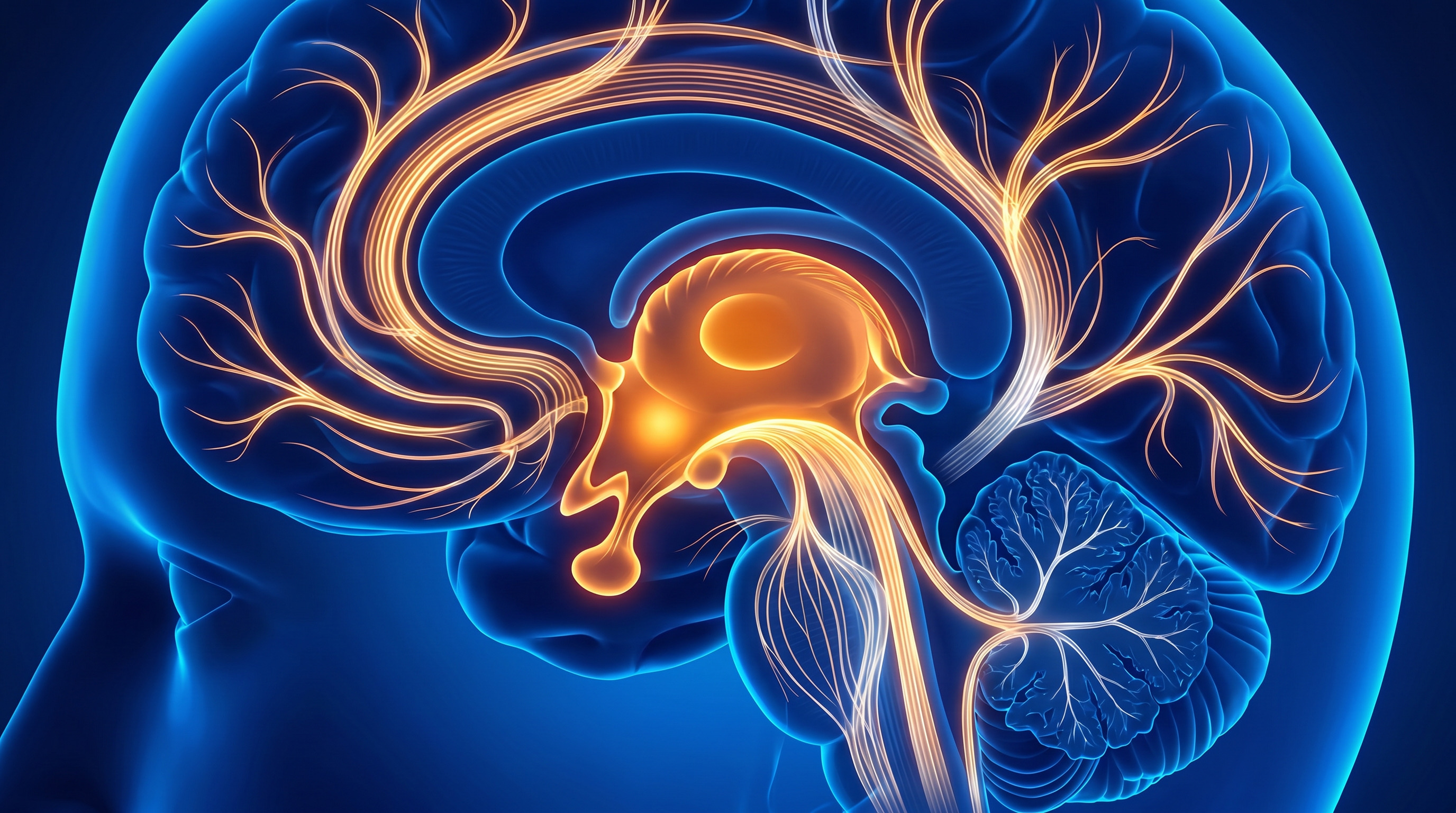
To understand how these "magic bullet" drugs work, one must look deep inside the hypothalamus, the brain's master control center for autonomic functions. [5] Within the hypothalamus lies the median preoptic nucleus, which acts as the body's internal thermostat. This thermostat is heavily influenced by a specialized group of nerve cells known as KNDy (kisspeptin, neurokinin B, dynorphin) neurons. [3, 4][3][4][5]
In a pre-menopausal woman, KNDy neurons are kept in a delicate state of equilibrium by two opposing forces. Estrogen acts as an inhibitor, calming the neurons down, while a neuropeptide called neurokinin B (NKB) acts as a stimulant, binding to neurokinin 3 (NK3) receptors to excite the neurons. [4, 8] As long as estrogen and NKB are balanced, the body's temperature control center remains stable.[4][8]

During the menopausal transition, however, ovarian estrogen production plummets. This sudden withdrawal removes the inhibitory "brakes" on the KNDy neurons. [3] Left unopposed, the stimulating NKB signal causes the KNDy neurons to become hypertrophic and hyperactive. [4] They begin firing erratically, sending false signals to the hypothalamus that the body is dangerously overheating.[3][4]
During the menopausal transition, however, ovarian estrogen production plummets.
The brain responds to this false alarm by triggering emergency heat-dissipation mechanisms. It commands blood vessels near the skin to dilate rapidly—causing the characteristic flush of heat across the chest, neck, and face—and activates the sweat glands. [8] This cascade is the biological anatomy of a hot flash.[8]
The new class of medications intervenes precisely at this neurological juncture. Fezolinetant is a highly selective NK3 receptor antagonist; it binds to the NK3 receptors on the KNDy neurons, physically blocking the NKB neuropeptide from attaching. [4, 6] By muting the unopposed NKB signal, the drug artificially restores the balance that was lost when estrogen levels dropped, calming the KNDy neurons and stopping the false overheating signals at their source. [8][4][6][8]
Elinzanetant builds upon this mechanism by acting as a dual receptor antagonist. It blocks both the NK3 receptor and the NK1 receptor. [1, 3] Because the NK1 pathway is also implicated in sleep architecture and mood regulation, researchers hypothesize that this dual blockade may offer additional benefits for the sleep disturbances that frequently accompany severe vasomotor symptoms. [2, 7][1][2][3][7]
The clinical efficacy of these targeted neurological therapies has been striking. In the Phase III OASIS 1 and 2 clinical trials, women taking elinzanetant experienced a statistically significant reduction in both the frequency and severity of hot flashes within the first week of treatment. [2] By week 12, the reductions were profound, with many patients reporting a near-total cessation of disruptive daytime and nighttime vasomotor events. [1, 2][1][2]

Early proof-of-concept trials for NK3 receptor antagonists published in The Lancet demonstrated that blocking this pathway could cut hot flash frequency by 73 percent and reduce symptom severity by 45 percent, matching or approaching the efficacy of traditional hormone therapy. [4, 5][4][5]
Crucially, because these drugs do not introduce exogenous estrogen into the bloodstream, they do not carry the systemic risks associated with HRT. [7] They do not stimulate breast tissue or the uterine lining, making them a viable option for women with a history of estrogen-sensitive cancers or those who simply prefer to avoid hormone therapy. [8][7][8]

The safety profile of the new drug class has been generally favorable, though they are not without side effects. The most common adverse reactions reported in clinical trials include headache, fatigue, dizziness, and somnolence. [3] Additionally, because the drugs are metabolized by the liver, patients may require periodic monitoring for elevated hepatic transaminases, though severe liver toxicity has not been a hallmark of the class. [3, 8][3][8]
The development of NK receptor antagonists is being hailed by endocrinologists and gynecologists as one of the most significant advancements in women's health in a generation. [5, 8] By decoding the precise neurocircuitry of the menopausal transition, science has finally provided a targeted, mechanism-specific solution to a physiological challenge that has burdened women throughout human history. [8][5][8]
How we got here
2013
Researchers identify the hypertrophy of KNDy neurons and the role of Neurokinin B in triggering hot flashes.
April 2017
Early proof-of-concept trials published in The Lancet show NK3 receptor antagonists cut hot flash frequency by 73%.
May 2023
The FDA approves Astellas' fezolinetant (Veozah), the first non-hormonal NK3 receptor antagonist for menopause.
August 2024
JAMA publishes the OASIS 1 and 2 trial results, demonstrating the efficacy of the dual-antagonist elinzanetant.
October 2025
The FDA officially approves Bayer's elinzanetant (Lynkuet), expanding the class of targeted non-hormonal therapies.
Viewpoints in depth
Clinical Researchers
Focusing on the neuroendocrinology and the precise mechanism of receptor antagonism.
For neuroendocrinologists, the development of NK receptor antagonists represents a triumph of translational science. For decades, the exact biological trigger of a hot flash was poorly understood. By isolating the KNDy neurons and identifying the specific role of the neurokinin B pathway, researchers were able to design a molecule that acts as a precise neurological 'off switch.' This targeted approach is seen as a massive leap forward from systemic hormone therapy, which affects tissues throughout the entire body.
Women's Health Advocates
Emphasizing the historical lack of options and the burden of untreated vasomotor symptoms.
Advocates highlight that menopause has historically been under-researched and under-funded, leaving millions of women to suffer through years of debilitating symptoms that disrupt their careers and sleep. The arrival of highly effective, non-hormonal options is particularly celebrated for breast cancer survivors, who are often thrown into sudden, severe menopause by their cancer treatments but are strictly barred from using estrogen-based therapies to find relief.
Pharmaceutical Developers
Focusing on market expansion and the dual-action innovation of newer compounds.
Industry analysts view the approval of elinzanetant as the beginning of a highly competitive new market for women's health therapeutics. While Astellas proved the concept with the NK3-specific fezolinetant, Bayer's strategy with elinzanetant was to target both the NK1 and NK3 receptors. Developers hypothesize that blocking the NK1 pathway—which is involved in mood and sleep architecture—could give dual antagonists a competitive edge in treating the holistic burden of the menopausal transition.
What we don't know
- Whether the dual NK1/NK3 blockade of elinzanetant provides a clinically significant advantage over the single NK3 blockade of fezolinetant in real-world patient populations.
- The long-term neurological effects, if any, of suppressing the neurokinin pathways over multiple years.
- How broadly insurance providers will cover these new, specialized medications compared to inexpensive generic hormone therapies.
Key terms
- Vasomotor Symptoms (VMS)
- The medical term for hot flashes and night sweats, caused by the sudden dilation of blood vessels near the skin.
- Hypothalamus
- A small region at the base of the brain that acts as the body's master control center for temperature, hunger, and sleep.
- KNDy Neurons
- A specialized group of nerve cells in the hypothalamus that regulate the body's internal thermostat.
- Neurokinin B (NKB)
- A brain chemical that stimulates KNDy neurons, triggering heat-dissipation mechanisms when left unopposed by estrogen.
- Hormone Replacement Therapy (HRT)
- A traditional treatment that supplements the body with systemic estrogen and progesterone to relieve menopause symptoms.
Frequently asked
Are these new medications hormones?
No. Unlike traditional hormone replacement therapy, NK receptor antagonists do not contain estrogen or progesterone. They work by blocking specific chemical receptors in the brain.
Who are these drugs designed for?
They are designed for women experiencing moderate to severe hot flashes and night sweats, particularly those who cannot take hormone therapy due to breast cancer risk or personal preference.
What is the difference between Veozah and Lynkuet?
Veozah (fezolinetant) blocks only the NK3 receptor, while the newly approved Lynkuet (elinzanetant) is a dual antagonist that blocks both the NK1 and NK3 receptors, which may offer additional benefits for sleep.
How quickly do they stop hot flashes?
Clinical trials showed that patients experienced a significant reduction in the frequency and severity of hot flashes within the first week of starting treatment.
Sources
Source coverage
8 outlets
3 viewpoints surfaced






[1]BayerPharmaceutical Developers
FDA approves Lynkuet (elinzanetant) 60mg capsules
Read on Bayer →[2]JAMAClinical Researchers
Elinzanetant for the treatment of vasomotor symptoms associated with menopause: OASIS 1 and 2 randomized clinical trials
Read on JAMA →[3]Drugs.comPharmaceutical Developers
Lynkuet FDA Approval History
Read on Drugs.com →[4]The LancetClinical Researchers
Neurokinin 3 receptor antagonism to treat menopausal hot flushes
Read on The Lancet →[5]NIHClinical Researchers
Neurokinin 3 receptor antagonism - the magic bullet for hot flushes?
Read on NIH →[6]Pharmacy TimesWomen's Health Advocates
FDA Approves Elinzanetant as First Nonhormonal Therapy for Menopause Vasomotor Symptoms
Read on Pharmacy Times →[7]American Journal of Managed CareWomen's Health Advocates
FDA Approves Elinzanetant for Moderate to Severe Vasomotor Symptoms
Read on American Journal of Managed Care →[8]Factlen Editorial TeamWomen's Health Advocates
Synthesis by Factlen editorial team
Read on Factlen Editorial Team →

More in health
See all 47 stories →Movement Therapy
The Evidence for Exercise as a Primary Treatment for Depression
7 sources

Peptide Therapy
How Peptides Moved From Underground Biohacking to Mainstream Medicine
7 sources

Cellular Therapy
‘Immune Reset’ Breakthrough: CAR-T Cell Therapy Puts Severe Lupus Into Drug-Free Remission
6 sources

Lupus Breakthrough
‘Immune Reset’ Therapy Puts Severe Lupus Patients Into Remission in Breakthrough NHS Trial
6 sources

Every angle. Every day.
Get health stories with full source coverage and perspective breakdowns delivered to your inbox.