
How Local AI Conquered Consumer Hardware in 2026
Driven by privacy concerns and hardware breakthroughs, millions of users are now running powerful, offline AI models directly on their laptops and smartphones.
By Factlen Editorial Team
- Privacy & Open-Source Advocates
- Prioritize data sovereignty and freedom from corporate cloud subscriptions.
- Hardware Ecosystem Giants
- Leverage local AI to drive hardware upgrade cycles and ecosystem lock-in.
- Enterprise Pragmatists
- Focus on cost-efficiency and deploying the right-sized model for specific tasks.
What's not represented
- · Cloud Infrastructure Providers
- · Regulatory Agencies
Why this matters
Running AI locally eliminates subscription fees and ensures your private data—from proprietary code to personal journals—never leaves your device. As Apple and open-source developers optimize models for consumer hardware, AI is transitioning from a rented cloud service to a private, built-in utility.
Key points
- Millions of users are shifting to local AI models to ensure data privacy and avoid cloud subscription fees.
- Apple's iOS 27 and macOS 27 require 12GB of unified memory to run their most powerful on-device models.
- Mixture-of-Experts (MoE) architectures allow massive models to run efficiently by only activating necessary parameters.
- Open-weight models like Gemma 4 and Phi-4-mini bring high-level reasoning to standard consumer laptops.
- Developers are now deploying fully offline voice pipelines that run entirely on standard CPUs.
In 2023, running a large language model required renting time on a massive, energy-hungry server farm. By mid-2026, the paradigm has quietly flipped. Millions of users are now running frontier-class AI entirely on their own laptops, desktops, and even smartphones, severing the umbilical cord to the cloud and transforming how we interact with machine intelligence.[8]
The shift from "cloud-by-default" to "local-first" is driven by a convergence of hardware breakthroughs and radically optimized software. Tools like Ollama and LM Studio have transformed the installation process from a tangle of Python scripts into a simple drag-and-drop interface. Users can now download a model, disconnect from the internet, and chat with an AI that rivals the capabilities of early ChatGPT—all without paying a monthly subscription or sharing a single keystroke with a tech giant.[1][8]
Privacy is the primary catalyst for this migration. When code, financial documents, or personal journals are processed by cloud APIs, they inherently leave the user's control. Local models act as cryptographic fortresses; because the inference happens entirely on the user's silicon, there is zero risk of data being ingested to train a corporate model. For developers handling proprietary code or users working in regulated industries, this data sovereignty is no longer a luxury—it is a strict requirement.[1][3]
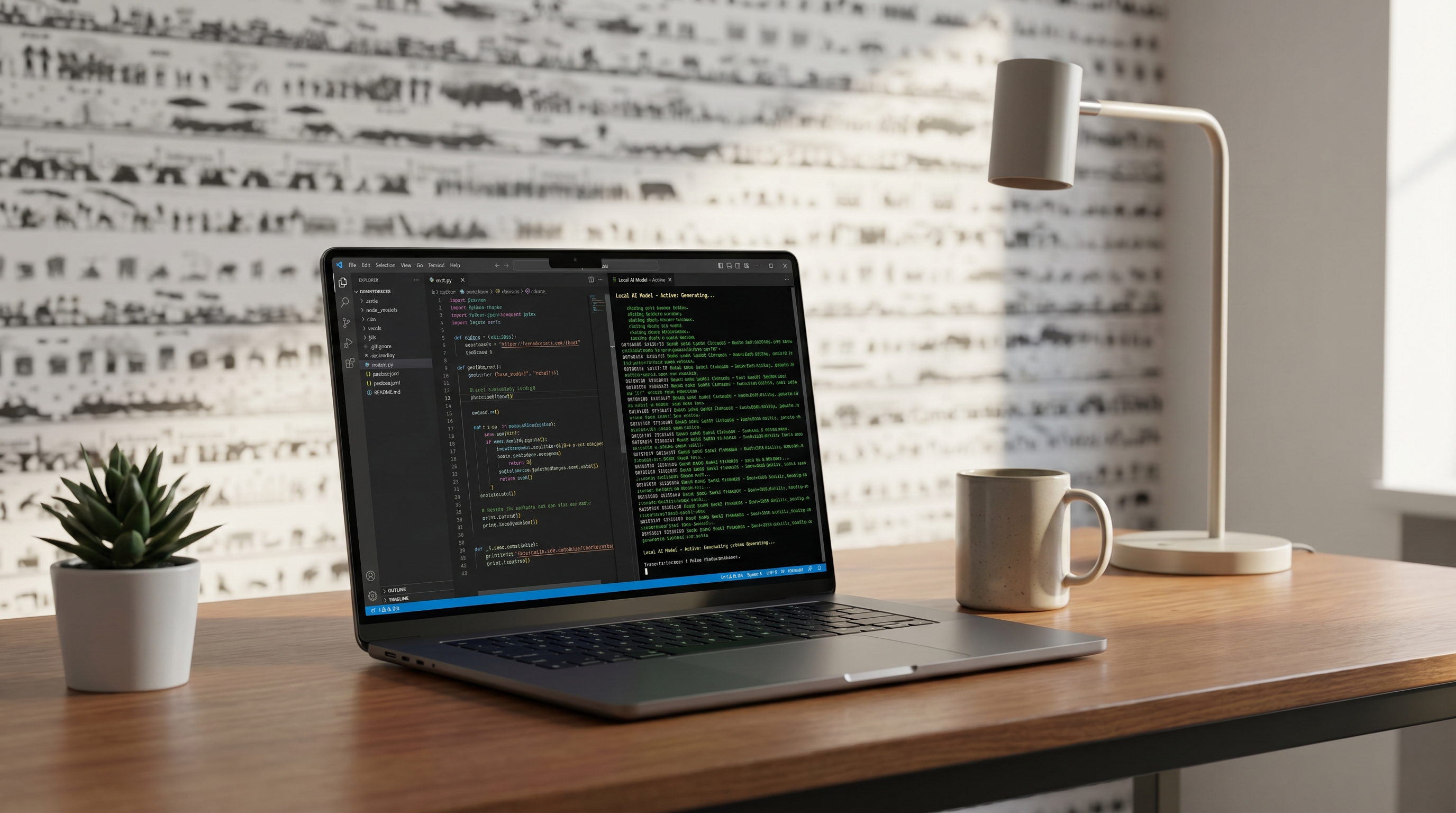
The economics of local AI have also become impossible to ignore. Cloud-based coding assistants and API-driven agents incur recurring costs that scale with usage. By moving inference to local hardware, the marginal cost of generating a token drops to the price of the electricity required to run the machine. Developers are increasingly pairing local models with interfaces like VS Code and Cline to create private, offline coding assistants that operate without metering or API limits.[3]

This local revolution is powered by a fundamental architectural shift in how AI models are built, specifically the dominance of Mixture-of-Experts (MoE) designs. In a dense model, every parameter is activated for every word generated, requiring massive computational overhead. MoE models, however, route queries only to the specific "expert" neural networks needed for that exact prompt, drastically reducing the active memory required for inference.[5]
Apple has aggressively capitalized on this architecture for its 2026 operating systems. The company's newly announced Apple Foundation Model (AFM) 3 Core Advanced is a natively multimodal, 20-billion-parameter model designed specifically for on-device inference. Thanks to its sparse MoE architecture, it only activates between 1 and 4 billion parameters at a time, allowing it to run smoothly on consumer hardware without draining the battery or melting the chassis.[2]
Apple has aggressively capitalized on this architecture for its 2026 operating systems.
To support these advanced local models, hardware requirements have shifted dramatically. Apple's iOS 27 and macOS 27 draw a hard line in the sand: running the most powerful on-device AI requires a minimum of 12GB of unified memory. This restricts the top-tier features to devices like the M3 and M4 Macs, the iPhone 17 Pro, and the new iPhone Air, leaving older hardware reliant on cloud fallbacks.[2][8]
The advantage of Apple's "unified memory" architecture is that the CPU, GPU, and Neural Engine all share the same pool of high-speed RAM. In traditional PC architectures, data must be copied back and forth between system memory and dedicated graphics memory (VRAM), creating a severe bottleneck. A Mac Mini M4 Pro with 48GB of unified memory has emerged as a "sweet spot" for local AI developers, capable of running massive 70-billion-parameter models at highly usable speeds of 8 to 12 tokens per second.[7]

In the PC ecosystem, Nvidia's RTX 4090 remains the gold standard for consumer inference, leveraging its 24GB of VRAM and massive CUDA core count. However, the open-weight community has also made astonishing strides in CPU-only inference. Microsoft's Phi-4-mini, a highly optimized 3.8-billion-parameter model, can run entirely on a standard laptop CPU while maintaining a massive 128,000-token context window—perfect for summarizing long documents offline.[1][7]
Google has also entered the local fray with its Gemma 4 family. Released in mid-2026, the Gemma 4 12B model is designed to fit perfectly within 16GB of RAM, bringing native audio processing and high-level reasoning to standard laptops. Its larger sibling, the 26B MoE variant, can hit blistering speeds of 85 tokens per second on higher-end consumer hardware, proving that local models can now outpace the latency of cloud APIs.[6]
The capabilities of local AI are expanding beyond simple text generation into fully autonomous, multimodal systems. Developers have recently successfully deployed fully offline voice-interaction loops—combining tools like Silero for voice activity detection, Parakeet for transcription, and Supertonic for speech synthesis. These pipelines run entirely on standard CPUs, allowing users to have fluid, spoken conversations with their AI without a single packet of data ever leaving their machine.[4]

Despite these breakthroughs, local inference still faces immutable physics. The primary bottleneck for running AI on consumer hardware is memory bandwidth—the speed at which the processor can load the model's weights from RAM—rather than raw computational power. As models process longer conversations, the "KV-cache" (the memory used to remember the context of the chat) swells, eventually choking the system and slowing generation to a crawl.[5]
Furthermore, while local models excel at coding, summarization, and drafting, they cannot match the sheer encyclopedic breadth or complex multi-step reasoning of trillion-parameter cloud behemoths like GPT-4 or Gemini 1.5 Pro. For the hardest edge-cases, the cloud remains undefeated.[1][8]
Yet, for the vast majority of daily tasks, the ceiling of local AI has risen high enough to make the cloud unnecessary. By transforming AI from a rented service into a local utility—as private and ubiquitous as a calculator or a spell-checker—the 2026 hardware and open-weight ecosystem has fundamentally democratized access to machine intelligence.[8]
How we got here
Late 2023
Tools like llama.cpp emerge, allowing early open-weight models to run on standard consumer CPUs.
Mid 2024
User-friendly interfaces like Ollama and LM Studio launch, removing the need for complex command-line setups.
Late 2025
Mixture-of-Experts (MoE) architectures become standard, drastically reducing the active memory required for inference.
June 2026
Apple announces iOS 27 and macOS 27, deeply integrating 20-billion-parameter local models into its core operating systems.
Viewpoints in depth
Privacy & Open-Source Advocates
Prioritize data sovereignty and freedom from corporate cloud subscriptions.
For this camp, the shift to local AI is fundamentally about control. By running models on their own silicon, users ensure that highly sensitive data—whether proprietary corporate code, legal documents, or personal journals—never traverses the internet. They view cloud-based AI as a privacy liability and celebrate tools like Ollama and LM Studio for democratizing access to uncensored, unmetered intelligence.
Hardware Ecosystem Giants
Leverage local AI to drive hardware upgrade cycles and ecosystem lock-in.
Companies like Apple and Nvidia view the local AI boom as a massive hardware catalyst. By integrating powerful, sparse models directly into the operating system—such as Apple's AFM 3 Core Advanced—they create compelling reasons for consumers to upgrade to devices with 12GB+ of unified memory. For these giants, on-device AI is a feature that differentiates premium hardware from budget alternatives.
Enterprise Pragmatists
Focus on cost-efficiency and deploying the right-sized model for specific tasks.
Rather than chasing the absolute highest reasoning benchmarks, enterprise developers are adopting local models to slash API costs. They recognize that a specialized 12-billion-parameter model running locally is often more than capable of handling routine tasks like code autocomplete, log parsing, and document summarization. This approach eliminates recurring subscription fees and reduces latency by avoiding network round-trips.
What we don't know
- How quickly memory bandwidth on consumer hardware will scale to support even larger models natively.
- Whether cloud providers will lower API costs aggressively to combat the migration to local inference.
Key terms
- Mixture-of-Experts (MoE)
- An AI architecture that divides a model into specialized sub-networks, activating only the necessary 'experts' for a given prompt to save computing power.
- Unified Memory
- A hardware design where the CPU and GPU share the same pool of high-speed RAM, eliminating the bottleneck of copying data between them.
- KV-cache
- The temporary memory an AI model uses to store the context of an ongoing conversation, which grows larger as the chat gets longer.
- Inference
- The process of a trained AI model generating a response or prediction based on a user's prompt.
Frequently asked
Do I need an internet connection to use a local LLM?
No. Once the model file and the software (like Ollama or LM Studio) are downloaded, the AI runs entirely offline on your device's hardware.
Can my current laptop run these models?
It depends on your RAM. Modern models like Gemma 4 12B require about 16GB of RAM, while Apple's newest on-device features require at least 12GB of unified memory.
Are local models as smart as ChatGPT?
Local models are highly capable at coding, summarizing, and drafting, but they generally cannot match the complex, multi-step reasoning of massive cloud models like GPT-4 or Gemini.
Is it free to run AI locally?
Yes. Once you own the hardware, there are no subscription fees or per-message API costs. Your only ongoing cost is the electricity used by your computer.
Sources
Source coverage
8 outlets
3 viewpoints surfaced








[1]Hugging Face BlogEnterprise Pragmatists
Why Teams Are Moving to Local LLMs in 2026
Read on Hugging Face Blog →[2]Apple NewsroomHardware Ecosystem Giants
Introducing the Third Generation of Apple's Foundation Models
Read on Apple Newsroom →[3]How-To GeekPrivacy & Open-Source Advocates
Privacy, no subscription fees, and offline use: Local AI Coding
Read on How-To Geek →[4]AI WeeklyPrivacy & Open-Source Advocates
Developer Ships Fully Offline Voice Loop for Ollama on CPU Only
Read on AI Weekly →[5]Agent NativeEnterprise Pragmatists
Ultimate Guide to Local LLMs in 2026
Read on Agent Native →[6]PinggyEnterprise Pragmatists
Top Local LLMs and Tools in 2026
Read on Pinggy →[7]FungiesHardware Ecosystem Giants
7 Best Hardware Setups for Running Local LLMs in 2026
Read on Fungies →[8]Factlen Editorial TeamPrivacy & Open-Source Advocates
Synthesis by Factlen editorial team
Read on Factlen Editorial Team →

More in ai
See all 45 stories →AI Filmmaking
How Indie Creators Are Building Entire Films With AI Video Workflows
6 sources
Agentic AI
How Agentic AI is Automating Everyday Digital Workflows
8 sources

On-Device AI
How Small Language Models Brought AI Out of the Cloud and Onto Your Phone
7 sources
Local AI
How Local AI is Putting Powerful Models on Your Laptop (and Why It Matters for Privacy)
8 sources
Every angle. Every day.
Get ai stories with full source coverage and perspective breakdowns delivered to your inbox.