
How Empty Offices Are Becoming Apartments (And Why It's Harder Than It Looks)
Driven by record office vacancies and a severe housing shortage, the pipeline for office-to-residential conversions has surged nearly 500% since 2021. But structural hurdles and high costs mean adaptive reuse is a complex puzzle, not a silver bullet.
By Factlen Editorial Team
- Urban Revitalization Advocates
- Argue that adaptive reuse is essential for saving downtowns from economic decline.
- Real Estate Pragmatists
- Emphasize the structural and financial limitations that prevent mass conversions.
- Sustainability Proponents
- Focus on the massive environmental benefits of avoiding demolition.
What's not represented
- · Local municipal zoning boards
- · Construction labor unions executing the retrofits
Why this matters
Transforming empty commercial buildings into housing addresses two massive crises at once: the collapse of downtown office real estate and the national shortage of affordable homes. Understanding the mechanics of this trend reveals how the American city is physically adapting to the post-pandemic economy.
Key points
- The U.S. pipeline for office-to-apartment conversions has grown to over 70,000 units, a nearly 500% increase since 2021.
- Roughly 20% of the nation's office space remains vacant due to the permanent shift toward hybrid and remote work.
- Structural challenges, such as deep floor plates and centralized plumbing, mean only 15% to 30% of office buildings are viable for conversion.
- Repurposing existing buildings retains concrete and steel, reducing the carbon footprint of a project by up to 82% compared to new construction.
- While conversions are revitalizing specific urban corridors, they will not single-handedly solve the national shortage of millions of homes.
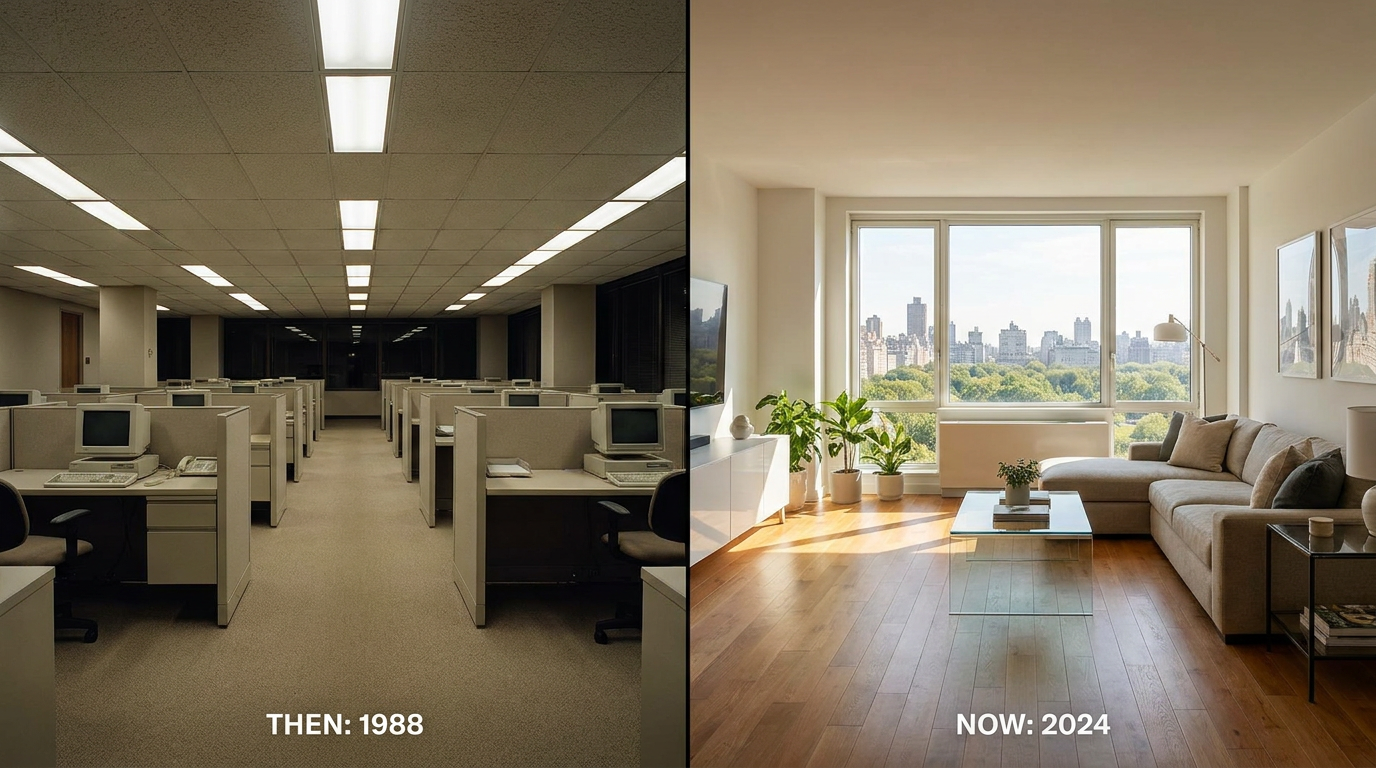
The American downtown is undergoing its most profound physical transformation in a century. Driven by the permanent entrenchment of hybrid work, the national office vacancy rate hovers near 20% in 2026, leaving nearly a billion square feet of commercial space sitting idle in city centers across the country.[2]
Simultaneously, the United States is grappling with a historic housing shortage, with estimates suggesting a deficit of anywhere from 4 million to 10 million homes. To many urban planners and developers, the solution seems obvious: turn the empty corporate desks into much-needed living rooms.[7]
This concept, known as adaptive reuse, has rapidly shifted from an architectural novelty to a booming sector of commercial real estate. In 2021, there were roughly 12,100 office-to-apartment units in the U.S. conversion pipeline. By late 2025 and into 2026, that figure surged past 70,000—a nearly 500% increase in just four years.[1]

Major urban hubs are leading the charge. The New York metro area currently boasts over 8,300 units slated for conversion, followed closely by Washington, D.C., Los Angeles, and Chicago. In Manhattan alone, conversion starts more than doubled over the last two years as property values reset and developers capitalized on distressed commercial assets.[1][4]
But despite the intuitive appeal of swapping cubicles for kitchens, the reality of executing these projects is notoriously complex. Not every vacant office building is a viable candidate for residential life. In fact, industry experts estimate that only 15% to 30% of existing office stock can be realistically converted into apartments.[3]
The primary hurdle is structural geometry. Modern office towers, particularly those built in the 1990s and 2000s, were designed with massive, deep "floor plates" to maximize desk space. Residential building codes, however, strictly require natural light and ventilation for bedrooms, making the dark, cavernous cores of modern offices entirely unusable for housing.[3][7]
Architecture firms have developed algorithms to identify the "Goldilocks" building. The ideal candidate is typically an older, Class B or C structure built in the 1970s or 1980s. The crucial metric is the distance from the central elevator core to the exterior windows, which ideally sits at about 35 feet, allowing developers to carve out standard 30-foot-deep apartment units.[3]

Architecture firms have developed algorithms to identify the "Goldilocks" building.
Beyond the floor plan, the mechanical overhauls required are staggering. A typical office floor might have two large communal bathrooms and a single centralized HVAC system. Converting that same floor into a dozen apartments requires punching dense new plumbing, electrical, and ventilation channels through layers of solid concrete and steel.[5][7]
These structural realities dictate the economics of conversion. Retrofitting an office building can cost anywhere from $100 to over $500 per square foot, depending on the complexity of the design, the age of the building, and the presence of hazardous materials like asbestos that require careful remediation.[5]
In many cases, these high costs push the financial viability of a project to the brink. Because purpose-built residential buildings often command higher rents than converted spaces, developers frequently find that the math only works with significant government intervention.[5][7]
Recognizing the threat of an "urban doom loop"—where empty offices lead to closed storefronts, plummeting property tax revenues, and declining city services—municipalities are stepping in. Cities like Boston, Chicago, and New York have introduced major tax abatements and streamlined zoning approvals to subsidize the high costs of adaptive reuse, provided developers include affordable housing units.[5]

While the financial math can be tight, the environmental math is overwhelmingly positive. The construction industry is a massive contributor to global greenhouse gas emissions, with concrete alone accounting for roughly 8% of the world's carbon footprint.[3]
Demolishing a 40-story office tower and building a new apartment complex from scratch releases a staggering amount of carbon. Adaptive reuse, by contrast, retains up to 90% of the existing concrete and steel. Studies show that repurposing a building can result in an 82% reduction in global warming potential compared to new construction.[3][6]
Despite the environmental benefits and the surging pipeline, real estate pragmatists caution against viewing conversions as a silver bullet for the housing crisis. Delivering 70,000 new apartments is a monumental achievement for the commercial real estate sector, but it remains a drop in the bucket against a national shortage of millions of homes.[7]
Furthermore, conversions alone cannot manufacture a thriving neighborhood. Downtown districts built exclusively for 9-to-5 commuters often lack the basic infrastructure required for residential life, such as grocery stores, public schools, parks, and affordable childcare facilities.[8]

Ultimately, the office-to-residential boom of 2026 represents a critical, albeit partial, solution to a complex urban puzzle. It is not a panacea for the housing shortage, nor will it single-handedly rescue the commercial real estate market from the realities of remote work.[7][8]
What it does offer is a blueprint for resilience. By transforming obsolete, carbon-heavy monoliths into vibrant, mixed-use spaces, cities are slowly rewriting their own DNA, ensuring that the downtowns of the future are defined not by where people work, but by where they live.[8]
How we got here
Pre-2020
Office conversions are a niche architectural practice, primarily focused on historic warehouses and factories.
2021
The U.S. conversion pipeline sits at roughly 12,100 units as remote work begins to empty downtowns.
2023
Cities like Boston and Chicago introduce tax incentives to encourage developers to repurpose vacant commercial space.
2025–2026
The pipeline surges past 70,000 units, marking a 484% increase as adaptive reuse becomes a mainstream real estate strategy.
Viewpoints in depth
Urban Revitalization Advocates
Argue that adaptive reuse is essential for saving downtowns from economic decline.
This camp points to the very real threat of the 'urban doom loop,' where empty offices destroy local retail ecosystems and gut city tax bases. By incentivizing conversions, they argue, cities can create vibrant, 24/7 mixed-use neighborhoods that are inherently more resilient to remote work trends than traditional 9-to-5 business districts.
Real Estate Pragmatists
Emphasize the structural and financial limitations that prevent mass conversions.
Pragmatists note that only a fraction of buildings have the right floor plates for residential use. With conversion costs reaching up to $500 per square foot, they argue that without massive government subsidies, the math simply doesn't work for most developers. They view adaptive reuse as a valuable niche solution rather than a broad market cure for the housing crisis.
Sustainability Proponents
Focus on the massive environmental benefits of avoiding demolition.
This group highlights that the construction industry is a massive carbon emitter. By retaining the existing concrete and steel of an office tower, adaptive reuse drastically cuts the 'embodied carbon' of a project, offering up to an 82% reduction in climate impact compared to building a new apartment complex from scratch.
What we don't know
- How many of the 70,000 proposed conversion units will actually secure the financing needed to reach completion.
- Whether cities will expand tax abatements broadly enough to make Class A office conversions financially viable in the future.
- How the influx of residential tenants will reshape the retail and service economies of traditionally commercial downtown districts.
Key terms
- Adaptive Reuse
- The process of repurposing an existing building for a use other than what it was originally designed for, such as turning an office into apartments.
- Floor Plate
- The total rentable square footage of a single floor in a commercial building, which dictates how much natural light can reach the interior.
- Class B Office Space
- Older, mid-tier commercial buildings that lack the modern amenities and premium locations of top-tier (Class A) properties.
- Embodied Carbon
- The total greenhouse gas emissions generated by the manufacturing, transportation, and installation of building materials like concrete and steel.
- Urban Doom Loop
- A cycle where empty downtown offices lead to closed local businesses, dropping tax revenues, and a decline in city services, which in turn drives more people away.
Frequently asked
Why can't all empty offices become apartments?
Most modern office buildings have deep floor plans that prevent natural light from reaching the center, making them illegal or impractical for residential bedrooms.
Is it cheaper to convert an office or build from scratch?
It depends on the building. Ideal candidates can be up to 30% cheaper to convert, but buildings requiring massive structural and plumbing overhauls can cost more than new construction.
Do these conversions help the environment?
Yes. Repurposing an existing building retains its concrete and steel, which can reduce the project's global warming potential by up to 82% compared to demolition and new construction.
Will this solve the housing crisis?
No. While the 70,000 units currently in the pipeline are a significant achievement, they represent only a fraction of the estimated 4 to 10 million homes needed nationwide.
Sources
Source coverage
8 outlets
3 viewpoints surfaced








[1]ResiClubUrban Revitalization Advocates
The pipeline for converting office spaces into apartments has surged by 484% in just 4 years
Read on ResiClub →[2]CBREReal Estate Pragmatists
U.S. Office Figures and Conversion Trends
Read on CBRE →[3]The HustleUrban Revitalization Advocates
How an algorithm is turning empty offices into apartments
Read on The Hustle →[4]Cushman & WakefieldUrban Revitalization Advocates
New York City Office-to-Residential Conversions Hit Record High
Read on Cushman & Wakefield →[5]Bipartisan Policy CenterReal Estate Pragmatists
Converting Vacant Offices to Housing: Challenges and Opportunities
Read on Bipartisan Policy Center →[6]Construction ExecutiveSustainability Proponents
The Rise of Adaptive Reuse in Commercial Construction
Read on Construction Executive →[7]Hughes MarinoReal Estate Pragmatists
The Office-to-Residential Shift: Demolition, Not Conversion
Read on Hughes Marino →[8]Factlen Editorial TeamReal Estate Pragmatists
Synthesis by Factlen editorial team
Read on Factlen Editorial Team →
Every angle. Every day.
Get real estate stories with full source coverage and perspective breakdowns delivered to your inbox.