
How AI and Biomechanics Are Democratizing the Perfect Golf Swing
Advancements in computer vision and artificial intelligence are transforming smartphones into tour-grade biomechanics labs, allowing everyday golfers to unlock the 'kinematic sequence' and gain distance without injury.
By Factlen Editorial Team
- AI Technology Developers
- Focus on democratizing elite-level swing analysis through accessible mobile software and computer vision.
- Biomechanics Researchers
- Prioritize objective measurement of forces and the precise sequencing of human movement.
- Teaching Professionals
- Advocate for blending objective biomechanical data with human intuition and proprioception.
What's not represented
- · Amateur golfers who prefer a purely feel-based, technology-free approach to the game.
- · Orthopedic surgeons treating golf-related spinal injuries.
Why this matters
By democratizing access to tour-level biomechanical data, AI is allowing everyday golfers to significantly improve their performance, lower their handicaps, and prevent chronic back injuries without spending thousands of dollars on specialized equipment.
Key points
- Artificial intelligence is democratizing tour-level biomechanical analysis for amateur golfers.
- The 'kinematic sequence' dictates that power transfers from the pelvis, to the torso, to the arms, and finally the club.
- Modern smartphone apps use computer vision to track up to 33 bodily landmarks without wearable sensors.
- Real-time AI voice coaching provides immediate feedback, accelerating motor learning during practice.
- Properly sequencing ground reaction forces not only increases driving distance but also prevents lower back injuries.
The golf swing is no longer a mystery of abstract "feel." It is a solved physics equation.[10]
For decades, amateur golfers relied on vague aphorisms—"keep your head down," "swing easy"—while professional players honed their mechanics using million-dollar biomechanics laboratories.[10]
That gap is closing rapidly. In 2026, artificial intelligence and computer vision are democratizing elite-level swing analysis, transforming the smartphone in a golfer's pocket into a tour-grade biomechanics lab.[9][10]
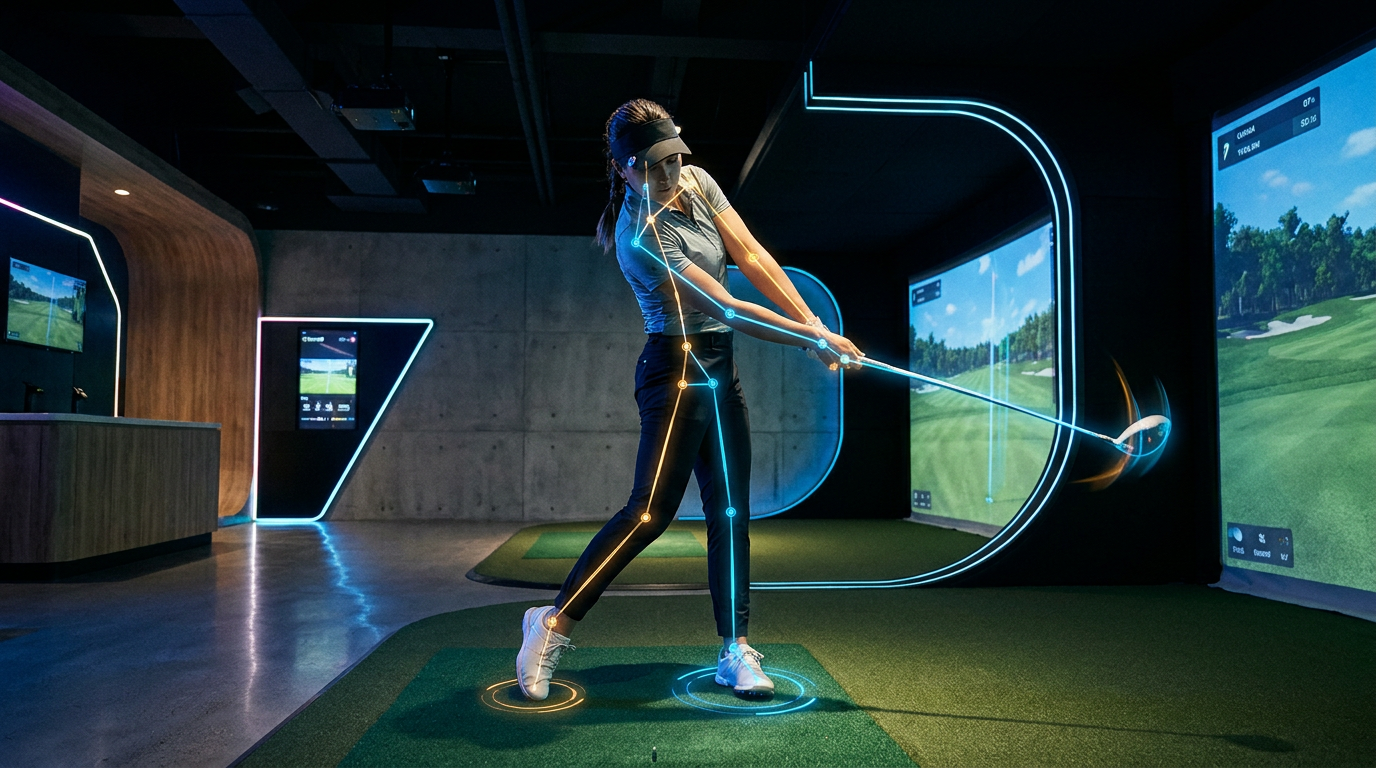
At the heart of this technological revolution is a concept known as the "kinematic sequence." This is the precise order in which a golfer's body segments accelerate and decelerate to transfer energy to the clubhead.[4][6]

Research demonstrates that in an efficient swing, peak rotational velocities occur in a strict proximal-to-distal order: the pelvis fires first, followed by the thoracic spine (torso), then the lead arm, and finally the golf club.[4]
When this sequence is optimized, energy transfers maximally to the golf ball without placing unnecessary strain on the body's joints. Conversely, amateurs often disrupt this chain by initiating the downswing with their arms, resulting in a loss of power and erratic ball flights.[4]
But the kinematic sequence only describes the motion—the visible result. The invisible engine driving that motion is found in "kinetics," specifically Ground Reaction Forces (GRF).[6]
Power in the golf swing originates from the ground up. Biomechanists have identified a specific "kinetic sequence" of forces: horizontal glide peaks first to shift pressure, followed by rotational torque to turn the pelvis, and finally a vertical launch force that acts as a braking mechanism to whip the club through impact.[1]

Historically, measuring these invisible forces required standing on expensive force plates while wearing a suit covered in reflective motion-capture markers.[1][9]
Historically, measuring these invisible forces required standing on expensive force plates while wearing a suit covered in reflective motion-capture markers.
Today, markerless motion capture powered by machine learning has eliminated the need for wearable sensors. Advanced AI algorithms can extract a full 3D skeletal model—tracking up to 33 distinct bodily landmarks—directly from standard 2D smartphone video.[2][9]
This leap in computer vision allows mobile applications to evaluate biomechanical "gates" in real-time. Platforms like GOATCode and DeepSwing don't just record video for later review; they process the kinetic chain instantly, scoring the swing's efficiency on a 0-to-100 scale.[2][9]
The timing of this feedback is crucial for motor learning. Rather than waiting to review annotated footage after a practice session, golfers can now receive live voice coaching from an AI between every repetition, capitalizing on the body's immediate kinesthetic memory.[2]

Beyond adding distance and lowering handicaps, this data-driven approach plays a vital role in injury prevention. A common amateur flaw is "hanging back"—failing to shift pressure to the lead foot during the downswing.[7]
To compensate and reach the ball, the golfer must drastically increase their side-bend while rotating at high speeds. This combination creates the "crunch factor," placing immense shearing stress on the lower lumbar spine. AI tools can instantly flag this dangerous pressure pattern.[7]
Despite the analytical power of these systems, the technology is not designed to entirely replace human instructors. Golf remains a game of feel, proprioception, and course management.[3][8]

Instead, a hybrid model is emerging. Teaching professionals use platforms like Greenside AI and Uneekor to provide students with objective, tangible data during lessons, bridging the gap between what a golfer feels and what they are actually doing.[3][5]
The AI then serves as a daily practice companion, ensuring the student doesn't drift off track between professional sessions.[2][3]
By translating abstract feelings into concrete, measurable data, artificial intelligence is finally eliminating the guesswork from golf practice. The perfect swing may still be elusive, but the roadmap to finding it has never been clearer.[10]
How we got here
1990s
Early biomechanical research on the golf swing requires million-dollar laboratories with wearable electromagnetic sensors.
2010s
Radar and camera-based launch monitors become standard equipment on professional tours, providing precise ball-flight data.
2023
Advancements in markerless motion capture allow standard smartphone cameras to extract 3D skeletal data.
2026
Mobile applications introduce real-time AI voice coaching, providing golfers with instant biomechanical feedback between swings.
Viewpoints in depth
Biomechanics Researchers
Focus on the objective measurement of forces and the precise sequencing of human movement.
This camp emphasizes that the golf swing is fundamentally a physics equation. They argue that understanding the "kinematic sequence" and ground reaction forces is essential for maximizing power and preventing injury. By breaking down the swing into measurable data points like horizontal glide and rotational torque, researchers aim to eliminate the guesswork and subjective "feel" that has historically dominated golf instruction.
AI Technology Developers
Focus on democratizing elite-level swing analysis through accessible mobile software and computer vision.
Developers of platforms like GOATCode and DeepSwing believe that tour-level data should not be confined to million-dollar laboratories. They champion the use of markerless motion capture and machine learning to extract 3D skeletal models from standard smartphone cameras. Their goal is to provide everyday golfers with real-time, actionable feedback and live voice coaching during practice sessions, accelerating motor learning without the need for expensive hardware.
Traditional Teaching Professionals
Focus on blending objective biomechanical data with human intuition, proprioception, and on-course strategy.
While embracing new technology, veteran instructors caution against an over-reliance on raw metrics. They argue that golf is ultimately a game of "feel" and spatial awareness (proprioception). This camp advocates for a hybrid approach where AI tools serve as diagnostic aids and practice companions, but human coaches remain essential for interpreting the data, teaching course management, and helping students translate abstract numbers into repeatable athletic movements.
What we don't know
- It remains to be seen if over-reliance on AI feedback might disrupt a golfer's natural athleticism and 'feel' for the game.
- The long-term impact of AI coaching apps on the traditional golf instruction industry is still unfolding.
Key terms
- Kinematic Sequence
- The proximal-to-distal order in which body segments accelerate and decelerate to transfer energy efficiently.
- Ground Reaction Forces (GRF)
- The forces exerted by the ground on a body in contact with it, which golfers use to generate power.
- X-Factor
- The rotational separation between the pelvis and the torso during the backswing, used to store elastic energy.
- Proprioception
- The body's subconscious ability to sense its movement, action, and location in space.
- Computer Vision
- A field of artificial intelligence that enables computers to derive meaningful information from digital images and videos.
Frequently asked
What is the kinematic sequence in golf?
The kinematic sequence is the specific order in which a golfer's body segments reach peak rotational speed during the downswing: pelvis first, followed by the torso, arms, and finally the club.
Do I need expensive sensors to track my swing?
No. Modern AI applications use computer vision to extract a 3D skeletal model directly from a standard 2D smartphone video, eliminating the need for wearable sensors.
What is the 'crunch factor'?
The crunch factor refers to the shearing stress placed on the lower spine when a golfer rotates at high speeds while simultaneously side-bending, often caused by failing to shift their weight forward.
Can AI replace a human golf coach?
While AI provides excellent real-time biomechanical feedback for practice, teaching professionals remain essential for interpreting data, teaching 'feel,' and guiding on-course strategy.
Sources
Source coverage
10 outlets
3 viewpoints surfaced










[1]Swing CatalystBiomechanics Researchers
The Kinetic Sequence
Read on Swing Catalyst →[2]GOATCodeAI Technology Developers
Best AI Golf Coach 2026: Which AI Actually Coaches You?
Read on GOATCode →[3]Greenside AITeaching Professionals
A Game-Changer for Golf Teaching Professionals
Read on Greenside AI →[4]FitMiaBiomechanics Researchers
The Biomechanics of the Golf Swing
Read on FitMia →[5]UneekorAI Technology Developers
The Rise of AI in Golf
Read on Uneekor →[6]New Horizons GolfBiomechanics Researchers
Kinetics vs Kinematics in Golf
Read on New Horizons Golf →[7]Golf 247Teaching Professionals
The Global Platform for Innovative Technologies
Read on Golf 247 →[8]Golf BiomechanicsTeaching Professionals
Swingtrace AI and Proprioception
Read on Golf Biomechanics →[9]DeepSwingAI Technology Developers
Best Golf Swing Analyzer Apps in 2026
Read on DeepSwing →[10]Factlen Editorial TeamTeaching Professionals
Synthesis by Factlen editorial team
Read on Factlen Editorial Team →
More in sports
See all 10 stories →Preview
England's 2026 World Cup Outlook: Inside Thomas Tuchel's High-Stakes Group L Campaign
0 sources
College Baseball
Troy Trojans Complete Historic Cinderella Run to Reach First Men's College World Series
0 sources

MLB Preview
San Diego Padres Look to Snap Road Skid Against Baltimore Orioles in Interleague Clash
0 sources

Grassroots Tech
How 'Drop-In' Sports Apps Are Rewiring Urban Communities and Fighting Loneliness
0 sources

Every angle. Every day.
Get sports stories with full source coverage and perspective breakdowns delivered to your inbox.