
How Agrivoltaics is Solving the Land-Use Conflict Between Farming and Solar Energy
By co-locating solar panels and agriculture, dual-use farms are proving they can increase crop yields, reduce water evaporation, and boost energy efficiency simultaneously.
By Factlen Editorial Team
- Agricultural & Ecological Advocates
- Focuses on soil health, water retention, and maintaining crop yields, advocating for higher panel clearances to accommodate farming equipment.
- Renewable Energy Industry
- Driven by the need to maximize megawatt output and scale infrastructure rapidly to meet climate targets.
- Policy & Systems Researchers
- Focuses on optimizing the food-energy-water nexus and designing financial incentives to bridge the cost gap of dual-use systems.
What's not represented
- · Local Zoning Boards
- · Traditional Farming Communities
Why this matters
As the global transition to renewable energy accelerates, finding space for solar panels without destroying active farmland is critical. Agrivoltaics offers a proven, scalable model that protects rural economies while securing clean electricity.
Key points
- Agrivoltaics co-locates solar panels and agriculture, solving land-use conflicts between food and energy production.
- The shade from solar panels significantly reduces soil evaporation, allowing crops to thrive with less irrigation.
- Moisture released by the crops cools the solar panels, increasing their electrical conversion efficiency.
- Governments in Europe and the US are rolling out specific subsidies to offset the higher capital costs of elevated solar racking.
The global transition to renewable energy faces a fundamental geographic bottleneck: space. In the United States alone, achieving net-zero emissions will require up to 10 million acres of land for solar development by the middle of the century. This massive footprint puts energy developers in direct competition with the agricultural sector for prime, sun-drenched acreage. For years, local zoning boards and rural communities have viewed this tension as a zero-sum game, fearing that the push for clean electricity would inevitably hollow out local food production and permanently alter the rural landscape.[5]
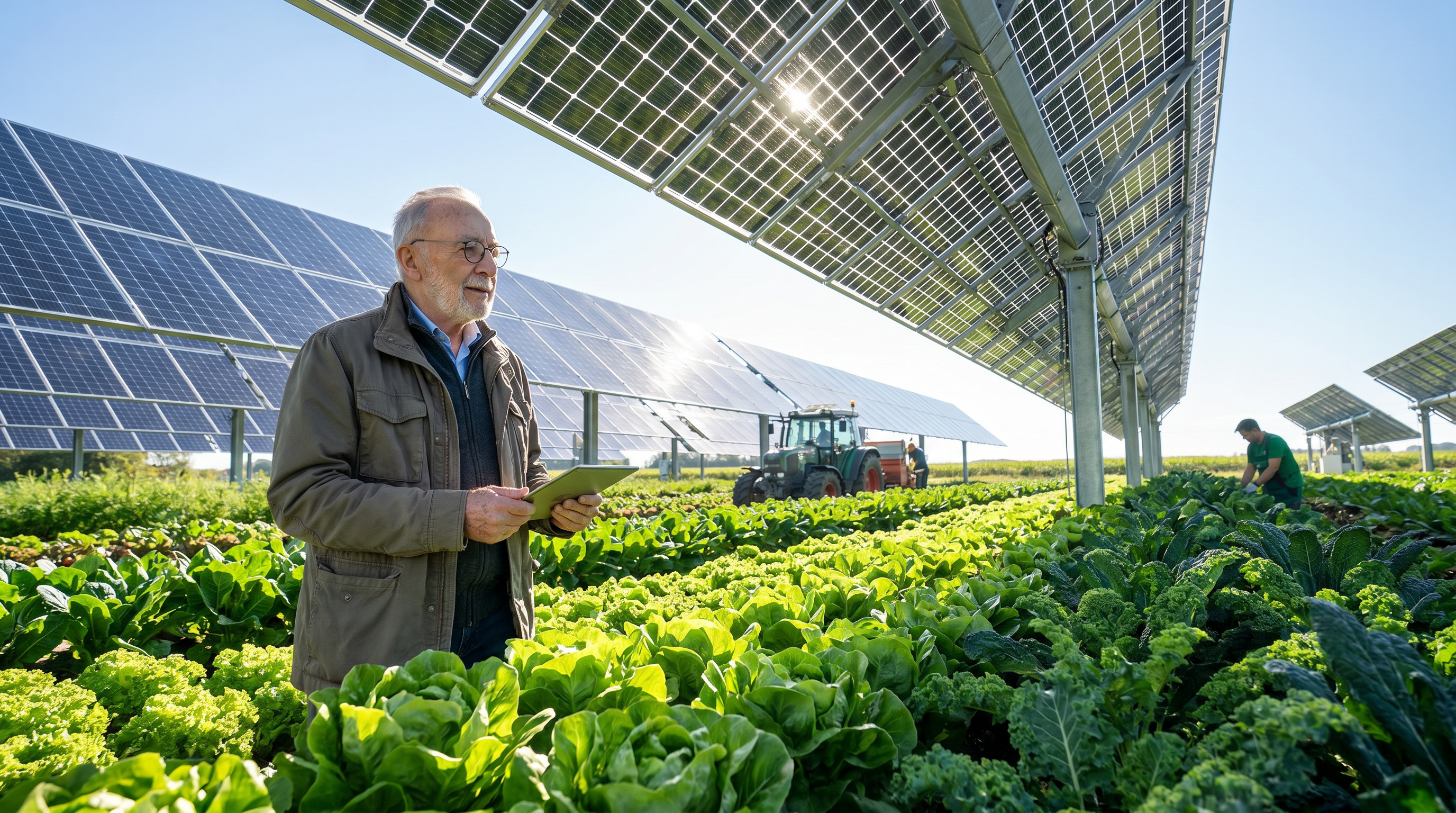
Traditionally, solar developers would lease farmland, strip the topsoil, and install standard ground-mounted arrays, taking the land out of agricultural production for decades. But a rapidly scaling approach known as agrivoltaics—the co-location of solar panels and agriculture on the same parcel of land—is proving that acreage can simultaneously harvest both sunlight and crops. By elevating the panels and spacing them strategically, farmers can maintain active cultivation while generating utility-scale power.[2][8]
In 2026, agrivoltaics is transitioning from a niche experimental concept to a commercial-scale infrastructure model. The evidence base, built over the last five years by institutions like the U.S. Department of Energy (DOE) and the University of Arizona's Biosphere 2, demonstrates that dual-use solar is not merely a compromise. Instead, it operates as a synergistic system where both the crops and the photovoltaic panels perform better together than they do apart.[1][2][7]
The most robust evidence for the efficacy of agrivoltaics centers on water retention and microclimate regulation. Solar panels cast partial shade throughout the day, which significantly reduces direct soil evaporation and lowers the atmospheric demand for water. In an era of increasing droughts and unpredictable rainfall, this artificial canopy provides a crucial buffer against extreme weather, allowing soil to retain moisture for significantly longer periods.[1]

In dryland experiments conducted by the University of Arizona, researchers found that crops like cherry tomatoes grown under panels required irrigation only every few days, compared to multiple times a day for identical crops planted in open fields. The total fruit production for the agrivoltaic tomatoes actually doubled. Similarly, at pilot sites in France operated by energy developer TSE, the shade from agricultural canopies reduced periods of water deficit for soybean crops by 57% during peak summer heat.[1][4]
Crucially, the benefits of this co-location flow in both directions. Solar photovoltaic panels are inherently sensitive to heat; as ambient temperatures rise above their optimal operating range, their electrical conversion efficiency steadily drops. In open-field solar farms, the intense summer sun can cause panels to overheat, resulting in a measurable loss of megawatt output exactly when grid demand for air conditioning is highest.[1]
Crucially, the benefits of this co-location flow in both directions.
However, the crops growing beneath an agrivoltaic array continuously release moisture into the air through a natural biological process called transpiration. This acts as a localized evaporative cooling system. The rising moisture lowers the operating temperature of the panels directly above the plants, mitigating heat stress and boosting their energy output during the hottest parts of the day.[1][8]
Despite the clear agronomic and energetic benefits, scaling agrivoltaics requires navigating complex engineering and economic tradeoffs. Traditional utility-scale solar is designed for maximum energy density and minimum capital cost. Standard arrays utilize low-to-the-ground, tightly packed panels that are relatively cheap to install and maintain, but leave no room for tractors or meaningful cultivation.[3]
Agrivoltaic systems, by contrast, must be custom-engineered to accommodate active farming. Panels must be elevated significantly higher off the ground to allow tractors, harvesters, and human laborers to pass underneath safely. This increased height exposes the arrays to greater wind-loading risks, requiring heavier, deeper, and substantially more expensive steel racking infrastructure to secure the system.[3]

Furthermore, the panels must be spaced further apart to ensure sufficient sunlight reaches the crops below. This wider spacing reduces the total megawatt capacity per acre compared to a conventional solar farm. Developers and farmers must carefully negotiate these configurations, balancing the developer's need for maximum energy revenue with the farmer's need for optimal crop yield and operational clearance.[3][8]
To bridge this economic gap and accelerate deployment, governments are stepping in with targeted policy frameworks in 2026. Europe is currently leading the scale-up phase, moving decisively from isolated pilot projects to industrial deployment. Italy, for example, is targeting 1.04 gigawatts of agrivoltaic capacity by June 2026, supported by a €1.7 billion allocation from its National Recovery and Resilience Plan.[6][7]
In the United States, the Inflation Reduction Act's 30% investment tax credit provides a baseline incentive for commercial solar, while state-level policies are driving specific dual-use adoption. Massachusetts has pioneered a feed-in tariff adder of $0.06 per kilowatt-hour specifically for agrivoltaic projects, compensating developers for the higher capital costs. Meanwhile, New Jersey has launched a 200-megawatt pilot program focused on deploying arrays on unpreserved farmland.[5]

Federal agencies are also mobilizing to support the transition. The Department of Energy and the USDA are deploying collaborative grants to test dual-use systems across diverse climates, aiming to reach 10 gigawatts of domestic agrivoltaic capacity. These initiatives are designed to gather long-term data on soil health, crop viability, and rural economic impacts across different agricultural zones.[2][6]
As the industry matures, the focus is shifting toward standardizing zoning definitions and developing crop-sharing power purchase agreements that fairly distribute the financial benefits. If these regulatory and financial frameworks can successfully align the incentives of the energy and agricultural sectors, agrivoltaics offers a rare, evidence-backed solution to the intertwined challenges of water scarcity, food security, and climate change.[5][8]
How we got here
2019
University of Arizona researchers publish landmark Biosphere 2 data showing mutual benefits of agrivoltaics in drylands.
2022
The U.S. Inflation Reduction Act passes, providing a 30% investment tax credit that accelerates commercial solar and dual-use projects.
2024
The USDA and DOE launch collaborative initiatives to study and fund agrivoltaic deployments across diverse US climates.
2025
Massachusetts pioneers specific financial incentives, offering a $0.06/kWh adder for agrivoltaic energy production.
June 2026
Italy targets the completion of 1.04 gigawatts of agrivoltaic capacity as part of a €1.7 billion national scale-up program.
Viewpoints in depth
Agricultural Sector
Prioritizes soil health, water retention, and maintaining crop yields.
For the agricultural sector, the primary value of agrivoltaics lies in climate resilience. Farmers view the solar panels as an artificial canopy that protects crops from extreme heat and reduces irrigation costs. However, they advocate strongly for system designs that accommodate traditional farming—demanding higher panel clearances and wider row spacing so that tractors and harvesters can operate without obstruction, even if it means generating less electricity per acre.
Solar Developers
Driven by the need to maximize megawatt output per acre and minimize capital expenditure.
Energy developers are tasked with scaling renewable infrastructure rapidly to meet national climate targets. While they recognize the permitting benefits of dual-use systems, they highlight the steep economic tradeoffs. Elevating panels requires heavier, more expensive steel racking to withstand wind shear, and spacing panels further apart lowers the overall energy density of the site. Developers argue that without targeted subsidies or feed-in tariffs, these custom configurations are difficult to finance.
Policymakers & Researchers
Focuses on optimizing the food-energy-water nexus and designing incentives to bridge the cost gap.
Researchers and government agencies view agrivoltaics as a critical tool for solving the zero-sum land conflict between food and energy. They emphasize the systemic benefits—such as reduced water usage and increased panel efficiency—and are focused on standardizing zoning definitions. Policymakers are actively designing tax credits and pilot programs to absorb the initial capital premiums, aiming to make dual-use solar the default standard for rural energy development.
What we don't know
- How long-term soil health and carbon sequestration metrics will evolve over the 25-year lifespan of a commercial agrivoltaic array.
- Whether the increased capital costs of elevated racking can be fully offset by crop yields without sustained government subsidies.
- How insurance markets will price the combined risks of agricultural failure and energy infrastructure damage from extreme weather events.
Key terms
- Agrivoltaics
- The simultaneous use of areas of land for both solar photovoltaic power generation and agriculture.
- Transpiration
- The process by which moisture is carried through plants from roots to small pores on the underside of leaves, where it changes to vapor and is released to the atmosphere.
- Microclimate
- The climate of a very small or restricted area, which differs from the climate of the surrounding area, such as the cooler, more humid space beneath a solar panel.
- Feed-in Tariff
- A policy mechanism designed to accelerate investment in renewable energy technologies by offering long-term contracts to renewable energy producers.
- Fixed-Tilt vs. Tracking Arrays
- Fixed-tilt panels remain stationary at a set angle, while tracking arrays follow the sun's path across the sky to maximize energy capture.
Frequently asked
What crops grow best under solar panels?
Shade-tolerant crops like leafy greens, tomatoes, peppers, and root vegetables thrive in agrivoltaic systems. In dry climates, the partial shade significantly reduces their water stress.
Does agrivoltaics make solar panels less efficient?
No, it actually improves their efficiency. Plants release moisture through transpiration, which cools the surrounding air and prevents the solar panels from overheating during peak sunlight hours.
Why aren't all solar farms built this way?
Agrivoltaic systems are more expensive to build because the panels must be elevated higher on reinforced steel racking to allow farm equipment to pass underneath. They also produce slightly less electricity per acre due to wider panel spacing.
Can livestock be integrated into these systems?
Yes. Sheep grazing is currently the most common form of agrivoltaics in the United States, as the animals manage vegetation growth without damaging the solar infrastructure.
Sources
Source coverage
8 outlets
3 viewpoints surfaced








[1]Nature SustainabilityAgricultural & Ecological Advocates
Agrivoltaics provide mutual benefits across the food–energy–water nexus in drylands
Read on Nature Sustainability →[2]U.S. Department of EnergyPolicy & Systems Researchers
Agrivoltaics: Solar and Agriculture Co-Location
Read on U.S. Department of Energy →[3]National Renewable Energy LaboratoryPolicy & Systems Researchers
Agrivoltaic Designs and Configurations
Read on National Renewable Energy Laboratory →[4]TSEAgricultural & Ecological Advocates
The benefits of agrivoltaics for the plants
Read on TSE →[5]Kleinman Center for Energy PolicyPolicy & Systems Researchers
The Use and Potential of Agrivoltaics in the United States
Read on Kleinman Center for Energy Policy →[6]SunhubRenewable Energy Industry
Agrivoltaics In 2025: Scaling Food And Solar Together
Read on Sunhub →[7]SolarplazaRenewable Energy Industry
Advancing agrivoltaics: Europe's 2026 scale-up phase
Read on Solarplaza →[8]Factlen Editorial TeamPolicy & Systems Researchers
Synthesis by Factlen editorial team
Read on Factlen Editorial Team →
More in energy
See all 9 stories →Advanced Geothermal
Enhanced Geothermal Systems Reach Commercial Scale as Drilling Costs Plummet
7 sources
Methane Tracking
The Methane Accountability Era: How Satellites and EU Import Rules Are Forcing a Global Cleanup
8 sources

Grid Storage
Grid-Scale Battery Costs Plummet to Record Lows, Pushing Renewables Past Coal in Historic Milestone
7 sources
Virtual Power Plants
How Virtual Power Plants Are Rewiring the Electrical Grid
8 sources
Every angle. Every day.
Get energy stories with full source coverage and perspective breakdowns delivered to your inbox.